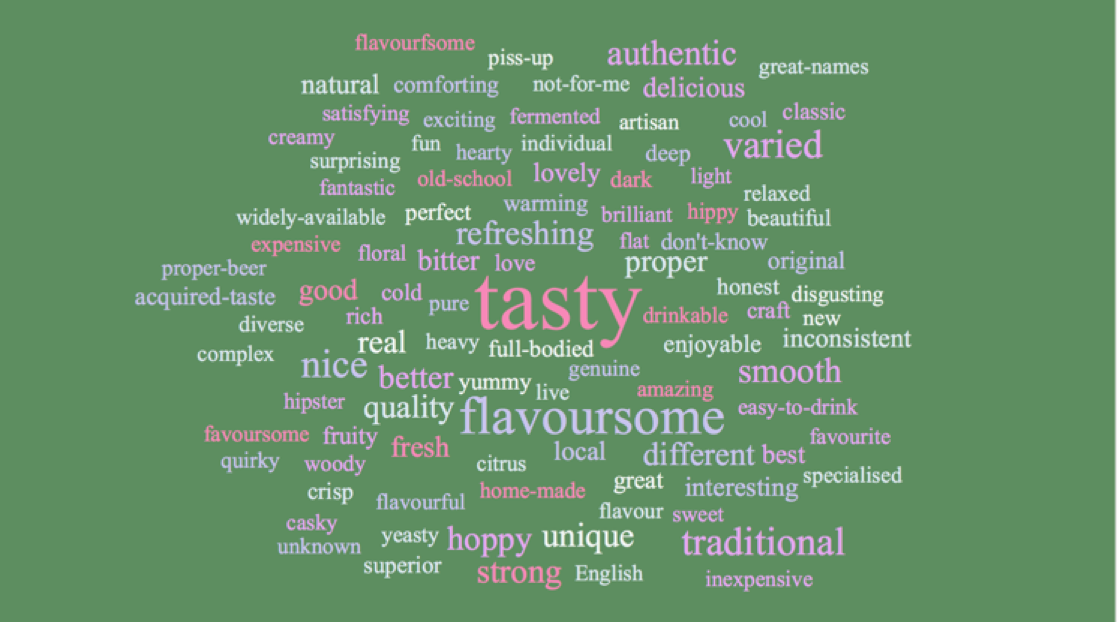
When trying to categorise beer, it may be time to drop subtle distinctions – because there are signs the beer drinker already has.

(photo credit: James Beeson)
I’ve always argued that traditional cask ale is craft beer. Many of these who founded the first wave of American craft breweries think so too.
In this long-running argument, opponents of my view may concede that some cask ale is craft beer, but not the stuff that’s bland, or ‘twiggy’. To which I reply that if the actual quality or flavour appeal of the beer has anything to do with it, there are scores of modern craft breweries turning out bland or downright horrible stuff too.
The real reason many craft fans struggle with cask is best summarised by the slide below, which I’ve used several times before.

Cask is a traditional part of British heritage, whereas craft is modern, trendy and American. Despite the protestations of craft beer die-hards that it’s all about the integrity of the product, they’re as image-led as anyone – it’s just that the image is communicated via different channels.
But as well as the chart above – which was based on extensive research among drinkers of both cask and craft in other formats – there’s growing evidence that the broad mainstream of drinkers see at least a partial overlap between craft and cask, perhaps even more than that.
When compiling research for the Cask Report, I missed one or two fascinating nuggets contained in Marston’s On-Trade Beer Report. Check this out:

Drinkers who say they understand what craft beer is and claim to drink it were asked to name a craft beer brand. A majority of them – 55% – named a beer the researchers felt was a ‘traditional ale’. Tellingly, the report’s authors say that 45% ‘correctly’ named a brand they deem to be craft – implying that those who named a traditional brand were incorrect in doing so.
Perhaps you agree. Perhaps you’re sitting there thinking, ‘Blimey, over half of people who think they’re drinking craft beer don’t even know what it is.’ Maybe to you this is a sign of how bigger brewers have co-opted the term ‘craft’ and made it meaningless. Maybe you just think these people aren’t as knowledgeable about beer as you are. Or maybe – just maybe – they’re right and you’re wrong.
Craft has gone mainstream. That means it no longer belongs solely to the bloggers, geeks, brewers and experts. And that means we don’t get to have the final say on what is and isn’t craft. When people say craft has become a meaningless marketing term, they need to clarify that it has become meaningless to them. When 13 million UK adults say they enjoy drinking craft beer, it takes some pretty extraordinary arrogance to say that they’re all wrong – that what they’re drinking is not craft, or that craft actually doesn’t mean anything.
If you want to carry on those debates, that’s up to you – but please do it somewhere else out of my earshot. I’ve been having this argument for eight years now and it’s boring.
My reason for bringing up this consumer perception that craft and cask are pretty similar, if not the same, is that I think it’s increasingly useful to view the market in this way. Because if a majority of drinkers think they’re the same thing, people analysing the market should probably do so too. If you look at them as the same from a data point of view, it’s pretty interesting.

If you add together the on-trade volume sales of cask ale and craft beer in other formats, you see that in September 2014, they accounted for 18.9% of all beer sold in the on-trade. Now that’s already quite impressive. But by September 2018, that joint figure had increased to 23.5%. If we call this ‘the market for more interesting or flavourful beer than the mainstream’, it’s on course to account for one in four pints drunk across the entire on-trade.
This is important for a whole bunch of reasons:
- You can no longer call it a niche: craft and cask together are bigger than the entire premium lager category, which accounts for 22% of the on-trade.
- Craft is not just cannibalising cask: yes, cask is in decline and many publicans cite the growth of craft in other formats as the main reason, but the growth of craft is many times bigger than the decline in cask. Craft is bringing new people into this ‘interesting beer’ segment.
- Mainstreaming might help everyone. There’s some understandable paranoia that big players muscling in might snatch the market away from ‘true’ craft brewers. But there’s that hackneyed phrase, ‘a rising tide lifts all boats.’ When big players come in, they have the budgets to do proper marketing. They have the reach to get to places smaller players can’t. They familiarise a much bigger audience with the whole concept of craft beer. At least some of the people they bring in are going to move on to ‘true’ craft brands as they learn more. This is exactly what happened when Magner’s created the cider boom of the 2000s. There were small, artisanal cinder makers who loathed the brand, but still thanked it for their very existence because even they saw the benefit of new people coming into a market that had been in seemingly terminal decline.
So from now on I’m going to be talking about ‘the market for interesting beer, across all formats’. It just needs a catchier, more accurate name. How about ‘craft’?
n.b. Thank you to Heineken’s Andy Wingate for supplying me with the CGA data that confirmed my hunch.