Category: Uncategorised

| Uncategorised

Hops and Glory in Notting Hill

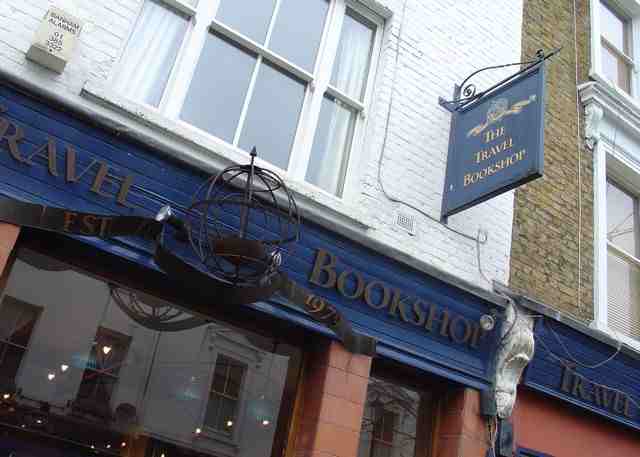
I’m doing a reading at the esteemed Travel Bookshop in Notting Hill, West London, tomorrow – Thursday 14th October.  Doors open, 6.30, we kick off at 7pm.

The talks I’ve been doing at festivals up and down the country have been getting bigger and bigger and selling out, which is deeply gratifying.  This is more intimate, and is the first one I’ve done in London for nearly a year.

As an added attraction, we have a couple of quite cool beers.  As the bookshop is on Fuller’s manor, I asked them if you would supply a couple of beers.  So we’re going to have Bengal Lancer to taste, and then, as we talk about how IPA aged, we’re going to illustrate this with the 2005 expression of Fuller’s Vintage Ale, which is drinking particularly well just now according to head brewer John Keeling.

All this for the measly price of £5!  Buy now from here (as I said, it’s an intimate venue) to avoid disappointment.

Hope to see you there.

| Uncategorised

What I did on my holidays

Post Cask Report launch, the Beer Widow and I took a much-needed week’s holiday and went to Majorca.

I’d heard that there were nice parts of it, that it wasn’t all Costa del Puke.  What I wasn’t expecting was for the vast majority of the island to be beautiful, with loads of fantastic historic towns and villages, with the seedier side of British and German holidaymaking confined to a few small strips of coastline.  It’s a wonderful place.

Beer
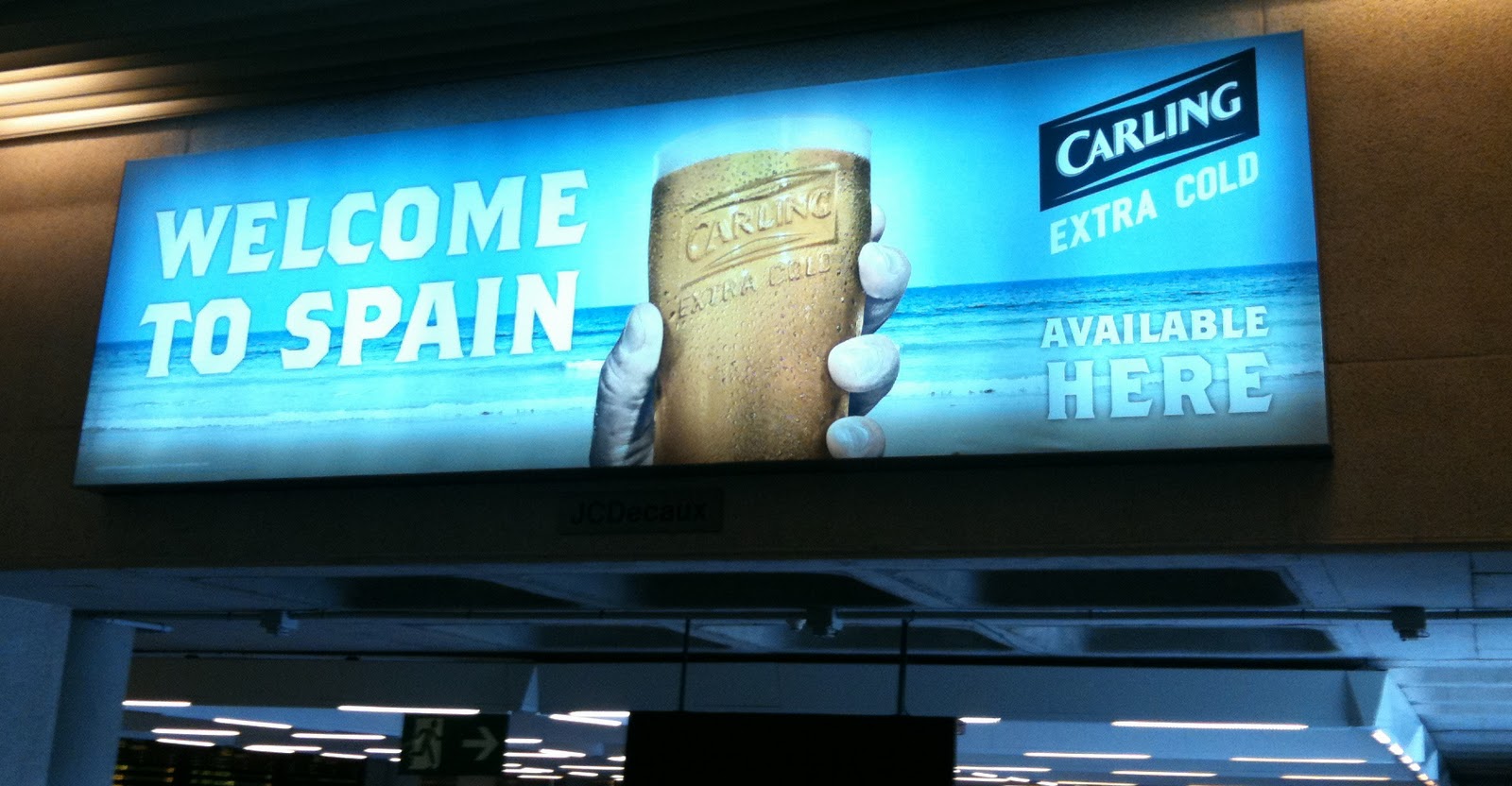
Admittedly it doesn’t start well, when this is what greets you even before passport control:

Oh.  Great. 
Spain has some great lagers.  They’re not finely structured Pilsners.  They don’t have a delicate nose of grassy, spicy Saaz hops.  But they come with a tight, creamy head, and they have flavour – a nice full-bodied sharp sweetness followed by a drying bitter finish.  There’s substance in the likes of Estrella and Cruzcampo.  They’re satisfying drinks.
We didn’t do much in Port de Pollensa.  We read books and sat on terraces along the unspoiled, pine tree-lined pathway along the bay shore, relaxing and gazing at sunsets like this one:
“Of course they were much better than this on board Europe you know.”
“Yes dear.”
Wary of the airport Carling ad, for the first few days I asked what the beer was whenever I ordered one, and it was always Estrella or Cruzcampo.  The latter soon emerged as my favourite, and we gravitated to the bars that served it.
And so I relaxed.  And I grew complacent.
On our fourth night we tried a new restaurant, and I just asked for a beer.  When it arrived in a Strongbow pint glass, an alarm bell started ringing in my head, but not quickly enough.  I took a mouthful of something that was thin and watery, and yet still managed to taste offensive – overly sweet and cloying, like watered down Cresta soda.  
“That’s Fosters,” I spluttered, to an eye-rolling Beer Widow.
The thing is, I can actually drink Carling.  If you haven’t yet had a beer that day, so your palate hasn’t yet been woken to the flavour profile it expects, Carling is merely bland.  It’s unremarkable but inoffensive, like a sense memory of a decent beer that you almost evoke, but not quite. Whereas Foster’s is one of those special beers that manages to be bland and actively taste foul at the same time.  I’ve never been able to understand how they do that.
But that wasn’t the worst part.
The worst part was that later, when I went inside to the loo.  I walked past the bar and saw that there were two draught beer fonts: Fosters (so I had identified it correctly – get me) and next to it, Cruzcampo.
My heart sank.  Because this meant that when I’d ordered my Cerveza with a heavy English accent, the waiter hadn’t even bothered to explain that there was a choice of beers, and ask me which I would like.  He’d simply heard my accent, and assumed that I would be a Foster’s drinker.  I was English.  Therefore I would want the shit, English beer rather than the halfway decent Spanish one.  He knew this.  He didn’t even have to ask.
When I wrote about Chodovar I wondered why we Brits actively choose to drink shit quality lager.  I pointed out that well made lagers were no more challenging or difficult to get into, no less fizzy or refreshing.  They were just nicer.  Now, more depressing than that, we actually insist on taking our inferior beer abroad with us, and drinking it when there is a much nicer beer waiting there for us.  I’m sure it costs more to buy Foster’s in Spain than Cruzcampo, and there’s simply no comparison between them.  Depressing.
Booze
To cheer myself up, we went to the offie.  I was hoping to find a decent Fino or Madeira.  I failed, but we found something much better – the two best spirits brands I’ve ever seen.
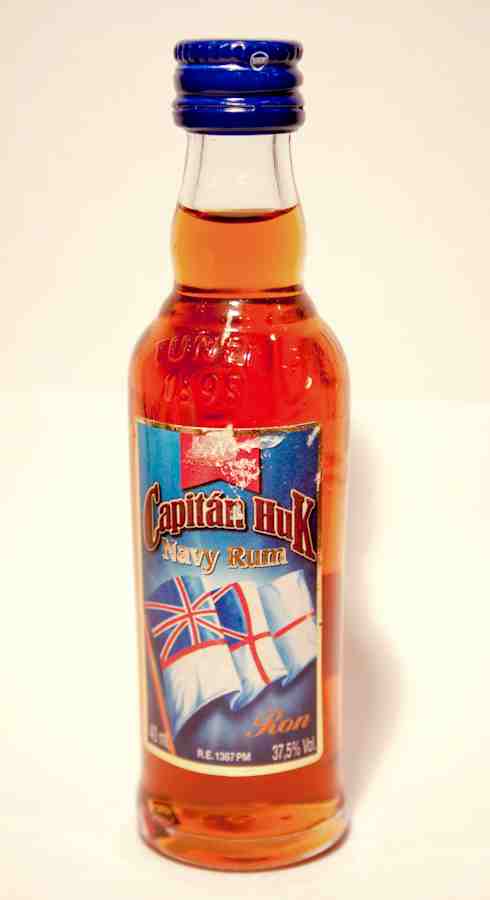
First up, here’s Capitan Huk rum:

I’ve no idea who makes this.  I’m guessing it’s not Diageo.
This is one of the best brands I have ever seen in my life.  I can imagine the meeting that gave birth to it. Translated from the Spanish, it went roughly as follows:
“OK, so we’re going to launch a rum. How should we brand it?”  
“Well, the history of rum is tied inextricably with the British navy.  If we’re going to sell this to holiday-making Brits, that would be a good association to evoke.  They’re always wearing England shirts and that, so if we create a sort of naval ensign flag that combines the Union Jack and the St George’s Cross we’re onto a winner!”
“Brilliant!  Let’s do it! So who shall we get to draw the label then?”
“How about my eight year old son?”
“Brilliant!  Does he know what the Union Jack looks like?”
“No.”
“OK, but given that we’re investing a sizeable amount of money in launching a new brand, should we at least perhaps give him some visual reference so he gets it at least partly accurate?”
“No, fuck it, I’ll just describe vaguely what a Union Jack looks like, and then invest several thousand Euros in printing up the first thing he comes up with.”
“OK, cool.  So what about a name?  Something English and naval…”
“How about Captain Hook?”
“Wasn’t he a pirate in a children’s story, and therefore both fictitious and absolutely nothing to do with the British navy?”
“Yes.”
“Ok, works for me.”
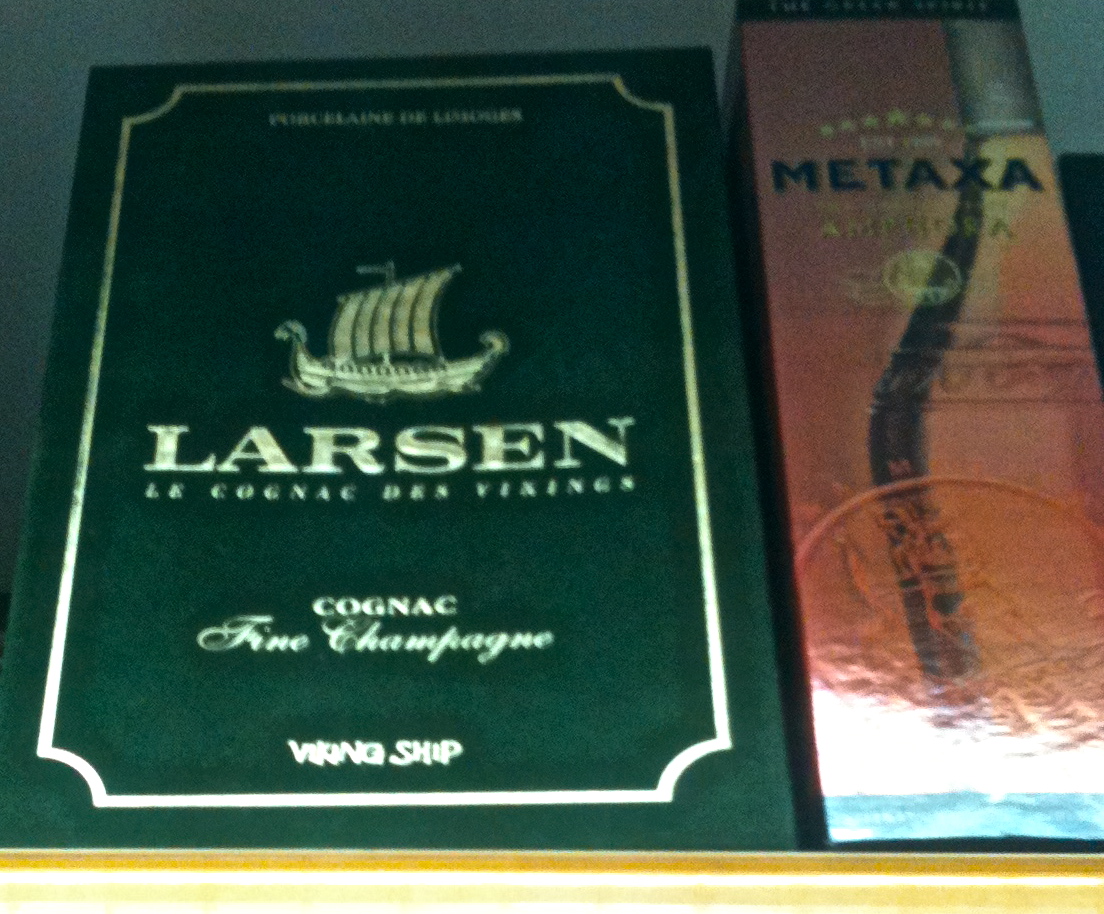
But Capitan Huk was not the best brand in that offie.  Oh no.  The best brand, high on the top shelf, out of reach without the use of a stepladder, was this muscular bad boy:
It says ‘Viking Ship’ on the bottom.  In case you don’t know what the drawing is.

LARSEN, the cognac of vikings.

The very concept of a ‘cognac of Vikings’ is wrong in so many different multi-layered ways, the person who dreamed it up can only be genius.

Every single part of the execution of that concept reinforces the original wrong-headedness of it.

The random inclusion of ‘fine champagne’ just to reinforce the quality cues.

Labelling it with ‘Viking Ship’ like a child would label his drawing.

‘Le Cognac des Vikings.’

I’m in mourning that I didn’t go out and get a stepladder and buy this, just so I could look at it every day when I needed to smile.

Sparkly hat
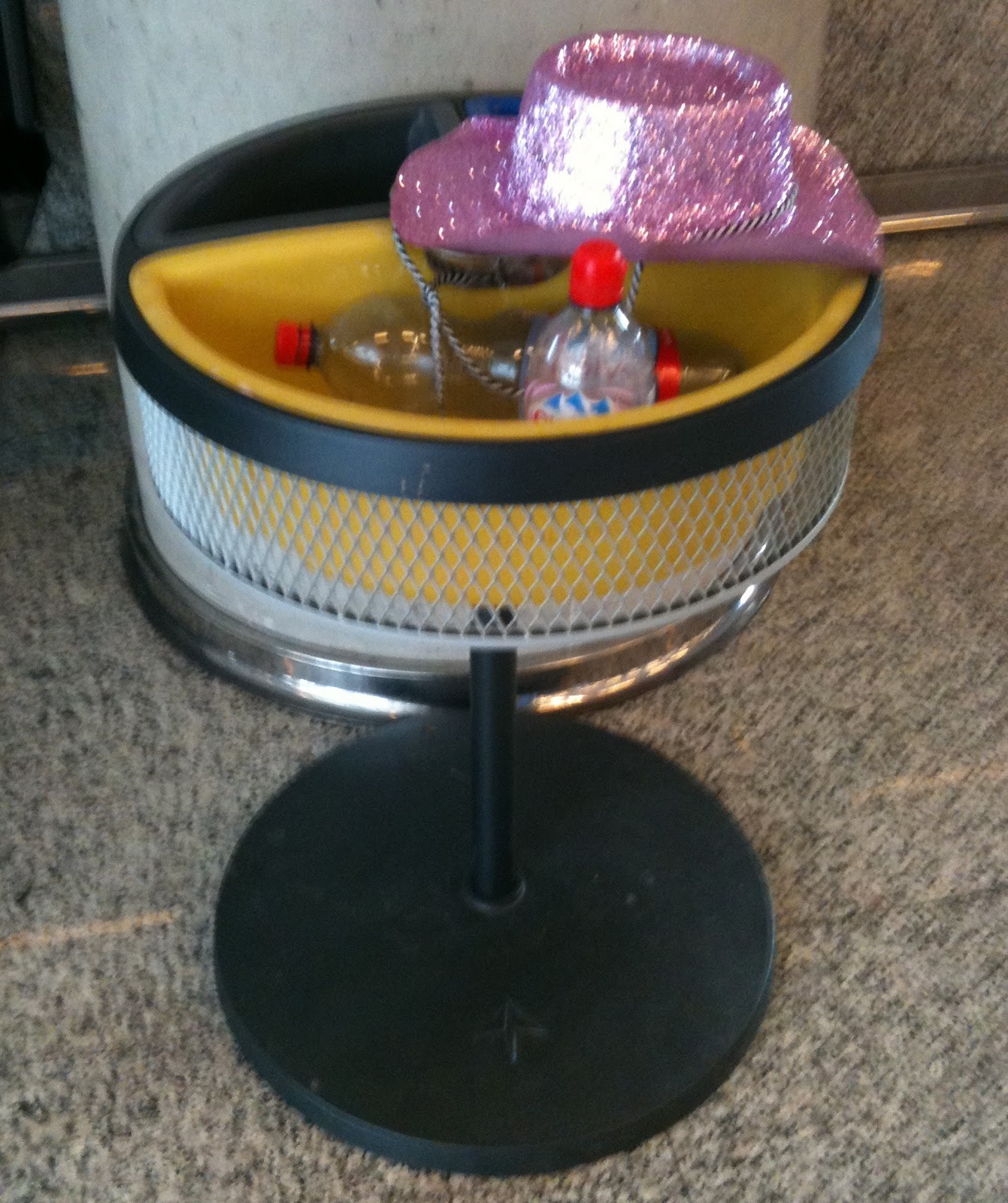
Anyway we had a great holiday, even if we did have to fly Ryanair.  At the airport on the way home we, along with a long, snaking queue of other budget holiday makers, used unstaffed check-in desks to weigh our bags and repack them to stay within the airline’s draconian baggage weight restrictions.  Here and there, items were discarded.  And in one waste bin, about half an hour’s queuing away from the one check-in desk Ryanair deigned to open, we saw this:

Majorca.

At some point, the glittery cowboy hat has replaced the Kiss-Me-Quick policewoman’s hat in British holidaymaking law, quickly and completely.  If a picture paints a thousand words, this one tells you the story of a thousand Mediterranean holidays, encapsulated perfectly.  The object itself.  The fact that it’s been discarded.  The fact that it was only discarded minutes before check-in.

Did its owner intend to take it home then change her mind? Or did it symbolise her holiday, and was she clinging to that holiday till the last possible second?

Did she think “Oh I can’t be arsed to take this on board now I think about it,” or did she think, “I can’t bear to part with you, and all that you represent.  But I must.  For tomorrow I have to go back up Tesco’s.”

The tanlines fade.  But the pint of Carling will always be there for us.

| Uncategorised

The Best Bit of the Job

(Catch-up post: this has been on my to do list for almost two months!)

It was the Brooklyn Chocolate Stout that did it.
I’d been waxing lyrical to Dominique, proprietor of Hardy’s Brasserie, and she was nodding and clearly starting to enjoy the beers I’d brought for her to taste.  Then, as I opened the Brooklyn Stout, I said something that was potentially very rash.
“This is a perfect dessert beer.  No, seriously, beers can match perfectly with dessert.  In fact – taste that, it’s gorgeous – in fact, you could just pour this beer over a scoop of vanilla ice cream and it would be wonderful.”
“No,” said Dominique, incredulously.  
“Yeah, seriously.”
“No.”
“Absolutely, I promise.”
“Ok then.”  And Dominique stood up suddenly.
At this point I remembered that she was a restaurateur.  And that we were having our conversation at a table just outside her restaurant.
Two minutes later, Dominique returned with a dish of home made vanilla ice cream.  I tried not to let my nervousness show as I poured the beer over it.
A minute after that, after the oohs and aahs, and mmmms, she simply said, “Right I’m convinced.  So how do we go about organising this beer and food matching dinner then?
Three weeks later, with a slight change of ingredient in a nod to an up-and-coming local brewer, ‘Stout poured over ice cream’ had become ‘Vanilla Ice Cream Affogato with Kernel Export Stout’ (you get to call it that when it’s a chef that pours the beer on the ice cream).  And it was one of six choices for dessert on a three course beer and food matching menu at Hardys Bar and Brasserie, Fitrovia, Central London.
There’s a good reason why portlier blokes should be wary of having their photos taken with slim, attractive women.  I actually look about twice as big here as I do in real life.
It’s always a pleasure talking to fellow fans of craft beer.  But it’s an even greater pleasure to convert new people to the delights of beer.  Once convinced, Dominique leapt into the world of beer appreciation with a dedication and professionalism that was inspiring to watch.  Within three weeks, the brasserie’s beer list had gone from Becks, Budvar, Kronenbourg and Hoegaarden to include Kernel porters, stouts and IPAs, Schiehallion, Westmalle, Brooklyn, Ola Dubh and many more.
And rather than stop there, having made the investment Dominique went to great lengths to make sure the evening was a success.  The restaurant was full to bursting on the night, mainly with curious foodies rather than beer fans.  I did a talk and beer tasting, signed a few books, then we sat down to the menu with beer recommendations worked out between us, ably assisted by Mike at Utobeer.

It was one of the best events I’ve been involved with.  Afterwards, Dominique said, “Hardy’s beer dinner was a great success! Pete’s talk and tutored tasting was the perfect combination of information and entertaining anecdotes. Our wine drinking regulars surprised themselves at how well the beer complemented the food. Particular highlights for us were The Kernel Pale Ale Centennial with the delicious Barbecued Ribs (recipe taken from Pete’s recommended BBQ bible) and the Duchesse de Bourgogne, a slightly sour red Belgian beer with Stilton. We are now trying to finalise a new interesting beer list and it’s a tough choice as my mind and palate have been opened to this vast, exciting new world. We are also thinking of offering a Christmas menu with beer matching.”

Since the dinner, the beer list has evolved and expanded.  I often say you can’t tell people about beer and food, you have to show them.  Hardy’s is certainly showing them now.  If you’re ever in London, check them out.

And thanks once again to Niki ‘The Flavour Thesaurus’ Segnit for making that auspicious first meeting happen.

| Uncategorised

What now?

I must be losing my touch.

This ad is obviously a few years old, but I only just became aware of its existence.

If you’re familiar with it and your reaction is “Oh keep up grandad”, I invite you to move along quickly.

If it’s new to you, however, this is a banned ad from the successful ‘no nonsense’ campaign that ran in the early noughties, when Peter Kay was fresh and interesting and when large ale brewers still made some kind of serious attempt to sell their beers.

Ah, those were the days…

| Uncategorised

October Wikio Rankings

Gosh, it’s that time of the month again, when beer bloggers get grouchy and irritable for a few days and I’ll just draw that analogy to a close before it gets going.

Here are the rankings for the month of September:

Wikio.co.uk Beer & Wine Ranking – October 2010

1 Pete Brown’s Blog (=)
2 Pencil & Spoon (=)
3 Brew Dog Blog (=)
4 The Pub Curmudgeon (=)
5 Woolpack Dave’s beer and stuff blog (+3)
6 Are You Tasting the Pith? (+1)
7 Tandleman’s Beer Blog (-1)
8 Beer Reviews (+1)
9 Called to the bar (-4)
10 Zythophile (+1)
11 Boak and Bailey’s Beer Blog (+1)
12 Brew Wales (+3)
13 The Beer Nut (-3)
14 Thornbridge Brewers’ Blog (+5)
15 Spittoon (-2)
16 I might have a glass of beer (Ent.)
17 Reluctant Scooper (-1)
18 Beer. Birra. Bier. (-4)
19 “It’s just the beer talking” – Jeff Pickthall’s Blog (+2)
20 Travels With Beer (-3)

Ranking made by Wikio.co.uk

No change up at the top then.  But look what’s happening overall: with the honourable exception of Spittoon (which to be fair looks like a very well put together blog about wine and food) the rest of the top 20 are now all beer blogs.

So momentous is this, Wikio has even started calling it the ‘beer and wine’ listing rather than ‘wine and beer’.

I wrote a section in the Cask Report about how the online beer community is actually helping drive the growth of craft brewing in the UK, spreading enthusiasm and knowledge, giving brewers a platform to showcase their beers.  With my marketing hat on, when you look at the twiss ups, meet the brewer events, V-blogs, promotions, beer swaps etc that are happening now, I think we’re seeing a new marketing model emerge, where consumers and manufacturers work together to promote the category.  Sure we can be inwards looking and cliquey at times, as any community can, but please, keep it up – this is brilliant.

And do let me know if you’d like to feature the exclusive rankings on your blog at any time.

| Uncategorised

What’s on YOUR pub juke box?

No it’s not.  Mine is.

I’ve been really busy, and then I’ve been away on holiday, drinking vast quantities of Estrella and Cruzcampo (and an accidental awful pint of Fosters) which means I missed the publication in the Morning Advertiser of My Pub Jukebox.

I get drawn to this column each week, like an itchy scab.  Every week, without fail, sales reps from brewers and pub equipment suppliers, and middle managers from pubcos, choose tracks by Queen, Bryan Adams, Michael Jackson, Chris Rea and Chris de Burgh.  I swear someone once even chose a track by the vile, unspeakable M*ka.

And every time I read it a bit of me dies a little inside.

Yes, I’m a music snob.  Far more than I’m a beer snob.  If I was as snobby about beer as I am about music, you would not be reading this blog.  You’d be trying to find my address so you could come round and punch me in the face.

So I abused my position and demanded the chance to do my own pub jukebox.  They said yes.  Sadly, it’s not a feature that merits inclusion on the MA’s website, so I can’t give a link to it.  But if you don’t have a copy of the MA dated 23 September, here’s my selection below.

If you like, you can debate it, and suggest your own track listing.  It won’t be as good as mine though.  Just live with that.

Pete Brown’s Pub Juke Box

“Long before I was a beer snob I was a music snob: a terrible, obnoxious snob who delighted in stuff other people had never heard of, or found unlistenable. Having said that, at least eight of these ten would liven up a night down the boozer.  Just accept that my music collection is better than yours, and we’ll get along fine…

1. New Order – Temptation

The soundtrack to my life – simple as that.  It’s been played at every meaningful event I’ve ever experienced; the sound of a band intoxicated by the realization of how good they might – and almost did – become.

2. Roland Alphonso – Phoenix City

I found this by accident on a Trojan Records compilation and it’s been my party starter ever since.  Why it’s not a staple cover of every ska band on the planet I’ll never know.

3. The Clash – Straight to Hell

If a pub has a jukebox that doesn’t have at least one Clash CD, I won’t drink in there.  It’s a litmus test.  Music but no Clash means the landlord doesn’t know what he’s doing, so the beer’s probably going to be rubbish too.

4. Arcade Fire – Wake Up!

“WHOOOOAA-OH! WHOOOOAA-OOH-OOH-OOOOOOOH-OH!  WHOOOAAA-OH-OH-OOOOOH-OH! WHOOA-OH-OH-OH-Ooooh.” I think that says it all, really.

5. Orange Juice – Consolation Prize

“I’ll never be man enough for you”.  A geek’s rant raised to something noble and majestic by one of the most inspirational men singing today – mainly because it’s a bona fide miracle that he still is – Mr Edwyn Collins.

6. The Blue Nile – Tinseltown in the Rain

Their albums come along less frequently than Halley’s comet, but that’s because perfection takes a long time. Songs of neon, traffic, bitter coffee and rain – the soul of the city, written as epic by the singer’s singer.

7. Godspeed You Black Emperor! – The Dead Flag Blues (intro)

From a genre known as ‘post rock’, the bleakest song ever written.  So dark it’s actually funny: “The sewers are all muddied with a thousand lonely suicides.  And a dark wind blows.  The government is corrupt.  And we’re so many drunks with the radio on and the curtains drawn.” I’m just showing off now.

8. Guillemots – Sao Paulo

While stuck on a container ship en route to India with a barrel of traditional IPA for my book Hops and Glory, I went a bit mad.  This wildly inventive group’s 11-minute caterwauling, multi-dimensional masterpiece was the only thing barmy enough to make me feel a sense of equilibrium with the world.

9. Elbow – One Day Like This

“Throw those curtains wide. One day like this a year would see me right.” Pubs used to play the national anthem at closing time. Now they should play this – by law – for a mass sing-a-long just before last orders. Talking of which…

10. Richard Hawley – Last Orders

From a man who lives in the pub, whose music is the pub, a melancholy piano solo to soundtrack a sleepy walk home after a night well-lived.”

My favourite REAL pub juke box is at the Shakespeare in Stoke Newington, London N16. It’s almost as achingly hip as my selection, and has the added bonus that it exists.

If you want a more crowd-pleasing version, the Beer Widow has already posted her response.

| Uncategorised

The Two Peters venture into the world of video blogging

Peter Amor is a very nice man.  25 years ago he set up the Wye Valley Brewery, which brews some very nice beers indeed.  Earler this year, once the silver jubilee celebrations had died down, he decided he wanted to give something back to the industry he´d built his livelihood on.  He wanted to do something to help celebrate British beer.

Ian Hudson, a former brewery employee, had by this time set up a film production conmpany.  So Ian and Peter started talking, then contacted me with a view to making some kind of film that sang the praises of British beer.

After kicking a few ideas around, we decided to start off by making a series of video blogs.  Once a month, we will be filming in a particular region of the UK, to produce monthly pairs of blogs.  I believe (though I may be wrong) that these represent a bit of a depatrture for V-Blogging in that they´re made with a full film crew and hopefully therefore have a veneer of professionalism to them. 

They´re not necessarily aimed at a beer geek audience but at a more general public, and we´re exploring ways to give them a wider reach in an age where TV channels won´t commission many serious content about beer.  So if you´re a fellow beer blogger and you´re thinking ´this is rally basic stuff´ – fine, but it´s not basic to most people.  The featured beers will be limited to cask ales, because that´s what Peter´s passionate about and he´s paying the bills.  But in today´s brewing scene, limiting it to cask is hardly a hardship.     

My bit is easy.  I have to select a few beers from that region, drink them, and talk about them on camera.  We decided to do the first one from Nottingham, home of the 2010 Champion Beer of Britain, Harvest Pale.  Here are the results.  Apart from convincing me of the urgent need for a diet, I´m quite pleased. 


Pete Brown’s British Beer Blog from Ian Hudson Films on Vimeo.

Mr Amor has a harder task.  He has to explain the history and production of beer, the ingredients and the process. Here´s his first one.


Peter Amor’s British Brewing Blog from Ian Hudson Films on Vimeo.

We´re quite pleased with the results for a first go.  Next month we´re in Wales.  If you think we should come and see you, let me know!

| Uncategorised

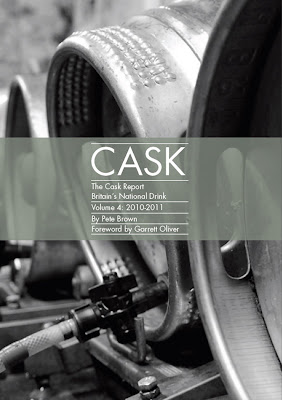
The Cask Report

Have spent most of the day in a radio studio doing syndicated interviews about the Cask Report, which we’re launching today.  This means the Report, which I was hoping to put up here as an exclusive here earlier today, has already been picked up by several bloggers which, along with some favourable national media coverage, is great stuff.
Regular readers of this blog will know I’m hardly a cask ale purist.  I regularly criticize people who are.  But cask ale is the most misunderstood of beers.  And it was cask ale brewers who got together and decided we needed an industry report on their part of the beer market.  I’m proud to write the report each year, and to be a spokesperson for cask ale when the report comes out. 
This year’s report contains great news for cask ale brewers and pubs that sell it.  In fact, it’s the best news we’ve had in the four years I’ve been doing the report: 
  • 5% value growth versus 2% value decline for beer overall.
  • Volume steady versus 4% volume decline for beer overall – the first time since 1994 that cask volume hasn’t fallen.
  • 120,000 new drinkers taking total cask drinkers to 8.6 million
  • 4% increase in distribution, with 3000 new pubs stocking cask
  • Average age of the cask drinker is getting younger – 17% increase in 18-24 year-old drinkers.

This in an amazing performance given the general state of pubs and the collapse of volume in the beer market as a whole.
But despite the fact that many people simplify this good news into “cask is growing”, actually it’s not.  Cask’s fantastic performance is great news for drinkers, but good as it is, it’s still only static in volume terms.  That’s because most cask ale drinkers only drink it infrequently, and average throughput of cask ale (in line with beer generally) is down 5 per cent.  
I have a tiny worry that in spreading the good news about cask, we might make drinkers, brewers and pubs complacent, that all you need to do is stick a few handpulls on the bar and everything will be sorted.  
It doesn’t work like that.
In the beer world, we spend time with other like-minded people.  The brewers and publicans I speak to are all doing really well, but that’s because they work hard developing beers, keeping them in great condition, and telling people how good they are.  It doesn’t happen automatically.  46% of the UK population have still never tried cask ale.  Only 18% of drinkers claim to drink it on a regular basis.  People still don’t know that much about it.  
It’s important that anyone who loves cask ale who reads the report (downloadable here in full) reads the warnings as well as the fantastic news on cask’s resurgence.
Look, I just do as I’m told.

| Uncategorised

Plzen: Built on Beer

OK so the live blogging experiment was only partially successful (what can I say? I had a cold).  But here, better late than never, is another post from our recent beer bloggers’ Czech trip.
In retrospect, some places seem fated to become what they are, drawn hopelessly to their destiny.  I thought I knew the story of Plzen, but as with so many stories, the narrative is geological.  Sometimes I’m a historian, but sometimes you have to be an archaeologist: if you gently scrape away the story on the surface, you find another one beneath, and maybe even one below that.
Wonder if this is where my publisher got the idea for the horrid old cover of Man Walks into a Pub from?
Plzen (places in the Czech Republic have both German and Czech names, and when you’re there it starts to feel appropriate to use the Czech spelling) is synonymous with beer, and with the date 1842, when Josef Groll allegedly brewed the first golden lager, the style which eventually became known as Pilsner.  That’s bollocks of course – there was golden lager before Groll – but there’s no denying the astonishing impact his intervention had on the beer world.
Legend has it that the circumstances leading up to Groll’s appointment saw the quality of the town’s beer deteriorate so badly that it was ceremonially poured down the drain in front of the town hall.  Prior to this, the people of Plzen had had the right to brew themselves – a privilege not given lightly.  After the ceremonial dumping of the beer, the city formed a burghers brewery, a collective venture that employed Groll and made history.
The clues to the layer beneath are there for all to see in that story.  Why was beer so important to the citizens of Plzen?  Why did they all have brewing rights?
And so you come back to fate and destiny.
Plzen lies in rolling, tree-lined Bohemian countryside.  Naked, in the thirteenth century, it would have been one of those locations that screamed “Build on me!”, especially if you were looking to build a gaff that could be easily defended during centuries of almost constant warfare.  Amid a confluence of rivers, stands a gentle, dome shaped hill.  Town square on top of the hill, a cathedral in the middle of that with a 100-metre-high tower for observation, nice grid system of streets, a network of walls and moats at the bottom of the hill, and you’ve got a town that withstood fairly regular assault until 1618 and the opening exchanges of the Thirty Years War.
Why is this relevant to beer?  Because that gentle hill is made of sandstone, easily excavated.  And as soon as the town was granted its charter in 1295, the citizens began to dig.  First cellars, then tunnels joining them up, and soon there was a 19km underground network inside the hill.   
And according to the tour guide (not always reliable, but in this case very plausible), the initial reason for digging was storage for beer – in other words, lagering.  All burghers had brewing rights, and it seems many used them.  It backs up what Protzy has discovered talking to historic German breweries, that lagering goes back much longer than we thought.  In the labyrinth beneath Plzen, there are even underground bars and restaurants, where people who brewed better beer than their neighbours sold it to them though holes in their cellar walls.
You can now go on a tour of the ‘Plzen historic underground’ starting at the town’s brewery museum.  Thankfully the old man in Czech trousers who greets your hangover with traditional songs played on an accordion remains on the surface, and a sexy-librarian type tour guide issues hard hats (this is not just health and safety gone mad – you will smack your head) and guides you through 800 metres of tunnels and caves.
The sound of running water is constant.  There are about 360 wells down here, providing the famous soft water that’s so important to Pilsner beer.  The natural temperature is around five degrees Celsius.  Among the many museum pieces are drinking vessels from down the centuries.  Tin steins from the fifteenth century look pretty similar to anything you see in souvenir shops today.
OK, the table’s from IKEA, but the tankard is over four centuries old.
All these factors – along with the treasured Saaz hops grown nearby – come together to make brewing great beer seem inevitable.  Beer came to the Czech Republic with its first inhabitants – evidence of brewing and drinking has been found in the dwellings of early Teutons, Slavs and Celts, and by AD 922 the newly consecrated Bishop Vojtech was complaining about the scale of brewing in Brevnov monastery in Prague. 
So Plzen was a hugely significant brewing city before Groll came along.  In fact, that’s why they hired him – it was inconceivable that the city should have substandard beer after such a long brewing history.  Plzen literally stands on its brewing heritage.  The question is, what really happened to make such dramatic intervention necessary?  Why did the burghers pool their collective brewing rights?  Did the beer really deteriorate so badly it had to be poured away, or was the move simply a less dramatic reaction to the Industrial Revolution, an acknowledgement that brewing needed to happen on a bigger scale?
I don’t know, but in Plzen, nobody is saying anything to spoil the legend.