Category: Uncategorised

| Uncategorised

Celebrating the Beer Hunter

This month the Brewery History Society releases a very special edition of its magazine, focused on the life and work of Michael Jackson, the Beer Hunter.

When I won UK Beer Writer of the Year in 2009, it was a particular honour because it was the first year when the award was named after Jackson.  And it was even more of an honour some months later when, as the winner of that award, I was invited to guest-edit this collection of pieces about Michael and his immense contribution to beer appreciation and beer writing.

There are more details of the result here, and you can download my introduction here.  But in a nutshell: the BHS’ Tim Holt came up with the idea, and suggested we approach various writers with topics they might want to cover.  With one exception, everyone we approached immediately came back and said yes, and delivered their pieces promptly.

I took a while to get around to reading the collection we’d assembled.  But when I finally did, I read the whole lot in just about one sitting.  When I was judging the beer writers’ awards last year, there was so much to get through we had to skim-read the entries first time around to whittle them down.  With such a big pile to get through, it was rare indeed to find a piece that you ended up reading the whole way through, and left you disappointed that you’d got to the end and there was no more.  Every time that happened, you knew you had a winner from the 400+ entries in front of you.

I’m not just being obsequious here, but that happened with each one of the pieces of writing in this collection.  What makes it even more compelling is the way it builds, so you turn to each new chapter going, ‘What, he did that as well?’  It truly is staggering to see Michael’s entire contribution to beer writing and beer appreciation, even the welfare and development of beer and brewing itself, summarised so comprehensively and so well.

We’re launching the collection at The Rake in Borough Market, SE1, on Sunday 27th March at 6pm – I only just found out that, appropriately enough, this is the anniversary of Michael’s birthday.  Tim Holt, continuing his excellent job at making this whole project happen, is trying to get as many of the writers as possible to attend. Mark Dredge and I will definitely be there.  Others would have to travel from further afield, but include Zak Avery, Roger Protz, John Keeling, Jeff Evans, Carolyn Smagalski, John Richards and Martyn Cornell.

The magazine goes out free to BHS members and costs £4.50 otherwise.  If you can’t make it on the night, I guess you can get them from the Brewery History Society website.

Hope to see you there.

| Uncategorised

All at sea again: Imperial Russian Stout is coming home.

I am SO going on this.

This is old news now, but I’ve been meaning to promote it for ages and, having just paid my deposit, now seems like the perfect time.

This June – almost four years since I recreated the journey of IPA from Burton-on-Trent to India – a group of brewers corralled by a man almost as mad as I am will be recreating the Baltic Run, from London to St Petersburg.

This is the journey that foreshadowed IPA, and its recreation is taking place on the kind of epic scale, and with the a level of authenticity, that I only wish I could have achieved with my adventure.  Tim O’ Rourke, a longstanding figure in the beer industry, had the idea a few years ago after a chat I had with him about my IPA voyage, and he’s worked tirelessly to make it a reality.

He’s hired Thermopylae – the yacht above – and convinced eleven brewers to create Imperial Russian Stouts that will be loaded on board after a special beer festival in London, running from 12th to 15th May.  The ship will then set sail across the North Sea, and will tour pubs and beer festivals around the Baltic, with the intention of arriving in St Petersburg on 15th June.  The journey will be in stages, and volunteer crew are still needed for various bits of it.  It’s a non-proft making venture and hiring a round-the-world clipper plus professional skipper and watch captains doesn’t come cheap, so it costs £700 per person per week.  But it’s worth it to be part of this once-in-a-lifetime – sod that, once-in-two-centuries -experience.

It’s a common misconception that stout was shipped to Russia by Burton brewers in the days of the Czars.  Well, while some stout may or may not have gone in later days, the beer that made Burton famous was strong, sweet, nut-brown ale.  Years later though, London’s porter brewers got in on the act and started exporting their beers to Imperial courts that fell in love with strong British beer styles.  British ships originally went to the Baltic to source wood for barrels, and figured they needed to take something on the outward journey to make it worthwhile.  So they took beer, and it really took off.  Maybe it was because of Staffordshire glass blowers working on the new palaces of St Petersburg.  Maybe it was inspired by attempts to keep up with Peter the Great, who served it at royal banquets, or Catherine the Great, who was ‘immoderately fond’ of British beer.  But the Baltic was Britain’s first great export market, until a combination of Bonaparte and prohibitive duty rates killed the trade off.  Back in Burton, it was the infrastructure and knowhow developed for the Baltic trade that allowed Burton brewers to crack the Indian market.

On the modern day version, the beers taking the trip come from:

1.     Harveys
2.     Coors Museum Brewery/William Worthington Brewery
3.     Wadworth
4.     Shepherd Neame
5.     St Austell
6.     Elgood’s
7.     Thrornbridge
8.     Meantime
9.     Bartram Brewery
10.  Black Sheep
11.  Fullers

I wish I could go along for the whole voyage, but I’ll be helping The Beer Widow organise Stokey Lit Fest again at the start of June.  Happily, we have just enough time to recover from the Litfest before getting a flight to Helsinki, where we’ll meet the ship and her cargo for the final leg to St Petersburg and what will hopefully be a triumphant arrival.

Middle of June, Baltic, a sun that never sets… I might even take the Beer Widow with me this time.  Go to www.thegreatbalticadventure.com if you’re interested in joining us.

| Uncategorised

We’ve got to acc-en-tu-ate the positive

Sorry – really long post – really big topic.
I’ve seen lots of conversations recently that all come together around a central theme that is, to my mind at least, one of the key themes for beer this year.  Namely this: factionalism and blind prejudice – on various sides – is threatening to kill, or at least stall, the beer revolution.
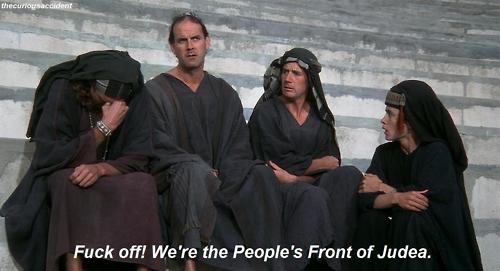
The people’s front of Judea and the popular Judean people’s front.  Or is it the other way round?
It first struck me when Martyn Cornell expressed his dismay that seven of the supposed ten best beers in the world are Imperial Stouts, which began a war of indignation that has currently run to almost 150 comments on his blog.  Then, after my recent posting on a very good-natured and enjoyable beer versus wine matching dinner, Cooking Lager temporarily dropped his comedy mask to make the very good observation that in wine, you never hear people promoting good wine by slagging off cheap wine.  And, last week, I was talking to Zak Avery about my growing concern over negativity in the beer scene, and he said, ‘wait till you see my next column’.  Zak published his thoughts on the subject yesterday, arguing for more inclusivity and tolerance.
As Zak says, the passion that people have for beer can only be a good thing, and I would never want to deter anyone from expressing their passion.  I’d just ask you to think about the way in which you express it (and by the way, I’m not exempting myself here – I’ve been guilty too).
When I first started writing about beer, I was infuriated by CAMRA because it was the only voice in the UK championing good beer, and it did so in a way that I felt was blinkered, bigoted, and downright insulting to beer drinkers who were not already part of the club.  CAMRA-friendly beer writers would not only dismiss mainstream beers as ‘industrial yellow fizz’, but also their drinkers as brainwashed morons.  It was only half a step away from the nasty abuse of ‘chavs’ or ‘pikeys’ under which class prejudice hides today – sometimes not even that far.
CAMRA has since changed and become more open, and has seen its membership double.  I think the two are not unrelated.  (From now on, I’m going to refer to the rump of unreconstructed CAMRA diehards who hate anything new or different as Old CAMRA, to differentiate them from the broader-minded but still real ale-loving mainstream CAMRA).
But CAMRA is no longer the only voice championing good beer.  We now have what Zak refers to as the ‘crafterati’ – beer bloggers and other vocal drinkers who champion great beers from or influenced by the North American brewing scene.  I’d like to believe I was among the first of these in the UK.  But now I look at what Martyn calls ‘the extremophiles’, and I’m seeing a similar unpleasant snobbery to that of CAMRA ten years ago – just coming from a different direction. Where the rump of Old CAMRA members still dismiss even quality Czech and German lagers as ‘yellow fizz’, the extremophiles similarly deride ‘Boring Brown Beer’.  Each dismisses vast swathes of beer, denigrating perfectly good brews simply because they are not of the style they prefer.
Old CAMRA and the extremophiles do at least agree on one thing – that any beer brewed by a big brewery must be shit.  In the US, the definition of Craft Beer hinges on the size of the brewery rather than the ingredients and processes used, or the passion of the brewer.  Over here, Old CAMRA now forgets that it was regional brewers like Young’s and Greene King who kept real ale alive long enough for the micros to arrive, casting them in the role of evil big brewers oppressing the micros, while extremophiles dismiss their beers as hopelessly square and bland.
All of this is childish, and ultimately damaging for beer – all beer.
I just got back from the SIBA conference, where one of the prevailing attitudes was inclusivity about what makes good beer.  During the closing panel session, Roger Protz cut an increasingly isolated figure as he defended CAMRA’s stance on only promoting cask ale.  One minute he said CAMRA could only ever promote real ale because that is what it is for, suggesting that this forty year-old body is simply incapable of changing to reflect changing times. The next minute he boasted that CAMRA had proudly defended Budvar for twenty years.  The brewers of quality British lager – some brewed locally – who were in the room were left scratching their heads as to why CAMRA could promote a foreign quality lager but not a British one.  Roger confessed to enjoying some quality keg products and exhorted fans of them to form a campaign for keg ale.  But in doing so he missed the whole point – it’s not about cask or keg.  It’s now about a broader championing of good beer in an age where method of dispense is no longer the key differentiator of quality.  The audience – comprising mainly of cask ale brewers – was then asked if they thought CAMRA should broaden its remit.  A show of hands revealed roughly 80% believed CAMRA should – and I repeat, these are brewers of cask ale.  Roger said he was ‘horrified’ by this result.
At the other end of the scale, we had a Guild of Beer Writers meeting last week, and after the meeting, we all enjoyed pints of Gales Seafarers, Adnams Bitter and London Pride.  These beers were perfectly kept, wonderfully tasty, but some of us who might be counted as ‘crafterati’ (me included) felt a need to justify or at least comment upon the fact that we could enjoy these ‘boring brown beers’ as much as we did.  I’ve enjoyed great pints of Greene King IPA on occasion – in the right pub at the right time – and I now reject a beer scene where anyone needs to be defensive about that, just as much as I reject a beer scene that says cask ale is the only beer worth drinking.
There was a different aspect of the same thing with some of the criticism of the Proud of Beer video.  Why was Carling in there? Wasn’t this supposed to be a video promoting craft beer?  Well, no.  It was supposed to be a video promoting the British beer industry.  Because if Old CAMRA, the extremophiles, those arguing that SIBA brewers are parasites, those who believe Molson Coors are going to close down Sharps (even though the Cornish brewery has just had some brand new fermenting vessels delivered), those who hate beer tickers, those who say cask is dead, those who say keg is de facto shit, those who think any beer with under 50 IBUs is shit – if you could all just lift your heads out of you navels and look around for a bit, you’d see the real picture. 
There’s a war on drink at the moment, and beer is the scapegoat.  Every article on Britain’s binge drinking epidemic uses the pint as its frame of reference, despite the fact that beer sales overall are nose diving while wine and spirits sales increase.  Tax on beer has gone up by 26% in the last two years, and will go up by another 7% in this month’s budget.  Beer is massively under-represented in popular press coverage, and most people in the general public still perceive it as uninteresting and not for them.  Pubs are closing at the rate of 29 a week.
So if you care about beer enough to write about it, or evangelise it in any other way, it would be really great if you could do so positively.  Anyone who looks in on our industry, our beer scene, from the outside, sees a pack of squabbling kids.  If you’re a curious drinker who might try beer, it puts you off pretty quickly.  If you’re a minister wondering whether the industry deserves a break, you see a fragmented and ineffective lobbying body.  By focusing on internal battles, we’re allowing wine and spirits on one side and teetotallers on the other to reposition beer as something not worth bothering with.  We simply don’t make Planet Beer look like a very attractive place to be.
I’m not saying don’t be passionate about your favourite beer or favourite beer style.  But I would ask you to try one experiment.  If you do write about beer, and you write something about a beer you like, and you use what you regard as a crap beer as a point of comparison, save it and put it to one side.  Then, try to write the same piece without slagging off inferior beers.  Now, find a friend whose opinion you trust, who isn’t as passionate about beer as you, and ask them which they think reads better, which makes them want to try your beer – the one that praises the beer on its own merits, or the one that slags off what it is not?
Also – anticipating the first wave of comments and cries of hypocrisy here – I’m not saying never be critical, and I’m not saying don’t call bullshit when you see (or taste) it.  But do judge something on its own merits.  
Think of, say, a Jay Rayner restaurant review.  He does negative reviews – and how – but he does these on the basis of the restaurants own merits or lack of them, visiting it, and taking it on its own terms.  He doesn’t slag off a kebab shop for not having a Michelin star, or a provincial family-run restaurant for not being in the West End.  
See what I’m saying?  I hope so.  When I slagged off Stella Black, for example, I did so on the basis of tasting it, judging it as the super-premium lager it claimed to be.  It was revealing and sad that Cooking Lager expressed surprise that I had actually tasted it before slagging it off – what does that say about our perceived prejudices? 
What I am saying is two things:
Firstly, let’s not draw these ideological lines in the sand any more.  Let’s try to celebrate beer
Secondly, when we celebrate the beers we love, let’s do that, rather than constantly using what they’re not as a frame of reference.  Because you know what? It’s lazy, and it comes across as really insecure.
I look forward to all your positive, inclusive and constructive comments, people.

| Uncategorised

Wikio Rankings – February

It’s all change in the Wikio rankings – not sure what’s going on!

1 Pencil & Spoon
2 Pete Brown’s Blog
3 Beer Reviews
4 Master Brewer at Adnams
5 Bibendum Wine
6 Zythophile
7 Drinking Outside The Box
8 Reluctant Scooper
9 Sour Grapes
10 The Wine Conversation
11 Spittoon
12 Tandleman’s Beer Blog
13 Are You Tasting the Pith?
14 Called to the bar
15 Raising the Bar
16 Rabid About Beer
17 Thornbridge Brewers’ Blog
18 The Good Stuff
19 The Pub Curmudgeon
20 Real Brewing at the Sharp End

Ranking made by Wikio

Congrats to Young Dredge for making the top spot.

Interesting to see some wine guys making a much stronger showing than they have over the last year or so – this can only be encouraging in terms of diversity etc.

I’m also really pleased to see brewers’ own blogs making an increasingly strong showing, with Adnams, Sharps and Thornbridge in there – not sure what’s happened to Brew Dog!

Off the back of hosting The Session, Reluctant Scooper shows a strong rise.  If you’ve never read him before, please take the chance to do so now.

| Uncategorised

Calling all beer writers: major new beer writing competition announced

Oxford Brookes University and Wells and Young’s have come together to offer £2000 Bombardier Beer prize for writing on “the joys and jolliness of beer”

Bombardier Beer and Oxford Brookes University today announce the launch of a new competition with a £2000 cash prize offered for the best piece of writing about beer and its role in society.

The competition is open to anyone who writes about beer – or aspires to do so – from mainstream journalists and the top names of the beer-writing world, to young bloggers and as-yet-unpublished enthusiasts.

The judges are asking for a piece of up to 1500 words on the subject of beer’s role in society, or as writer, food critic and competition judge Charles Campion puts it, “the joys and jolliness of beer”, and beer’s role as a social lubricant.

“We’re not looking for technical writing, campaigning tracts or extracts form guidebooks,” continues Campion, “beer is the most sociable drink in the world and doesn’t get fair recognition. This prize is an attempt to help change that.”

As well as Campion, judges will include Paul Wells from Wells and Young’s who are sponsoring the prize, Donald Sloan, the Chair of Oxford Gastronomica at Oxford Brookes University, and Pete Brown, writer and winner of the Michael Jackson Gold Tankard Award for Beer Writer of the Year in 2009.

The closing date for entries will be Friday 1st April 2011. The winner will then be announced at the 2011 Sunday Times Oxford Literary Festival on the evening of Friday 8th April, during a dinner and reception at the Oxford Malmaison Hotel

For full details on format of entries and submission process contact Razia Nabi (rnabi@brookes.ac.uk)

I was very honoured to be asked to be one of the judges – until I found out about the size of the prize and realised I couldn’t enter.  Good luck!

| Uncategorised

Proud of British Beer

We have a curious relationship with pride in Britain.

Maybe it’s guilt over our colonial past.  Maybe it’s British understatement.  Or maybe the notion of national pride has been so poisoned by the Daily Mail, UKIP and the far right, that we are scared of sounding boorish and nationalistic.  We don’t know how to be proud without sounding arrogant and objectionable – even though it’s something other countries seem to manage with ease.

Why else does St Pancras station – a magnificent British building – try so hard to be French? There are no English pubs or shops at the stations on the other end of the Eurostar, in Paris Gare du Nord or Brussels Midi, and nor should there be – they are our points of entry to exciting foreign countries with different cultures and cuisines than ours.  But St Pancras is half-French – it’s almost apologising to travellers for arriving in Britain, with its champagne bar, Des Vins Cafe,  Crepeaffaire, Paul, and Pain Quotidien.

Why else does Britain have fewer local food and drink items protected by European Protected Designation of Origin status (PDO) in total than France has for cheese alone?  Far fewer even than germany or Portugal?  Why do ‘British’ delicatessens stock Italian and French cheeses but no English cheeses?  Come to think of it, why are we calling them delicatessens?

Why, as I pointed out last year, can an American brewer rhapsodise about how Britain is the only nation on earth able to consistently brew beers of such quality and depth of character and flavour as real ales, at alcohol levels below 4% ABV, when you rarely hear moderate and reasonable British people expressing a similar opinion?

It’s a weird one.  And it’s a condition that’s being tested again today by the launch of SIBA’s answer to last year’s American ‘I am a craft brewer‘ film.  It’s simply called ‘Proud of British Beer’, and here it is:

SIBA chairman Keith Bott said, “Nobody could have made a more convincing, compelling case for British beer than the brewers captured on this film. Their pride in their beer, and the pubs that sell it, jump out from every frame and will be felt, and we hope shared, by all who view it.”

Personally, I love it. But then I would – I wrote the script.  And while we’re on the theme, I’m proud to have been asked.  I’m proud to have contributed.  I’m proud to be a part of this film.

It was pulled together in an incredibly short space of time on a small budget, and I think everyone involved did a grand job.
It’s designed to raise awareness, and to lobby MPs, most of whom are emphatically not proud of beer (the House of Commons shop sells a variety of souvenir wines – bottled in France – but no souvenir beer).  There’s an alternative version with a different ending that challenges politicians, asking why they would commit to duty increases that massacre pubs, create job losses, hurt one of our last manufacturing industries, and actually result in lower revenue to the treasury.
The film has been leaked early on Twitter, before its press launch.  Some of the early comments already illustrate the problem we have with pride, the discomfort we feel with people who express it.  Please, if this is your initial reaction on watching the film, challenge yourself on it.  I’m not asking you to lie if you think there are serious flaws in how it has been made, but try to overcome that difficult pride thing and at least judge it on its merits.
If you do like the film, and if you are proud of British beer, then please get the embed code from the Vimeo link above and post it on your blog.  If you are a brewer, or CAMRA, or a trade press magazine, or any other beer body, put internal politics to one side.  Forget the fact that it’s not just talking about real ale, or it features a macro brewer, or you weren’t asked to be in it.  Post it.  Talk about it.  Publicise it.  And help get the message out to as broad an audience as possible.

Alternatively: take the piss.  Parody other people’s efforts to help save and promote British beer while you sit on your arse and do nothing.  But don’t then complain when you’re favourite pub closes, or your favourite beer is no longer brewed.

Come on people.  If we don’t start to show some pride in what we do then basically, we’re fucked.  Let’s try being a little positive for a change.

| Uncategorised

Beer judging and Burton on Trent

We shot this month’s video blog in Burton on Trent at the Brewing Industry International Awards, a prestigious competition that’s back after a six year absence.  800 beers from around the world judged only by active brewers – no beer writers, no industry figures, this was about excellence, peer-to-peer.

And there wasn’t too much emphasis on beers being ‘to style’.  The focus was on ‘is this a great well-made beer?’ and ‘is this a beer that drinkers would/should love?’

Anyway, the competition took place in the reopened national Brewery Centre in Burton – a great location to talk all things beer. We talked to Steve Wellington in the new William Worthington Brewery and tasted a couple of beers.

Hope you enjoy!

| Uncategorised

Beer versus wine. In a nice way.

To the Thatchers Arms, Essex, a pub recently taken over by young Mitchel Adams, an ambitious publican who wants to create a destination food and drink pub. Via a combination of doing his job very well and using social media to promote the place, he’s quickly succeeding in his aim. The Thatchers has already been named CAMRA’s Pub of the Year in the region.

On Friday, Mitch persuaded Adnams to run a beer and wine matching evening with a five course dinner. As well as employing one of the UK’s most talented young brewers in Fergus Fitzgerald, Adnams’ Cellar and Kitchen stores boast a formidable wine selection. One of their main suppliers is New Zealand winemaker Forrest Wines, who sent Sam Lockyer to try to persuade us that the wines he’d chosen to go with the food were better than Fergus’ beers. Both were matching blind: they’d seen the menu written on a piece of paper, but not tasted the dishes.

When it comes to the rivalry between beer and wine, when we’re on the front line like this, I’m with Garrett Oliver, finding as I do on so many occasions that he’s said what I want to say before me, better than me. Garrett says that, while campaigning for beer to be taken as seriously as wine, as a craft beer brewer and beer evangelist he has far more in common with a passionate sommelier who wants to educate and inspire people about flavour than he has differences with them.

As well as being true, it’s a clever stratagem: anyone who goes around saying “beer is great and wine is crap”, or “beer is ALWAYS a better match with food than wine,” sounds just as blinkered as his opposite who dismisses the idea of beer ever being as worthy as wine. It actually undermines beer’s credibility.

That’s why, as we sat down, I was genuinely hoping that I would prefer wine to beer with at least one course. It would make beer’s victories sound much more convincing…

To Start
Beetroot Risotto with a Spinach & Parmesan Pesto
Beer: Adnams ‘The Bitter’ Cask 3.7%
Wine: 2006 Chardonnay, Forrest Estate, Marlborough

The two misunderstood, much-maligned pariahs of their respective worlds. No, not Adnams and Forrest specifically, but brown bitter and chardonnay; the former often persecuted in craft beer circles for being dull, boring and characterless, the latter the tart of wine, going anywhere with anyone, so much so that it had a fictional WAG named after it. Can either cover themselves in glory?

Well, as individual drinks, each is impressive – a lovely subtle, fresh, herby hop balanced perfectly with liquid Twix, versus a sharp fruitiness with just enough, and not too much, buttery backbone.

With the risotto… hmm. The chardonnay’s acidity stomps all over it, annihilating the food’s flavour. The beer looks up hopefully, but fails to make any impression at all. For me it’s a goalless draw, each side shooting wide. But others enjoy the match, and it splits the crowd down the middle with a narrow beer victory.

Aggregate scores out of five:
Wine 3.0 vs Beer 3.2

Fish Course
Mackerel & Horseradish Fishcake
Beer: Adnams ‘American IPA’ Cask 4.8%

Wine: 2009 Sauvignon Blanc, John Forrest Collection, Marlborough 

I always compare the aromas of American hops to those of Kiwi Sauvignon Blanc – and here they are, head to head. I’m not sure the cocktail of Cascade, Amarillo, Chinook and Centennial is done full justice by being served on cask. American hops can become brutish thugs in cask beer. Sometimes their power and violence can be breathtaking, but more often it can just be a bit nasty. Carbonation elevates them, refines them, has them swapping studded leather jackets for Thomas Pink shirts and cravats.

But Fergus argues that there’s a real breadth and depth of flavour here. He tells us there’s a lot of bitterness, so he’s whacked in a lot of malt for balance.

Sam talks about terroir. It’s a wonderfully evocative advert for going to New Zealand. When he describes the smell from the wet stones by the river after rainfall as being the aroma of the wine, I think he has us seduced. Again, both are excellent drinks on their own.

But then…

Once again, the wine charges in and smashes the place up. This is my favourite wine style in the world. I often have it with fish, but here the acidity once again just creates noise. The beer fares a little better – there’s the beginnings of a herby matching of flavours. But I’m not blown away. A narrow beer victory for me, and a total split in the room.
Wine 3.5 vs Beer 3.5

I’m obviously here as a beer fan. I want the beer to win. But on the basis of these two so far, I’m starting to wonder: is wine actually capable of matching with food at all? I’m so accustomed to looking for complementary flavours, I’m shocked by the boorish display of acidity here, too vulgar for an effective contrast. I adore these wines on their own, and resolve to stock up on them as soon as I can. But they need much bigger food than this to go with them. Even then, I’m not sure they would work. Is food and wine matching a myth?

And then, everything changes.

Main Course
Venison & Binham Blue Cheese Suet Pudding
(V) Mushroom & Blue Cheese Vegetarian Suet Pudding
Beer: Adnams ‘Oyster Stout’ Cask 4.3%
Wine: 2005 Cab Sauvignon/Merlot/Malbec, Cornerstone, Newton Forrest Estate, Hawkes Bay

The oyster stout is a good stout. It’s a good beer. As expected, it’s full of coffee and dark chocolate and looks to all the world like a confident contender. Matching it with a venison pie is a no-brainer, a routine operation. It goes in, gets the job done, comes out again.

And then I nose the wine.

I first started getting into wine late in my university career. A year or two after the Iron Curtain came down, Hungarian and Bulgarian Carbernet Sauvignons began appearing in the supermarket for £1.99 a bottle. I mean, who would want to drink East European wine? Well, students for one. Initially buying it because it was even cheaper than Liebfraumilch, after the first bottle we drank little else thanks to its concentration of spiced Ribena blackberries on liquid velvet. These bottles quickly went up to £2.99, then £3.99… by the time we graduated they were £7.99, beyond our reach. And by the time I could afford them again, they just didn’t taste the same. Either my palate had improved massively, or the wines had been dumbed down.

Here, Cornerstone reveals itself my first winey love, back from the dead, all aniseed, pepper and red berry compote. It swaggers in and sits down heavily next to the Venison and Binham Blue Cheese Suet Pudding, invading its personal space. No slouch itself in the flavour department, the pudding looks timid, nervous. “You and me. We’re friends, right?” growls the wine. The food meekly agrees. It’s a match, but only because the food knows it would get knocked about the room and bounced off the walls it if disagreed.

The beer tries a friendlier approach: a winning smile, some supportive overtures, a technically competent and absolutely complete matching of various elements of flavour.

The food likes the beer, but it just wants to be friends. The food looks at the beer sadly, takes the wine’s hand, and checks its bag to make sure it’s got the foundation it’ll need tomorrow to cover up a black eye
I want to support the beer.  But when I’m with the beer, nodding and smiling with it, I’m secretly thinking of the wine. The wine may be a bastard, but I can’t help loving it.

No contest.

And yet, bizarrely, for the first time the room overwhelmingly prefers the beer. The rest of this audience is obviously much nicer than me.

Wine 3.6 vs Beer 4.2

Dessert
Treacle Tart
Beer: Adnams ‘Tally Ho’ Bottle 7.0%
Wine: 2006 Botrytised Riesling, Forrest Estate, Marlborough

Our Botrytised Riesling is a kind of wine equivalent to lambic beers, both in how Sam describes its production, and in the effect it has on my palate.

It smells of petrol. But not in a bad way – I like the smell of petrol.

It tastes like cough syrup. But not in a bad way – I like the taste of cough syrup.

Well, sometimes.

Tally Ho is strong and dry with a not unpleasant hint of oxidisation that makes it come across as venerable and authoritative. Initially I think it lacks the sweetness I want from a dessert beer, and wish it was a barley wine instead.

It’s OK with the tart, competent, but no more than that. But then I take a spoonful of the tart together with its accompanying vanilla cream, and it’s like that bit in musicals where the back wall falls away to reveal the set for a big show tune. New flavours walk into shot, smiling, like carol singers during the finale of a Val Doonican Christmas Special. Chocolate, vanilla and caramel all sing harmonies, and beer, wine and cream become one.

The wine is way too phenolic, with or without the cream. It walks into the analogy in the above paragraph banging a drum and playing a tuneless harmonica until everyone stares at it coldly, willing it to leave.

Again, opinion is divided elsewhere – but a well-deserved victory for the beer overall.

Wine 3.2 vs Beer 3.4

OK, so on my palate I’m looking at one nil-nil draw, one beer victory by default, one bruising wine triumph and one graceful beer victory. I think the results don’t reflect how close the play has been and things could still go either way. But oh dear – here comes the cheese.

And we all know about beer and cheese.

Cheese

Mrs Temple’s Alpine, Suffolk Gold
Beer: Adnams ‘Broadside’ Bottle 6.3% & Adnams ‘Innovation’ Bottle 6.7%
Wine: 2009 Late Harvest Sauvignon Blanc, Forrest, Marlborough

Sam stands up to introduce his late harvest sauvignon blanc with a dead look in his eyes. He knows he’s already lost. It’s almost unfair to make him compete in this round, and he knows it. The best I can say is that if he’d deployed this wine back there at the treacle tart’s Christmas party, that result could well have gone the other way. It’s a great wine with an unexpected flavour dimension. It’s got interesting things to talk about.

But when the cheese comes out, it falls apart, makes its excuses, gets its coat and leaves quickly.

Maybe we could accuse Fergus of cheating by bringing a tag team, especially when its these two. But either one wipes the floor on its own. Broadside with the Suffolk Gold is magisterial. Innovation with Mrs Temple’s Alpine is simply perfect.

Wine 2.2 vs Beer 3.9

I’ve learned a lot. And as I put my notebook away and Fergus celebrates his victory by producing some very special Adnams’ beers that are possibly older than he is, Sam, he and I discuss the action. In the room it’s 4-0 to beer with one draw – and this was not a room full of beer geeks, but a balanced audience of foodies who, if anything, might be expected to go with the wine. I’m happy because beer is the winner. But I did emphatically prefer the wine in one course, so my palate’s conscience is clear.

It’s dangerous to attempt to draw conclusions from one New World winemaker going up against one Suffolk brewer, but the general trend tonight has been that wine on the whole has been aggressive, thuggish and brutish. Even its victory on my palate was down to its power and intimidation, and this was emphatically the reason for its defeats. It’s the beer that has demonstrated subtlety, sophistication and style, and this is arguably the reverse of the popular image of the two drinks. Beer is supposed to be a bit thick and dumb, wine intelligent and stylish. Across a menu of diverse flavours, the positions have been reversed, and I wonder if this is true in a broader sense.

But maybe not – maybe a match between New Zealand wines and US beers, or British beers and French wines, would have seen the contenders belonging to the same class, and given a more balanced result.

No matter – It was great fun, I’ve made new friends in both beer and wine, and every drink was excellent in its own right.

Thanks Fergus, thanks Sam, and thanks Mitch and everyone else. From my hazy recollection of aged beers and bar billiards, I think the night got even better after the dishes were cleared away.

| Uncategorised

Pete’s Pub Etiquette: “This beer’s off”

Here’s one that I think will divide along the lines of drinkers versus people who work behind the bar: what’s the right thing to do when a customer complains about a beer being off? Or rather, not the right thing, but the most realistically acceptable thing?
I’m pretty sure it’s not what happened to me in the Queens pub in Primrose Hill, NW1 the other week.
I ordered a pint of Young’s Special that was full of diacetyl.  This is a concentrated butterscotch flavour that can also have a greasy mouthfeel.  Hints of it can be positively wonderful in the right beer, but when it’s all you can smell or taste in the beer, it’s pretty horrible.  It occurs during fermentation and then normally falls away to very low levels.  So apparently, these excessive levels are due either to a prematurely ending the brewing process, or to bacterial infection.  I’m not an expert, but I could immediately identify the fault.  At the end of the day, if the beer tastes so horrible you don’t want to drink it, and you can identify the off-flavour, you have to take it back.
“This beer is off,” I said.
The first thing the barman did was to pour some more beer from the barrel.  He sniffed and tasted it.  “Do you think it’s getting near the end of the barrel?”
“No, it’s full of diacetyl,” I replied.
He made it clear with his facial expression that he wasn’t convinced, that he didn’t think there was anything wrong with it, but he replaced my pint with an alterative without saying anything else.
But then, he didn’t take the beer off sale.  He continued to serve it to other punters, who didn’t complain.
And here’s the dilemma: the reason I’m writing this is that this really pissed me off.  I’d told him the beer was unfit for sale, and specified why.  He had decided not to disagree with me, but by not taking the beer off sale, he was effectively telling me either that I was wrong, or that my opinion didn’t matter.
I hate taking pints back because I’m always worried that the conversation might reach a point where I have to make a ‘do you know who I am’ type comment to establish the fact that I know what I’m talking about, that I’m not one of those belligerent old punters who mumble about ‘the pipes’.  But when I’m standing in a pub watching a barman continue to serve a beer I’ve told him is unfit for sale, my only options are to accept that he is basically humiliating me – “I’m tolerating your complaint but it makes no difference to me” – or to make a complete arse of myself and start banging on about how much I know about off-flavours.
But look at it from his point of view.  He obviously didn’t know what diacetyl is.  He saw a punter complaining, replaced the pint, job done.  How was he instructed to handle this kind of incident by the management, by the PubCo? (This was a Young’s beer in a Young’s pub – it would be interesting to know what their policy is.)  If you threw away the barrel every time a punter complained that he didn’t like his pint, wouldn’t you bankrupt the business?  And no other punters were complaining, were they?
But I still think he was wrong.  Most people don’t complain – they just don’t go to that pub again, or don’t drink that beer again.  Sometimes, they can be turned off real ale for life.  They don’t know enough about beer faults, don’t have the confidence to take on a skeptical barman.  How many punters did that faulty barrel discourage from drinking that beer in that pub again?  And if you think I’m wrong, tell me.  Let’s loose the passive aggression.
What do you think?