Category: Uncategorised

| Uncategorised

Foster’s (US) joins the Artois Academy of Marketing Nonsense

Oh dear.

Sometimes I feel have to apologise to the world on behalf of marketing.  Not because marketing has done something that’s my fault, but because I occasionally still work in marketing and no one else who does is going to do the decent thing.

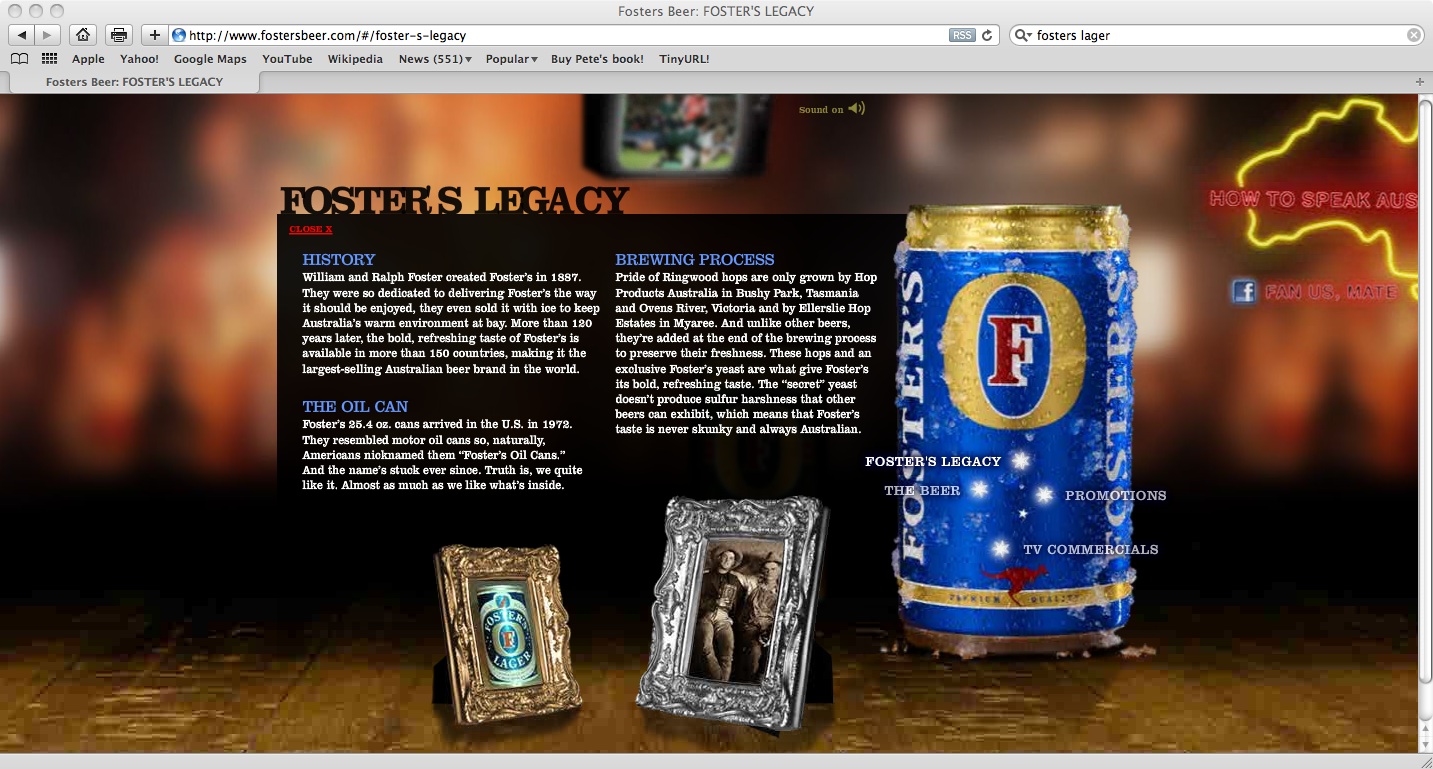
I’ve just been writing a piece for Garret Oliver’s upcoming Oxford Companion to Beer on the subject of Foster’s, and I found this, the brand’s American website.  Here, on the landing page, we find a bold product claim that would put even Stella Artois to shame:

“Unlike other beers, [our hops] are added at the end of the brewing process to preserve their freshness.”

Wow.

Foster’s is different from other beers because they add their hops at the end of the brewing process?

And the reason they do this is to preserve the freshness of the hops??

Just how wrong can someone be???

For those of my readers who may be unfamiliar with the brewing process (such as those of my readers who work on Foster’s in the US), hops add two key things to the character of beer (apart from their contribution to preserving it): bitterness and aroma/taste.

When you add hops at the beginning of the boil, the compounds break down, the alpha acids are released, and their pungent aroma disappears.  These hops add bitterness to the beer.

Towards the end of the boil you add more hops.  You don’t give these a chance to break down.  The aroma compounds remain intact, and these hops give beer its floral, grassy, herby, spicy or fruity notes.

This is standard practice across brewing, and while there are probably some beers that do not have a late hop addition, I don’t know of any.  Any book you read on the brewing process will describe an early addition and a late addition of hops as absolutely standard practice.  And Foster’s is claiming it is unique to their beer.

Attentive readers may also realise that Foster’s seems unaware why it is adding hops late in the boil.  They mention nothing about the aroma stuff I just described; they say it is to preserve the freshness of the hops.

If the person who write this had ever been near a brewery in their lives, they would know that even where brewers use whole hops, 99% of the time they have been dried and stored – they’re not fresh to start with.  And most industrial brewers such as Foster’s don’t use whole hops anyway – they use dried, concentrated pellets, or even hop oil.  Freshness has nothing to do with it.

What makes me angry about deliberate misinformation like this is that it helps no one.  Having worked on the dark side, I can tell you that they probably come out with bullshit like this because as a ‘premium’ brand, they’re looking for a ‘reason to believe’, a ‘Unique Selling Proposition’ that provides a rational basis for product choice.  They would probably argue that their ‘target audience’ is not beer nerds, but mainstream drinkers who have no knowledge of the brewing process.  They don’t want to hear too much information, just enough.  And if that information is heavily distorted or even wilfully wrong, they’re never going to find out, and wouldn’t care much if they did.

This is insulting the intelligence of the people they’re talking to – deliberately writing off any curiosity they may have.

It’s distorting the truth of the market, insulting all other beers.

And it’s exacerbating a problem facing craft brewer and corporate lager brewer alike: one reason wine is surging ahead, taking people from beer, is that it’s premium, yet easy to understand – it’s made from grapes.  There are different varieties of grapes, and you’ll prefer some to others.  People aren’t really aware of what beer’s ingredients are, what each contributes, and what the brewing process does.  It’s quite complicated, and that makes it hard to engage with. And when people who have a responsibility, or at least an opportunity, to act as ambassadors for beer, if they add to that confusion by wilfully, deliberately, further confusing, distorting and lying about the brewing process just to say something that sounds differentiating and simple, they betray their drinkers, their brand, and everything about beer.

And I don’t even have the energy to take them to task on what they go on to say about yeast.

Shame on you, Foster’s.  Next time, just stick to the image-based marketing that actually works for brands like yours.

More candidates will be inducted into the Artois Academy of Marketing Nonsense forthwith.

| Uncategorised

“Lager drinkers are brainwashed morons.”

How CAMRA volunteers greeted guests at the Great British Beer festival a few years ago.

There was a welcome but just a teensy bit patronising piece in the FT on Saturday about how the sandals-and-black-socks twattish image of real ale – and CAMRA – is no longer accurate, particularly given that the latter has doubled in size over the last decade.  The number of – shall we call them ‘characters’ – in society has not doubled, meaning that while some of us may still have issues with the organisation in some areas, it is succeeding in reaching out to a broader base of people.  (And yes, I know some critics believe people are just joining for the Wetherspoons vouchers, and many join and are not active, but still.)

Next month is CAMRA’s 40th anniversary, which is likely to generate a lot more media focus and a lot more debate.

But how’s this for an extraordinary acknowledgement of some of the issues CAMRA has, some of the problems people like me have with the way the organisation can sometimes put itself across?

The following is a quote from Michael Hardman, one of the original four founders of CAMRA back in 1971.  Talking to the FT last week, what do you possibly think he could mean when he says:

“I must point out that we’re not fighting against anything, we’re fighting for something,” he says, as measured as a well-poured pint. “There may be some members who give a different impression and I apologise to the general drinking public for the fact that we’ve recruited those people.”

Any CAMRA member/activist who agrees with these sentiments from their founder – and I know there are many of you – will find no quarrel with me.

Mr Hardman MBE, next time I see you I owe you a pint.

(Thanks to Glenn Payne for pointing sending me the article.)

| Uncategorised

Some facts about cheap supermarket beer prices

14p per unit

Listen: the idea of minimum pricing worries me a little.  I don’t believe that there is a direct link between Britain’s supposed binge drinking problem and the widespread availability of cheap booze.  And I don’t lay sole blame for the plight of the pub at the door of supermarkets.  OK?

But I wanted to comment on the disquiet in the blogosphere about this whole question of whether supermarkets ever sell beer at below cost price, with some comments on this blog suggesting the entire idea is a myth, and others asking if it’s really plausible that any retail business would sell something on which it makes a loss on a sustained basis.

I don’t blame anyone for thinking this – in a logical world it sounds like an insane idea.  But supermarkets are not always logical – or rather, their logic is different from ours.

Below cost selling DOES happen in supermarkets.  I know this because I’ve had conversations about it with the brewers who sell their beer to supermarkets and with the supermarkets who buy it.  They wouldn’t thank me for sharing this, so I’ll keep it completely anonymous, but here are a few trade secrets.  Well I say that, a lot of it is common knowledge within marketing circles.

Beer is what’s known in the trade as a loss leader.  It’s a common concept.  Most beer bought in the UK off-trade is sold on price promotion.  When you have people spending £200 on a mixed basket of groceries, you can afford to lose a few quid on staple items because you make it back – and more – on the premium items they’ll also be buying in your shop.

We do big supermarket shops in the car, stocking up on heavy items.  That means we keep an eye on the prices of bulky purchases.  Research consistently shows that people respond to newspaper ads for cheap beer, driving to one chain instead of the other because we can save a few quid on slabs of lager.  We assume that everything else will be pretty much the same price, and we may be right – but the cheaper beer supermarket is getting the whole of our spend that it wouldn’t otherwise have, and therefore makes a profit overall.  When we stock up in bulk on beer – at Christmas, bank holidays and big sporting events – supermarkets have to cut deeper and deeper to compete with each other, and this is when it can go below cost price.

Ever wondered why beer is right at the back of the supermarket – about as far away from the door as you can get? As soon as you’ve walked through the sliding doors, the cheap beer has done its job.  You’ve got to walk past all the expensively packaged fresh salad, the healthy looking fruit and veg, the deli counter, the bakery with the smell of fresh bread being pumped into the store, to get the the cheap beer you came for.  That’s why you end up putting a heavy 24-pack in the trolley on top of your bagged lettuce, fresh bread and eggs – doesn’t make sense, does it?  Until you think about it from this perspective, that is.  I’ve heard one supermarket buyer say that if they could, they’d take beer off the shelf as soon as you walk in.  They don’t like not making any money on it, but they see it as a necessity to drive footfall, so they make it work as hard as it possibly can to deliver profit. But it delivers this profit indirectly.

And what of the brewers? The people behind one big beer brand told me that on average, their profit margin is 1p per can.  It’s a grim business.  That’s the average profit – meaning that there’s some volume they make more profit on, and some they make less on.  Meaning sometimes, they end up selling it at a loss.

They have to do this to keep the contract, which they need to maintain volume and market share. Once again, there’s plenty of consumer research that shows mainstream lager drinkers view any big, established brand as being acceptable.  You may prefer Carling to Fosters, for example, but if they didn’t stock Carling, or Fosters was a quid cheaper per slab, you’d be absolutely fine with Fosters instead.  The fact that most beer is put in the trolley by women – who don’t often drink it themselves – further erodes loyalty to any one specific brand.  So supermarkets hold the threat of delisting over the heads of even the biggest, most popular brands.

Recently one chain delisted one very big brand and they eventually had to cave in and concede ground to the brewer.  This was significant, because most of the time the sheer volume market power of big supermarket chains means they can kick and bully all their suppliers – even the biggest – as much as they want.

Another popular ploy is for a supermarket chain to decide at the last minute to give a steep price cut on a brand, without getting the agreement of the brewer first, and then simply sending the brewer the bill for the money the supermarket lost by cutting the price!  I’m not saying the brewer always coughs up.  But sometimes they feel compelled to do so.

These are the tricks of the trade.  I’m not suggesting for one minute that all beer or most beer is sold by supermarkets at a loss.  But this is why some of it is.

| Uncategorised

Stella Cidre: a footnote

I don’t like returning to the same theme twice.  It smacks of overkill, flogging a dying horse.

But for pity’s sake, I’m only human.

Yesterday I invented a pisstake interview with Stella Artois, the brand, as a comment on the launch of Stella cidre.  I’m gratified that people found it amusing.  Then, yesterday afternoon, AB-Inbev CEO Stuart Macfarlane gave a real interview to Justdrinks.com.
It’s even funnier than my pisstake.
To demonstrate this, below are six quotes: three from my pisstake interview, three from the real interview with Macca.  See if you can guess which are the genuine quotes and which are the parodies.  And remember – I wrote mine BEFORE the real interview was published.  I’m not taking the piss out of Macca here.  If anything, he’s imitating me.  
Of course, you can cheat by following the link to his interview, and/or just scrolling down to read yesterday’s post.  But you’d only be cheating yourself.
Here goes – answers in tiny type at the bottom:

“When you’re the nation’s favourite alcohol brand, consumers have raised expectations of everything. We’ve worked hard to make sure that our cider is significantly ahead of the industry benchmark.”

“Stella Artois is dogged by an undeserved reputation as loopy juice, and some people even call it ‘Wifebeater’. Giving our drinkers permission to create Stella snakebite seems like the perfect way to rid the brand of this entirely undeserved reputation.”
“Stella Cidre can be the flywheel for cider category growth. We will bring more premium drinkers into cider than any other brands can do, because they don’t transcend other categories like Stella does.” 
“The Stella Artois brand can do what none of the other brands can do. This is game-changing, we are the first beer brand to move into cider.”
“If more companies sought to find opportunities and to innovate more, they’d be more optimistic. I urge the people in our industry to find that opportunity. Other brewers need to start acting more like FMCG companies.”

“As a company, we are leading innovation in drinks. Actually, I could argue that A-B InBev is leading innovation in the entire FMCG sector.”

Answer: 
I lied.  Number two is mine.  Unbelievably, the rest are all genuine quotes.

| Uncategorised

Some cheap shots and infantile musings on the launch of Stella Cidre

Several people emailed and tweeted me yesterday with the news that Stella Artois is to launch a cider brand.  I don’t know why you think I would be interested, but it seems some people are keen to hear my thoughts on the matter.

No, wait – this is going to blow your freakin’ mind.


The thing is, Stella owners AB-Inbev and I are not on speaking terms at the moment.  I no longer get press releases from them, and I certainly don’t get invited to events such as the launch of Stella Cidre, which happened yesterday.

Was it something I said?

Anyway, in the absence of any facts, I’m left with no alternative but to fabricate an utterly spurious and quite unfair conversation about this latest marketing triumph.

Hello, Stella Artois!
Hello, Pete.  You’re not going to be mean to me are you?


Of course not.  I’m just going to ask you some questions.  So what’s this latest launch of yours then?
Right, you’re not going to believe what we’ve done.  As you’ll know from what we’ve done to Stella Artois over the last ten years, we don’t actually like the taste of beer.  Hops make us gag.  We’ve managed to get rid of as much of the flavour as possible, but even when we use these ingredients in homeopathic quantities, you still get a bit of a taste.  So we were thinking, like, what if we could invent a drink that’s kind of like beer, but is made of something else and doesn’t have to have horrid hops in it at all?  And then we had a flash of genius! You might not know this, but apples have fermentable sugars in them.  So we’ve invented this new alcoholic drink that’s a bit like beer except it’s loosely based on apples, and we’ve called it – cider!  Except we wanted to make it sound a bit French, so we spelt it wrong.  Cidre!!


But cider’s existed since at least Roman times.
Has it?  Bollocks.  


Yes.  And it’s really popular just now.  There are loads of ciders on the UK market, they’re doing really well.
Well, it sounds like we got here just in time then!  But never mind that.  We decided to do something that no one else has EVER done before.  You’ll never guess.  This is going to fuck with your brain.  What we’re doing, right, is launching this ‘cidre’ in a pint bottle and get this – we’re suggesting people drink it in a pint glass full of ice!  Now is that innovation or what?!


Well, no it’s not.  Magner’s introduced that concept to the mainstream UK cider market five years ago.  And every big brand has copied them.  You’re kind of late to the party here.     
No, you must be mistaken.  Look here, our CEO says this is “another demonstration of our commitment to innovation and investment in Stella Artois”.   Innovation means new, right?


OK, moving on.  It’s been pointed out that the launch of this product means the Stella Artois brand now provides both ingredients for the infamously intoxicating cocktail, snakebite.  Any thoughts on that?
Absolutely.  Stella Artois is dogged by an undeserved reputation as loopy juice, and some people even call it ‘Wifebeater’.  Giving our drinkers permission to create Stella snakebite seems like the perfect way to rid the brand of this entirely undeserved reputation.  And as an added value proposition, our consumers can also now interface with Stella Artois ‘Snakebite and Black’? Heh heh!


Yes, but in this context, the word ‘black’ is short for ‘blackcurrant’.
No it’s not.  Not if we say it isn’t.


Fair enough.  So what’s in it then? What percentage apple juice is it?
Look, even if I knew or understood how cider was made, you know I wouldn’t tell you.

Finally, most marketing theory advises against launching endless line extensions when the parent brand is in decline.  Positioning, The Battle For Your Mind, by Ries and Trout, is a marketing classic that refers to this as one of the most common positioning traps in marketing, giving countless examples of how, 90% of the time, it results in failure that can also further weaken the parent brand…
Ooh, get Mr Swotty here with his fancy marketing speak.  I don’t know what any of that means, but let me tell you mister, we don’t use the word failure around here.  Artois Bock?  Peeterman Artois? Eiken Artois? Stella Black?  Successes.  Every last one of ’em.

So no qualms about wilfully confusing what Stella Artois stands for and diluting brand equity rather than exploring Belgium’s genuine cider making tradition and creating an intriguing new brand that just might have an air of authenticity about it then?
None whatsoever.

OK, until your next – what did you call it? – ‘innovation’ then, cheers!

Thanks to Chris Ainger for the snakebite observation, and to Chris G for the Snakebite and Black gag.  

There really is a Belgian cider making tradition.  Stella Artois Cidre will be brewed in Belgium.  Whether or not there is any connection between these two facts, we’ll have to wait and see.  I will try Stella Cidre when I come across it, and if it tastes nice, I’ll say so.

| Uncategorised

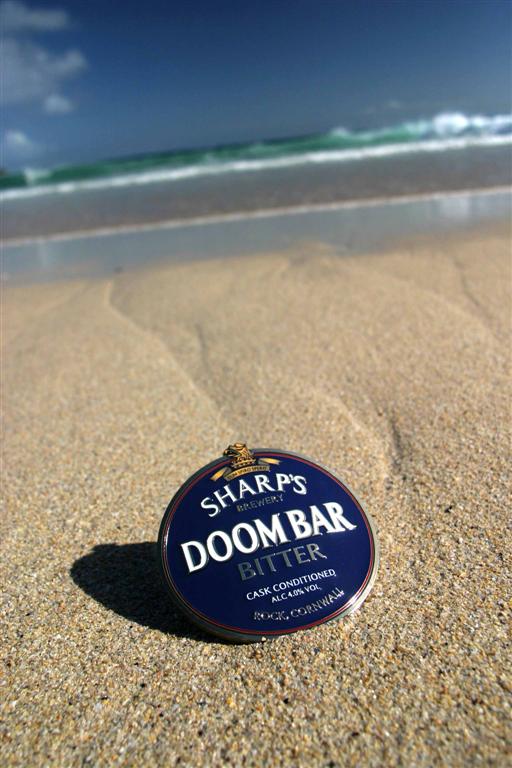
Molson Coors buys Sharps!

Transfer window madness: Burton-on-Trent buys Cornwall

Yes, it’s the same story that will be appearing on about eight or nine UK beer blogs at this very moment:

Burton-based Molson Coors, brewers of Carling and Grolsch, have just announced the purchase of Cornwall’s Sharp’s Brewery, home of the fast-rising Doom Bar and a range of wonderfully eclectic, sometimes even visionary, but difficult to get hold of beers from top brewer Stuart Howe.

There’s not too much info on the value of the deal, what it means for breweries and brands etc.  The press release quote from Molson Coors CEO Mark Hunter is:

The Doom Bar brand is modern and progressive.  It has a loyal following and excellent reputation amongst consumers and customers alike and has the potential to become a truly extraordinary brand. We have a wealth of experience with this type of venture and an excellent track record of building brands across all markets. We respect and want to preserve the unique culture of Sharp’s Brewery and the special appeal of their brands to beer drinkers.”

Stuart Howe adds:

“We are delighted to be joining the Molson Coors team, all of whom are passionate about Sharp’s Brewery and committed to the Doom Bar brand. We are incredibly proud to be voted the best regional cask beer by our customers, with the support of Molson Coors we’re looking forward to being recognised as the best cask beer in the country.”

So what does it all mean? Why has it happened? Here are some initial, ill-informed thoughts and speculations.

Firstly, before we get into the detailed ramifications, this represents a major change in direction for the UK cask ale market.  In four years of writing the Cask Report, we’ve been saying that the big national brewers have abandoned cask ale and left it to the regionals and micros.  Molson Coors have been talking a good cask ale game for a while now without doing much to deliver against it until recently.  This marks the creation, or reinvention, of a national brewer with a big commitment to cask ale.

Of course there are good and bad sides to that.  Many will ask why MC can’t just leave cask ale to people who care about it.

But this is actually a great fit.  To beer aficionados, Doom Bar is an acceptable but very ordinary beer.  And yet it is massively popular with mainstream drinkers.  It looks contemporary on the bar and recruits new people to the ale market.  It’s taken on by many pubs who are looking to trial cask for the first time.  Anyone who met the previous owners will have got the impression that they were aggressively building the brand, attempting to turn it into a national cask ale brand as quickly as possible.  It’s only been going since 1994 and the original recipe was from a kit, so it’s not as if there is any heritage here that’s about to be trashed by a big corporate.  There’s no better brand for MC to acquire – mainstream, modern, little specialness to lose.  With glorious hindsight, this is just the logical next step for Doom Bar’s evolution.

So how does it fit with the Worthington brand, also given a reboot by Molson Coors with the building of the new William Worthington Brewery (which I wrote about in this week’s Publican magazine)?  Doom Bar is at the moment stronger in the south, while Worthington’s is bigger in the Midlands.  Mark Hunter told me that draught White Shield and the long-awaited Red Shield will be focusing on a radius around Burton.  My prediction is that MC will aggressively build Doom Bar as a national cask ale brand.  My hope is that they’ll then nurture White Shield/Red Shield as something a bit more special.  If that’s what happens to Doom Bar it’ll be good for cask ale overall, making the gateway to the category that bit bigger for the kind of drinker who doesn’t have the confidence to seek out flavourful beers without the reassurance of big brands. (Yes, I know I just described Doom Bar as a flavourful beer, spare me the wisecracks – I’m talking relatively).

And what of Stuart Howe and the rest of what he does at Sharp’s?

Those of us who have met Stuart know he finds brewing Doom Bar a bit of a chore – it’s growing massively, it’s a routine to brew – and he has a huge imagination. The line from MC is that Stuart “Stays doing what he’s doing but supported by more investment in the brewery and greater distribution capability.” I’d like to think this means he’ll be staying on in the new company, and will be given freedom to experiment, getting some of his Belgian-influenced ales out into the market properly. My mouth also waters at the prospect of collaborations between him and Worthington brewery legend Steve Wellington.

But whether or not this will actually this will happen within the well-meaning but slower, more corporate, conservative set-up of Molson Coors, I’m more doubtful about.  Stuart won’t hang around if he’s just brewing Doom Bar on a bigger kit, and if he does eventually jump ship, you can bet your life it will be to start something new with a greater focus on innovative beers.  So the craft beer drinker still wins out.

I’d say the only people who could/should be pissed off or alarmed by this are the regional brewers like Greene King, Marston’s and Wells & Young’s, who now face a serious new contender.  It’s going to be interesting to see how they react.

Meanwhile, Howe’s blog is going to make even more compelling reading than normal!

| Uncategorised

Don Younger – a beer world legend

Don Younger RIP

Last night the brewing world lost one of its best, someone who summed up everything – every last little wave and particle – that is good about the world of beer and pubs.  And that’s no hyperbole – anyone who ever shared a drink with Don Younger could tell you what those qualities are, and how Don encapsulated them.
I was introduced to Don when I was in his hometown, Portland Oregon, while researching my second book, Three Sheets to the Wind.  If I tell you that I have read out the bit about our encounter at every single event at which I was promoting the book, that might give you the first inkling as to what a great man he was.  It was one of the highlights of the book – one of the funniest passages, but also one of the most revelatory about the nature of beer.
I was in Portland because it’s the heart of North American craft beer.  You might now say that’s San Diego, or wherever has produced this month’s latest extreme whisky aged Imperial stout, but Portland still has more craft breweries per capita than anywhere else (I think), and its brewers and drinkers perfectly capture the cooperation, camaraderie and conviviality that make beer great – uniquely great.
And Don was its Godfather, its benign inspiration, in his passion, his kindness, and more than anything else, his legendary drinking prowess.
The story I was told is that he bought the Horse Brass Pub after a night on the piss.  He woke up the next morning clutching a piece of paper bearing his signature, confirming that he was the new owner of the pub. He’d never wanted to run a pub, and had no memory of signing the paper.  He could of course have blamed the booze and negotiated his way out of it.  But he always lived by a strict code: if you make a decision or promise while drunk, you either follow through with it when sober, or you give up drinking.  And Don never gave up drinking.
Under his leadership, the Horse Brass became the hub of the emerging craft beer scene, attracting beer loving locals, many of whom went on to start celebrated breweries.  No one in that brewing scene speaks of him with anything other than love.
Don was 68 or 69, and had a fall last week in which he injured his shoulder.  According to reports, this led to multiple complications, and he died around midnight last night, West Coast time.
I’ll leave it there.  I only met Don the one time and I’ll leave the proper obituaries to the people who were lucky enough to know him well.
But on the basis of one meeting, he was one of my favourite people in the beer world.  Even if you didn’t know who he was till now, take a while to read about him, and raise a glass of your favourite US craft beer to him tonight.  After all, there’s a good chance it may not have existed without his influence.

| Uncategorised

January Video Blog – It’s Festival Time!

Went to the National Winter Ales Festival in Manchester last week, and had a rather marvellous time.

The result is a video with me and Peter Amor – he gets to talk to people and I get to drink a lot of beer.  I almost manage to hold it together to the end…

| Uncategorised

Britain’s beer tax problem

Don’t have time to really write much about this today but I received an interesting press release from the British Beer and Pub Association (BBPA) this morning.

As the budget approaches, the beer industry is bracing itself for yet another duty increase.  Duty on beer increased by 26% between 2009 and 2010, and is due to carry on increasing.  The Tories have committed themselves to sticking with Alastair Darling’s policy of increasing duty on beer by 2% more than the rate of inflation.  Which means that this year, just a couple of months after a 2.5% VAT increase, we look set for an increase of 5.7%.

Beer volumes are already in steep decline.  The plight of pubs is exacerbated because supermarkets continue to absorb the increases and keep prices low – because they can afford to lose money on beer to get people into the store – while pubs can’t afford to.

Analysts PriceWaterhouse Coopers have predicted that this relentless duty increases will actually result in the government receiving lower tax revenue overall, as the benefit for a higher tax per pint is more than outweighed by the resultant fall in demand the price rise creates.

And yet, incredibly, there are some ill-advised, hostile or just plain ignorant people out there who believe that, in the face of a watered down announcement about minimum pricing, tax on beer is too low.

If you hear anyone spouting such garbage, feel free to share with them a few stats the BBPA pulled together:

UK taxes (duty plus VAT) on beer already massively outstrip rates in any of our neighbouring countries. UK tax rates are EIGHT times higher than in France, TEN times higher than in Spain and ELEVEN times higher than in Germany.
The BBPA analysis also reveals the astonishing figure that Britain’s beer drinkers are paying FORTY per cent of the entire beer duty bill in the European Union – despite Britain’s small, 12 per cent share of the total population.  UK beer drinkers are paying £3.1 billion out of an EU total of £7.7 billion in beer duty revenues.
In addition, some countries, such as Italy, Portugal, and Spain, have lower tax rates of tax for pubs, bars and restaurants – to help their hospitality industries and the hundreds of thousands of jobs that depend on them.
BBPA Chief Executive Brigid Simmonds, comments:
“When it comes to alcohol taxation, we need a debate based on facts, not myths. Our alcohol taxes are among the highest in the developed world, and for beer we have had huge, 26 per cent duty increases in the past two years. What we really need is a freeze in beer duty in the Budget.
“Our already high taxes show that duty-plus-VAT cannot be used as a proxy for a minimum price for alcohol. This would have a particularly devastating effect on pubs. When it comes to tacking alcohol misuse, what we need most is improved alcohol education and awareness, and tougher, targeted enforcement of the huge range of existing laws. Pubs need lower taxes – and less red tape.”