I based this on everything from stats (37% of adults are aware of craft beer; 40% of pubs would like to stock a craft beer, the word ‘craft’, when applied to beer, stands for quality, flavour, and a beer that’s worth paying more for) to personal experience (every major global brewer, or one of their agencies, has approached me to have a chat about craft beer and whether they should be doing something about it) to anecdotal (more of my non-beer friends know their hops and ask to be guided to some interesting craft beers).
Most entertainingly, Hollywood has made a craft beer RomCom, out in the UK any day now, which from the trailer doesn’t look entirely shit, and seems to capture an appropriately indie aesthetic for craft beer.
In my speech I used the analogy – as I always do – of music. This particularly instance was inspired by a conversation I had with
Richard King, author of the definitive history of indie music, in which he told me that you could look at blogs discussing the definition and direction of craft beer, substitute the phrase ‘craft beer’ for ‘indie music’, and ten years ago EXACTLY THE SAME blogs were being written, the same arguments, the same factions.
Of course since then indie music has all but died. The process that began with Oasis breaking through, becoming chart-toppers, tabloid front page regulars, and playing to a third of a million people at Knebworth, ended with the majors cashing in, and indie becoming a debased, meaningless term, divorced from its roots, and applied to any band that had a noticeable amount of hops – sorry, guitars – in it.
So will the same thing inevitably happen to craft beer?
Well, some people think so. I personally think it’s not about the size of the brewery, or its ownership, but the
intent of the people who will inevitably jump the bandwagon. Do they want to help craft beer grow while retaining its integrity, to provide a business that has long term profitability and sustainability? Or do they want to cash in and make a quick buck from this trend while keeping an eye out for the next one that will come after it?
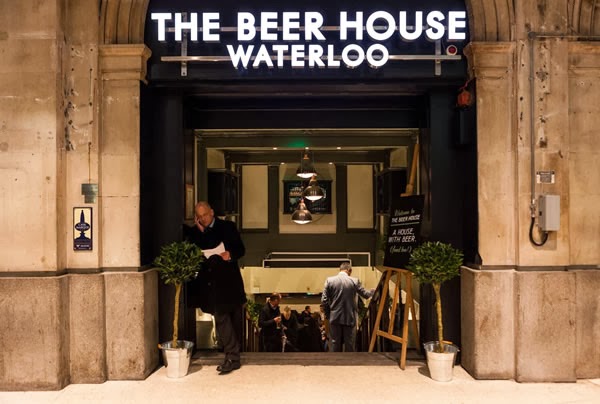
A clear example of the latter is there for anyone travelling through Paddington or Waterloo stations.
Last year, The Beer House launched in both locations, and there are surely more to follow. The Beer House is owned by SSP, the same company that owns all the other retail franchises on UK train station platforms. If you have ever visited an Upper Crust or a Pumpkin, I’m guessing that sentence has caused chilled dread to start creeping down your spine.
The launch press release says, “This brand was developed to capitalise on the growing trend in the market of consumers looking for something interesting and different as the craft beer movement continues to gain momentum.”
You can just feel the passion for beer bursting from the page can’t you?
The Beer House
does not have a website. There’s a Twitter account that posts scheduled broadcasts of the kind of ‘Hey, what’s everyone doing for the weekend?’ type tweets you get from big corporates and rarely, if ever, talks about beer. It doesn’t do tap takeovers or meet the brewer events. It boasts of ‘over fifty’ craft beers, and then releases a publicity shot with two of the world’s biggest mainstream lager brands in the foreground:
Anyone can ask James Clay to supply them a bunch of interesting beers and stick the word ‘craft’ everywhere on chalk boards. And someone just did.
Hopefully such places will die out when it becomes apparent to them that they cannot attract people who actually care about beer, or flavour, or integrity, and they realise they’re selling more Heineken than anything else, and they close or rebrand. Hopefully.
So should the major labels of brewing be allowed anywhere near craft beer at all? Are they destined to be rubbish, by definition, if they do?
I’ve been hugely impressed over the last year or two with craft beer offerings from brewers such as
Thwaites and
Brain’s. Many of their beers are as good as any from a typical micro – in some cases better, as these are breweries with technical expertise, laboratory facilities and so on. They may not push the boundaries as much as a Brew Dog or a Wild Beer Co, but craft beer doesn’t always have to push the boundaries. (Indie label Creation Records may have broken new ground with the likes of the Jesus and Mary Chain and My Bloody Valentine, but their biggest ever band simply copied the Beatles, and were no less exciting for that – at least at first.)
If a large UK regional brewery is making good, interesting, flavourful beer, then any debate as to whether it is ‘craft’ or not is political rather than being about the beer itself. So what are we to make of Greene King’s foray into craft?
Last week I went to the opening of the brand-new £750,000 St Edmunds Brewery. “Greene King’s long tradition of crafting quality ales enters an exciting new phase as the company throws the doors open on its new innovation brewhouse,” says the press release. They are careful not to call themselves a craft brewer, but have unashamedly launched a new range of what they call craft beers.
From an objective point of view, there was good and bad on display. But it definitely felt as though the intent was genuine.
Among the bad is Noble Craft Lager. While it is brewed with Tettnang hops (a lager hop) and lager malt, it is fermented with Greene King’s usual ale yeast and is not lagered (stored for maturation) for any significant period, so according to either of the two separate but often interrelated definitions of lager, it’s not a lager at all, but a pale ale that’s a bit sweetish for my palate. I’m sure that sweetness (and the masquerade as a lager) will mean it does very well. But it’s cheeky to call it a lager – and taking the piss to call it a craft lager.
I’m also a bit dubious about repackaging established Greene King beers as part of this new craft range. Strong Suffolk Ale is one of my favourite Greene King beers, and if it were a new brew I wouldn’t have thought it unusual that it’s here. St Edmunds Golden Ale, launched a few years ago, belongs in the mainstream GK range by any defintion. Simply rebadging these sends out the wrong message, making the whole thing feel a bit too marketing-led (and one of the defining characteristics of craft beer is that it is led by brewers, not marketers, even though the latter have an important role to play).
On positive side, it was a joy to be introduced to beers such as the new Suffolk Porter, Twisted Thistle IPA and St Edmunds Anniversary Ale. Yardbird is a solid pale ale in the style of Camden or Meantime Pale. And while I wasn’t quite convinced by the new Hop Monster IPA – yes, people, Greene King now makes a ‘proper’ IPA! – many of my press colleagues really enjoyed it. I’d be perfectly happy to drink any of these beers, and to refer to them as craft beers while doing so.
After the tasting, we did get the obligatory marketing spiel – “The Greene King of the last few years is going to look very different in the future” – and surprisingly, for me this was just about the most valuable part of the day. Because I think Greene King are helping us get to a place where craft beer UK can mature properly.
I love microbrewers because they act on instinct and intuition. I like larger regional brewers because they can afford to do market research, and when it’s done well, and reveals new insights that can be shared, it’s incredibly valuable.
When Greene King went out to talk to craft beer drinkers they found two groups: a more mainstream group of ‘beer explorers’, who have their favourite beers but like to try new ones, and a generally younger, more specialist group who buy into the core craft aesthetic. As the number of craft brewers grows, and the number of craft beer bars grows, the number of people who drink craft beer is growing. That’s why nearly half of all pub landlords want to stock at least one craft beer. And as it grows, what the broad market thinks of as ‘craft’ is taking a new shape:
This chart (presented, refreshingly, without PowerPoint) is hugely important, as I think it unlocks the headache many British craft beer enthusiasts have been suffering from.
What confuses us about craft beer in the UK is familiarity.
We take our lead on craft beer from America, believing that US craft beer styles, and the flavours they represent, are the ones that matter. We frame any attempt to define craft beer in relation to the American definition. But we, and the Germans and Belgians, have something the American craft movement doesn’t – an unbroken history of interesting, flavourful, small-scale brewing. You could argue – because it’s true – that we have always had craft brewing, long before the Americans coined the phrase in its current context.
There was no discernible craft beer in America before the current microbrewery boom began. Craft in America reacted against the total lack of interesting beer. Every craft brewer in America is a relatively recent arrival. So if we take our cues from America, craft beer is all about novelty. But this is circumstantial rather than intrinsic – the word ‘novelty’ does not appear in the US definition of craft beer.
But the word ‘traditional’ does.
We have craft brewers that are hundreds of years old. There is no novelty there, and if we think novelty is important, then these brewers don’t feel to us like craft brewers. What GK’s market research shows (and I have seen other pieces of research that arrive at exactly the same point, albeit with slightly different labelling) is that the broader mass of people now getting into craft believe there are two types of craft beer – traditional, which includes pretty much any real ale, and speciality – which could be Belgian speciality, German wheat beer, America IPA or the next thing Evin O’ Riordain dreams up.
And that broad mass of people is right. If a brewer in Portland, Oregon were to set up shop tomorrow brewing exactly the same beers Greene King have been brewing for years, and grew to be exactly the same size as Greene King is now, no one would have any hesitation in calling them a craft brewer. You might think some of those beers are bland, but I’ve tasted bland from young micros too. Worse, I’ve tasted beers that are challenging for the sake of being challenging, and beers that exhibit a lack of brewing skill, but apparently these are still craft beers.
You might think Greene King are too big to be a craft brewer. Sure, the facsimile in Portland, Oregon would be a tiny drop in the US market, but you know what? GK’s share of the UK market too, big as they might seem close up, is relatively tiny. If you’re trying to be objective about craft beer, as opposed to trying to find a definition that includes the beers you like and excludes the beers you don’t, then Greene King – and Marston’s, and Fuller’s, and Wells and Youngs – are craft brewers. But they are traditional (or familiar) craft rather than speciality (or novel, or experimental) craft. And that might be a helpful distinction to make.
When the Publican’s Morning Advertiser tweeted the story about me saying craft has gone mainstream, two responses on Twitter struck me. One said that because the likes of Brooklyn Lager and Goose Island IPA were now relatively easy to find in pubs belonging to the big PubCos, they could no longer possibly be considered craft. The other effectively said that craft couldn’t be considered mainstream because the big PubCos don’t allow their licensees to sell craft beer brands. At least one of these statements has to be wrong.
There’s still confusion and disagreement about what is and isn’t craft, and there always will be. There will always be good and bad craft beer made by microbrewers, and increasingly there will be good and bland craft beer made by regional brewers. But I don’t think the regionals are going to destroy craft beer by their intervention. They will help it grow and mature, which it needs to do, otherwise it will become a fad and recede.
Rooney Anand is not Simon Cowell. Importantly, unlike crafty brands such as Shocktop in the US, Greene King, Brain’s and Thwaite’s make no secret that they are the bigger, more familiar brands behind these new craft ranges. If you want to keep it real and avoid beer from any brewer over a certain size, that’s your call, and the brewer makes it easy for you to do so. But occasionally, you’ll be missing something special.
So long as bigger brewers remember that craft is about brewing before marketing, about flavour before packaging, about integrity and honesty before segmentation and exploitation, there is no reason I can see why they can’t make ‘craft’ beer. In and of itself, this does not represent a dilution of the meaning of the term. They may occasionally need to be reminded of the this (as I have done here in the case of Noble Pale Ale) but on balance I believe the entry of brewers like Greene King to the craft sphere is a good thing.
I hope I’m not proved wrong.