Tag: craft beer

| Barley, Craft Beer, Hops, Miracle Brew, Water, Yeast

Miracle Brew – and me – to hit North America!

My new beer book is published in the United States and Canada this week. And I’m going to be doing a short tour to promote it. 

My latest book, Miracle Brew, is a globetrotting adventure into the nature of beer. It’s a tale that grew in the telling, with some parts going back as far as ten years, coalescing into the idea for a book about the ingredients of beer back in late 2014.

Why a book about the ingredients of beer? Well, it’s a timely thing: recent research in the UK by the There’s A Beer For That campaign shows that only 22% of people know what beer is made of, which is odd given that it’s the third most popular drink on the planet.

So in response: Miracle Brew presents a complete natural history of beer and emphasizes the importance of place—or terroir—that each ingredient brings to the finished glass. I travelled from the vast hop gardens of the Yakima Valley in Washington State to Bamberg in the heart of Bavaria, where malt smoked over an open flame creates beer that tastes like liquid bacon. The book explores explores traditional malting techniques, the evolution of modern hop breeding, water chemistry, and the miraculous catalyst that is fermentation to show how craft beer brewing has become a part of the local food movement and is redefining how the world perceives beer.

There’s more information about the book, and reviews, here.

So I have a short but very busy promotional schedule as follows. If you’re in town, have any beer or cider tips for me, or want to interview me or chat about the book, just let me know!

Saturday 14th October to Tuesday 17th October – New York

I’ll be doing some interviews and podcasts, and on Monday 16th taking part in an event for the Legion of Osiris.

Wednesday 18th October – Somerville, Massachusetts

An evening event with Aeronaut Brewing.

Thursday 19th October – TBC

Friday 20th October -Brattleboro, Vermont

An evening event with Hermit Thrush Brewing.

Saturday 21st to Sunday 22nd October – Toronto

On the Saturday afternoon I’m delighted to be doing a book signing alongside friend and fellow author Stephen Beaumont at the magnificent Cask Days festival. Then on Sunday evening I’m doing an event with Henderson Brewing.

Monday 23rd to Tuesday 24th October – Boston

On the evening of Monday 23rd I’m doing an event with Harpoon Brewing, then kicking around Boston for the day before flying home on Tuesday night!

Madly excited about my first ever North American book tour. I’ll be adding more dates back home in the UK on my return.

| Uncategorised

I just realised how the debate about craft beer is changing

Last week, my latest column for the Publican’s Morning Advertiser focused on the response to craft beer by the giant, global brewing corporations that dominate the beer market. It was inspired by a new project at Guinness which has produced some beers I consider to be very good indeed. I suggested that maybe we’re getting to the end of the usefulness of the term ‘craft beer’, because it disguises the fact that breweries of any size can and now sometimes do make really good beer. 
The response to the piece was mixed, from sentiments along the lines of ‘Damn right, it’s all about good beer, whoever brews it,’ to ‘No! Big brewers are shit by definition and we will always need craft brewers to stand against them.’
The more I thought about these differing views, the more I realised they were arguing about different things. 
The narrative of craft beer is a familiar one: global brewers make boring bland beer because they are trying not to offend anyone, they always want to cut costs, and they sell style over substance. Craft brewers saved us from mediocrity by brewing more interesting, flavourful beers, operating a more nimble business model, driven by passion and flavour rather than shareholders, marketers and accountants. Medium-sized brewers – such as regional and family-owned real ale brewers in the UK, or brewers who were craft but have grown huge, sit somewhere in the middle and generate most of the argument about what is and isn’t craft.
It can be expressed as a linear continuum along which you can plot your favourite and least favourite brewers and beers:
I think this is how most of us see the issue. But it’s rather too simplistic. If it ever was right, things have moved in beyond it.
We’re kidding ourselves if we think every beer created by a craft brewer is good – there are some awful beers out there from passionate beer advocates who simply aren’t very good brewers, or who might be walking the craft beer walk but are in reality just as cynical as the big brewers, but operating on a small scale hoping to get rich quick from the latest craze. And on the other hand, there are big brewers who have bought smaller brands and haven’t (yet) screwed them up. And there are the occasional beers – such as the best ones I tasted at Guinness, and Carlsberg’s Jacobsen range – that are simply very good beers made by brewers employed by a global corporation, that in a blind tasting would be considered good craft beers. 
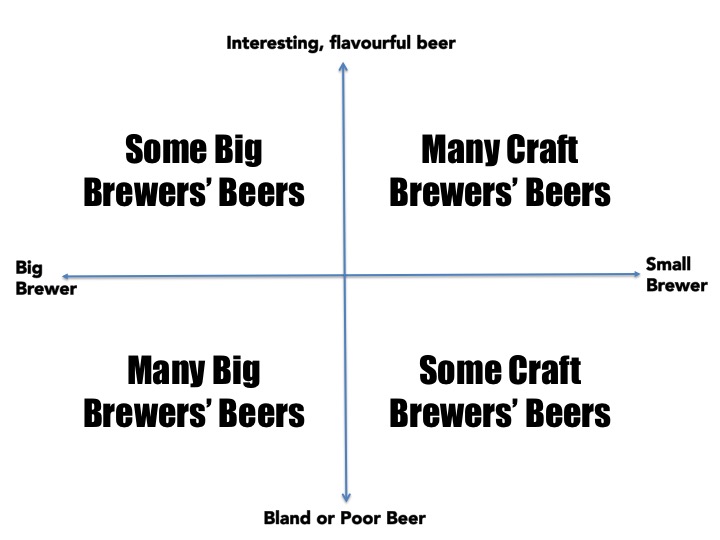
So it would be more accurate to look at the market on two axes rather than one continuum, like this:

Now, if you were to plot every beer brand in the world on this chart, the vast majority of global brewers’ brands would still be in the bottom left quadrant, and the majority of craft beers would probably sit top right. But there would be notable exceptions, so I think the reality of the beer world today probably look like this:

When you look at the market in this way, your emotional response to it will tell you what you really care about in beer, and different people care about different things at different times. That’s why we sometimes talk at cross-purposes in debates about craft versus big.
Given a free choice, I’d prefer to drink in the top right quadrant. I prefer to drink good quality beer brewed by a small, passionate company. I’m sure most of you would agree. But if these beers weren’t available to you, would you rather have a very good beer brewed by a big, nasty corporation, or an inferior beer brewed by a really great guy under a railway arch just down the street?
If the quality of the beer is the most important thing, you’ll happily drink a great beer from Carlsberg or Guinness. But if that thought makes you angry, then you aren’t actually thinking about the beer at all. You’re thinking about the craft beer movement, and your decision is driven by your beliefs, politics and morality rather than your taste buds.
I’m not knocking either approach. What I am saying is that if we confuse arguments about beer quality and flavour with arguments about an unfair balance of power, the importance of supporting small local businesses and the excitement of feeling like part of a movement, we end up sounding stupid. Anyone who genuinely believes big brewers are incapable of making and releasing good beers simply doesn’t know anything about brewing. And anyone who thinks any small-scale craft beer is automatically good because of where it comes from has their head in the sand. 
This made me think about where I stand as someone who makes a living writing about beer. If I discover a great beer made by a big brewer and I refuse to write about it, or I say it’s shit when it isn’t, I’m not doing my job properly. I can choose what I want to focus on in the most detail, but I do have a duty to report interesting stuff that I find out in the course of doing my job. If I was thinking purely as a fan of beer, I might have a different view. 
The craft debate will rumble on. Beer gets under our skin precisely because it is many things – that’s why I started writing about it in the first place. In most cases, it’s not just about the quality of the beer – it’s about expressing who we are, making choices that say something about us. It is politics and fashion and identity as well as flavour. In reality, it’s these aspects that are driving most of the current debates about the future of craft beer.
It’s your choice what you drink. If you choose to boycott any beer made by a large corporation, no matter how good it is, I’d have some respect for that point of view. Just don’t tell me you’re doing it because the beer is shit.

| Uncategorised

What’s the difference between craft beer snobs and Kopparberg drinkers?

Are we really chasing authenticity, flavour and story? Or just endless novelty?

If you follow North American beer writers on social media (and if not, you should) you might have seen this piece from yesterday, in which formidable beer writer Andy Crouch writes a perfectly balanced profile of Jim Koch, founder of Boston Beer Co, and craft beer’s first billionaire.

Jim, it seems, is pissed off. His brewery has become so big, the hip craft beer joints that arguably wouldn’t be here without his vision will no longer stock his beers. His brand is no longer new, and the beers themselves, according to detractors, are mediocre and middle of the road. And he doesn’t think that’s fair.

While the claim that Boston Beer Co ‘invented’ craft beer can be challenged (the likes of Anchor and Sierra Nevada would have ultimately fathered the current craft beer scene even if Boston hadn’t been there) it is undeniable that BBCo has shaped it more than any other. Jim Koch was a graduate of business school and brand consultancy, and he used the big corporate brewers’ own tactics against them to create a challenger brand that ultimately took craft beer mainstream.

Amid all this brandspeak, what about the beer? Is it really mediocre? Well, not in the eyes of the judges of every single beer competition I’ve ever seen it judged in. It’s always winning prizes.

BBCo’s sin is to brew a wide variety of traditional styles very well, from Bavarian-style lagers to English-style bitters, from wheat beer to Kolsch, from seasonal specialities such as pumpkin ale and Christmas ale to mainstream-style beers that balance flavour and accessibility. Andy’s article says that, reluctantly, Jim has now been forced to brew West Coast-style hop bomb IPAs just like every other craft brewer.

And Jim Koch is not alone. Another piece that went online yesterday features the brewers of Widmer and Deschutes – two more American craft beer pioneers – defending themselves from attacks from the craft beer community. Their crime? Being so good at what they do, they’ve grown substantially to become big businesses.

This all strikes a chord on this side of the Atlantic.

Curiosity about flavour is one of the defining characteristics of people who like interesting beer. It’s always great to find something new. But with so much new stuff around, we can forget the old.

It happened for me with Belgian beer. Ten years ago Trappist ales were the centre of my world. And then I discovered North American IPAs, and then their British counterparts. When I found a dusty bottle of Chimay Blue in my cellar a few years ago, I realised I hadn’t had a Belgian beer in years, and tasting it rekindled an old love affair. Now, Saison Dupont, Westmalle Dubbel, Duvel, Orval, Rochefort and St Bernardus are back at my beery core, despite having no new news, no rock star brewers and little distribution in craft beer bars.

Forgetting old favourites in the rush of the new is one thing. But actively deciding that beers or brewers are boring, bland, middle of the road or sell-outs simply because they have been around for a while, or have grown much bigger than they were, is foolish, snobbish and blinkered.

This is why it pisses me off when craft beer neophytes slag off ‘boring brown beer’ and include all classic best bitter in that description. Sure, some traditional beers are boring and bland, just as some single hop IPAs are monotone and grating after the first pint. But there are wonderful examples of both.

Sure, some breweries do compromise on quality, ingredients and brewing time when they grow and the accountants take control. Others stick steadfastly to their principles. And as Gary Fish of Deschutes says in the second piece linked to above, commercial success can improve quality. Though it pains me to say it, Goose Island IPA is actually a better quality beer since it has been brewed with cutting-edge A-B Inbev technology than it was on knackered old microbrewery plant that couldn’t keep up with volume. Budweiser Budvar remains one of the best quality lagers in the world, thanks in no small part to its 90-day lagering. Timothy Taylor Landlord is one of the finest ales on the planet when kept well. All are dismissed by craft beer purists whose definition of the word ‘craft’ has more to do with scale and novelty than with any measure of skill or quality.

Which brings me to Rekorderlig.

I’m sure most fans of the latest craft breweries would run a mile from any suggestion of similarity to drinkers of a glorified alcopop constructed from industrial alcohol spirit, sugar and artificial flavourings. But the success of the faux-cider alcopops is based entirely on novelty: it’s all about which flavour variant is coming next. As soon as they run out of different combinations of fruit syrups, they’ll run out of road.

Let’s not allow the current momentum in beer go the same way. Because at the moment, it looks awfully similar. One brewer creates a single hop citra IPA, and everyone else does. Then that gets boring and it’s all about ‘saisons’ brewed with the contents of the brewer’s spice cupboard, some of which are about as authentically saison as Rekorderlig is cider. Then it’s endless different takes on Berliner-Weisse. And so on. And woe betide anyone who doesn’t follow the path, who instead simply carries on making great beer that was fashionable five years ago, and sells it in greater quantities now than they did then.

Last year, I was deeply impressed by relatively new kids on the block such as Wiper & True, Siren, Tiny Rebel and Orbit. I was also pleased to see the likes of Camden, Beavertown and Waen reach new levels of scale and skill. But I also wondered why Otley, Redemption and Windsor & Eton didn’t seem to be getting the chatter and buzz they once did.

Thornbridge celebrates its tenth anniversary this year. My adoration for what some argue is the ‘original craft brewery’ is no secret. But I’m starting to hear rumblings about them that would sound depressingly familiar to Boston Beer Co, Deschutes, Sierra Nevada and others: they’re too big. They’re blander than they used to be. They’re selling out and going mainstream.

Bollocks.

Craft beer, whatever you want to call it, has gone mainstream. Now, it’s growing up and maturing, and it already has several generations of brewers. Without the pioneers, the rest wouldn’t be here today. And while today’s newbies push the envelope ever further – which is what they should be doing – the bigger, older breweries are getting better at what they do, building bigger names, and providing a bridge between the mainstream and the cutting edge.

If you simply reject their achievements and their vital contemporary role in favour of what’s new this week, whatever that is, you’re not interested in authenticity and story at all. You’re just following the latest fad among your peer group. And that makes you no more discerning, no cooler, no edgier, than the guy pouring his strawberry and lime flavoured ‘cider’ over ice.

| Uncategorised

Why J D Wetherspoon’s is fast becoming my favourite craft beer bar

In eight years of blogging and writing articles and columns about beer, I think everything I’ve written about JD Wetherspoon splits pretty evenly between “This is amazing” and “This is absolutely appalling.”

Wetherspoons is a mixed bag. Remarkably, nothing about it is simply OK – that mixed bag contains both the best and worst of British pubs. But recently, the balance for me is shifting. I’m becoming a ‘Spoons denizen.

Now is the time to make your jokes about being pissed by 10am and shouting randomly at strangers. Done that? Good, let’s carry on.

It started in the summer, when ‘Spoons started selling cans of craft beer imported from the US at the ridiculous price of £1.99 each.

Sixpoint is a good brewery, and Bengali Tiger in particular hit the spot over a long, hot summer. But ‘Spoons remained a distress purchase, a bedraggled, sad pub chain without soul that just happened to sell a few good beers.
But the chink in my anti-‘Spoons armour had been opened. ‘Spoons was now a place I would consider going. And the more I’ve been, the more I’ve liked it. 
There was a day back in October when I needed to get out of the house with a manuscript and a red pen to try to sort out a sample chunk of a new book I’m writing. I like doing this kind of work in pubs – it focuses me and, perhaps counter-intuitively, gets rid of distractions. I went to a local craft beer pub – the kind of place I still remain overjoyed about, in theory, counting myself lucky that I live within walking distance of several such places. 
I ordered a pint of cask beer and it wasn’t good. I hate these situations. It wasn’t that the beer was off; it wasn’t displaying any recognisable faults, it just hadn’t been kept with love and care and simply wasn’t pleasant. So I thought that for my next pint, I’d move on to keg. BrewDog Dead Pony Club – perfect at 3.8%, an increasingly mainstream beer that wasn’t strong enough to make me lose focus on my work – £5.20 a pint. They also had Beavertown Gamma Ray IPA, one of my beers of the year, brewed just a couple of miles from where I was standing – £6.50 a pint. And I just thought, that’s too much for those beers. I don’t like the quality of the cask, and I’m not prepared to pay that for a keg beer, and so I left.
Stuck for where to go next, I ended up in my local Wetherspoon’s, the Rochester Castle on Stoke Newington High Street. And there, I found Devil’s Backbone – an American IPA from a celebrated brewer – brewed under license in the UK, admittedly – for less than three quid a pint.

And so I asked myself, why should I pay £6.50 a pint for something I can get yards away for less than £3?

The arguments in answer to this came pretty quickly. But I found myself knocking each one of them back.

Yes, but it’s a one off, this isn’t a ‘proper’ craft beer bar.
Oh no? I’ll admit the range will always consist of what is becoming known as ‘mainstream craft’, but those are the kinds of beers I prefer to drink anyway. As well as Devil’s Backbone, there’s a range of bottled craft beers including BrewDog, Goose Island and Lagunitas. They’ll keep me happy for a session, at half the price of the nearby craft beer bar.

But Wetherspoons outlets are so soulless. There’s no atmosphere there.
Yes, Wetherspoons are often big, echoey hangars, and the lack of music gives the air an odd hue. But most craft beer bars are sparse and spartan and echoey too, and the music they play is often shit, chosen by the staff to show how hip they are rather than to create the appropriate atmosphere for the space. Some of the buildings Wetherspoons have taken over and preserved are beautiful, and there’s always a nod to its history in the decorations on the walls.

Wetherspoons aren’t ‘proper’ pubs. They’re managed outlets just like a McDonald’s.
So are most craft beer pubs I know, whether they’re part of a small branded chain or not.

The staff don’t know what they’re doing. They’re disinterested.
I beg to differ. Wetherspoons staff may be trained to be just like their counterparts in chain restaurants, but in the Roch at least, I find the service to be polite and professional, with none of the sneering attitude I sometimes (to be fair, rarely) encounter in hip bars. I’m used to having to argue with the bar staff if I have to take a pint of beer back because it’s off. In Spoons, I’ve had the best service I’ve ever encountered in this situation.

The quality of the beer is shit/they buy short-dated stock.
Wrong. Most Spoons pubs have Cask Marque. Their cellar standards are excellent. And I have it on very good authority that the short-dated thing is an urban myth.

Fine, but look at the kinds of people you have to drink with. They’re awful!
My local Spoons has some dodgy characters, it’s true. Especially the guys who sit by the window. They’re casualties of life, the people who do turn up and start drinking at breakfast time, the people who have been forced out of the pubs they used to drink in by gentrification and £6.50 a pint. Some of them are shouty. Some of them smell a little ripe. There’s no getting away from that. But inside, my local Spoons is a true community pub. It’s where all the local posties gather when they’ve finished their shifts. There are always big tables of council workers and teachers, and a smattering of students. And no hipsters. None. I’m not having a go at hipsters, but I live in a multicultural, multifaceted community, and Spoons is one of the only pubs that reflects that. Some of the negative attitude about ‘Spoons drinkers is snobbery, pure and simple.

Add to this the free wifi, cheap meals (with calorific content of each dish clearly displayed – where else does that?) the bi-annual real ale and cider festivals that include unique collaborations with craft brewers from around the world flying to the UK to brew here, and you have a proposition that would be celebrated by every beer writer and craft beer geek in the country if it wasn’t ‘Spoons doing it.

I’m not going to defend everything about the place, and I’ll accept that standards vary across the estate an I just might have a good one on my manor, but increasingly, in many areas, J D Wetherspoon is setting standards for more ‘serious’ bars to live up to.

I never thought I’d see the day.

*Amended at 10am – I previously said that Devil’s Backbone was imported. It isn’t, and JDW don’t make that clear. Thanks to Boak and Bailey for the clarification. Read their take on the crafting of ‘Spoons here.

| Uncategorised

Extreme Beer Judging

No, not the practice of judging extreme beer, but the sometimes dangerous pastime of being a beer judge, as I discovered on a trip to Tuscany back in September…

If you’re going to spend Sunday morning judging a beer competition, this is where you want to do it.

We’re inside an old villa atop a gentle hill just outside the Tuscan village of Buenconvento. The stone building is cooled by its high ceilings, and huge double doors are flung open onto an avenue of cypress trees leading down to freshly ploughed fields. I’m joining a mix of sommeliers, beer writers, importers and brewers to judge the Belgian-style section of a home brew competition as part of Villaggio della Birra, a beer festival now in its ninth year, which began as a celebration of imported Belgian beers and has now grown into something much bigger. Italy is steadily developing its own, original beer styles, but Belgium still seems to be the dominant influence from outside.

The standard of beers in the competition is incredible. I taste a saison that’s easily the best beer I’ve had since arriving in Italy three days ago. And then it goes one better: a dark Trappist-style beer that would substitute quite happily for Rochefort 10, in my opinion one of the best beers in the world.

But we’re asked to be harsh in our marking. We judge these beers to the same standard as if they were created by professional brewers. Out of a possible fifty marks, anything that scores less than thirty doesn’t get through to the next round. Despite the excellent stand-out beers, most score somewhere in the mid-twenties. We fill out our scores on the kinds of forms used in beer judging competitions around the world, giving marks for appearance, aroma, taste and so on. We are asked to give comments that will be fed back to the brewers, and we write our names at the top of each sheet.

The judging is over by lunchtime, and we head into the bright sunshine with a slight jolt. Belgium is cloudy and rainy as a rule, and one thing its beers do not mix well with is bright, hot sunshine. I take shelter in the barn where the main beer festival is taking place, spending tokens on a mix of Belgian, Italian and American beers. After a morning of strong Belgian beer, it doesn’t take long for the whole event to become woozy and floaty.

Around 4pm the judges are asked to assemble in a corner by the bar as the results of the competition are read out to the public. A combination of my being drunk and not understanding any Italian means it takes a little while before I figure out what’s going on. Then, with mounting discomfort, I recognise a sheet with my handwriting on it. I watch as the chair of the judges reads out an Italian translation of my comments – and then passes the sheet to a man who is obviously the brewer of the beer.

This is not how it was meant to go. It’s not that I don’t stand by my comments, it’s just a bit awkward where we’ve been critical in an unvarnished way, assuming we’ll never meet the people whose babies we’ve just called ugly.

And now here’s a seven foot-tall monster, a Death Metal fan with a gigantic ponytail hanging down his back like thick ship’s hawsers, boots like Judge Dredd and a Nordic storm giant’s beard, striding forward through the crowd to claim his sheet. He reads it and shakes his head, a movement that causes weather fronts to gather over the Tuscan hills. He frowns, and lightning bolts shoot from his eyes. I don’t think he’s happy with the scores he’s been given. I don’t think he agrees with them. I don’t think the person who judged his beer is going to be alive for very much longer. I can’t run – that would look bad. So I crane my neck around to see the piece of paper in his hand… the handwriting is not mine.

I breathe a sigh of relief. My shoulders slump. The last score sheet is handed back, and the ordeal is over.

And then there’s a tap on my shoulder.

“Pete, what is this word, ‘cloying'”?

This is worse than the threat of being dismembered by the giant. This is a young, slight, nervous guy in his early twenties, with big brown eyes that have gone slightly watery. He’s holding a sheet with my name on it, an I’ve pissed on his dreams. I’ve given his beer 24 out of 50, and he wants to know what the word ‘cloying’ means, because that’s how I’ve described his beer.

“It means sweet,” I stammer, “but not in a good way… they asked us to judge to style you see. It was quite sweet for the style, that’s what I meant. I liked it! But it wasn’t quite to style.”

He doesn’t seem satisfied, but there’s nothing else to say. He nods once and walks off. Ashamed of myself, I crawl away for another beer.

Disclosure: I visited Tuscany for a week courtesy of www.to-tuscany.com, who gave me a villa for the week to allow me to explore and learn about the Tuscan craft beer scene. I paid for all other expenses such as flights, care hire etc. I stayed at La Torre at Pretaccione, in the heart of Chianti, and will be writing more about the trip in various places.


| Uncategorised

Cask ale is booming as part of the craft beer revolution – new Cask Report launches today

Every year I’m paid to compile the Cask Report on behalf of Cask Matters – a loose affiliation of brewers and industry bodies including SIBA, CAMRA, Cask Marque and most of the leading regional and family brewers in the UK. The eighth report launches today to coincide with the start of Cask Ale Week.

Success makes people nervous, and with some justification. When you’re struggling on your way up, as a business, or as a person or organisation putting forward a point of view, argument or campaign which you hope will change hearts and minds, you know very clearly what you have to do: get your head down and keep plugging away, working steadily towards your goal.

When you succeed, what then? Is your job done? Do you need to redefine your goals? Is it true to say the only way is down? Now you’ve achieved, is someone going to come along and try to take it all away from you?

Until about two or three years ago, the aims of the Cask Report were very clear: persuade publicans and commentators around the beer industry that cask ale was not in terminal decline, that it had a role to play on the pub bar, that it had something to offer drinkers beyond the traditional stereotypes.

Now, the job has changed. There’s little point banging the drum that cask ale is successful. Whether they accept and believe it or not, people have heard this before. The questions now are, how does cask ale deal with success? And given that all the chatter in beer now focuses on craft beer, does this mean cask ale’s days are numbered? What’s the relationship between cask ale and craft beer?

Here are a few summary points from this year’s report that attempt to answer these questions.

1. Cask ale is still thriving
Cask ale volume sales grew by 1.1% in 2013 and 1.4% so far in 2014. If those sound like small figures, bear in mind that total on-trade beer volumes fell last year – cask ale is doing 4.5% better than beer in pubs overall. And when you bear in mind that cask ale is only really available in pubs, and 31 pubs a week are closing, for it to be growing in a declining market is some feat. More people are drinking cask ale and pubs are stocking a wider range of beers. But big volume drinking is declining. More people are drinking a wider variety of beers, but doing so less often as healthier lifestyles become more common.

There are two different estimates of the number of breweries now in the UK, but the British Beer and Pub Association (BBPA) puts the number at over 1470 – more than at any time since the early 1930s. Three new breweries open every week. And while craft keg is booming – 19% of SIBA’s member breweries claim to be producing some keg beer now – the vast majority of microbrewery beer is cask.

The number of styles being brewed is increasing:

There’s more good beer available now than at any time in living memory.

I’ve also heard a few people say that craft keg is killing off cask ale, that you rarely see cask in good craft beer pubs these days. That’s not reflected in total market figures. The craft keg surge is not enough to stop cask increasing its share of all draught ale versus keg – over the last decade, their relative positions have reversed.

2. Cask ale and craft beer are not the same thing, but neither are they entirely separate – there is a pretty big overlap
It’s increasingly popular in beer geek circles now to say that craft beer is over as a thing – that the only people who use the term are big brewery laggards seeking to cash in on an exploited, used up trend.

You might think this, but there are millions who disagree with you. They might not know what the definition of it is, but according to Mintel six million UK adults think they’ve drunk craft beer in the last year.

We did a survey where we asked cask ale drinkers and publicans serving cask ale the same or similar questions. Craft has pretty widespread awareness and acceptance among both:

They have some pretty definite views on how to describe craft beer even if they don’t know how to define it. Views that craft beer has to contain loads of hops, be served on keg only or be influenced by American styles are only held by a minority. The main characteristics of craft beer, according to the majority of people who drink it, are that it is made by small brewers, or brewed in small batches or limited editions, or is only available in limited places.

We can see that people decisively reject the idea that any cask ale is by definition a craft beer. But the overlap between cask and craft is strong. The top three characteristics here apply just as much to most cask beer as they do to craft keg. Furthermore, the most popular format of craft beer is draught dispense – that’s how 80% of craft beer drinkers have tried it. Cask is still far more widely available than keg, and a lot of drinkers claim to be drinking craft cask beer.

There’s a lot more to say on this, which I’ll expand on in a separate blog post in the next day or two But the message of the Cask Report is clear: most cask ale is craft beer, and (in the UK) most craft beer is cask ale.

3. The pricing of cask ale relative to craft keg beer is dangerously screwed up
There are factors in the production of craft keg beer that mean it is more expensive to make than cask ale. But the current differential between the two is way bigger than this would dictate. Wide variations in the price of craft keg beer reveals that there is a degree of opportunism on the part of some licensees. Example: there are two pubs near me that sell Kernel Pale Ale on keg. It costs £4.80 a pint in one, and £6.50 a pint in the other. (And before the Fair Pinters kick in, neither is tied to a pubco.) On average, data from market analysts CGA Strategy hows that craft keg retails for over £1 a pint more than craft cask.

This automatically positions craft cask as hugely inferior to keg. Whatever your preference, as a blanket statement this simply isn’t true. It’s also worth noting that where the price of craft keg is lower on average – guess what? – pubs sell more of it.

This massive price differential damages the quality perceptions of cask ale. It limits sales of craft keg. And the hyper-inflation of craft keg pricing pushes it dangerously close to being seen as a cynical fad rather than a permanent shift in the market – when the novelty wears off, what reasons will drinkers have to pay £6 a pint instead of £3.80? Craft beer publicans need to think about sacrificing short term profiteering in favour of long term market development. I repeat – yes, there is a justifiable price premium. But it’s currently too wide.

4. Drinkers don’t know how much goes into serving the perfect pint of cask
Drinkers are far less likely to appreciate the relative difficulty of serving cask beer than are publicans.

Drinkers also believe that bar staff receive much less training around keeping and serving cask beer than publicans claim:

On every single aspect of the perfect cask ale serve, publicans claim to be training staff more than drinkers believe.

So are publicans exaggerating the extent they care for cask, or are drinkers unaware of how much hard work goes into it?

It’s probably a bit of both, with the emphasis on the lack of knowledge among drinkers. Higher prices mean people expect a more premium product. If drinkers are educated more about what goes into cask ale they’ll think of it as more special and will drink more of it and potentially be happy to pay more for it.

So education is key to cask’s continued success – but so is good training of bar staff. One interesting point coming from our research is that we also asked what promotional tactics work in selling more cask ale. In answer to that question, 81% of publicans said that personal recommendations by bar staff were the most important way of selling more cask ale. Yet in the graph above, you can see that only 57% of publicans say they encourage their staff to taste cask ales so they know more about them. How can bar staff be expected to recommend ales they know nothing about?

5. Publicans don’t necessarily know their drinkers
We’ve been saying for years now that the old stereotypes of real ale drinkers no longer apply. CAMRA membership has increased from less than 60,000 ten years ago to over 170,000 now. It has nearly trebled. The number of middle-aged beardy men wearing socks and sandals and carrying leather tankards on their belts has not. Cask ale is reaching a broader audience. 15% of all cask ale drinkers tried it for the first time in the last three years. 65% of these new drinkers are aged 18-34. A third of all female alcohol drinkers have tried cask ale. Of these three-quarters say they still drink it at least occasionally.

Whenever we ask drinkers about the old stereotypes, they’re disappearing. But we get a different view when we ask publicans:

If as a publican you don’t think women are into cask ale, or you don’t think it’s for younger drinkers, and if you don’t position it to appeal to them, you’re immediately cutting off more than half your potential audience.

Summary
There’s a lot more in the report, which is free to download from the link above from late this afternoon. But these are the points that stick with me after weeks of writing, editing, summarising and debating.

We are in the middle of a beer revolution in Britain, and cask ale is at its heart. It’s brilliant that the whole craft beer thing is moving the debate about what makes good beer away from packaging format and towards style, flavour, where it comes from and who makes it.

But I had a tweet this morning saying that all this was ‘bollocks’, that craft beer was just keg beer with better PR. And I also hear far too many people automatically excluding the entire cask ale market from any discussion about craft beer. Now that really is bollocks. We should be celebrating what a brilliant time we’re in for good beer in any format, and making sure that these different formats complement each other if we want to ensure their long term success.

Disclosure: The Cask Report is a paying gig for me and I write it on behalf of cask ale brewers and interested bodies. While it always looks for the positive news on cask, it is honest and accurate. I never distort or excessively spin the facts, and I never write anything in it that does not reflect my own personal views. 

| Uncategorised

Alliterative Book Review: Boak and Bailey’s ‘Brew Britannia’

Imagine if the history of rock music was done in the style
of beer writing:
“Unknown Pleasures by
Joy Division was recorded at Strawberry Studios, Stockport, between 1st
and 17th April 1979. It is 39 minutes and 24 seconds long and consists
of ten songs, which contain drums, bass, guitar, synthesisers and vocals, with
added special effects.”
There would then be an online debate about whether or not
the use of synthesisers meant that the record was ‘real indie’ or not, segueing
into a huge disagreement about whether the album should best be described as
‘indie’ or ‘goth’, or perhaps neither as, being completely original and
ground-breaking, it was in fact ‘not to style’.
I thought about this when reading How Soon is Now? – a
definitive history of indie music by Richard King. Read a biography of a band,
or a sweeping review such as King’s that seeks to contextualise and explain a
musical movement, and it’s not about what instruments they played or how big
the studio was: it’s about the people, how they were influenced previous bands,
other artistic forms or just what was in their air at the time, and how music
made them and their fans feel.
‘Wouldn’t it be brilliant if someone wrote a history of
craft/good beer following the conventions of music journalism rather than beer
writing?’ I thought. ‘Not writing so much about cascade hops and the structure
of the industry, but more broadly about the trends and most of all the people,
the decisions and sacrifices they made, the chances they took, the ideas and
creativity that drove them. That would be a good book. I should give that a go.”
Of course, I never did. Jessica Boak and Ray Bailey did it
instead. Sort of.
Boak and Bailey are two of my favourite beer bloggers. I
love their combination of obvious passion and clear reason. Occasionally their blog
posts can be a little too po-faced and navel-gazing, but their air of slight
detachment means they usually end up calling things right much more often than
most other bloggers, this writer included.
Their first book, Brew Britannia (Aurum Press, £12.99) seeks
to explain ‘the strange rebirth of British beer’ from the 1960s to the present
day. While I’d quibble over the adjective ‘strange’ (interest in beer has
mirrored – and mostly followed – a similar rediscovery of flavour, tradition
and experimentation across many food and drink categories) it’s a smart
approach. Many beer history books (my own included) take the long view and deal only briefly
with the modern period. Whereas that idea of writing a history of craft beer
would probably have started around the early 2000s, would have been much too ‘of its
time’ and would have dated badly.
What we have here instead is a story of beer gradually
becoming something worth caring about, something to be appreciated – at first
by retired World War Two officers looking for an excuse for a piss-up, through
the foundation of CAMRA to the discovery of new ideas in beer, the growth of
the brewpub and the microbrewery, and finally, yes, the modern craft beer
phenomenon, in all its wonderful, frustrating, murky glory.
Anyone who follows B&B’s conjoined Twitter account will
be aware of how many months of painstaking research went into this book. It
seems as though they’ve read every old issue of What’s Brewing, tracked down every living person who has ever
brewed beer on a small scale in the last fifty years, as well as the surviving families
of those who are no longer with us, and then cross-referenced everything,
caveating any claim they were not able to wholly substantiate. In an age where
some observers obsess over tiny details rather than seeing the big picture, the
working here is meticulous.
But the big picture is there too. I knew that in its early
days, CAMRA had a fresher approach than the strict orthodoxy that binds it
today. But I had no idea that the founders didn’t even know what cask beer was
until the campaign had all ready formed with a semi-serious purpose to
revitalise ‘ale’, a word chosen simply because ‘it seemed solidly Northern and
down to earth – less pretentious… than beer’.
And modern ideas of ‘craft’ have much earlier roots than I
ever realised. I was aware that Sean Franklin, was using cascade hops at Rooster’s last
century, but had no idea that his craft – and that of others – went back to the
early eighties. Or that the current arguments between big brewers and
microbrewers have been raging in one form or another since the mid-1970s.
Sometimes the formal tone becomes a little stilted – the
insistence on putting anything from ‘real ale’ and ‘world beer’ to ‘greasy
spoon’, ‘foodie’ and even ‘tasting’ in ‘inverted commas’ often jars and
occasionally evokes those high court judges who need to ask someone to explain
what this ‘rap music’ is that the ‘youngsters’ are listening to.
But on the whole, the approach works. You need a steady hand
on the tiller when trying to unpick the various internecine squabbles and
Judean People’s Popular Front posturings of CAMRA, and give an accurate record
of the campaigns evolution. You need someone who doesn’t use words and phrases
like ‘squabbles’ and ‘Judean People’s Popular Front’. I’m sure there will be
some who feel their particular point of view on the use of gas dispense or
BrewDog’s Portman Group battles haven’t been given enough room, but no one on any side of the debate can
go so far as to be upset by such a clear-eyed and dispassionate account of
controversial and often confusing subjects.
What stops the detachment becoming boring is the
all-important contextualisation. Having just learned about Ian Nairn and hisideas of ‘Subtopia’ though an event at our recent literary festival, it was
fascinating to see how his ideas extended to beer – a passion that became his
eventual undoing. We learn that it was an appreciation of wine that eventually
led Sean Franklin to brew with cascade hops, that the Firkin chain – which had
an incredible influence before it was bought and cheapened into oblivion – was
originally a product of one man’s intuition and creativity. And that possibly
the most brilliant craft brewer you’ve never heard of (if you’re under fifty)
is now revolutionising the principles of banana growing – in Ireland.
Some writers who were quicker than me at reading and
reviewing this book have commented that it goes downhill at the end – that the
account of the last decade or so feels a little rushed and scrappy. Zak
suggested it’s perhaps too soon to analyse what’s just happened with the same
insight as things that happened twenty or thirty years ago. The last few
chapters do read more like blog posts from the end of 2013 rather than a
complete account of trends. But that’s OK too: the story is open-ended. It
hasn’t finished yet. Interestingly, many of my beloved music books – including
How Soon is Now – neatly avoid this problem by telling the story from one date
to another, flagging up an artificial cut-off point after which the
protagonists don’t necessarily live happily ever after, and the struggle
continues. I really don’t think that was an option here for a book that was
published as the story it tells is yet to reach its dramatic peak. 
If I had written my version of this story it would have been bloodier and more chaotic than this one: more evangelical, more
critical, more involved. I’d have made a lot more of the indie music analogy, and
gone Big Picture to the point of wilful digression.
Which is why I’m glad Boak and Bailey got there first and
did it their way. We need this account, in this form, if we are to fully
understand where beer is today, how it got here, and from there, to start to
speculate about where it might go next.
While they were pitching this book to publishers, Boak and
Bailey wrote a review of Shakespeare’s Local in which they kindly said I was a ‘writer
[publishers] think has really nailed it in commercial terms’ when it comes to
beer books. Here I can return the compliment by saying this is a book that I
wish I had written, but was beaten to it by people who have done a better job than I would have.                                                               

| Uncategorised

Crap Beer – it’s the future

Friday, late afternoon. Stranded in Chesterfield waiting for The Beer Widow, who is attempting to come up the M1 from London to meet me before we go on to the Great Peak Weekender at Thornbridge. The journey will eventually take her seven hours (it should take no more than three), so sitting in Chesterfield station’s dispiriting concourse isn’t an option. 
I follow signs to the town centre and walk for about ten minutes without seeing a single shop, pub, restaurant or commercial premises of any description. I’m dragging a suitcase. It starts to rain, hard, and I’m getting desperate. There is no one on the streets: it’s like 28 Days Later, only less pleasant.
Eventually a find a pub. In the window it advertises a ‘wide range of cask ales’. I smile to myself and go in. On the bar there are just two handpumps: one serving Doom Bar, the other Greene King IPA. But there’s a half pint glass over the GK pump, so my ‘wide range’ consists of Doom Bar. As I occasionally do at times like this, I order a pint of Kronenbourg. It’s utterly undrinkable, so I drag my suitcase back into the rain.
A little further down the street, I spy a Marston’s logo outside another pub, the Crooked Spire. Oh well, a pint of Pedigree will do. I walk in. Once again, there are just two handpumps on the bar. They look like they haven’t been used for some time. It’s not that the pumpclips are turned around: there are no pumpclips at all. The keg fonts are Budweiser, Becks Vier, Strongbow.
“Do you have any cask ale?” I ask.
“No,” replies the barman. 
“Do you have any Marston’s beers at all?” I follow up.
He just shakes his head. 
For only the second time in recent memory, I say apologetically that I’ll have to try somewhere else because there’s nothing on the bar I want to drink.
I walk a little further, starting to feel desperate, and finally I find the Blue Bell, advertising not just cask ales, but also craft beers on a permanent sign just outside the door. Relieved, I go inside.

The whole pub stinks of BO. Undeterred, I walk to the bar. Here is the standard selection of two handpumps: this time Hobgoblin and Jenning’s Cumberland Ale. The weighty pump clips suggest they are permanent and unchanging. I look along the bar for the craft keg fonts. Finding none, I scan the fridges, but there’s only Bud, Becks, Bulmer’s and Koppaberg.

“Are you looking for anything in particular?” asks the very friendly barmaid.

“There’s a sign outside saying you sell craft beer,” I reply.

She looks confused. “Sorry?”

“Craft Beer?”

“What? CRAP beer?”

“No, CRAFT beer.”

“Oh. What’s that?”

“There’s a sign by the door saying you sell it.”

“I’m sorry love, I don’t even know what craft beer is. I’ve never heard of it.”

“I think they mean that,” says one of the regulars at the bar, pointing to the Hobgoblin. 

But that would come under cask ale. They say they sell both craft beer and cask ale outside, I want to say. But I’m too confused. Could it be that someone who works here has never read the signage outside the front door? And why is it there anyway? 
“I’ll have a pint of Kronenbourg thanks.”
*

Over an excellent weekend at Thornbridge, I’m informed by many people that Chesterfield has some brilliant pubs selling a fantastic range of beers. I have absolutely no reason to doubt them. I just managed to pick a very unlucky route through the town centre.

On our way back home on Sunday, we decide to try again, and find a nice country pub on the outskirts of the city that advertises food served from 12 noon to 3.30pm. It’s now 2.30pm. The pub is about half full – certainly not busy.
“I’m sorry, we’ve run out of food,” says the bar person.
“What, no food left at all?”
“No, absolutely none.” 
Some pubs simply don’t deserve to stay in business. And I really need to get my pub radar fixed.

| Uncategorised

With great beer comes great responsibility

I didn’t want to write this post, but I have to.

It comes on the back of me breaking my own cardinal rule about not behaving like a dick at the bar.

In a version of that classic “Do you know who I am?” thing that spoilt celebs do, there are often times when I’m tempted to counter claims of “There’s nothing wrong with that pint” or “Well, no one else has complained” by pointing out that I know the brewer of said beer, have judged it competitions, written tasting notes for it, perhaps even helped brew it myself. It’s a horrible situation where even though I might be right, I would still be an insufferable, pompous prick for pulling rank in this way. So I have always resisted the urge.

Until last week.

I was staying in a hotel in Bristol. The Bristol Hotel in fact. I went into the bar and was utterly blown away by the range of beers on offer. Not the widest or best range of beers I’ve seen by a long way, but certainly among the very best I’ve ever seen in a British hotel bar, where usually it’s a choice of Stella, Becks Vier and Boddington’s on tap. This place has Freedom as its pouring lager, a couple of decent craft keg ales, and a wide range of bottled beers from Bristol Beer Factory.

I ordered a bottle of BBF’s excellent Southville Hop. The barmaid began pouring it into a branded glass. ‘This is excellent,’ I thought.

Then, halfway down, she swirled the bottle to agitate the yeast, and poured me a cloudy beer with bits in it.

“What are you doing?” I asked.

“That’s how it’s supposed to be poured,” she replied.

“No it isn’t, can I have another one where you don’t do that?” I asked.

She referred me to the duty manager, who looked far too young to be out this late.

“It’s meant to be poured like that,” he said. “We’ve been trained.”

I spotted bottles of Bristol’s Hefeweizen in the fridge, and understanding dawned.

“Ah, no,” I said, “They probably showed you how to pour the Hefe with a swirl, to agitate the yeast – it’s a tradition for that style. But you don’t do it with an IPA.”

“Look,” he said angrily, “I’ve done a training course with the brewery. And I’m telling you that’s how you pour this beer!”

And that’s when I cracked.

“No, you look,” I replied, “I’m one of the UK’s leading beer writers. I’ve written a whole book about IPA. And I’m doing an event with the brewer of this beer tomorrow. And I’M telling YOU that it’s not poured this way.”

Rhetorically, I had won the argument. But not really. The barchild had proven himself to be a twat. I had proven myself to be a bigger twat. There were no winners. So I ordered a pint of lager instead, which thankfully came without bits in.

There are of course debates to be had about the desirability of swirling yeast in a bottle conditioned beer. Coopers Sparkling Ale use this as their serving gimmick. (I did check with Bristol Beer Factory, and they don’t.) But in any case, with any beer, the accepted norm in the UK is to try to pour a bottle conditioned beer without the yeast. And if you DO want the yeast, that is a matter of personal choice. This is why most good bar staff leave it to the customer to pour their own bottled beer as they see fit.

I still think it’s wonderful that the Bristol Hotel stocks such excellent beers. And I think it’s amazing that the brewery offers training to bar staff. But here was a classic example of a little bit of training having the opposite effect to that intended.

The downside of the craft beer revolution is that such hazards are commonplace. I hear stories of brewers trying their own beer in craft beer bars, taking it back because it’s cloudy, and being informed that the beer is unfiltered and is meant to be served that way. If the brewer wants to explain that he created the beer, and that he goes to great lengths to have the beer served sparkling clear, he’s running the risk of emulating my twattish behaviour.

Recently I was served a pint of porridge in a local Cask Marque accredited pub. When I took it back, the barman poured another pint from the same tap, the same barrel, and said, “No look, this one’s the same. It’s meant to be like that.” I’ve almost stopped drinking cask in London craft beer pubs, because so many seem to think that it’s OK to serve a beer as soon as it’s dropped clear. They proudly tell you “This one only came in this morning!”which I find confusing given that every single piece of cask ale cellar advice I’ve ever seen insists the beer should condition for three days in the cellar before it’s ready to serve. Of course, this varies from beer to beer. But hop-forward cask beers in particular have a jagged, pixellated flavour when they have not been given time to condition.

Then there are the bars and pubs with six handpulls, all of them with pump clips turned backwards, because on a busy shift where a lot of beer is being drunk, there’s not a single member of staff on the premises who knows how to change a cask.

The situation is often little better with craft keg: beers pour cloudy, flat and lifeless, and because it’s ‘craft’, most bartenders and drinkers, for whim this is a new experience, assume it’s meant to be like that.

At six quid a pint, this simply won’t do.

Sometimes a lackadaisical approach to beer quality is born of simple greed and cynicism. America may be the home of late stage consumer capitalism, but over there, there is at least a belief in the value of capitalism, and pride in a job done well.  Other European countries are less aggressively capitalist than us. We seem to have this uniquely British combination of belief in the primacy of profit, but a cold cynicism of achieving it by any means necessary, preferably not involving genuine hard work.

In other pubs, intentions are good and honest, but the sheer hard work of trying to stay afloat as a pub means that training in speciality beer styles and optimal serves is simply too difficult to achieve.

Either way, it’s just not good enough.

Craft beer, whether it’s in bottle, keg or cask, is capable of saving pubs and making them profitable. It sells at a price premium. It justifies that premium because it is better beer. Because it is better beer, it deserves to be kept properly. If you cannot serve it properly, you should not be selling it – and you certainly shouldn’t be selling it at a premium.

It’s a simple as that.

If you think you can’t train your staff, or it’s not worth doing so because they move on quickly, then consider that staff who have better training have better job satisfaction, and stick around longer. If it means you have to pay then more, then do so – you’re asking them to do a more specialised job than their counterparts in a bog standard pub selling Fosters and John Smith’s Smoothflow, and your prices already reflect this.

If you went to a fine restaurant and your sommelier was a nineteen year-old who knew nothing about wine, poured your bottle of Margaux badly and didn’t offer you a taste first, you’d be appalled. But we still accept similar standards in bars that boast of being beer specialists, that have accreditation and even awards saying they are.

Any fool can phone up James Clay and ask for a selection of interesting beers. That doesn’t make you a great beer bar. If you want to be known for great beer, you have to go further than the average pub and take some pride in how the beer is kept and served. If you don’t, then as the price of a pint of craft beer increasingly takes the piss, the bubble will very quickly burst.

With great beer comes great responsibility: if you can’t look after it properly, if you’re not prepared to learn how it should be served, then don’t fucking stock it. You haven’t earned the right.