Tag: craft beer

| Uncategorised

Two contrasting responses to the growth of craft beer from two different big brewers

The big global brewers are coming for craft beer.  And there’s nothing you can do about it.

Craft beer, interesting beer, flavourful beer, microbrewed beer, whatever you want to call it and however you insist on defining it, is the only part of the beer market where there is any significant margin. In First World, mature, developed beer markets, brewers have willingly commoditised big brands and increasingly treat them no different from pet food or toilet roll.  The power of retailers has stripped any profitability out of these brands for the manufacturer, which is why all the big guys are now focusing on developing markets such as China, India and Brazil.  The huge scrap over who gets to own Tiger beer shows just how important these markets are to the giants of beer.

But the guys left in boring old Europe and North America still need something to do.  They can’t simply give up on beer’s homelands.  So they’re hearing all this noise about craft, and coming over to see what all the fuss is about.

This year I’ve had several conversations with global brewers about craft – from the very rich companies who say “please tell us in detail who all the main players are, the secrets of their success, what the main drivers of craft are, who’s drinking it and where it’s going to go,” and then decide they don’t need to know after all when I ask for a fee in return for this insight, to those who seem genuinely interested in developing more of a craft-like arm to their business.

You know it’s getting serious when you see a ‘segmentation’ of craft beers buyers, like I did this summer.  I used to do this kind of thing for a living, and it requires lots of expensive research to put together.  There were four different kinds of craft beer drinker in this study – each segment was a different size, with a different level of knowledge and different reasons for drinking craft.  And you know what?  You were in one of those segments.  Yes, YOU.  So was I.

So the big boys are going to start flirting with craft, to see if they can take some dollars, pounds and euros from hopheads and beer geeks.  In fact, they’ve already started – with Anheuser-Busch having dabbled with a half-decent pumpkin beer, Blue Moon of course, Carslberg’s Jacobsen range, and now, new offerings from A-B and Carlsberg that talk about ‘craft values’ in their launch press releases.

Some of these things are going to be horrible.  Some will be badly thought-out and misconstrued.  Some will even be insulting to the intelligence and the palate of craft beer drinkers.

But will they all be?  I don’t think so.  We all know there are some very talented brewers within the global giants. The question is, will any of them be allowed to make interesting beer that will then be given sympathetic support by the rest of the organisation?

In recent weeks, I’ve learned about two different approaches to craft by two different beery behemoths.

One is excellent, the other is cynical, lazy and contemptuous.  Let’s deal with the good one first – no reading ahead, I’m sure you can guess who the poor relation is.

Last month I went to see my mates Steve and Rudgie in Toronto.  Steve is the world’s greatest beer writer* and Rudgie works for MolsonCoors.** Rudgie will be familiar to readers of Hops & Glory as one of the key men who made my whole trip to India possible, and is now the world’s greatest Professional Canadian.  (Not bad for someone who spent the first three and a half decades of his life being a northerner from Warrington.  But he says al-oo-minum now and everything.)

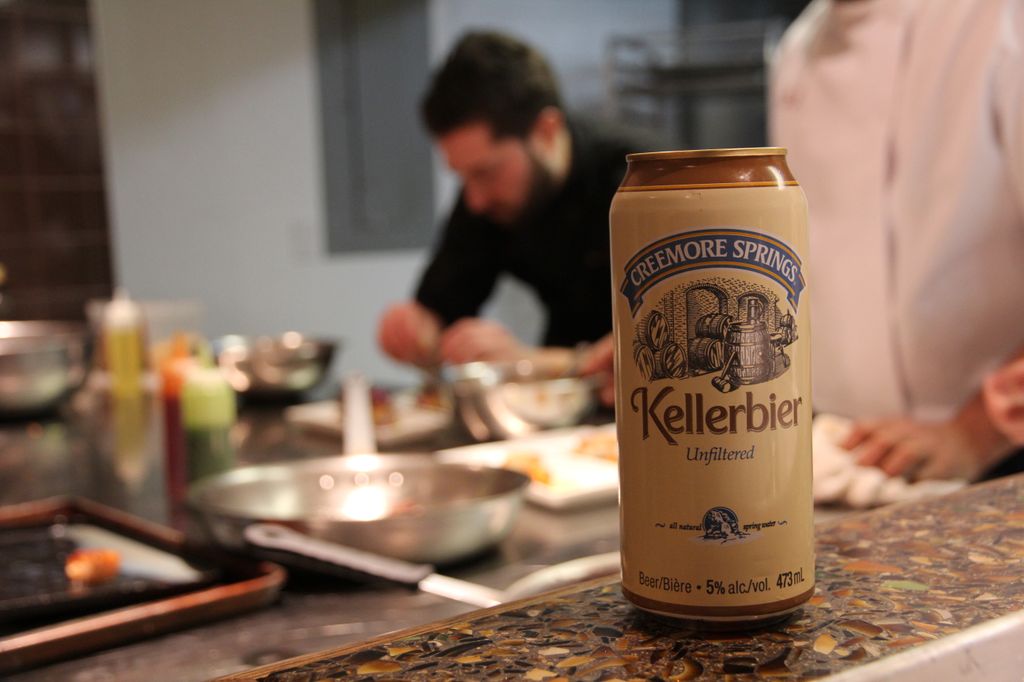
So anyway, last time I went to see Rudgie, he took me to Creemore Springs, a craft lager brewer in the heart of Ontario that proudly boasts of being ‘a hundred years behind the times’ and was bought by MolsonCoors seven and a half years ago.

Having watched what happens when giant brewers buy little brewers, you could be forgiven for expecting these excellent beers, including a sublime kellerbier, to have become blandised, cheapened and bastardised.  Instead, MC invested in increasing capacity and worked on spreading distribution, and simply left the brewing alone, with the clear admission that if they did get involved they would screw it up, because they didn’t understand how the market worked at that level.
In a global market that usually looks no further ahead than two years for return on investment, if they were going to screw it up, they would have done so by now.

Then they took over Vancouver’s Granville Island Brewing – possibly the first craft beer I ever drank when I spent a lot of time in Canada in the 1990s.  Same arrangement.  Granville Island gets sales and distribution support, and doesn’t get accountants sniffing around the hopping rates.

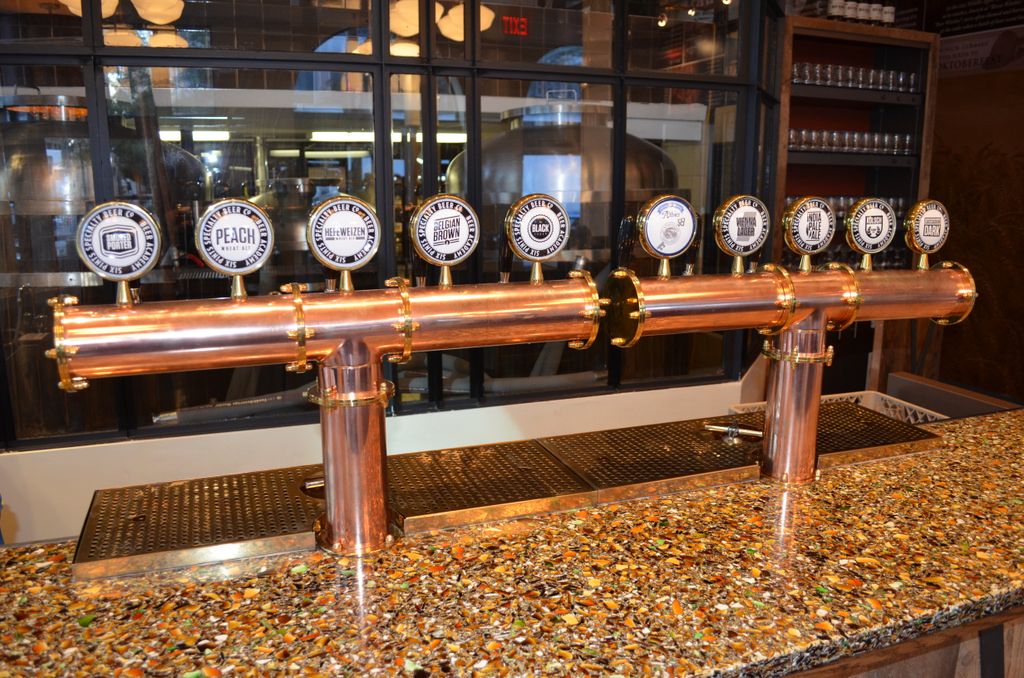
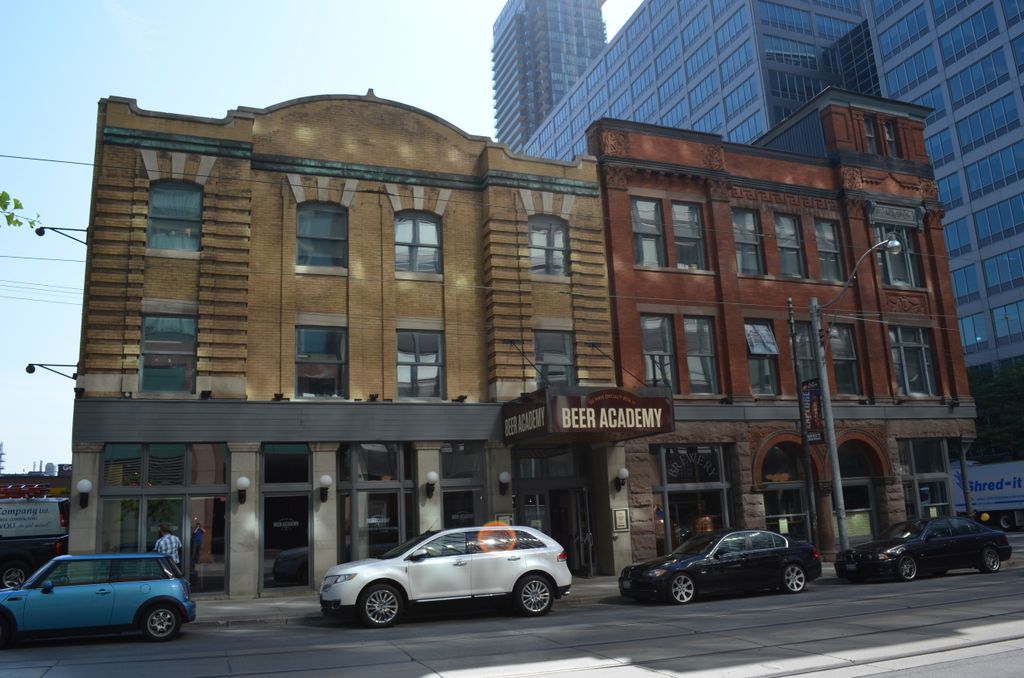
Last year, this flirtation with craft was expanded and consolidated.  Molson Coors bought a brewpub the founders didn’t want any more and created the Toronto Beer Academy.
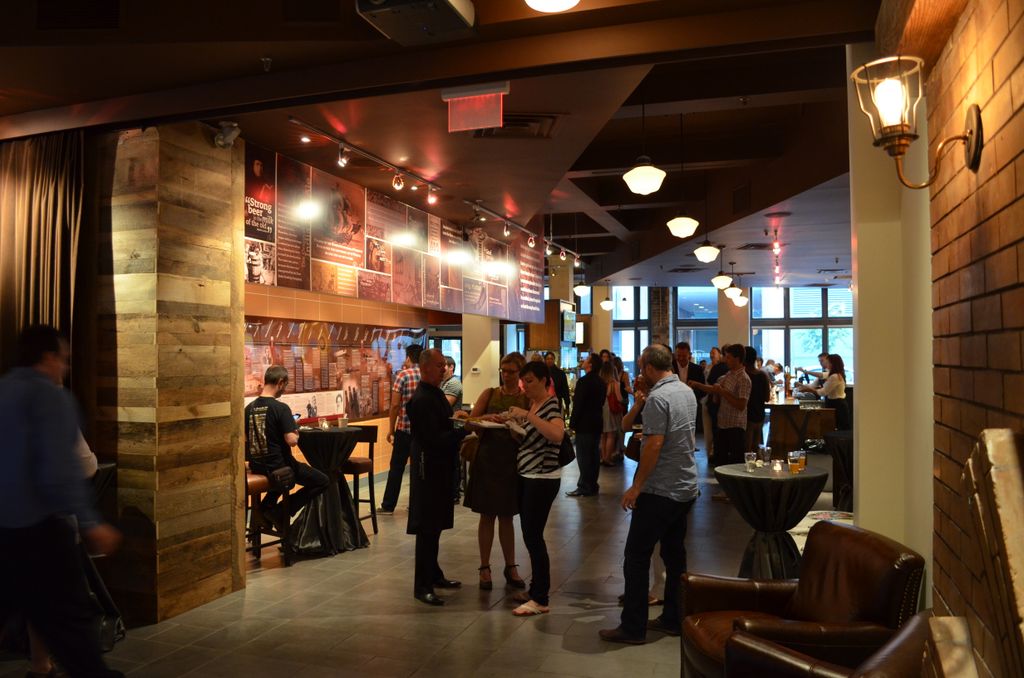
Here, the brewery makes a range of interesting beers as authentically as possible, from classic styles around the world to new craft creations.

They’re brewed by good brewers who want to make good beer (and have significantly improved the old kit so they can do so), and are sold on site.  Creemore Springs and Granville Island beers are also sold here, in a bar that celebrates beer in all its shapes and colours.
Together, Creemore Springs, Granville Island and Beer Academy are now part of an independent unit within Molson Coors called the Six Pints Specialty Beer Co.  It’s part of MC, but not controlled by it.  It runs as a separate unit, to different rules. There is no MolsonCoors branding here, and no MolsonCoors brands are stocked.
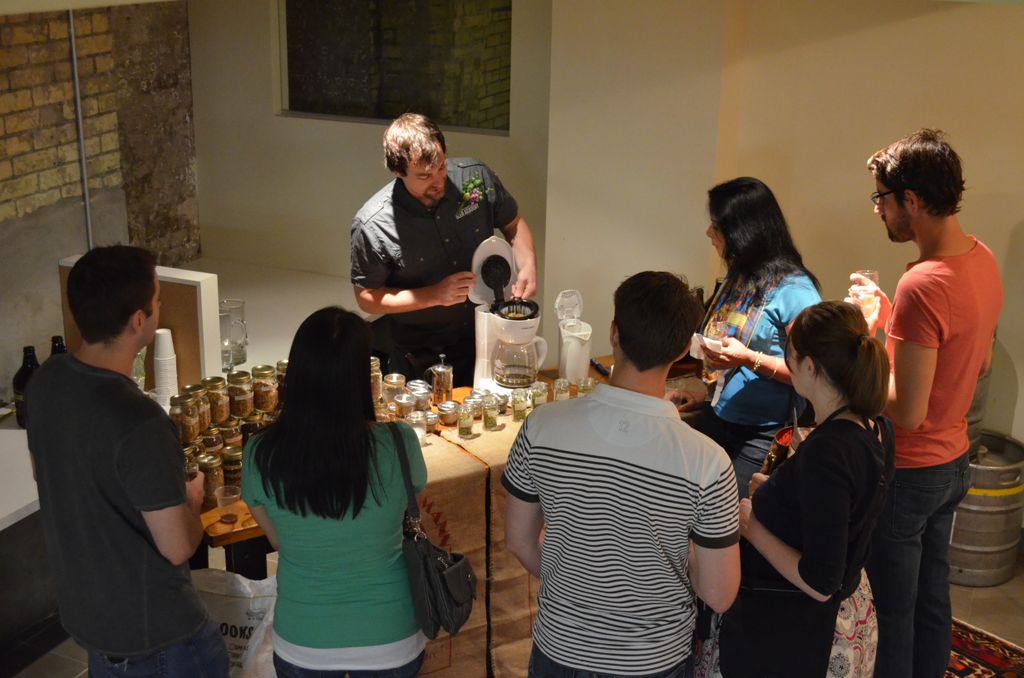
The bar holds brewmasters dinners, and seminars on beer ingredients and the brewing process.  There are new beer launch nights, beer and cheese matching evenings and beer dinners.  All stuff a good microbrewer should do, and done well.
Talking to the guys who run this, there’s a philosophy of enlightened self-interest.  It’s only going to work if it’s done right – and that means not doing it the MC way.  But if it’s done well, it might just create a halo effect that makes people think a little bit more of beer in general, in relation to wine and other drinks.  And that would, ultimately, help the rest of the MC business. 
I’m not saying it’s the best beer I’ve ever tasted, and I’m not saying Beer Academy is the best beer bar I’ve ever been in.  I am saying that this is proper craft beer, served in a proper craft beer bar, and that there is no evidence whatsoever of the ultimate owners trying to screw anything up with short cuts, dumbing down, cost cutting or corporate bullshit.
It’s an extraordinarily intelligent response to the growth of craft beer.
Compare that then, with the billboard spotted in Los Angeles by ace beer photographer Robert Gale:
Photo: Robert Gale – his blog has photos of way nicer beery stuff than this
That’s right: the biggest brewery conglomerate in the world reacts to the growth of craft beer by trying to claim that one of it’s top three priority brands for global domination is somehow in the same space as microbrewers and craft beer.

No shame. And no clue whatsoever.

You might feel that you would always want to support a true micro rather than a big brewer, and that’s a view that’s difficult to argue with.

But not all big brewers are the same.  They all want a piece of craft.  Personally I’ll be welcoming the stuff they do well, in the hope of killing off the crap, insulting stuff as quickly as possible.

* In joke. Not saying it isn’t true of course.

** Full disclosure following the admission that I do some consultancy in this area – while Rudgie is a mate, I have not been paid any consultancy or PR fee by MolsonCoors, and have had no advisory role or any other involvement in what’s discussed here

| Uncategorised

A jolly weekend in Cockermouth (stop sniggering at the back)

Great weekend last weekend, but I have to slow down and get this damn book written.

After the Social Media Beer Tasting in Glasgow, I went down to the Lake District for Taste Cumbria.  They’re really doing an awful lot to promote Cumbria as a food and drink destination, and it’s working really well.

Friday night I stayed at the Kirkstile Inn just outside Cockermouth, one of those pubs where the thick stone walls, wood fires and silence outside save for the hiss of river and tree lull you to sleep like a baby.  Another reason to go there is that it’s the brewery tap for the Loweswater Brewery, also known as Cumbrian Legendary Ales.  Their Loweswater Gold was named Champion Golden Beer of Britain at this year’s Great British Beer Festival, and the only thing better than sinking a few pints of it would be doing so after tramping across some of the irresistible mountains just outside.  They were calling to me, I tell you. They just weren’t calling as loudly as the comfy seat by the fire, or my bed, or one other very noteworthy beer.

CLA also brew Croglin Vampire.

Completely out of keeping with a range of beers that’s very nice but nothing you wouldn’t expect from a Cumbrian brewer, Croglin Vampire is an 8% Doppelbock, rich and spiritous, dark and brandy-like, and utterly wonderful.  Currently the Kirkstile Inn is about the only place you can get it.  Don’t worry, it’s a worthwhile trip.  Just as well they have rooms.

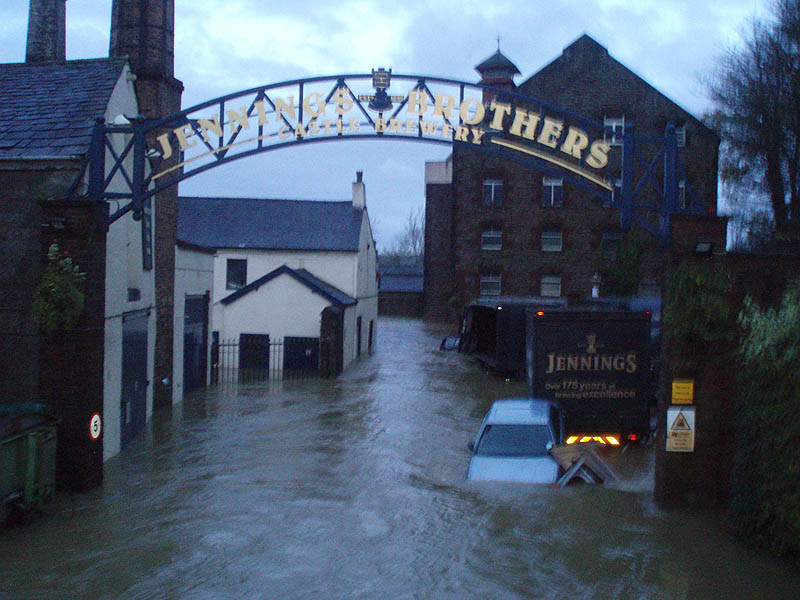
Next day we were off into Cockermouth – yes, Cockermouth – for the festival itself.  This is where Jennings Brewery is.  Again, the beers are good quality but nothing that you wouldn’t expect here.  But I love the story of Jennings brewery.  I’m not an apologist for big regional brewers – I just have an open mind about them.  I find this quite an interesting place to be. When Jennings was bought by Marston’s in 2005, the local CAMRA branch shouted that Marston’s were going to close the brewery, and continued to shout this even when Marston’s invested £250,000 improving the brewery.  If Marston’s had the slightest intention of closing the brewery, they had the perfect excuse to do so when it flooded in 2009.

Photo: Vanessa Graham on www.visitcumbria.com

But they didn’t.  They invested millions getting it open again.  I don’t know if anyone still thinks Marston’s are going to close Jennings, but if anyone does think that, I’ve got some magic beans you might want to buy.

But I digress.  On the first day of the festival, Jeff Pickthall and I were doing a beer and food matching event.  We’re both a bit vague about organisational stuff, and so were Taste Cumbria, so we ended up with about two hours to put some pairing suggestions together from food and beer being exhibited at the festival.  Not everyone was keen to have their stuff featured.  It was like an episode of the Apprentice. But as people filed into the room, we were just about succeeding in putting plates together for the following:

Mitchell Krause Hefe Weizen with goats cheese from Wardhall Dairy

Hardknott Cueboid with smoked cured boar

Jennings Sneck Lifter with lovely raisin fudge from Duerdens Confectioners of Burnley

Coniston Brewery’s Blacksmith ale with an amazing chocolate cake from Ginger Bakers in Ulverston

(We swapped these two around – people were split on what went best)

The aforementioned Croglin Vampire with Parsonby, another cheese from Wardhall which has been rind-washed in The Black Galloway porter from Sulwath brewery.  Beer washed cheese is the future, if you like your cheese smelly and overpowering like I do.

Thanks to everyone who agreed to donate stuff for us.  Amazingly, despite time constraints, exploding hefe weizen bottles and seventy extra people turning up just when we thought we’d done enough plates of food, it all went rather well, and the matches were ace.

Later, we sampled the delights of Cockermouth nightlife.  And encountered the Boogie Bus:

The ‘Big Boogie Bus’ – does that mean there’s a little one somewhere?

As you can see, it’s a pink bus that has pole dancers and lap dancers and glowing dance floors inside it. It roams the streets of Cumbria, stopping to lure stag and hen parties on board.  Then it glows brightly, drives off, and the stag and hen parties are never seen or heard from again.

Jeff and I decided to pass.  Instead we roamed the pubs in search of good beer.  And finally, after trying everywhere else, we found Cockermouth’s perfect pub, a place I’d be happy to see in any town.

1761 is modern and stylish without trying too hard.  It has Guinness, Strongbow and Carlsberg on the pumps because that’s what people want.  But it also has a good selection of local cask ales, and a small but perfectly formed range of craft beers in bottles including Little Creatures, Orval, Duvel, and Pietra.

There isn’t a full kitchen, but they do something I wish more pubs would do – a small, simple tapas menu.  We had stuffed jalapeno peppers, a cured meat platter, cheese platter, and some chorizo cooked in wine, which formed a great alternative to the curry and Cobra we were planning on.

I write about 1761 because it deserves to be written about.  It’s not a fully fledged craft beer pub, but it’s a pub with aspirations that understands the needs of its local community, is independent, and friendly.  It’s not boring like some.  It’s not too raucous like others.  There should be more pubs like it.

| Uncategorised

Craft Beer and US-Russian Relations

I went drinking strong beer with Russians last night.

Don’t do this.  It’s not a good idea if you fancy living. They look at high ABVs and laugh contemptuously, necking them almost scornfully.

I was meeting Eugene Tolstov, Moscow’s number one home brewer, and Russian beer blogger.  Eugene looked after me in St Petersburg, and is in the UK three of four times a year with his day job, so I was happy to return the favour.  Eugene was happy to demolish beers the rest of us might be a little bit scared of.

We were in the newly opened Craft Beer Co in Leather Lane, Clerkenwell, London, EC1.  It’s a truly great place, and many other bloggers were there for the opening night last week – I know Young Mark has already covered it.  I counted 42 taps on the bar, about half of these being cask ale (which, as we all know, is a form of craft beer, so let’s not get started).  The cask ales are a reasonable (for London) £3.40ish, while the taps carry beers rarely, if ever seen in the UK on draught, so they’re a bit more expensive.

“Excuse me, have you got any beer?”
“Yes sir, this is a craft beer pub, not a Monty Python sketch”

What I liked about it though is that it still feels like a pub, a proper London boozer.  The glass ceiling is stunning, the roman numerals remembering the gaff’s previous spit-and-sawdusty days as The Clockhouse.

I was with one old Clockhouse regular who was complaining about the high price of beers such as Struise Old Albert (13%ABV), or Mikkeller’s nonsensically named but wonderful 1000IBU, being sold at four or five quid a half, until I pointed out this would be quite reasonable if you were looking at wine – and rare wine at that.

The Russians were gamely attempting to chug their way through the entire range when in walked a legend, an immortal, a god in little bald beardy man-shaped form.  Ladies and gentlemen, White House communications chief Mr Toby Ziegler! In a pub! In London!  OK, not the real White House Comms chief, the one in West Wing, which is even better than the real thing in all respects.  And not him of course, because he doesn’t really exist, but the actor who plays him, Mr Richard Schiff.  But Still.  Toby Ziegler!

I need to say now that, depending on your point of view, I was either too chicken or too sane to rush up to him and take a photo, or have my photo taken with him.  I wish I had been more courageous/sad.  In the end, I only got this photo of him when he was leaving.  But I promise you that is the back of his greying bald head:

“Yes, Mr President”

You can tell by the confident, authoritative way he looks up manfully at the brooding sky.

And here is from the front, in The West Wing, in one of the rare scenes that doesn’t have people walking up and down corridors talking extremely quickly:

See? You can tell.

Before he left, he spent a long time tasting samples of various different craft beers before ordering pints of a blonde one, a brown one and a dark one for himself and his posse.  I wasn’t close enough to him to ascertain whether or not he ordered by starting a sentence very-quietly-and-quickly-and-suddenly-gathered-pace-before-finishing with an OUTBURST OF MORALLY OUTRAGED SHOUTING!

But the best was yet to come.  As he got his beers, he glanced across the bar at me – or rather in front of me – and saw that I was eating one of the Craft Beer Co’s bloody excellent pork pies.  I saw him mouth the words, “Hey what’s that? I’ll have one of those too.”  TOBY ZIEGLER SAW ME EATING A PORK PIE AND THEN HE ORDERED ONE AS WELL!

Apart from now having the best lame claim to fame I’ve ever had, some gnawing self-doubt at the fact that a better (or worse) man than I would be sitting here today posting a photo of himself with his arm around Richard Schiff, raising our beer glasses to the camera, I’m just happy that one of the coolest guys in one of the coolest TV series ever is a craft beer (and pork pie) fan.  And if Craft Beer Co wasn’t cool enough for you before, it is now.

I tried explaining how cool all this was to the Russians.  You’ll be amazed to hear they don’t really get the West Wing.

But here we were: the former mortal enemies of the Cold War, brought together by craft beer. It was a beautiful moment.  Even if the Russians had no idea what was going on, and Richard Schiff remains forever ignorant of the meeting that never quite took place.

| Uncategorised

April Vlog: Burnley and Moorhouses

Our wayward ramble through the UK continues, and this month we hit the north west.

Why?

Because Lancashire Brewer Moorhouses has spent over £4m on a staggering expansion with a brand new brewery that increases their capacity by a ridiculous amount.  A confident investment for the future?  That’s an understatement.  Moorhouses MD takes a clearly jealous Peter Amor around the brewery, showing him where the money went.  As the most ambitious micros grow to the level of small regional breweries, some shrewd business people clearly believe the revival of interest in good beer is here to stay.

Then we go to Burnley town centre.  I have a strange relationship with Burnley because it’s in the north, has a crap football team and sounds a bit like Barnsley, so people often think I come from there, because I come from Barnsley, which is in the north, has a crap football team and sounds a bit like Burnley.

Anyway, I wish Barnsley had a pub as good as the Bridge Bierhuis (which is in Burnley).  If it did, I might not have left town as soon as I was able.

In various publications as well as this blog, I’ve written quite a bit over the last 12 months about ‘craft beer pubs’ – often moribund or failed pub sites that have reopened or repurposed themselves with a single-minded emphasis on interesting beer – real ale and otherwise.  One criticism that’s been fired back is that these fancy establishments might work well in That London, or maybe Leeds, but you can’t expect people in northern provincial towns to enjoy microbrewed cask ales, imported Belgian beers and German lagers.  The Bierhuis proves them wrong, by doing something quite rare – it combines being a beer shrine with being an excellent and important community Local.

I say all this in the video, actually – but I say more besides, so please give it a view and let us know what you think.

Next month: Scotland.

| Uncategorised

Don Younger – a beer world legend

Don Younger RIP

Last night the brewing world lost one of its best, someone who summed up everything – every last little wave and particle – that is good about the world of beer and pubs.  And that’s no hyperbole – anyone who ever shared a drink with Don Younger could tell you what those qualities are, and how Don encapsulated them.
I was introduced to Don when I was in his hometown, Portland Oregon, while researching my second book, Three Sheets to the Wind.  If I tell you that I have read out the bit about our encounter at every single event at which I was promoting the book, that might give you the first inkling as to what a great man he was.  It was one of the highlights of the book – one of the funniest passages, but also one of the most revelatory about the nature of beer.
I was in Portland because it’s the heart of North American craft beer.  You might now say that’s San Diego, or wherever has produced this month’s latest extreme whisky aged Imperial stout, but Portland still has more craft breweries per capita than anywhere else (I think), and its brewers and drinkers perfectly capture the cooperation, camaraderie and conviviality that make beer great – uniquely great.
And Don was its Godfather, its benign inspiration, in his passion, his kindness, and more than anything else, his legendary drinking prowess.
The story I was told is that he bought the Horse Brass Pub after a night on the piss.  He woke up the next morning clutching a piece of paper bearing his signature, confirming that he was the new owner of the pub. He’d never wanted to run a pub, and had no memory of signing the paper.  He could of course have blamed the booze and negotiated his way out of it.  But he always lived by a strict code: if you make a decision or promise while drunk, you either follow through with it when sober, or you give up drinking.  And Don never gave up drinking.
Under his leadership, the Horse Brass became the hub of the emerging craft beer scene, attracting beer loving locals, many of whom went on to start celebrated breweries.  No one in that brewing scene speaks of him with anything other than love.
Don was 68 or 69, and had a fall last week in which he injured his shoulder.  According to reports, this led to multiple complications, and he died around midnight last night, West Coast time.
I’ll leave it there.  I only met Don the one time and I’ll leave the proper obituaries to the people who were lucky enough to know him well.
But on the basis of one meeting, he was one of my favourite people in the beer world.  Even if you didn’t know who he was till now, take a while to read about him, and raise a glass of your favourite US craft beer to him tonight.  After all, there’s a good chance it may not have existed without his influence.

| Uncategorised

Exclusive: the Euston Tap: A Sneak Preview

When the Sheffield Tap opened almost a year ago, I wrote that it was almost worth getting the train to Sheffield just to sit and have a drink in the station.  Since then, I have done just that.  But now there’s no need: the team behind this wonderful craft beer bar – one of the best in the country – have now repeated their stunning success at Euston Station.
In an audacious and visionary move, Jamie Hawksworth and co – also responsible for the Pivo bar in York – have taken a lease on one of the iconic square Portland stone buildings flanking the front of the station, and made it the Euston Tap.  Yesterday, manager Yan Pilkington invited me for a look around.
London landmark becomes beery destination.
The builders – imported like the management from Sheffield – were still busy when I arrived.  A lobby into the bar area was being erected over the door, and Yan and Jamie were in the cellar struggling with the three pythons that will take the beer into the bar.  Said beer was standing on pallettes outside on the grass, and there was an awful lot of it.  I imagine the guys won’t be getting too much sleep between now and 6pm tomorrow,  Friday 5th November, when the place opens.
Signage will be subtle, to say the least
I love the ambition here.  And while it’s not finished, it already looks stunning.
It’s a small place, but not as small as you’d think if you walk past.  There’s standing room for around 65 downstairs, and then a spiral staircase leads to a second floor where a lounge area will seat up to around another 50.
When you walk in, the main bar itself – like the one in the Sheffield tap – takes your breath away.
Would you like a beer sir?

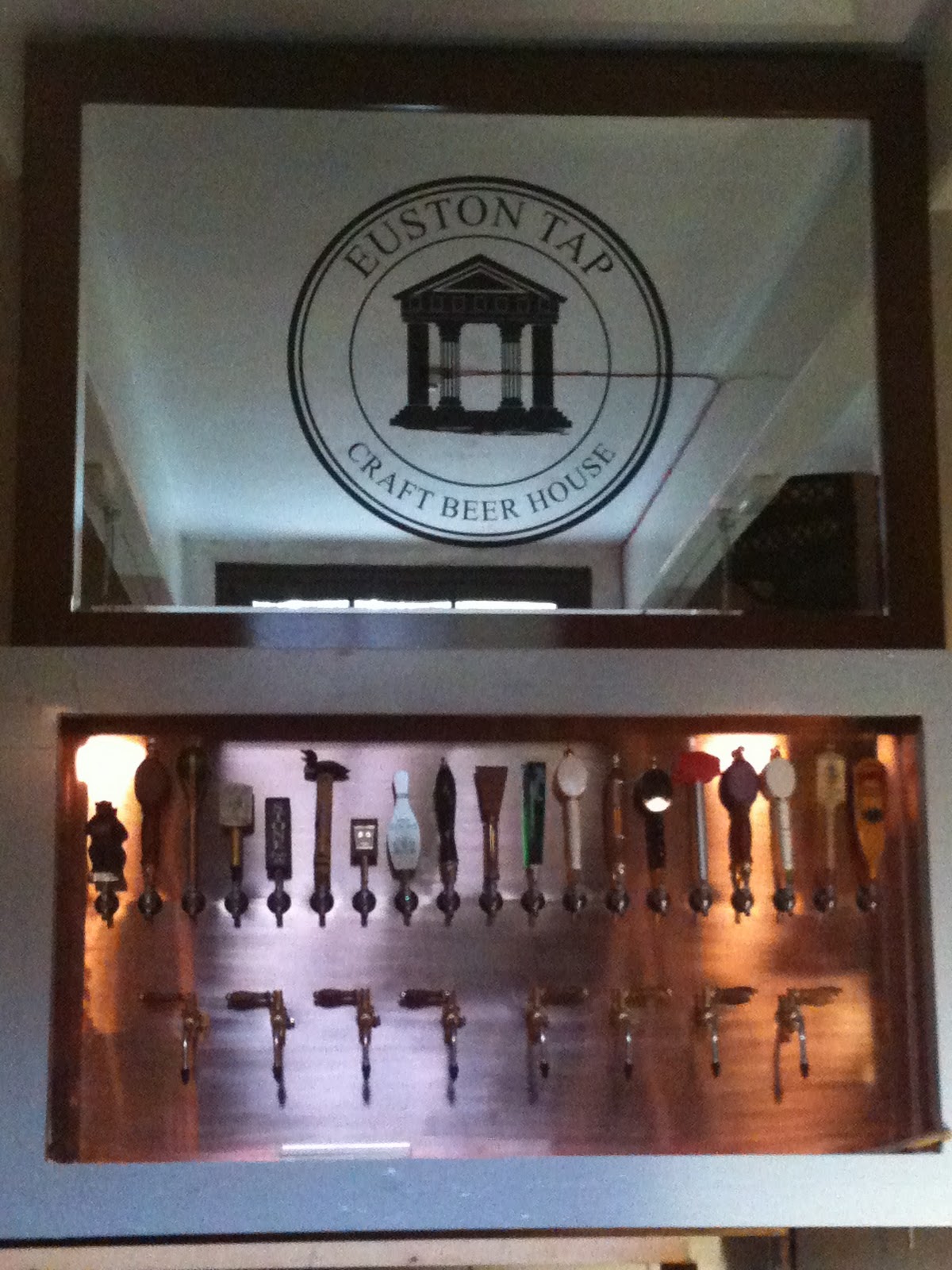
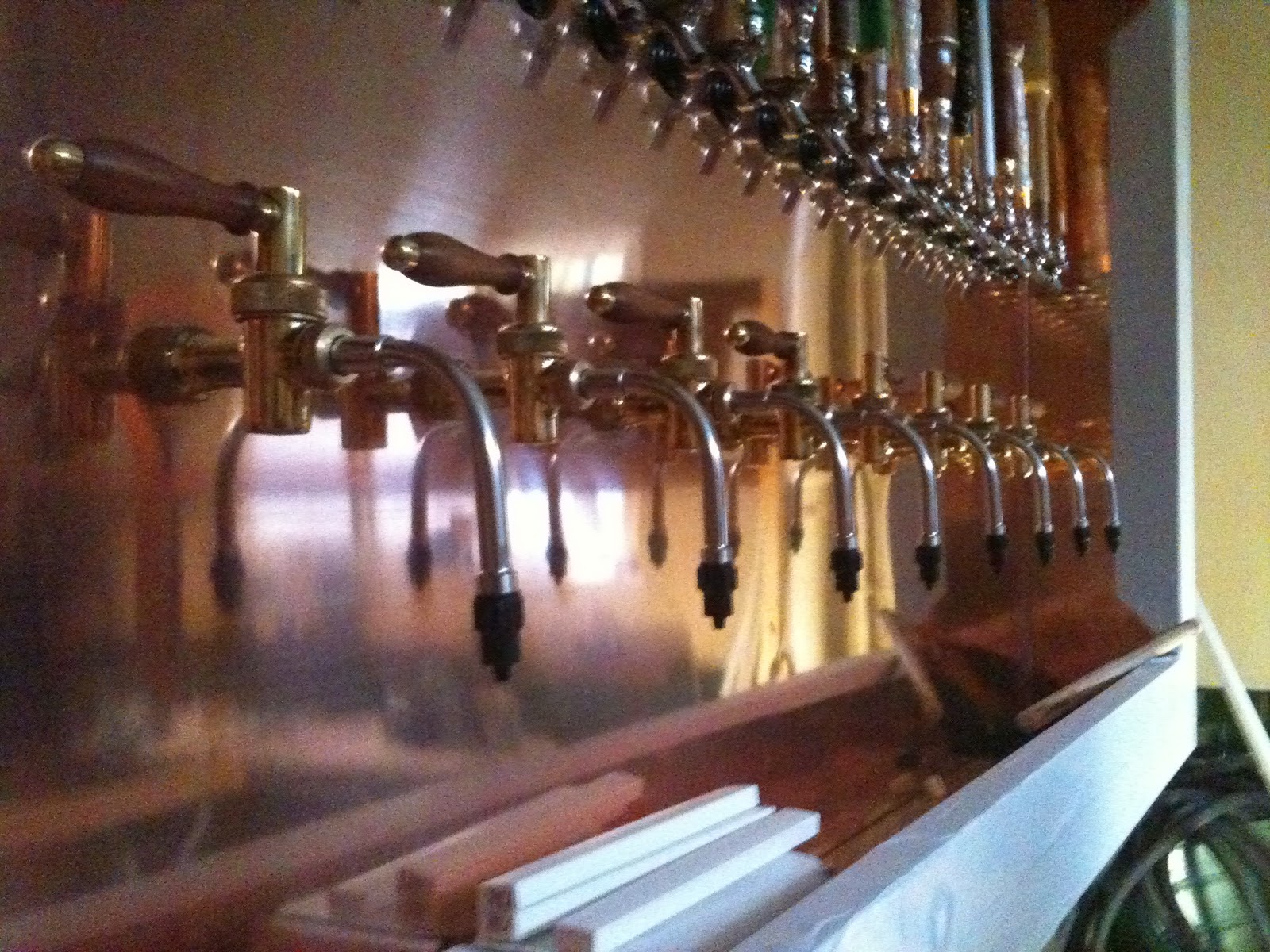
They’ve gone for the American craft beer bar style, with all the taps coming out of the back wall and nothing on the bar itself.  By opening time, this back bar will be flanked by two fridges, which you’ll be able to walk up to and inspect.

But the main stars are the draught beers.  Expect to encounter beers here that you will never see anywhere else.  The taps will be constantly rotating, and treats lined up for the first couple of months include cask Thornbridge Alliance and Bracia – outstanding, rare beers never seen on tap before – and Coalition, a collaborative brew with Dark Star that has been maturing for two years at Thornbridge.  One cask is coming here, the other is going to the Sheffield Tap, and the rest is going to be bottled – that’s how rare this beer is.  The cask beer selection will at all times include three beers from Thornbridge and three from Marble.
Eight cask ale taps, looking forward to the objections from dinosaurs
There are 19 quality keg beers.  I spotted Bernard’s wonderful unpastuerised lager, Matuska, a rising star from the Czech Republic that blew us beer writers away when we visited recently, Dogfish Head 90 Minute IPA, and Stone Pale Ale, to name but a few. In those fridges there’ll be 100 rotating bottles.  Currently these include 60 American craft beers, 30 German and ten from Danish cuckoo brewer Mikkeller.
You have never seen a craft beer selection like this anywhere else.  And Yan insists you won’t be paying through the nose for it either – cask ales start at £2.70.
There’s just one serious flaw.  This is a listed building, and the work that can be done to it is limited.  Which means there is one – ONE – toilet in the entire place, and it’s at the top of the spiral stairs. So remember to go before you get here.
   
If you’re a craft beer geek already, you will now be reading this already queuing outside the Tap for tomorrow’s opening.  If you’re not, I urge you to get to Euston as quickly as possible to sample some remarkable beers in what will be a wonderful atmosphere.  You’ll never make your train from Euston again.
See you there.

| Uncategorised

The Jolly Butchers: my manor gets its own serious beer pub

I write for lots of different reasons, some of which go very deep. I’ve wanted to be a writer – of some kind – since I was nine years old. But among all the complex psychology, creativity and ego needs, there are a few more pragmatic reasons why I’ve wanted to write specifically about beer over the last ten years or so.
One of these is that I really love drinking well-made, tasty craft beers, be they American hop bombs, beautifully balanced real ales or perfectly made pilsners.
The trouble is, until a few years ago not many pubs served them. I much prefer drinking in pubs to drinking at home, and nine times out of ten I would have to settle for something deeply average.
So purely selfishly, I figured that if I wrote about beer, and I was really good at it, I might in some small way encourage the spread and appreciation of great beer, and that would make it more common in pubs, and that would mean I could enjoy better beer when I’m out. You might think I do it to turn other people on to great beer, but my ultimate motive is entirely selfish.
And it’s kind of working. I’m not claiming any measure of direct credit for the spread in good quality beer, the huge rise in imports and the critical and commercial revitalisation of cask ale, but I am part of a big wave of enthusiasm that’s pushing the spread of great beer.
My local, the White Hart, used to have one dusty Spitfire pump in the corner of the bar. Now it has three well-kept cask ales – Doom Bar and Tribute on permanent, and a rotating guest.
And as of today, up the road, opposite the bus stop, we have the Jolly Butchers.
Previously, the Jolly Butchers was a Stoke Newington institution – in more than one sense of the word. It was also known as Stokie’s Bar and Father Ted’s, each rebrand not replacing the previous name but adding fresh layers to to it, like the coats of grime on the windows.
It was populated exclusively by old men wearing what the late Pete McCarthy dubbed ‘Irish drinking suits’, those once smart, now shiny and stained dark jackets and trousers that are the uniform of a certain type of veteran drinker. They’d huddle together in a vast, derelict space to watch an endless diet of horse racing on the pub’s many TVs, pumping the change from their pints of Foster’s into a bank of gaming machines.

The pub had a certain notoriety in Stoke Newington’s broader population thanks to its 3am licence, but whatever business this brought in it clearly wasn’t enough: rumour has it the pub was losing thousands of pounds a week when it finally closed earlier this year. Twitter briefly flurried with comments along the lines of “Where are we going to go to have a late night fight with an Irishman now?” and then fell silent.

Two days ago I was invited for a sneak peak at the new Jolly Butcher’s.

The Victorian wrought ironwork and stained glass above the windows, previously boarded over, has been exposed. The walls have been stripped back to the brickwork and left unfinished, stylishly shabby, apart from one wall covered in trendy Fornasetti wallpaper.
The central bar that once dominated the centre of the room has been moved to the side, and an open kitchen has been built in the corner. And as for that bar, well…

There are ten handpumps, combining beers from London’s late-to-the-party but finally emerging range of craft brewers, plus regular beers from Thornbridge and Dark Star, real cider from Gwatkin’s and a perry.

Apart from the ales, there’s smoked beer Schlenkerla on draught, as well as De Koninck, Bruges Zot, Mort Subite Kriek, Vedett, Erdinger and Meantime Helles. Yes, all on draught. Then there’s a lot of Chimay in bottles, some more Meantime and a few others. The bottle range does need beefing up, but landlord Martin wanted to focus on getting the draught range right first.
I used to have to get on a train for two hours to drink Jaipur on draught. Now I have to walk five minutes to the end of my street. My plan has worked.
I can’t claim any credit at all for the Jolly Butchers though – Martin had never heard of me until he started placing orders for beers. But when he did, people kept telling him I lived locally and he should get in touch with me. I’m so glad he followed their advice.
The other day I chipped in a few comments about the beers as the staff were taken through a tutored tasting of them by Martin (behind the bar, above). Some of the Irish drinking suits were hanging around outside, curious, proprietorial. They’re still welcome if they’re happy with no racing, no bandits and Meantime Helles instead of Foster’s.
Martin knows what he’s doing – he also runs the Rose and Crown in N16 and the Wrestlers in Highgate. Both those pubs are tied, but the Jolly Butchers is a freehouse. As such, he couldn’t wait to get his hands on it and turn it into a beer shrine. Why? Martin is a beer fan, but not a beer geek. He enjoys a decent pint, but talking to him you realise first and foremost he’s a businessman. He’s reinvented the Jolly Butchers, taking it from one extreme of the pub spectrum to the other, purely because he believes he’ll make a lot of money by doing so.
“If this doesn’t work, that means I don’t understand pubs. And the thing is, I do understand pubs – I’ve worked in them all my life,” he says.
It’s striking that he had to wait until he could get a freehold to do this – that PubCos simply wouldn’t allow him to create this dream. When the Jolly Butchers makes more money than Martin’s other pubs, than other Enterprise and Punch pubs, it will prove what readers of this blog understand but PubCos, global brewers and mainstream media still do not – craft beer is thriving, and when forty pubs a week are closing, catering to craft beer is a sure fire route to profit.
See you there tonight.