Author: PeteBrown

| Uncategorised

Cider: Always drink responsibly. Unless you’re from the 1970s.

It’s Cider O’ Clock here on Pete Brown’s Blog for the next week or so. World’s Best Cider is now on sale, and launches officially next week, which is nice, because it’s also the week of various Apple Day celebrations.
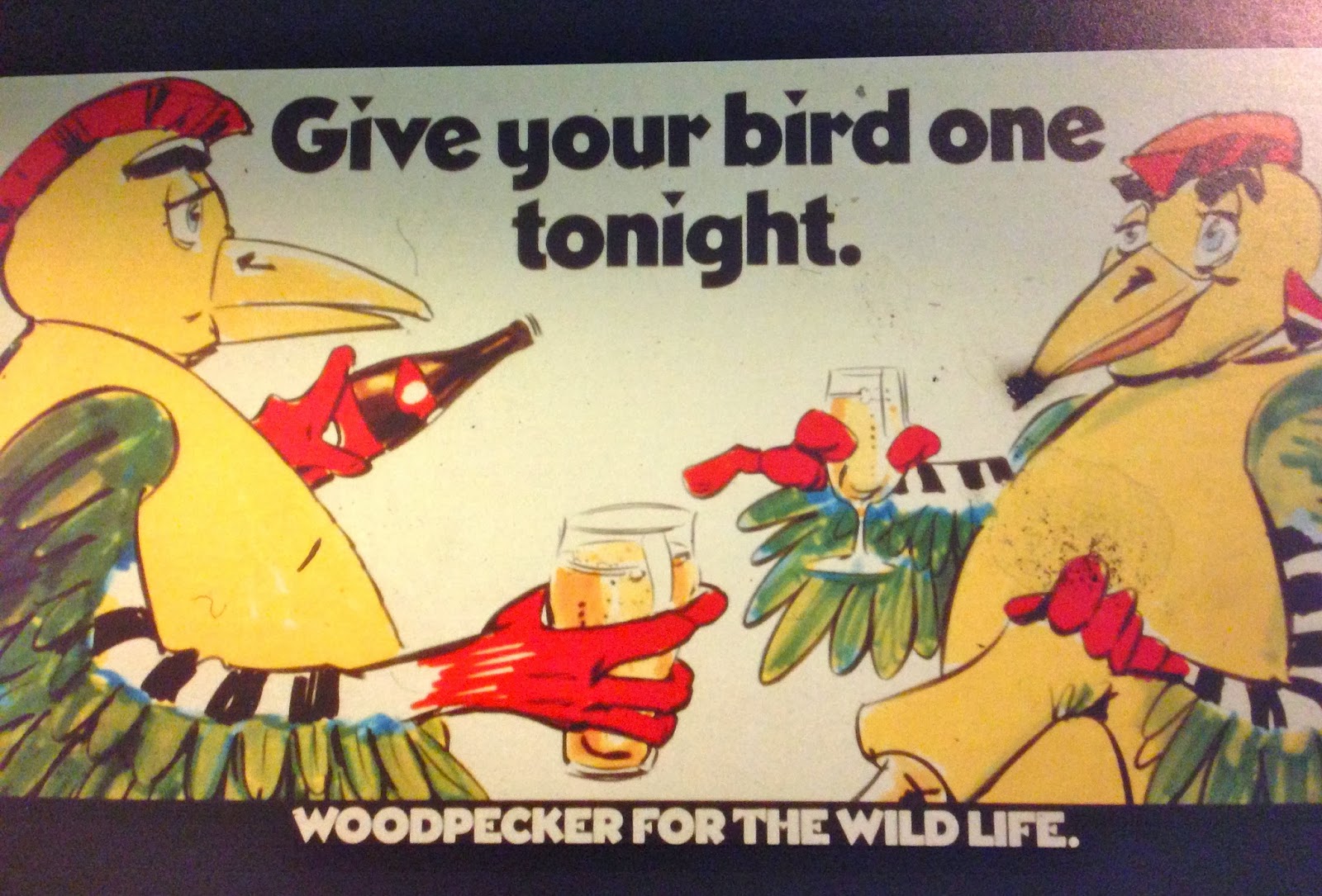
I’ll be writing quite a bit about the book, about the themes within it and some of the fantastic people we met while researching it, over the next week or two. But to kick things off, I wanted to share with you some images of real cider ads that ran in the 1970s and can still be seen in the Bulmer’s Museum in Hereford. It’s a great place. If you think Bulmer’s have only ever done bland, tasteless commercial crap, you need to go and have your perceptions changed. Once, they made the best cider in the world, by any reasonable standards, and the evidence of this is still there.
By the time the images below were being developed, they were making bland, commercial crap. But without this crap, we would never have got these ads. It’s a price worth paying. It’s ads like these that made Woodpecker such a success for Bulmer’s in the 1970s and 1980s, and they remain an inspiration – a lodestone – for alcohol advertisers in the new millennium.
Today, the British advertising Code of Practice states:

“Marketing communications must neither link alcohol with seduction, sexual activity or sexual success nor imply that alcohol can enhance attractiveness… [and] must not imply that drinking alcohol is a key component of the success of a personal relationship or social event.”
Happily then, this ad targets bar staff and simply urges them to draw pints of Woodpecker from the font, ready for thirsty customers with nothing but refreshment on their minds. 

Beer still struggles to shed a macho, boorish image after decades of advertising that many women have found alienating, or even offensive. This has led to a situation where only 15% of beer volume in the UK is drunk by women, compared to 40% in Spain.

Meanwhile, one of the main reasons for cider’s success is that it is acceptable to both men and women. It’s managed to avoid the sexist tropes and stereotypes that beer relied on for so long, and cider vlume is split much more evenly between men and women.
This ad, for example, simply asks us to imagine ourselves as winged creatures, as embodiments of Woodpecker’s brand values – colourful, interesting and free, chirpy and beloved, and to share our drinks in a responsible fashion with our fellow ‘birds’.

The rules on alcohol advertising in the UK are some of the strictest in the world. The introduction to the regulatory code states that “marketing communications for alcoholic drinks should not… imply, condone or encourage immoderate, irresponsible or anti-social drinking. The spirit as well as the letter of the rules applies.”
Mindful of this, our final ad depicts an abstract representation of two Woodpecker consumers sitting in a relaxed fashion, enjoying a responsible drink away from their natural habitat. Their informal poses indicate ease and comfort in each other’s company and their environment. The line simply reminds us that our usual routine and habitat – our ‘tree’ if you will – can feel restrictive, and every now and then it’s nice to go somewhere else and do something different. The very use of the word ‘some’, when it could have said ‘lots of’ or even ‘all’, reminds us that fact that consuming alcohol should be only an occasional occurrence.  
If only more of today’s alcohol advertisers followed the Code of Practice so closely, perhaps we’d have less of the Daily Mail/health lobby hysteria around alcohol that we have to endure today.

| Uncategorised

Beer festivals and festival beer: how Carslberg is missing a trick with its music sponsorship

You can have anything you want. So long as you want Tuborg.

When I’m not propping up the bar in a good pub, I like nothing better than jumping up and down and shouting at men with guitars.

I’ve been doing a great deal of the latter this summer at music festivals. The first time I went to Glastonbury in 1987 most people hadn’t heard of it, and for those who had, to suggest going was about the same as suggesting you quit your job, start freebasing crack and buy a mangy dog on a piece of string.

In 1987, the only mention of Glastonbury in the national media was the number of arrests (it was never pointed out that this number was always far lower than in any town of a population size equivalent to the festival over the weekend). Now it gets wall-to-wall coverage, and tickets are impossible to come by. And so we’ve seen a huge proliferation of festivals, with several happening every weekend from June to September. When we look at declining beer sales figures every summer, it’s a shame these events aren’t monitored. The picture might look a little different if we could take into account a hundred thousand people drinking steadily for three days each weekend.

Festivals are now big business, and big brands are all over them. And this led to two very different beer experiences at the festivals I attended this summer.

The Latitude Festival is held just outside Southwold in Suffolk. Recently it was taken over by Festival Republic, who also run Reading, Glastonbury and various other festivals. The organisation has signed a deal with Carlsberg to supply Tuborg lager and Somersby cider to all these festivals. At Latitude, at the ten or so bars around the festival site, Tuborg was the only lager on offer, Somersby the only cider. Hobgoblin was on sale too – for some reason. Whether Carlsberg thought this was a better bet than their own Tetley’s beer, or festival republic signed a separate ale deal with Marston’s, I’m not sure.

I have nothing against Carlsberg really, even if I don’t drink much of it myself.  Tuborg is no better or worse than its mainstream competitors. Personally I don’t like Somersby, but other people do. And while I like the odd pint of Hobgoblin, it’s far too dark and heavy for a sunny festival weekend. After all, it’s achieved huge success by positioning itself as a beer for late Autumn. With these beers as the only choices on offer, anywhere, for four days, I ended up simply not drinking very much beer.

The Green Man Festival in South Wales is very different. It’s still independent. This year there was a real ale tent stocking 99 different Welsh ciders and cask ales. At the other beer tents on the festival site,
the selection was different from the Festival Republic formula, but just as narrow. 
And here we saw a fascinating experiment emerge. 
The queue in the real ale tent was never less than six deep, from midday to midnight. Men and women from eighteen to sixty stood around discussing the list, asking each other for tips. It took at least twenty minutes to get served. The ciders and perrys started running out on the Thursday night, before the festival had even begun properly. By Saturday everything had gone, and they were sending vans around Wales to grab whatever beer and cider they could to fill the empty stillages. 
By contrast, you could walk up to any other bar on site and get served straight away by bored staff, grateful for something to do. Ironically, after championing cask ale for a living and writing so much about interesting beer, I spent a lot of Green Man drinking their generic lager because I didn’t have time to queue for the good stuff between bands.
I’ve been in meetings where brand sponsorship of events is worked out. According to its website, Carlsberg likes to think that “the Tuborg brand is building a youthful, fun image through sponsorship of music and live festivals.” I’m sure the idea is that people will try Tuborg or Somersby at festivals, having no choice to drink anything else, and then grow to like it and order it next time they see it, because they now associate it with good times. 
But I fear it doesn’t work like that. People go to festivals (of any kind) because they want to see and try something different from the norm – whether that be bands, comedians, writers, food or drink. It’s one of the biggest examples of consumers seeking ever-greater variety in all walks of life. To go to a festival and be confronted with a range of drinks that any pub in the country would consider too narrow is anathema to the whole experience, and leaves a lingering bad aftertaste.

Of course as a beer purist it would be easy to say Carlsberg shouldn’t sponsor festivals, festivals shouldn’t be corporate, and everyone should celebrate small and independent. But the real world doesn’t work like that. Green Man retains an overall better atmosphere than any other festival I know because of its independence, but the price of that independence is that there’s no budget to book decent headliners – at least, there wasn’t this year. Thanks in part to Carlsberg’s dosh, I got to see Kraftwerk at Latitude. 
So the bog brands aren’t going to go away. I just wish they’d be a bit cleverer and show more of an understanding of what festival-goers want. Like any other multinational brewer, Carlsberg has a wide range of brands in their portfolio and is always looking at new product development. They have the Jacobsen and Semper Ardens beers, dark lagers and Belgian beers and stouts and wheat beers from around the world. Why not use festivals as a testing ground instead? With this captive audience, why not try new brews under the Tetley’s brand, or see how Carlsberg and Tuborg perform side by side, or see if there’s a UK market for their eastern European bocks or amber lagers?

I’m sure sales figures from the summer’s festivals were great. But as the glorious, independent experiment at Green Man proved, I’m positive they could have been even better.

| Uncategorised

The Cask Report shows how cask ale helps keep good pubs open

Today sees the launch of the Cask Report, the annual state of the beery nation I write on behalf of a loose consortium of brewers and beer industry bodies.
Every year I think ‘how can we do another one without just getting repetitious?’ and every year we somehow get enough insight and data to give us more understanding of why cask ale is increasing in popularity and why this is good news for publicans (the main target audience for the report). Everything can be downloaded from the Cask Report website, if not now then by the end of the day, but here are the main summary highlights…  

Cask ale is outperforming  the total beer market by 6.8%

Cask declined marginally by 1.1% in 2012, versus a total beer market decline of 7.9%, and the long-term trend remains one of steady improvement. Cask grew in value by 3% (thanks to increasing prices). Cask’s ale’s share of total draught ale has increased to 55%. Cask continues to grow its share of all beer with a 16% share of all on-trade beer. Although cask ale’s performance is flat, that’s much better than the general decline in beer.

Cask ale continues to grow in awareness and interest 

More pubs are stocking more cask ales on the bar. 57% of pubs now stock cask – up from 53% in 2009 – stocking an average 3.8 different brands. 

The growth in range is helped by the 184 new breweries that have opened in the last year

That’s three new breweries a week. We now have 1147 breweries in the UK, the vast majority of which brew cask ale.

Cask ale plays a major part in keeping pubs open 

Cask ale pubs see better results across the whole beer range, and cask drinkers are far more likely to visit the pub, far less likely to say they are doing so less often. Many people say they are going to the
pub less often than they used to, and 47% of the population say they are drinking less alcohol than they did a year ago. (So where are all the binge drink scare stories coming from?) The reasons they give are obvious, but interesting nevertheless. Only a tiny minority cite issues like the smoking ban as the reason for not going to pubs as often. 73% of drinkers say they are drinking more at home because it is cheaper. And the main reasons people are drinking less is that they want to get healthier. This is really important for pubs: if they want to stem the decline, it suggests we need some value alternatives, lower ABV drinks, better (and better value) soft drinks, and healthier food options on menus. Only 20% of cask drinkers (as opposed to 47% of all adults) say they are drinking less, and 25% say they are drinking more. Those who are drinking more are doing so because they perceive improvements in the quality, range and availability of cask. So cask drinkers are bucking the trend of declining pub-goers.

Cask ale has outgrown its traditional base 

It’s now a drink for men and women of all ages. Our research among drinkers shows a big take-up among a wider audience, and most cask ale publicans believe cask is bringing more women and younger drinkers into their pubs. One in five cask ale drinkers tried it for the first time in the last four years – proving cask is attracting new drinkers. 

A major appeal of cask to both drinkers and publicans is its variety

Both publicans and drinkers talk about the huge array of styles and flavours. The optimal cask range is a mix of style, colour, ABV, familiarity and provenance, and should be rotated on an on-going basis. But consumers want guest ales to stay on the bar for longer than licensees currently keep them, and want a core of familiar brands as well as new and different beers. Big and small both have a role to play.

Recent interest in ‘craft beer’ is driving awareness and appreciation of cask

Despite people on both sides of the ‘craft’ debate stirring up conflict on blogs, at events and in the trade press, creating the impression that new-style craft beer and traditional cask ale are threats to each other, most people – at least most who are aware of craft beer – think the two styles go hand-in-hand and have a large overlap. Awareness of ‘craft’ is not as widespread among consumers as it is in the industry. 77% of licensees are aware of craft beer, but only 37% of drinkers (this rises to 47% among cask ale drinkers). Those who are aware of it believe it denotes quality and is worth paying more for, and consider most cask ale to be ‘craft’. It’s a good thing. And it’s a real boost – not a threat – to cask ale.

Pub beer festivals are increasingly popular

33% of cask ale pubs – around 10,000 pubs in total – have run a beer festival in the last
year. This is a major source of trial for new drinkers. 39% of women who drink cask beer, for example, do so at festivals.

Cask ale publicans cannot imagine a future for pubs without cask. 

We carried out some original, independent research among licensees who stock cask. It was brilliant to hear from them about how at the novice end of the spectrum, people who start to learn about cask never having drunk it before quickly develop a genuine personal interest in it and start drinking it themselves. They go on to become passionate advocates for it. Most see it as an essential part of any quality pub’s product mix.

The launch of the report is timed to coincide with and kick off Cask Ale Week, which seems to be getting bigger every year. Go out and drink some cask ale. It’s a good thing.

| Uncategorised

“Events, dear boy, events!” (As Harold Macmillan probably didn’t say)

Early
autumn is busy at the best of times and I have a book coming out in October.
Here’s what’s keeping me on the road and off the streets for the next couple
months.
FRIDAY
23RD AUGUST: APG PLANNING RAMBLE IN SOUTHWARK
This one goes out to all the ad industry planners doing the job I used to do. I’m leading a meander of planners around Southwark tomorrow lunchtime, discussing Shakespeare’s Local and ending up in The George. Contact Sarah Newman at the APG to book a place if you’re interested.
SATURDAY
24TH AUGUST: HOPS AND GLORY AT THE HOPS AND GLORY!
4PM
I feel a bit bad that a pub named after George Orwell – one of the greatest ever English writers – was changed to the name of one of my books. But not too bad. The Hops & Glory is an excellent pub at the top of Essex Road in Islington. This Bank Holiday Weekend it’s having an IPA festival, and they invited me down to do a talk on the history of possible the greatest ever beer style. I’ll be talking, reading from Hops & Glory, signing books and tasting beers.
(After my talk, I’ll be checking out two other excellent Bank Holiday events in pubs that are walking distance from the Hops & Glory, purely as punter: a weekend-long cider festival at The Alma on Newington Green, and a celebration of East London Breweries at the Duke of Wellington on Balls Pond Road.)
THURSDAY 29TH AUGUST: THE HISTORY OF BRITAIN THROUGH BEER, WITH MEANTIME BREWERY
Meantime’s Old Brewery hosts a monthly beer dinner where you get to taste a stunning array of beers bound together by a loose theme. I was delighted to be asked back to do a new one after a successful IPA dinner at the end of last year. The theme for this one is the role of beer throughout British history, and a look at the different forces that have shaped the development of beer, and the way beer has in turn influenced the development of society. The beers on the menu are a symbolic, rather than literal, representation of key styles over time, starting from the present day and moving back in time. Here’s the menu in full:
A History of Britain According to Beer
The Old Brewery Beer and Food Night Menu
  
Introduction
Meantime London Pilsner
Timothy Taylor Landlord
Starter
Smoked eel, carrot and beetroot salad, horseradish
cream
Hobson’s Mild
Main
Beef Wellington, Welsh potato cakes, ale gravy
Redchurch Great Eastern IPA
Dessert
Apple pie with custard & vanilla ice cream
Meantime London Porter
Cheese
A selection of British cheese with beer chutney &
crackers
St Bernardus Pater C
  
To finish
Kernel Export Stout
Full details and ticket booking are available at the Meantime Old Brewery website.
SATURDAY 21ST SEPTEMBER:
WORLD’S BEST CIDER AT ABERGAVENNY FOOD FESTIVAL
The ‘Glastonbury of Food Festivals’ (copyright: the entire foodie media) has become a bit of a regular fixture for me and every year it’s so good I decide that I’m emigrating to Wales before subsequently sobering up. This year Bill Bradshaw and I will be talking about World’s Best Cider and sampling a few different ciders from around the world. 
Tickets for this event have already sold out! Returns may be available. But the next day, Bill will be interviewing one of my favourite cider makers – Simon Day from Once Upon A Tree. Simon’s ciders are quite unlike anything you might imagine, recalling the seventeenth century tradition of Herefordshire fine cyder. I’ll be in the front row holding my glass up. Tickets are available here.

THURSDAY 17TH OCTOBER:
WORLD’S BEST CIDER LAUNCH!
The book hits the shelves! We’ll be doing various events around the country. Details will go up here when confirmed. 

| Uncategorised

How to survive the Great British Beer Festival.

Huzzah! GBBF trade day dawns. If a bomb fell on Olympia this afternoon, there would be no British brewing industry left. And no British beer bloggers either… don’t get any ideas now.

GBBF can be a gruelling event, especially for the uninitiated. So here’s a guide based on 15 years experience – a few simple DOs and DON’Ts to maximise your beery enjoyment:

  • DO look after your glass. Repeat after Me: “This is my glass. There are many like it, but this one is mine. My glass is my best friend. It is my life. I must master it as I must master my life. My glass, without me, it’s useless. Without my glass, I am useless. My glass and I know that what counts in this festival is not the beards we wear, the noise of our burps, nor the silent-but-deadly farts we make. We know that it is the beers that count. I will keep my glass clean and ready, even as I am clean and ready. We will become part of each other. Before God, I swear this creed.”
  • Men, DON’T extend this duty of care to holding your pint in one hand while holding your penis in the other, pissing into the urinal. It’s not a great look, especially if you drain the dregs of your glass while shaking. Leave your glass with trusted friends, or finish your pint before you go to pee and use the opportunity to rinse your glass when you – here’s a hint – WASH YOUR HANDS.
  • DO eat before you go. You’ll need some stomach lining and you may not want to rely on the food concessions on site. Rumour has it that some of the burgers date back to the first time the festival was held at Olympia in 1992. And who eats olives? No but really though?
  • DON’T head straight for Bieres San Frontieres, the ‘foreign beer bar’. Yes, we all know it’s going to have the most interesting, rarest, most flavoursome brews, but they’re all at least 10% ABV and if you start on them your time at the festival will be dramatically curtailed.
  • DO be kind to the volunteers. This is their day in the sun – literally. Sometimes, it’s the only day they see the sun all year. They aren’t used to being around so many people and can startle easily. But they only lash out when frightened – making inappropriate ‘jokes’ about health and safety regulation infringements is not big or clever and if you do so you deserve all you get. They do a great job and the festival could not run without them. in recent years, they’ve even acquired admirable social skills.
  • DON’T bother trying to make sense of how the beers are organised and laid out. You’ll just be wasting valuable drinking time. Instead, treat GBBF as a magical mystery tour. Relax and go with the flow, wandering the bars at random and just trying anything that takes your fancy. There are over 800 beers and ciders and there’s bound to be something worth trying whichever bar you find yourself in front of, however random the combination of region, alphabetical order and association with British historical figures might be. 
  • DO take advantage of the fact that both pint and half pint glasses have a third of a pint marking on them. It is socially acceptable to order small measures and because the volunteers are really touchy about being served short measures in pubs, they pour almost a half when you ask for a third anyway, making it a great value way to drink. If you’re still worried, just get a third poured into a pint glass and pretend you’re a really fast drinker.
  • If you want to take non-beery friends along to show off your beery prowess and introduce them to some great brews, DON’T take them on Hat Day (Thursday). Hat Day is the great Gathering of the Nerds. Hat Day will make your non-beery friends look at you with the same expression they would wear if you had invited them to Torture Garden.
  • DO takes advantage of the fact that you’re in the same physical space as all your beery acquaintances and PUT THE SMARTPHONE DOWN. You can say the word ‘awesome’ to each other repeatedly in person instead, which is much nicer.
See you down the foreign beer stand real soon.

| Uncategorised

Flavour: there’s a lot more to it than meets the eye. (Or tongue, or nose, or ears…)

A couple of weeks ago, I received a press release from the Tring Brewery, which announced that their beers have been relaunched with a new look that uses ‘applied colour psychology’ to improve their appeal to drinkers.

Palettes of colours were carefully examined and one specific palette was selected to to convey the right messages about the brewery. According to research, these ‘autumnal’ tones are warm and comforting, suggesting natural ingredients and care for the environment.

It’s a clever move. And if it sounds to you like so much marketing psychobabble, prepare to have your perceptions of reality challenged.

The story reminded me of a dinner I attended as part of this year’s Edinburgh Science Festival. That the dinner just happened to fall on April Fool’s Day had no bearing on what followed, but provides a nice backdrop of incredulity – which itself could potentially play a role.

It all started when I began doing beer and music matching events.  I wrote a few years ago about experiments at Heriot Watt university which suggested that the flavour of wine – or the perception of it – could be altered by different styles of music. I took this as an inspiration to mess about pairing great beers with classic albums, the basis of an event I’ve done at literary festivals and corporate gigs a few times now. With a sound basis in science, it was an excuse to have a bit of fun and find a different way to present beers to people.

Word of my doing this eventually reached Professor Charles Spence, who spends his life looking into something called ‘crossmodal research’, or ‘multi-sensory perception’. He invited me to bring my party piece to Edinburgh’s Sensory Dining dinner. Here, 150 people had their senses challenged, and flavour was revealed to be far more complex and mysterious than anyone outside the fields of neuroscience or molecular gastronomy would have thought.

I learned far too much for one blog post, but here are a few highlights that show influencing our perceptions via colour palettes is merely the tip of a humming, red-hot iceberg. That smells of bacon.

Taste and Aroma

Most people who write about beer (and many who enjoy it) will already know that ‘flavour’ is not synonymous with ‘taste’, as we often use it to be, but is in fact a combination of taste and aroma – of which aroma makes up about 80%. 
So here’s a question: if four-fifths of flavour sensing is happening in the nose, why do we experience it – or think we do – in out mouths? It’s only by isolating nose and mouth that we can show ourselves what’s really going on, for example by holding your nose while eating. Psychologists, neuroscientists and even philosophers are currently exploring the question.
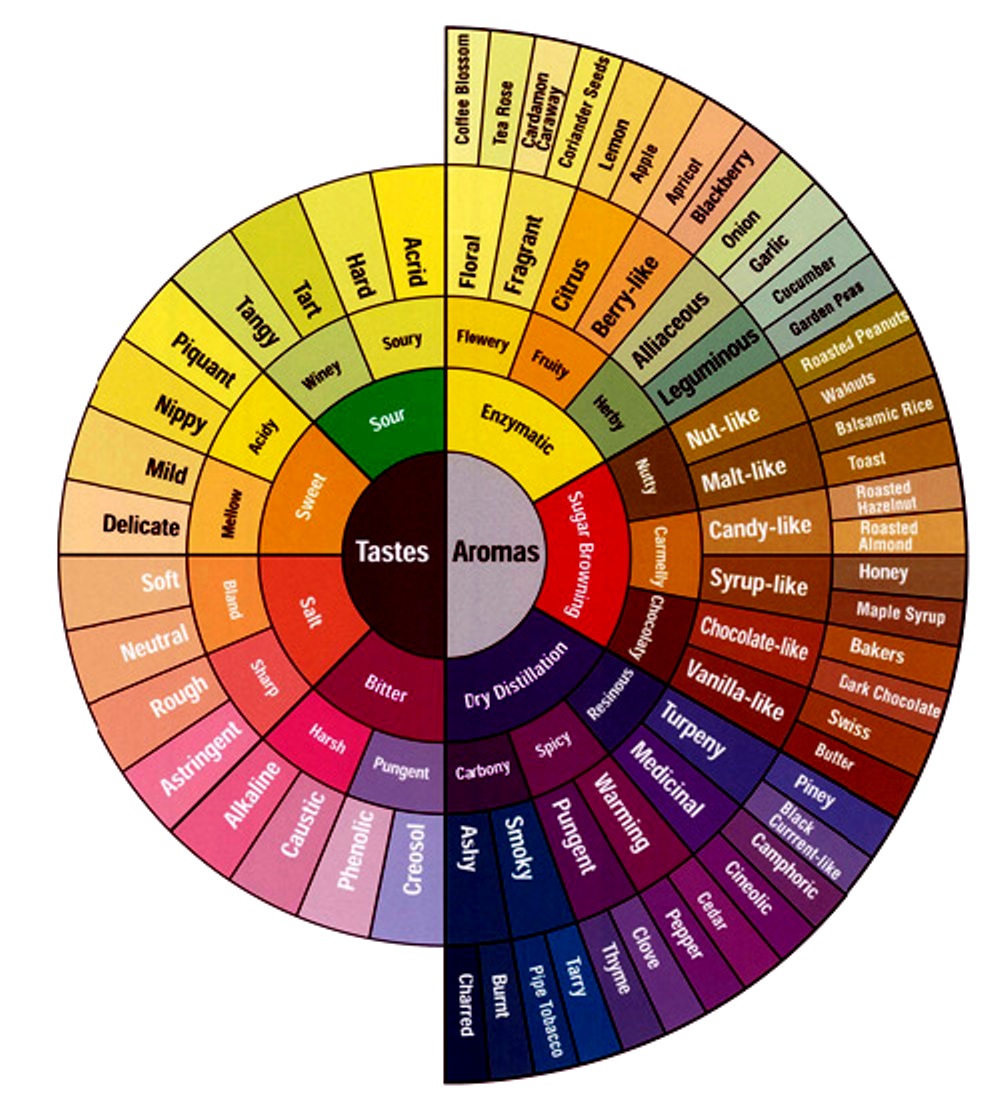
The coffee flavour wheel – but it’s not as simple as that.
I’ve always told people that if you hold your nose – or drink beer from a bottle, which is the same thing – you’re cutting out that 80% of flavour. But our first experiment gave an interesting development on this. We were given bags of Skittles, tiny sweets with intense fruit flavours. We held our noses and placed them in our mouths, and could taste nothing but sugary sweetness.  But then, with out mouths closed, we let go of our noses and the flavours flooded in, instantly recognisable as lime, lemon, strawberry etc. This is ‘retronasal’ activity – when the nasal passages are clear, air breathed in through the nose brings alive flavour which you think is in your mouth, but isn’t. You’re not ‘smelling’ it, but experiencing it in your nasal cavity via the passages linking the nose and the back of the mouth.  
Taste and Sight
It’s often been said that the first bite is with the eye. But that goes way beyond something simply ‘looking appetising’. For this experiment, we were served black ravioli, green mushrooms and purple pesto. It has to be said, it didn’t look great:
Black pasta is at least familiar, and I ‘tasted’ squid ink even if it was only food colouring. The green mushrooms were a real struggle, and the pesto didn’t ‘taste’ of pesto at all, but to me, of something quite fruity. 
This was a toned down version of a previous experiment that had been thought apocryphal, but which Charles Spence has managed to track down. In the early 1970s a bunch of people were fed a meal of steak, chips and peas under very low lighting. Halfway through, the lights were turned up and everything was the wrong colour. The steak was bright blue, and the sight of it caused half the diners to vomit, even though the steak was fine. 
Colour perception in food and drink is hardwired into our evolution. In evolutionary terms, fruit turns into beautiful, attractive colours when it is fully ripe and ready to eat. It wants to be eaten, because its seeds are then spread in the spoor of animals who move around and spread it over a wider area. 
Adding red food colouring to certain foods makes it ‘taste’ 10% sweeter.
But meat and fish are not meant to be blue. 
This reminded me of another press release I received back in March. An American company called DD Williamson gave teenagers three different drinks: one clear, one brown, one pink. They were, of course, identical apart from the colour. The respondents (81% of them) correctly identified the clear drink as having a lemon-lime flavour. The best they could do with the brown one was describe it as ‘sweet’ or ‘fruity’ (34%) with 15% saying it tasted of cola. The red one was considered ‘fruity’, ‘berry’ or ‘sweet’ by 38%, with others suggesting cola or ginger ale.    
A couple of years ago, Brew Dog and Stone collaborated to produce a ‘pale imperial oatmeal stout’. I tasted it with a blindfold at the launch of Brew Dog Camden, and was suitably amazed when the colour was revealed. 
Taste and Sound
Back to Edinburgh, and next up it was my gig. After what I’d experienced so far I was worried I might be bringing the tone down by pairing the Pixies’ Debaser with Duvel and simply saying, ‘Good, innit?’ (It is though – it really works!) 
So I decided to go a bit further. With Chimay Red, I chose Debussy’s Clair de Lune (specifically, from about 1.46 on this clip) because I thought it paired well with elegance, structure and swirling, mysterious depths (though Chimay Blue might have been better for this). I faded it out halfway through, and brought up Hendrix’s All Along The Watchtower instead, for its darkness and heaviness. Just about everyone thought the flavour of the beer changed. And 70-80% of those who did felt it tasted better with Hendrix.
But Charles Spence went one better – because he does this shit for real. He has briefed a composer to take one simple, tonal piece of music and arrange it in the style of ‘sweet’, ‘bitter’, ‘salty’ and ‘acidic’. He played each piece, and asked us to choose which flavour it aligned with. Obviously we could be back in pretentious territory here. But every time Charles does this, he gives the audience buttons to press which record their responses, so over time he’s building up a database of the choices people make. In our session, between 70-80% of respondents agreed on which piece of music went with which taste, and these findings were consistent with Charles’ norms. We may not be able to explain why, but we make consistent connections between certain sounds and certain flavours. 
Taste and touch/texture
For this course/experiment we had a nice shepherd’s pie with a leek and potato mash, and a range of utensils to eat it with. It tasted completely different when eaten with wooden, plastic and stainless steel spoons. It’s all about how the texture of the spoon influences the food. Interestingly, stainless steel, even when scratched, will react with the air and ‘repair’ the coating that prevents food tasting of metal. It’s therefore actually better than silver.  According to Mark Miodownik, the materials scientist who presented this course, we’re the first generations to be able to taste our food without its flavour being compromised.
As a tip – this is why you shouldn’t taste something from a wooden spoon while cooking – unless your guests are also going to be eating with wooden utensils, it’s going to taste different when served.
Mixing it all up – synaesthesia
This next bit is where the headfuck really kicked in for me. 
Synaesthesia, where the senses get mixed up, affects around one in 23 people. (It’s difficult to say for sure because there are so many different varieties of it and many people aren’t aware they have it.) Like many who consider themselves creative, I’d like to think I have a form of it but have never been sure, suspecting I was probably making it up. 
How synaesthetes might see letters and numbers – for some, each has its own colour
Julia Simner, a neuropsychologist and leading expert in synaesthesia, gave us each two lumps of sugar, one a cube, the other round. She told us one of them had been impregnated with a lemon flavouring and the other had not. Which one was flavoured? 
Jumping ahead, I guessed that shape would be influencing our perceptions, and that the two lumps were probably the same. I stared at them. “OK, if I have synaesthesia, the square will taste of lemon,” I thought to myself. Then I tasted them. “Oh no, it’s the round one – that really does have lemon flavouring, she wasn’t messing about. It’s really very clear.”
She then told us that neither shape had flavouring added – they were both just sugar.
So I have a crap palate then, I thought, or I’m just susceptible to suggestion. 
But here’s the thing – I went back for another taste, and even after being told there was no added flavouring to either, that they were identical, the round one still tasted of lemon – even though I knew objectively and rationally that it didn’t. 
Was she lying? Was this a double bluff? 
I put the two shapes behind my back, broke off a piece from each, swapped them around, tasted when I could not possibly know which shape each had come from – and they both just tasted of sugar, and nothing more. I looked at them again, tasted again, and the round one tasted of lemon. This carried on until I’d broken off so many bits the shapes were eroded. Eventually they were both just similar-looking blobs of sugar. The lemon flavour disappeared. 
I have no idea what practical use this newly discovered link between shape and flavour could possibly be, but it’s there, for me at least.

And totally screwing it around – the miracle berry
Finally, we were each given a miracle berry pill. This small fruit is sometimes used as a sweetener, not because it is sweet itself, but because it contains a compound which affects the tastebuds and blocks out sour flavours. 
After eating the berry, we ate a dessert of lemon and lime wedges, which tasted like fresh, sweet oranges.
*
The truth about what we ‘taste’ is that most of it happens not in the mouth, but in the brain. “Taste is, ultimately, just the firing of neurons,” said one of the speakers. “You don’t have to actually eat or drink to experience it.”
You can make someone ‘taste’ a roast beef dinner by opening their skull and stimulating the parts of the brain where taste is experienced (though you should not try this at home).  LSD makes people experience synaesthetic sensations. And due to advances in neuroscience and our increasing ability to map brain activity, we can now both manipulate it and understand it without sawing into people’s craniums.
All of which has amde me very nervous indeed about writing beer tasting notes.
After dinner, a few of the flavour academics and I sauntered to the bar. We were in a student union building and there was just one decent beer – Stewart’s IPA on cask. We carried on talking about synaesthesia and flavour perception for half an hour or so, and then Charles Spence noticed me frowning and grimacing and asked, “Is there something wrong, Pete?”
Yes there was. I was not enjoying my beer at all. It was dreadfully sweet. There was no hop character whatsoever, and it tasted like someone has stirred three sugars into it to compensate. I should have known better than to trust a student union bar with only one cask handle. 
Julia Simner smiled. “How long ago did you eat the miracle berry pill, Pete?”
“About 45 minutes ago, why?”
“The effect lasts for about an hour.”
Let’s hope this research never falls into the wrong hands.
Charles Spence has now thrown down the gauntlet to me to up my game in how apply some of this learning to beer and music matching. I will be attempting to do so at my next beer and music matching event, which is happening lunchtime on Sunday 18th August at the Green Man Festival. Given the amount of drugs the audience will have consumed by that time, I’m feeling pretty confident.

| Uncategorised

Alcopop: the drink that dare not speak its name.

Where’s George Orwell when you need him?

The inventor of double speak, already one of the best writers on pubs we’ve ever had, would have loved the shenanigans happening in the drinks market today.

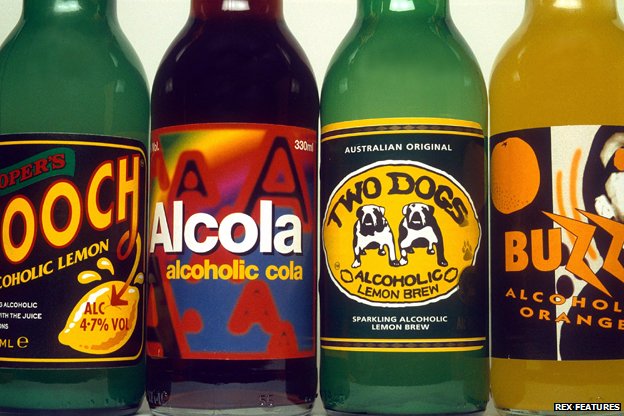
A couple of days ago, the BBC proclaimed ‘The quiet death of the alcopop‘.

These are – or were – alcopops.
Under the image above, they told us that the ready-to-drink, flavoured alcoholic beverage sector of the drinks market (alcopops to you or me) has halved in size since 2005. Interestingly, the decline is blamed on the tacky, garish image of the products above. Not much is said about the desire for sickly sweet, fruit-flavoured alcoholic beverages, and whether that has gone away or not.
The truth is, our desire for these concoctions is just as strong as ever. Sales of alcopops are soaring. The leading brands just don’t want you to call them alcopops, and some get angry if you do. 
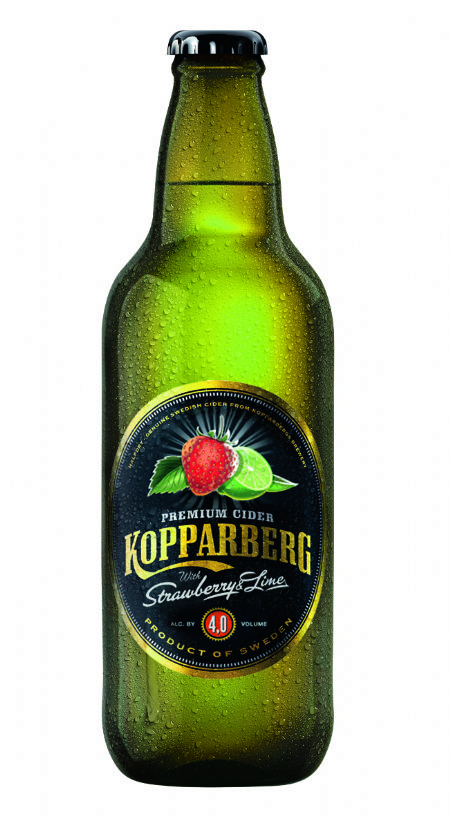
A few weeks ago I wrote in my column for the Publican’s Morning Advertiser that Kopparberg and Rekorderlig, which refer to themselves as ‘premium fruit ciders’, are nothing of the sort. They are alcopops in disguise – admittedly a very fetching, stylish disguise, especially in the case of Rekorderlig, whose packaging and labels are so beautiful that it sometimes takes a mental struggle to remember how unpleasant the product was – to my palate – when I tasted it. 
And this is another alcopop.

I understand that both brands were rather angry with the PMA for printing my opinion. I don’t understand why. I based my contention that these producers are not cider simply by quoting the ingredients they list on their labels/websites.

This is also an alcopop.

Kopparberg is made from ‘naturally occurring soft water’, fruit juice, sugar, acidifier (citric acid), flavouring, and potassium sorbate.

Likewise, Rekorderlig consists of ‘fresh spring water, pear and apple wines, sugar, acids: citric acid and sodium citric, berry flavours, preservatives: E202, E220 and caramel colour.’

Cider, on the other hand, is made from apples. The character of any cider depends on the varieties of apple that are blended, just as most great wines are about the blend of grapes (you can of course have single varieties of either). Even a leading commercial cider such as Magner’s – which many cider geeks would not consider cider at all – proudly talks on its website about the 17 varieties of apple used to make it. Say what you like about Magner’s, and I don’t drink it myself, but the draught version contains more Dabinett apple than the bottle does, a specific move to compensate for the fact that it’s going to taste different when not poured over ice.

By contrast, I can find no mention of apple varieties anywhere in Kopparberg or Rekorderlig’s promotional material. Rekorderlig’s website has a tab telling you about ‘flavours’. When you click on ‘apple’, this is what it says:

“Made from the purest Swedish spring water, traditional yet modern Rekorderlig Apple Cider is best served over ice for a crisp, cool and refreshing experience.” 

IN THEIR OWN WORDS, the ‘apple-flavoured’ variant of their ‘cider’ is made from water rather than apples.

Click on the ‘history’ bit on Kopparberg’s website, and the word ‘apple’ doesn’t appear once. Instead it talks about the minerality in ‘Koppaberg’s lakes and waters’, which proved inspirational to Kopparberg’s first ‘brew master’. Cider is not ‘brewed’. And once again, cider is made from apples. Not water.

It’s sad that we have such a lax regulatory environment that these alcopops are allowed to get away with calling themselves ciders. They do so, of course, because cider is so much more fashionable these days than any kind of flavoured alcoholic beverage.

But this post is not just about faux ‘fruit’ ciders – the current alcopop boom is much broader than that.

This, too, is an alcopop

Jeremiah Weed has had a brilliant launch. Again, it looks and feels too posh to be called an alcopop, but as a ready-to-drink, flavoured alcoholic beverage, that’s exactly what it is. It reeks of authenticity and heritage. In fact it has none whatsoever – it’s entirely a creation of 21st century Big Marketing. That aside, at least it doesn’t claim to be a different kind of product from what it is.

Or that’s what I thought – until the second comment below from eatingisntcheating.blogspot.com alerted me to this news story from last month – it seems Jeremiah Weed is now a cider too! In the company’s own words, although this product:

This is an alcopop, also

has not changed from when it was launched as a ‘ginger brew’, it is now, apparently, a ‘Kentucky style cider brew’. (Remember, cider isn’t brewed. At all.) And why have they pulled off this astonishing feat? Why have they changed one type of product into a completely different type of product, while not changing the product AT ALL? Why, “to help consumers, retailers and bar staff to better understand the brand’s exciting and innovative offering and [entirely fictitious] Kentucky heritage” (my italics). That’s right: they’ve started calling something a cider that isn’t a cider and didn’t used to be called cider to help people better understand what it is.

And then there’s the recent summer sensation: Crabbies ginger beer.

This is a tricky one, because ‘ginger beer’ is a recognised style of drink. You could get into an awful lot of semantics here because a true ‘ginger beer’ is brewed from a combination of ginger, sugar, water, lemon juice and a bacteria called ‘ginger beer plant’, and this fermentation process produces alcohol. But while it may be called ‘beer’, it resembles what we commonly understand as ‘beer’ in no way whatsoever – it has a completely different base of fermentable sugars and flavour ingredients from any beer. In terms of ingredients and process, it looks a lot more like an alcopop. And that’s assuming Crabbie’s is brewed in the traditional way – which it isn’t.


This is – oh, you get it by now.

But this ambiguity has now led to something truly absurd, something which makes the whole long-drinks market look utterly farcical, even more ridiculous than water-based ‘ciders’. Here’s the trade ad for Crabbie’s that ran on the back of the Publican’s Morning Advertiser last week:

I don’t know what the hell this is, but it’s certainly not a premium ale.

A cloudy alcoholic lemonade. Haven’t we had these before? Oh yes, they were the original alcopops weren’t they? Before the riot of different flavours came along. Surely there is no argument whatsoever that this is an alcopop.

But no: look at the second bullet point down: on the basis that ginger beer could be confused with actual beer, Crabbie’s claims to be not an alcopop at all, but a premium ale. That’s right: an alcoholic lemonade is classed as being the same kind of product as Fuller’s London Pride, Thornbridge Jaipur, and any other ale between 4.2% and 7% ABV.

Alcopops are enjoying a boom to rival anything they saw in the mid-90s, but they’ve learned their lesson and are now seeking to establish a credibility that will allow them to outlive the natural ‘fad’ life cycle they enjoyed last time. Because they do not have any intrinsic credibility of their own, the leading brands are stealing it from beer and cider, ashamed to admit what they really are.

A lot of people like them and that’s fine – not everything has to be crafted and balanced in flavour. But by claiming to be something they are not, they displace other products that have some integrity, increase confusion among paying punters, and denigrate the image of the drinks they are masquerading as.

| Uncategorised

The Guide to Welsh Cider and Perry

Wales has got its mojo back. The last refuge of off-colour jokes about people based on their nationality or ethnicity has flourished since getting its own Regional Assembly in the late 1990s (and a healthy wodge of EU funding), transforming itself from a ravaged post-industrial slumpland into a vibrant, exciting tourist destination that has stunning scenery and great food and drink at its heart.

Take the Abergavenny Food Festival – for one weekend every September, the whole of this beautiful market town is taken over by a riot of food and drink producers chefs, writers, beer tents and the occasional random performance artist for a joyous appreciation of food and drink. It might be lazy to refer to it as ‘The Glastonbury of food festivals’, as some journos have, but it’s not inaccurate.

Abergavenny also sits at the heart of Welsh cider country. Monmouthshire shares climate and geography with neighbouring Herefordshire – one of England’s two great cider making regions. And the last fifteen years have seen an extraordinary revival of a Welsh cider making tradition that had all but disappeared by the 1970s.
In 2000, two Welsh cider makers founded the Welsh Perry and Cider Society to promote what was then an embryonic re-birth. Now, the society has over forty producer members, from people who make a few gallons in their sheds for competitions, to large brands such as Gwynt Y Ddraig, which has nationwide listings in ‘Spoons among others. By the mid-noughties, Welsh ciders were winning more than their fair share of awards in national competitions, and today, from virtually nowhere, Wales is one of the most important cider making regions in the UK.
Last year the WPCS invited people to tender to write the Guide to Welsh Perry and Cider. Bill Bradshaw and I won the pitch. 
The Guide is now available. Self-published by the Society, it’s not as widely available as a book via an established publisher would be, but if you are interested in cider I’d humbly suggest it’s worth tracking down. 
The job of the book is to give details of everyone who makes cider commercially in Wales, as well as details of pubs that serve good cider, and festivals and events where you can try a decent range. I wanted to make this entertaining as well as informative, to capture some of the personalities and a sense of place. Bill’s excellent photography more than delivers on that. Like any great cider making region, Wales has a good smattering of eccentrics and visionaries with stories to tell. Wherever cider is drunk, an element of joyful anarchy is loosed, and it doesn’t hurt that you’re surrounded by some of the most stunning scenery in the UK. 
The book is available through Amazon here, and will be selling at events and in Welsh bookshops and tourist centres.
Talking of events, I will hopefully be doing something around the book at the Green Man Festival next month, which has a fully fledged Welsh beer and cider festival within it this year. (I’m already confirmed to do a beer and music matching event on the Literature Stage at 2pm on the Sunday). And Bill and I will be talking about the book and doing a tutored cider tasting at this year’s Abergavenny Food Festival – by which time, our World’s Best Cider book may also be available…
Iechydd da!

| Uncategorised

Reasons pubs are closing #453

Last week I was invited to the All Party Parliamentary Beer Group annual dinner.

It was a great event, with some wonderful beer and food matches and a bunch of awards handed out. Fergus Fitzgerald from Adnams was named Brewer of the Year – a richly deserved accolade for someone who is running a great range of traditional ales and an exciting programme of craft beer innovation side by side.

George Osborne was recognised and awarded for dropping the Beer Duty Escalator and for the first cut in beer duty since 1959. I loathe this man more than almost anyone alive, and being in the same room as him made my skin crawl. But it is right that he was applauded – he did something the industry had been asking for for years, something that benefits every pub in the country, and it’s right and proper we say thank you for that before getting back to hating him for his open warfare on the poor and disadvantaged, his arrogant shattering of the social contract that exists between a government and its people.

Also honoured was Andrew Griffiths, the MP for Burton-on-Trent. His was an easier gong to cheer. He’s a Conservative MP, a tireless campaigner for and genuine lover of beer, a great constituency MP, and a thoroughly decent bloke. He’s the proof that you don’t have to be arrogant, venal and cruel to be a Tory MP, even if many of them are. He made a long speech about the campaign against the duty escalator. He could have scored some easy party political points by pointing out it was introduced by a Labour government, but he didn’t. He could have scored more points by pointing out it was a Tory government that scrapped the escalator – instead, the first thing he said was that the campaign had been a cross-party effort. A thoroughly decent man who you’d happily buy a pint for – but that would involve getting to the bar before him…

After the dinner was over, a few of us – Griffiths included – wanted to go on for another drink somewhere else. It was late, and we were in Westminster, where licensing laws are overseen by a council that hates the very existence of pubs and refuses pretty much any requests for late licenses, so it was the kind of evening where you have to make compromises. Griffiths suggested the Players Bar, a late night place in Villiers Street in Charing Cross, apparently popular with MPs and their staff.

As you’d expect, the beer selection wasn’t great: A-B Inbev had inflicted their range on the bar, and draught beers consisted of Stella, Bud, Becks Vier and the loathsome Stella Artois Black. But alongside the Becks and Bud bottles in the fridge there was also Staropramen – not an immediate choice of mine, but I can drink it without complaint.

Or at least, I can when it’s served in a drinkable state.

When we were served our second round, I took a sip from my beer and discovered it was warm – room temperature in a hot room.

“Excuse me, this beer is warm,” I said to the barman.

“So?” He replied.

“Well, it’s undrinkable.”

“But you’ve had some out of it.”

“Yes, that’s how I know it’s warm. I can’t drink any more of it. Can I have another one?”

“I could give you a glass with some ice in it.”

“No, I don’t really like ice in my beer, thanks. Could you just replace it?”

He took the beer away and handed me a fresh, cold one.

“That’ll be £5.”

“What? You’re charging me to replace a beer that wasn’t fit to drink?”

“You’d drunk out of it.”

At this point Andrew Griffiths, ever the gentleman, stepped in and paid for the beer.

Conflict was averted. It would have been rude to have pressed the point when Griffiths – our host – had acted so decisively to head off the argument. But it spoiled my evening. We often make the comparison between pubs and coffee shops. It’s highly unlikely you’d ever be handed a stone cold cup of coffee. But if you were, it would be replaced with a hot one without question. Pubs like this – mercifully rare – seem incompetent and unfriendly by comparison. If this is where MPs come to drink, and this is the kind of service they get, no wonder so many of those who weren’t at the dinner tonight don’t seem that bothered about pubs disappearing.