Author: PeteBrown

| Beer, Craft Beer

Is anyone still interested in a definition of craft beer?

I wonder…

It’s been a depressing spectacle this last couple of years watching people who share a love of great beer tear each other apart over trying to define what craft beer is.

I’ve been using the term for years in a very loose way to describe most things that are not mainstream commercially produced lager. But in the last three years, as craft has become a defined movement, some people have felt an increased urgency to give it a proper technical definition. Others have asserted that because it doesn’t have one, it does not and cannot exist – an attitude that seems to me to display a curious mix of arrogance and paranoia.

There are various obstacles to coming up with such a definition.

One is competing interests. The nearest thing we have to a definition is that put forward by the American Brewers Association. It talks about size of brewer, ownership and adjuncts. The thing is, this is a trade association’s description designed to benefit members of that trade association. It serves their purposes, not the drinker’s. It changes to suit the evolving needs of its members. Which is fair enough – for them. What’s not fair is when they seek to impose this definition on the whole world of beer. The best beer I’ve had this year is a bourbon aged Imperial stout with cherries from Goose Island. According to the BA, this is not a craft beer because it’s owned by A-B Inbev. Now I hate A-B Inbev as much as anyone, and I’m deeply wary of their intentions to Goose Island. But any universe where the beer I had is not a craft beer is a strange place indeed.

Then at the other end there’s the whole “if it walks like a duck, talks like a duck…” school of thought, which says you don’t need to be able to define a craft beer to spot one. This has been criticised for reducing things to “I like this beer so it’s a craft beer.” I think that’s a bit disingenuous. Amid all the debates about what is and isn’t craft beer, those arguing could probably agree on nine out of ten beers being craft or not. But many people would rather spend their time arguing about the one out of ten that’s ambiguous.

The definition I have the least time for is the “craft beer is quality beer that is served in keg” school. This is absurd and feeble minded. The kind of people who say this in a positive way do so to distinguish ‘craft’ from what they see as ‘boring brown’ cask ale. It’s nonsense. By taking this stance against the real ale diehards who believe anything in a keg is bad, they’re merely proving themselves to be a mirror image of those diehards, just as ignorant and bigoted. If craft beer is about anything specific, it’s certainly not about the container it’s in – the whole point of it is that it should be all about the beer.

My personal view, as I expressed in response to Mark Dredge’s excellent recent post about craft beer whiners, is that it’s more useful to think of craft as an adjective rather than a noun. Not as a specific style of beer, but as a general description, the same way we’d say ‘dark’ or ‘full bodied’ or whatever – deliberately non-specific, but carrying a degree of commonly understood meaning.

That’s how I’ve always thought about craft beer. But I’m all too aware that many people in the beer world NEED technical definitions – it’s how they navigate the world.

Well if you’re one of those people, how about this?

At a recent conference on innovation in beer, St Austell brewer Roger Ryman gave a presentation about craft beer in which he quoted an article by Dan Shelton, which appeared in the last edition of the Good Beer Guide to Belgium. This guide is currently out of print because a new edition is launching this summer. But editor Tim Webb very kindly sent me a copy so I could read the piece and write about it here.

Dan Shelton clearly has some axes to grind of his own, but I found his multi-part definition of craft beer quite compelling. He identifies five aspects:

  • – Ingredients: does the brewer seek the best possible ingredients or is s/he more concerned about keeping costs down?
  • – Methods and equipment: the brewery’s intent – does the brewery do everything it can to maintain quality or does it let things slip as it grows? Is the brewery making the best beer it can?
  • – The brewer’s spirit: hard to measure, but does the beer reflect the brewer’s personality or is it simply generic and lacking in faults? Are they just following the market, or trying to do something special?
  • – Company structure: who’s calling the shots? It’s not necessarily about company size, but does the brewer decide what beers are brewed or does the marketing department?
  • – Control: is the brewer able to exercise some control over how the beer turns out or is s/he simply throwing in ingredients and hoping for the best?

Everyone who I would call a craft brewer ticks each of these boxes. What I like about this definition is that it’s objective. A global giant could produce a craft beer if they followed these rules, but they don’t. Their structures don’t permit it. But it doesn’t rule them out on size or ownership. It’s about intent.

And this definition does what no other does – it excludes small brewers who aren’t very good. Any idiot can throw an extra bag of citra hops into a copper, it doesn’t make them good brewers or their beer good beer. I’ve tasted bland beers that are not craft created by huge corporations, and I’ve tasted bloody awful beers created by tiny breweries that call themselves craft when they are not, because craft has to be about skill as well as size. I don’t know how you measure some of these criteria, but of it’s a neutral, objective detailed definition of craft you want, I think this does the job.

But like I said, I’m not sure we need it. While I was thinking about this post, I looked up ‘craft’ in the Oxford English Dictionary and it says “An activity involving skill in making things by hand.” Do we really need it to be any more complex than that?

| Uncategorised

And finally… Bondi Beer!

I can’t really write any more on this blog until I’ve closed the story of Bondi Beer.

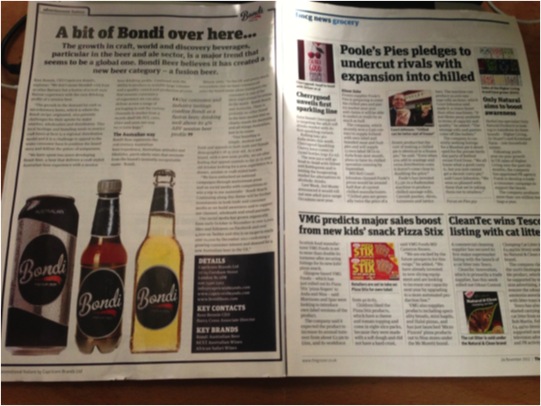
The story so far: in December I saw an appalling advertorial in The Grocer magazine for a beer called Bondi, which was calling itself a craft beer. I wrote a scathing blog post about it, assuming (I could find very few details about it online) that it was another cynical attempt to move into craft territory by a big brewer. I found a beer called Bondi online being promoted by Paris Hilton and obviously thought it was the same beer. (It wasn’t – turns out that was a different brand, different company, with the same name from the same country!)

Days later, the owner of Bondi beer contacted me. He was pretty angry and asked me to take the piece down. At first I resisted, and then I realised that this was in fact a very small company and that they were trying to do the right thing. They admitted the advertorial was rubbish and were very upset at the way it had been heavily edited. They asked me to meet them and taste the beer, and I agreed. I took my original post down – the first time I have ever done so – and explained why.

I’ve owed them this write-up ever since, but as you can see, I’ve hardly been blogging, because I’ve been so busy up against book deadlines. I could have slipped this post in at a time when this blog wasn’t really active, but I thought that would be the equivalent of trying to bury bad news at a time no one would see it. I wanted to wait until this blog was properly active again to guarantee this would reach my full audience. Sorry that has taken so long.

I met the Bondi guys in the fantastic Porterhouse in Covent Garden, which stocks their beer. We had a few beers and made peace. It was a good meeting. And it was a very, very good beer. Bondi is a four per cent lager that does not taste like you’d expect a four per cent lager with Australian branding to taste. It is contract-brewed in the Czech Republic, and it shows. There’s a brilliant Saaz hop character on the nose, bready and grassy, and a perfect balance of flavour, with proper body, a good buzzy finish, and yet the crisp refreshment of a good lager. It drinks way over four per cent – you’d guess at five, easily – so it’s very satisfying at such a low ABV.

I would heartily recommend this beer to anyone. I wouldn’t call it a ‘craft’ beer, as the advertorial originally did, but it’s a far better lager than any of the main commercial brands.

And that’s it, apart from two caveats.

One, I’m not writing this because Bondi asked me to. I promised them I would, and that was four months ago. They’ve put no pressure on me at all to get this post up here. I’m not saying it’s a great beer because anyone has told me I have to, I’m saying it because it’s a great beer, and if it wasn’t, I’d say that too. The only reason this didn’t appear before now is that I haven’t had time to blog about anything until the last week or so.

Two, in my defence, I just want to reiterate one point given that I took my original post down. A few commenters have been very keen for me to issue this clarification. One or two have accused me of slagging off a beer without having tasted it. I never did that. In my original post, I made no mention at all of the taste of the beer. I was slagging off the marketing – something I went way over the top with and regret in retrospect – but I make a professional point of not dissing a beer’s character without tasting it. (I took a similar approach with previous posts dissing the launches of Stella Black and Stella Cidre, following up with posts about the drinks themselves when I was able to try them).

Now I have tasted Bondi, I’m more than happy to talk about how good the beer is. I still think the launch marketing approach was ill-advised, and we talked about that too. The best thing Bondi can do is forget the jargon and sloganeering, and just put all their effort into trying to get beer into people’s hands.

I wish them all the luck in the world in replacing other Aussie beers on British bars.

| Uncategorised

The mischievous Swede and the truth about Stella Artois

A few months ago I was contacted by Jonas Magnusson, a Swedish TV programme maker who wanted to interview me for a series of programmes he was making about beer. We met in the George Inn and had a great chat.

I normally confine remarks to stuff I feel positive about in interviews such as this – when talking to a mainstream audience, I’d rather concentrate on what’s great about beer than moan about what’s wrong. But somehow we got on to big global megabrands that don’t actually care about beer at all, and we talked a bit about Stella Artois in particular in this respect.

A couple of days ago Jonas e-mailed me a link to a YouTube clip of when he went to Leuven to interview AB-Inbev about Stella. “You might be interested in this,” he said.

24 hours later there was another email titled ‘Did You Watch it’? I thought this was a bit pushy, as I’ve been frantically busy, but Jonas seemed really, really keen that I watch the clip.

And then, this morning, writer and blogger Max Brearley posted a link to the clip on Twitter, urging me to watch it.

I took the hint.

Here’s the film: if you’d like to watch it without my commentary, go ahead now. If you don’t have eleven minutes to watch it through, skip below to read about why you should.

Meet Jean-Jacques Velkeniers, Marketing Director for both Stella Artois and Jupiler in Belgium, Netherlands, France and Luxembourg. Jean jacques is a career marketer who is clearly passionate about his brand.

He says “it all started” with the merger of Interbrew and AmBev to create Inbev in 2004.  (Funny, because I thought Stella was a giant brand before then and was already in steep decline in the UK by this time.) He tells Magnus that these two companies shared the same vision and passion for beer.

What is this vision and passion?

“Conquering the world, market by market, using fantastic brands like Stella Artois,” replies Jean-Jacques.

Magnus then asks what would seem to be a fairly straightforward question: what does this world conquering beer actually taste like?

To which Jean-Jacques replies: “Can we cut there? That’s a very difficult question.”

The man responsible for marketing Stella Artois across a good chunk of Western Europe is unable to describe what the beer tastes like.

After consulting two colleagues he recovers his poise and claims he just didn’t know the words in English – this is astonishing as (a) so far his English has been impeccable – he has a perfect grasp of marketing jargon especially – and (b) even if he’s telling the truth, this means that as Marketing Director he’s never been asked what his beer tastes like in English before.

After being briefed on what his product tastes like, he tells us that it is very refreshing with a full-bodied taste, “crispy” (let’s be fair and put that one down to genuine translation issues) and that “after a couple of seconds you get that bitter after-note in your mouth that makes it quite unique.”

Yes, you read that right.

The marketing director of Stella Artois thinks his beer is unique because it has a bitter aftertaste.

To be fair, AB-Inbev do not allow their employees to taste beer from any other brewer, even when they’re off the clock, so maybe he wasn’t to know that bitterness is a common characteristic in almost all  beers – and that his brand rates pretty damn low in the bitterness stakes compared to most others. But still, you might have expected Jean-Jacques to have been given special dispensation given his role.

You might expect a man responsible for selling a huge beer brand in four European countries to have the first clue about what a typical beer’s flavour profile is.

But we press on. Magnus asks Jean-Jacques if he would be able to pick out this special, unique flavour in a blind taste test. He’s definitely up for it – you can’t fault him on his conviction.

But what he doesn’t know is that Magnus has already been out on the streets of Leuven, doing blind taste tests with people who regularly drink Stella and are loyal to the brand. It quickly becomes clear that no one can taste any difference at all between Stella and its sister brand, Jupiler. They do come from the same brewery – Jean-Jacques looks after them both – so perhaps they are – ahem – very similar beers packaged differently?

To make things more interesting, Magnus then gets out a cheap, crummy can of Swedish beer. “Yes, that’s definitely Stella,” say more Stella drinkers. “I had a pint five minutes ago and that tastes just the same.”

Back at AB-Inbev HQ, Jean-Jacques is gearing up for the blind taste test between Stella, Jupiler and the crappy Swedish beer when Natasha, the PR person intervenes. She tells Jean-Jacques that there was a pre-agreed script for the interview, and that this was not part of it.

If you want to interview someone from AB-Inbev you have to give them prior approval of a script!

As they discuss whether the taste test is going to be possible or not, Natasha briefly mulls over whether it would be OK just with Stella and Jupiler (Jean-Jacques is never allowed to drink a non-AB Inbev beer, remember) and Jean-Jacques has to remind his PR person that “They are filming everything we say.”

In the end, they decline to take part in any taste test, for three beautifully crafted reasons:

  • The beer is the wrong temperature
  • Jean-Jacques is “not prepared”
  • You need a glass of water to clean the mouth between beers 
I guess a glass of water was not available.
This is a sublime piece of film making. The number of different ways it skewers this marketing organisation, demonstrating that not only do they not care about beer, they don’t even know what it tastes like, is sublime.
You might not think there’s much difference between commercial lagers. But when I worked on Stella Artois fifteen years ago, before the merger that created Inbev, before the relentless cost-cutting came in, before everyone at Interbrew who had a genuine passion for beer was fired and replaced by career marketers like Jean-Jacques, everyone on our team could have picked out Stella in a blind taste test. We pursued this old-fashioned notion that you can’t sell a product properly unless you know and understand it. And you can’t do that unless you can train your palate to taste it – no scratch that – unless you can even be bothered to try it every now and again.
It’s something craft brewers do every day of their lives. And even among big global corporations, if you asked a similar corporate drone working for, say, Heineken or Carlsberg, they’d be able to tell you what the beer tastes like and why. They’d know that beer tends to have a bitter finish. They might not even have learned it for themselves in tutored tasting sessions, but if not they’d have access to some sort of cribsheet.
But of course, AB-Inbev is not a brewer, and Stella Artois is not a beer. It’s a fantastic brand that is too busy conquering the world, market by market, to worry about such trivial things as what the product is, or what it tastes like. 
The Great Beer Tour consists of three one-hour episodes, and starts on SVT (Swedish television) on 16th April. 

| Uncategorised

Meanwhile…

Dammit, I can’t wait.

The new website is going to take a while thanks to the appalling state of my finances after not having done any admin while working on new books.

One of my favourite lines in movies is from The Princess Bride, when one of the characters offers our hero the immortal advice, “Never start a land war in Russia, and never play cards with a Sicilian.” To that, for any aspiring writers out there, I would add, “Never agree to write two books simultaneously for two different publishers, especially at the same time as you’re supposed to be launching and promoting a third.”

Anyway, I’ve finished them now and am re-emerging into the real world. For the first time in two and a half years I’m not on a screamingly urgent deadline, and I have an itch to start blogging again, as well as going out, seeing friends, watching TV, and all the other normal stuff I’ve pretty much forgotten how to do.

The fruits of my labours mean it’s going to be a busy year.

In the UK, May 19th sees the launch of the Welsh Perry and Cider Guide I’ve co-written with cider photographer and blogger Bill Bradshaw for the Welsh Perry and Cider Society. Wales has come from nowhere in little over a decade to become one of the most important cider making regions in the UK, and now it gets its own guide. I’m married to a Welsh and spend a lot of time there. To see the country again through a cidery lens was truly special. Even if you don’t like cider – or Wales – this should give you pause to re-evaluate it.

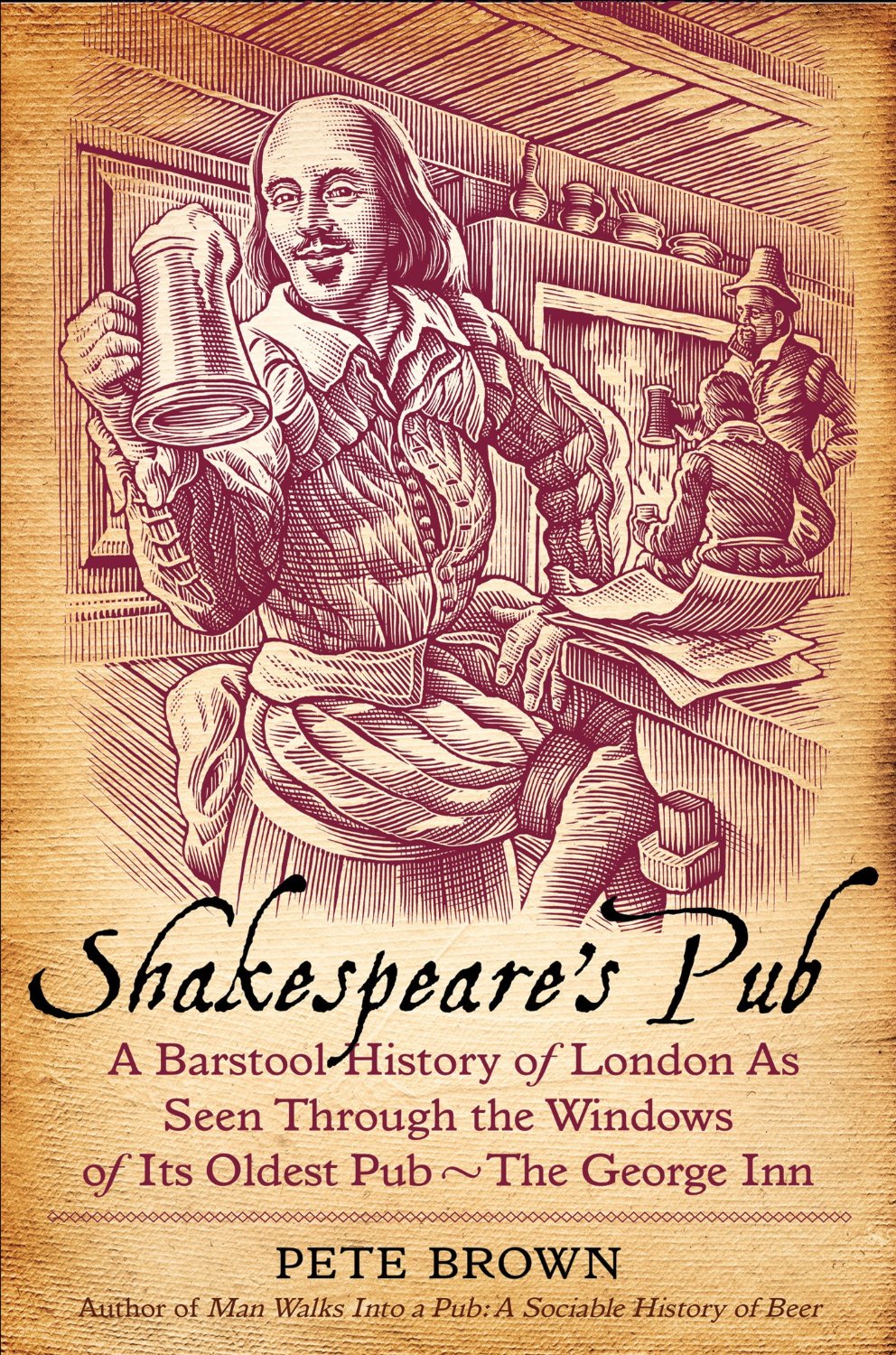
On 6th June the paperback version of Shakespeare’s Local comes out – perfect for those who don’t like shelling out on hardbacks or who have weak wrists!  I’ll be doing a lor of events to support this and will list them here.

And then Mid-October sees the launch of World’s Best Cider, again co-authored with Bill. Those big coffee table beer books have slipped into a fixed format since Michael Jackson wrote the first World Guide to Beer on the mid-1970s. There are shelves full of them, but not as many as there are for wine, and there are similar books on whisky, cocktails, tea, coffee – you name it. Except cider.

Everyone who makes and drinks cider thinks it’s just them that does so, and there’s never been a global look at cider until now. Cider makers in Britain, US, Germany, Spain and France have only just really started talking to each other in the last few years. And because cider is seen as rural and rustic, and so few people have compared the various styles around the world, it remains arguably the most misunderstood drink there is.

We were lucky enough to be commissioned by the company run by the woman who edited Michael Jackson’s World Guide to Beer. Our World’s Best Cider won’t be quite as good – not least because Michael put seven years research into that book and publishing no longer works on such luxurious timescales – but if it does even a tenth of the job for cider that Michael’s book did for beer, we’ll be very happy indeed.

I also get my first ever official US publications this year.  Shakespeare’s Local – rebranded ‘Shakespeare’s Pub’ – is launched in the US and Canada next month.

And in October, World’s Best Cider gets its own release in a country where cider has the same levels of excitement and wild experimentation that craft beer had twenty years ago.

So there’s so much else to blog about. I will be doing my update on the whole Bondi beer thing very soon, as that is well overdue and quite interesting. There’s lots of travel to write about. And this blog will increasingly feature content about cider as well as beer. Beer will always be my first love, but there is so much in cider that so few of us know anything about. It’s really exciting.

But first – later today if I have time – in true Pete Brown’s Beer Blog tradition, I have a cracking story about Stella Artois and a mischievous Swede…

Laters.

| Uncategorised

UNDER CONSTRUCTION

Hi, my name’s Pete Brown. You may remember me – I used to be a beer blogger round these parts.

No? Not ringing any bells?

I’ve kind of been getting busier. Two and a half books in eighteen months with three different publishers whose schedules have no reason to coincide. Blogging has faded away to nothing – for about a year there it was a luxury I couldn’t afford.

As I come out of isolation and look at the mountain of interesting stuff I have to blog about – a year’s worth of travel, trips, escapades, learning and reaction to what’s happening in the world – this ol’ blogger format is looking tired.

So given that this blog is almost defunct, this seems like a good time to do a long overdue upgrade.

My new website will be launching soon. It will still have a revitalised blog at the heart of it, but it will also collect together a lot of stuff I’m writing elsewhere, and have permanent content such as information and sample chapters from my books, up to date details of events, photo galleries, and all sorts.

As my focus expands from beer to include cider and more general writing about social history and stuff, it will be less overtly beery, but beer will no doubt still make up most of the content.

I can’t wait to get started on it.

See you soon.

| Uncategorised

The Pub Trade in 2013

Just before Christmas I was asked by leading pub trade mag The Publican’s Morning Advertiser to give some predictions for what will happen in the UK pub trade in 2013.  They had to edit for space, and killed one or two jokes in the process, so here is the full thing.
Apologies if it’s a bit cliquey for those not working in the UK pub trade – I didn’t have time to do proper predictions here.  Normal blogging will resume just as soon as I’ve finished writing my next book, World’s Best Cider, in about a month’s time.
January 
A beer blogger from Wrexham works out a definition of ‘craft beer’ that nobody has a problem with. She is subsequently awarded the Nobel Peace Prize.
February 
The rate of pub closures rises.  Everyone in the industry panics.
March 
A saboteur switches George Osborne’s weak Ovaltine for Timothy Taylor Landlord, and the chancellor unexpectedly tastes beer for the very first time.  He uses his budget statement to issue a heartfelt apology to the nation’s brewers and immediately freezes beer duty.
April 
The negativity on the Publican’s Morning Advertiser’s online forums reaches such an intensity that it creates a black hole just outside Crawley.  Professor Brian Cox is called.
May 
Brew Dog releases a 4.1% ABV premium bitter brewed with moderate amounts of Fuggles and Goldings hops. Beer bloggers declare this to be a stroke of subversive genius. The Portman Group slams it as stupid and irresponsible.
June
The royal baby is born.  Various brewers create commemorative ales. The Daily Mail accuses brewing industry of trying to give booze to babies.
July 
The Crawley Black Hole disappears. The nation celebrates. Brian Cox reveals he did it by showing cute pictures of puppies to PMA forum contributors until they cheered up a bit. And points out that this took THREE. FUCKING. MONTHS.
August
Brew Dog’s 4.1% bitter wins Champion Beer of Britain.  Beer bloggers declare this to be a stroke of subversive genius. The Portman Group slams it as stupid and irresponsible.
September
The rate of pub closures falls.  No one says anything about it.
October 
The editor of Observer Food Monthly commissions the first article about beer in the magazine’s thirteen-year history.

Just kidding.

November 
Shortly after releasing his blockbusting autobiography in time for the Christmas rush, Greg Mulholland MP flies to the jungle to appear on I’m A Celebrity Get Me Out Of Here.  And obviously wins it.  Because he’s AMAZING.
December
Wells & Young’s revives Young’s Christmas Pudding Ale (come on, guys, take a hint).
See you soon.

| Uncategorised

Beer Awards

I hate the Beer Writer of the Year awards.

It should be a special occasion where you just socialise with all your mates in the industry.  Instead, if you’ve entered your work, you sit there with a snake writhing in your guts, desperately anxious that your work be recognised, and when somebody else wins you have to be happy for them and try to hide the self-doubt and jealousy that try to consume you.

The year I won Beer Writer of the Year for Hops & Glory was actually the worst, because I was so anxious about winning.  I felt I’d given the awards my best shot, and if I didn’t win that year I would never win. So I could hardly eat anything, and when I was announced as the winner I’d managed to get myself into such a state that my only emotional response was relief.

What an idiotic way to live.

But I don’t think I’m the only person trying to make a living from writing who is an idiot, emotionally.

Last night was this year’s Guild of Beer Writers dinner and Beer Writer of the Year awards.  And for the first time I managed to work out a more grown up approach to it.  I didn’t have a book out (Shakey’s Local would fall into next year’s awards) and I’ve only ever won a category with a book before. There was a record number of entries.  While I thought I’d written some good stuff, I was aware that there has been so much beer writing and communication this year that I was able to go to the dinner for the first time with no hopes, expectations or anxieties about winning, and just enjoy the night.

When I got runner-up in online communication for this blog, I was happy but knew that was it – the rules are you can only win one category,  and only category winners go through for the final award.

So I was happily texting my wife when my name was read out as winner of the Trade Communications category for my column in the Publican’s Morning Advertiser, and I was genuinely shocked when chairman of judges Ben McFarland started reading out one of my blog entries in the run-up to his announcement of Beer Writer of the Year 2012.

I’m very happy and proud to win this award for my journalism, because somehow it feels easier with a book – it creates a bigger splash.

And I’m gobsmacked given what else was in contention this year.

I hadn’t realised Tim Webb and Steve Beaumont’s World Atlas to Beer was being entered this time – I thought it would be next year.  When it was announced as winner of the Travel Category, I texted the wife to say it was obvious now that it would win overall.  I’ve been meaning to review it for ages.  Michael Jackson’s World Guide to Beer set the bar for beer writing.  It takes balls to try to measure up to that book.  And at the same time, anyone trying to do so needs to make a case for why they should even bother trying.  Do we really need another beer coffee table book, especially when the information at its core is precisely the kind of stuff that now fills beer blogs and websites?  This book answers the call brilliantly.  There’s easily enough knowledge and authority between the two writers to make it worthwhile.  This sings through in the text, which acknowledges the changes that have happened since Michael was writing, updating this style of book for the twenty first century and the state of craft brewing today.  It even acknowledges mainstream beer, with the brilliant term ‘convenience beers’.  And it looks great.  You should obviously have my new book on your Christmas list, but if you can stretch to two, you need this one as well.

Tim Hampson does a great deal of work behind the scenes as Chairman of the Guild of Beer Writers and rarely gets any credit publicly.  His book on beery days out was runner up to Tim and Steve, and would have stormed the category any other year.

What a year for beer books though. On top of these two there was Roger Protz’s History of Burton which scooped Gold in the award for national writing (Roger was also runner up in trade for his PMA column) and Melissa Cole’s book Let Me Tell You About Beer – a book aimed at the beery novice rather than the geek – which would also have been a worthy winner.

Dan Saladino’s Food Programme is evidence that beer is being taken seriously on a wider scale and finally making inroads into mainstream media consciousness.  And Will Hawkes’ Craft Beer London app, which deservedly beat this blog to the online/social media top prize, demonstrates the new possibilities open to beer writing.

Martyn Cornell showed he can write about matching beer with food as well as he can its history, and Alastair Gilmour, who has won the top gong about a zillion times for his regional journalism, won that award again for his own magazine about beer and pubs in the north east, which should make any other region jealous that it doesn’t have something similar.  And props to Simon Jenkins for being runner up in that category, proving his triumph a couple of years ago was no one-off.

Ben McFarland says the final choice of Beer Writer of the Year was an incredibly difficult decision.  From that line up, I’m not surprised.

So yeah, I’m well chuffed.

In explaining the decision, Ben mentioned my obituary to Dave Wickett and then, to the consternation of some in the room cos it’s weird), read out an extract from my review of the Guinness film on the excellent Roll Out the Barrel DVD.

I’m delighted that both these pieces gained recognition.  I know I can sometimes be overbearing, facetious, irritating or just plain wrong. I know not everyone likes my style or the way I approach beer. But thanks for reading my stuff.

Check out the links to the rest of the work mentioned above too.  I don’t think there’s ever been so much good stuff being written about beer by so many different people.

| Uncategorised

Bondi Beer

For the first time in the history of this humble blog – OK, this blog – I’ve had to take down a post after having been threatened with legal action.

Ross Bennie is a real person, and he’s not at all happy with what I wrote about his beer.

There was one big factual inaccuracy in my post about Bondi Beer which I am more than happy to correct: Bondi Beer, which is now being launched in the UK and other markets, has absolutely nothing to do with Bondi Blonde, the now-defunct Australian beer that Paris Hilton and a gaggle of bikini-clad lovelies were associated with.  Completely different beer, completely different business.

Ross agrees that the advertorial on which my piece was based was awful.  He claims it was savagely edited, a process that cut out a lot of the information I thought should have been in there.

He also claims that the advertorial ran with a full page ad opposite, which would have given me the information I needed.  As you can see here, this is not true. Maybe it ran with an ad in other editions of The Grocer, but not the one I saw:

Ross also says that when I claimed the URL for Capricorn Brands (www.capricornbrands.com) wasn’t even registered, I’d made a basic schoolboy typing error and that www.capricorn-brands.com – with a hyphen – was indeed the fully functional website for his company.  It turns out that this is true, and that the website contains some useful information about the beer.  I would be extremely annoyed with myself if I’d made such a basic error.  However, in the advertorial:

There’s no hyphen.  It’s not my error.  The advertorial is carrying an incorrect URL for Capricorn Brands.

This really is one of the worst advertorials in the history of advertorials.

But Ross was most unhappy with the hyperbole I used at the beginning and end of my post.  I went over the top – intentionally so – for comic effect. Ross, whose livelihood depends on this beer, is not laughing.

I still believe there was nothing libellous about this, and that it was no worse than stuff you might read in columns by critics like Jay Rayner or Charlie Brooker.  Ross believes it was defamatory.  I believe it was harsh, but not libellous.

This is not what persuaded me to take the blog down.  If I were being threatened by, say, AB-Inbev in this way, I would happily invite them to bring it on.  But they don’t do that kind of thing, secure in the knowledge that a little blog like this can have no effect whatsoever on their business.

Bondi is different.  It’s a start up, and is fully independent.  Ross owns the brand and employs fifteen people.  It’s a small operation, and Ross clearly believes in his product.  If it is a good product, then my blog was unfair.  This is just a beer blog, for your entertainment, and I have no desire to put people’s jobs at risk.

I’ve agreed to meet Ross Bennie, hear about the beer, and taste it.  (It’s stocked by the Porterhouse in Covent Garden, and Peter who runs that place doesn’t stock shit beer).

If after doing this I still stand by my original blog post, I’m going to put it back up.  If the beer tastes great I will say it tastes great.  And if there are good plans in place for its launch I will share these with you.

I suspect what I’ll be reporting back is that I did a disservice to the beer itself, which does sound like it’s pretty good, but that I still won’t be happy with language such as ‘craft-styled’ in its promotion.  And that while this opens up Bondi to some justified criticism (someone surely must have signed off on that advertorial?) the net result will be that my original blog was unduly harsh.  And if that is the case, I will apologise.

We’ll see.

Given the sensitive nature of this issue, for the first time ever I won’t be opening this post to comments.

| Uncategorised

Come to dinner with India Pale Ale – 3rd December, Meantime Old Brewery

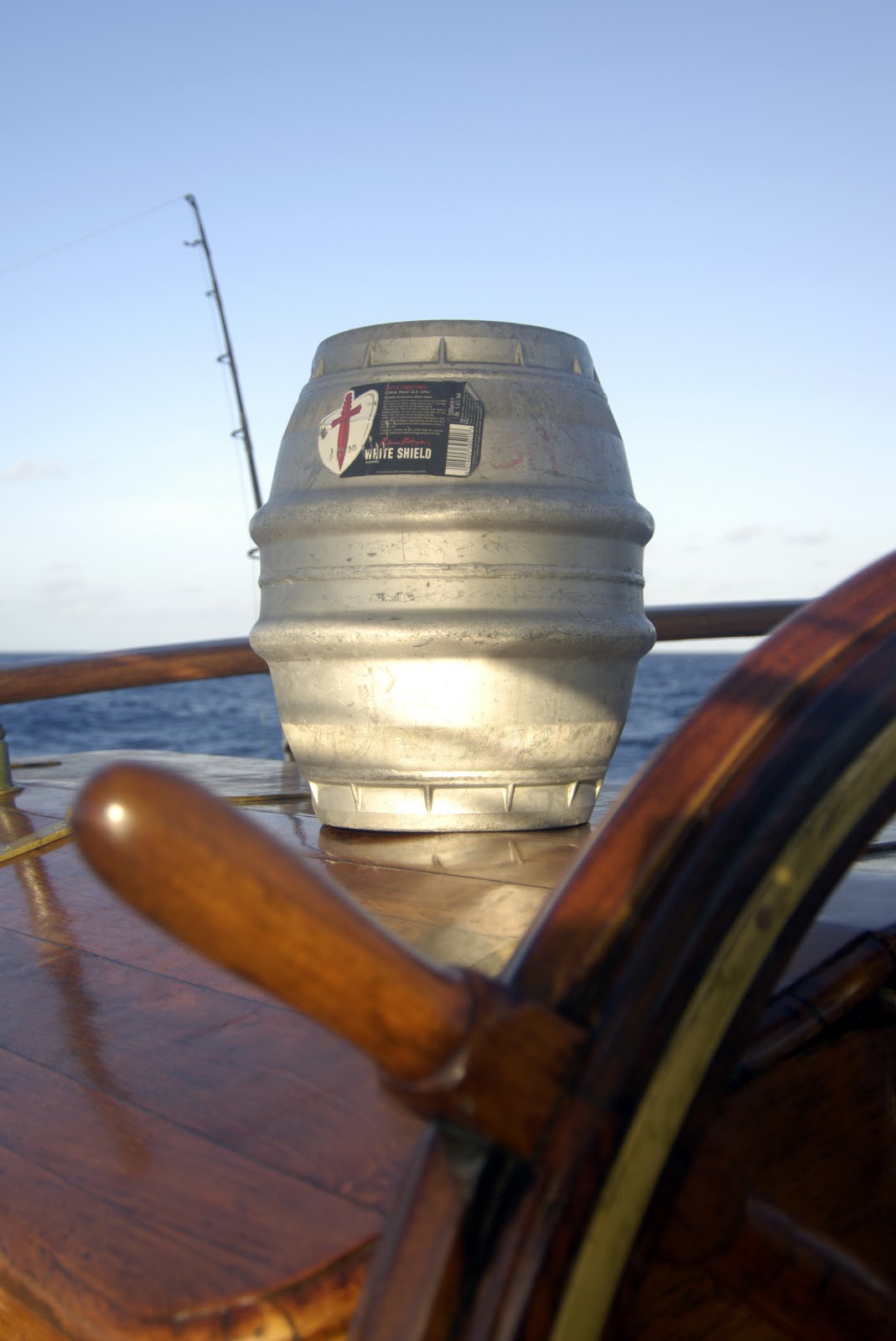
Barry the Barrel of IPA on his way to India. Or so he thinks.

IPA may be the most beloved beer style of craft brewers.  It may be the beer style that has driven the craft beer revolution around the world.  But it is also the most mythologised, debated, controversial and misunderstood beer style in the world.

Some people become incensed, possessed by violent rage, at what they perceive as falsehoods or inaccuracies in IPA’s history.

Others scream about commercial brands using ‘IPA’ in their name when they are not ‘proper’ IPAs.

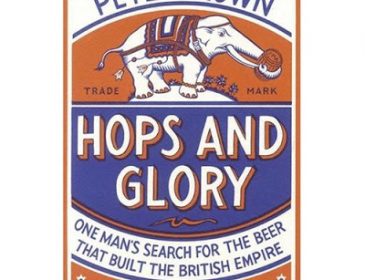
When I discovered various new facets of the history of IPA while researching my book Hops and Glory, some people simply dismissed my claims out of hand if they didn’t fit with their own story, ignoring facts I had discovered from primary research among original nineteenth century documents.

IPA is a cipher for all the various points of view and debates within brewing and beer fandom.

But it’s also a spectacular beer style that has at some point inspired pretty much everyone who loves craft beer today.

So when Meantime Brewing asked me to host a beer and food matching dinner as part of a regular series they hold at The Old Brewery in Greenwich, and asked if I would perhaps like to do this with an IPA theme, I leapt at the chance.

IPA has been around for well over 200 years.  Over that time, it has evolved, as tastes and brewing techniques have evolved.  We can’t say exactly what old IPAs taste like but we can infer things from various surviving recipes, contemporary accounts and recreations.  What we may not consider to be a ‘proper’ IPA today may have been universally understood to be the only valid interpretation of IPA sixty or a hundred yeas ago.

English troops enjoying Bass IPA, Bengal, 19th century

So what we’ve attempted to do is compile a list of beers for a tasting and then dinner which reflect how the style has evolved over the years, decades and centuries, and how it has reached a point in the last decade or so where it has developed into an extraordinarily broad range of different tastes and versions. I’ll be talking about each beer and more generally about how the style has evolved.

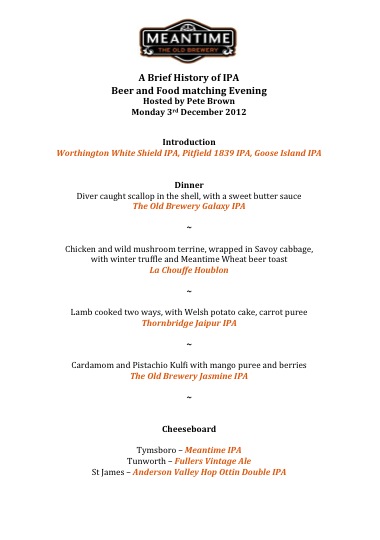
It’s not meant to be a point scoring exercise or a workshop in coming up with the definitive truth about IPA.  It’s meant to be a thoughtful look at arguably the greatest beer style, and an awesome evening of beer and food flavours.  Here’s the menu:

The evening starts at 6.30pm on Monday 3rd December, at the Old Brewery in Greenwich.  Tickets are £50 per person which includes all beers.  As of now it’s about 75% sold out but you can buy tickets by phoning 0203 327 1280 or by going to the Old Brewery website here.