Author: PeteBrown

| Uncategorised

In search of a Black Country Legend

“So you like beer then.”

“Yes.”

“What’s your favourite?”

“I don’t really have one.”

“Have you tried Bathams?”

“No.”

“Ah.  Well then.”

Some beers go beyond rationale analysis and objective evaluation, and attain mythic status.  The affection people have for them is not based simply on a hoppy aroma and firm malty base; it doesn’t have much to do with ingredients or flavour.  It transcends the liquid itself -or perhaps, that liquid becomes something divine and attracts all the clothing of religious devotion.

Westverleteren has it, though it’s carefully stage-managed by the Belgian monks who take pains to control its scarcity.  Timothy Taylor Landlord has it – a beer which excites old ale drinkers and new crafty beer drinkers alike, which elicits simple sighs from beer writers who have used up all the words they have in trying to describe its perfection.

These beers are revered.  I knew of them within about five minutes of entering the beer world.

But I happily published two books, made my mark with this blog, and gained at least one column in the pub trade press before I’d ever heard of Bathams.

I was doing some freelance advertising work with a bloke from Birmingham when I first had the conversation above.  I’ve since the same conversation about six times, each time with a native of Birmingham or the West Midlands.  Each time, my ‘no’ got a little less “No?” in that tone that goes up at the end as if to say, “Should I have?”, and a bit more “Nooooooo…” swooping down like a Messerschmitt in flames, defensive and frustrated and increasingly certain I was missing something special, fearing I was a lesser man, never mind a lesser beer writer, for not only having never drunk this beer, but for not having even seen any evidence of its existence apart from the word of an increasing number of Brummies who didn’t know each other, and therefore could not have been winding me up.

But I never see Bathams at festivals.  I never see anyone writing about it.  I don’t see it in shops.

Its acolytes try to describe its power to me.  It’s a session beer, they say.  But that doesn’t do it justice.  It’s more than that, it’s… oh, you just have to taste it, they say, and then, every time, they say, “Of course, there are only about five pubs in the world that sell it.  And they’re all in Birmingham and the West Midlands.”

The last person I had this conversation with was Charles Campion, food and drink writing legend and one of the most decent men on the planet.  And because Charles really is one of the most decent men on the planet, he resolved to put me out of my misery.  So a few weeks ago, nursing a brewers’ conference sized hangover, I found myself in the back of a car while Charles directed the Beer Widow to the Vine (or, if you’re in the know, the Bull and Bladder), the Batham’s brewery tap in the West Midlands.

It’s a cracking pub, one of those places that has withstood every single trend, technological development and interior design fad of the last thirty years.  It has carpets.  And separate rooms.  Aged banquettes that create a barrier between groups but still allow those groups to eye each other up.  A hierarchy so clear that as you walk in for the first time, you immediately know which rooms are open to you as a stranger, and which are not.  And a random collection of brilliant and nonsensical stuff on the walls that could keep you gawking for hours.

I was quite nervous when I got my first pint of Batham’s.  It’s made with Fuggles and Goldings hops, and contains invert sugar for a bit of extra sweetness.  It tastes quite sweet. And very nice.

I’ve noticed in some great session beers that the balance between malt and hops is not just about sensible balance, neither one being too extreme.  It’s about the combination, the mix of malt sweetness and hop fruitiness that combine to create a kind of glowing, floral perfume that hovers just above your palate.  This may sound horrible, cloying, sickly and effeminate, but is actually the opposite of all those things.  And Bathams does this very well.

But detailed analysis of the flavour is beside the point – that’s not what this beer is about.  It’s a beer that can be drunk easily and yet is satisfying, and it’s a beer that brings a smile to your face.  It doesn’t overwhelm you – you don’t have the first sip and go, “My God, that’s awesome!”  But the more you like it, the more you drink.  And the more you drink, the more you like it.

It also comes in bottles:

and I got to bring a few home with me.

This is not to be taken for granted.  Because over the weekend that followed this Friday night session, the stories began to come out.

You can’t find many places that sell these bottles, they say.  We visited one pub that does, but allegedly you have to take your empties back if you want some more, meaning it’s very difficult to get onto the Bathams ladder in the first place.

On cask, demand always outstrips supply, they say.  There are only certain pubs that get it, and these are known to serious drinkers.  Stocking Bathams wins a landlord instant admiration.  Some of these pubs have been known to order an extra cask, and then sell it on at a profit, on the thriving Bathams black market that exists in the West Midlands.

Weeks later, when I opened my final bottle at home, I wrote, ‘When you drink Bathams, it just make you feel NICE.’

That might sound like the most facile thing a beer writer has ever written.  But I believe there is truth and beauty in its simplicity.

I’m hanging on to the empties.

| Uncategorised

Funky Cool Medina

The day I finally finished Shakespeare’s Local and pressed ‘send’ to the publishers, I was combining my final proof read with a  few long overdue brewery visits.

I spent the morning and early afternoon in Ilkley, at the ambitious new brewery that’s turning heads after just two and a half years and already straining at the seams of the new brewery site they moved into last year.

They’re quite shrewd, brewing a range of beers spanning from the light session beers beloved of the archetypal Yorkshire drinker, through to some pretty kooky experimental beers.

No prizes for guessing what they wanted to brew when they invited both me and Melissa Cole to brew within a few days of each other.

This was a proper ‘Collabrew’ (that’s my new word) in which I got to have real input into what we were brewing.  Ilkley wanted to brew a dark saison.  We both love saison for the hints of spice and farmyard funkiness they offer.  The thought behind this brew was sod hints, let’s go for full expression.  So we used a saison yeast, lots of pale malt, a hint of crystal and a bit of torrefied wheat and dehusked carafa malt, aiming for a target strength of 6% ABV.

We then got a bit of the wort and started muddling different varieties of hop in the glass, trying out different combinations. The Ilkley chaps wanted to stick some New World hops in, and I was looking for something with an orangey nose to complement everything else we were about to bung in.  We settled on Saaz hops for bittering, and Amarillo and Summit for aroma.

Finally, near the end of the boil we added 2kg of dried orange peel, 300g of ground coriander, 150g of ground ginger and 60g of grains of paradise – an intense, aromatic peppercorn.

This was going to be a big beer, the kind of beer that would walk up to a bar and get served before you, even though it was your turn.  The kind of beer that, if it was a dog, and you took it for a walk, would pull you along disobediently, hunkering down and dragging you with its muscly forelegs.

When I tasted it after the boil, the spices didn’t quite punch me in the face, but they did bunch my collar in their fists and hold me up against the wall.  Taste memories of North Africa flashed through my brain, and I jokingly tweeted that I suspected we had just invented a new beer style – Moroccan Saison.  And so Medina was named – a beer to warm the heart on cold Saharan nights, a beer whose rugged boldness would not suffer fools.

It didn’t work out like that – at least, not quite.

No one quite knows what happened in the fermenter.  Wonderful things happen in fermenting vessels all the time, and our understanding of what and why is still hazy at best.

As it matured, our bold, spicy beer became smooth, sophisticated and urbane.  It took a degree, started reading the classics and listening to Mahler.  When it came out the other end, it was still big and powerful – it would still muscle to the bar and get served before you.  But when it did, it would say, “No, I believe this gentleman was here before me.”

The finished beer suggests exoticism and travel, but with a refined air.  It’s incredibly smooth and silky, more like a chocolate porter than a saison.  That must come from the dehusked carafa – unless someone bunged in a load of chocolate malt when no one was looking.  But it’s amazing what a difference it made given that this dark malt made up less than 5% of the total malt bill.

That smoothness opens out into a gentle, subtle but rounded fruitiness in the mouth, with a touch of vanilla.  And then, the spices build in the way they do in a very good curry – gentle at first at the back of the mouth, then slightly more assertive, a dry, peppery spice that gives the palate a definite but quite polite buzz.

Melissa brewed a similarly outlandish ‘rhubarb saison’ called Siberia, which I got to taste briefly at Craft Beer Co when my beer launched there a couple of weeks ago.  I was a little hazy by that point (Medina is 6% and very drinkable, and I always make the mistake of thinking I’m drinking less of beers like that by drinking halves) but I remember it being deliciously fruity and aromatic.  You can read a little more detail on that at Melissa’s blog.

I was very chuffed to hear that Medina had sold out before it had even left the fermenter, and it’s been getting great feedback from those people lucky enough to get hold of some – I managed to get another pint down at the new Cask Pub and Kitchen in Brighton at the weekend.

What I liked most about these experimental beers was the sense of fun that went with them.  We had a great time brewing them and I certainly had a lovely time drinking them.  They’re not the most ‘out there’ beers I’ve had in recent weeks – I’ll be talking more about some other ones very soon – but I’ve been really enjoying pushing the flavour boundaries.

There is a degree of cynicism about beers like this in some quarters, and doubtless there will be a few outraged trainspotters either denying that a Moroccan Saison could ever exist, or struggling to find the right place for it in beer’s ever-expanding taxonomy.  Sod them – it was a great beer to brew, a great beer to drink, and it makes people happy, so I’m happy too.

Doubtless there is a little bit of Emperor’s New Clothes around some experimental corners of beer production – as Tandleman recently averred.  But I’ve recently been enjoying both experiments such as this, and the joys of the traditional session pint.  There’s so much binary, black-and-white thinking in the beer world (even the sub-editors of the above piece misrepresented it as an attack on experimental beer, when if you read what I wrote, it’s patently not).  We all love talking about how beer is such a wonderfully diverse drink.  What on earth is the problem with diversity?  And what’s the problem with stretching that diversity further?  If it’s a bad beer, it’s a bad beer.  Maybe it’ll be a good one next time.

Thanks to Ilkley for allowing me to co-create a very nice one indeed – I hope they brew it again soon.

| Uncategorised

Greene King and Bombardier to go head to head on the telly

Real ale is about to burst onto our screens in a big way.

The week before last, two of the UK’s biggest ale brands launched their new advertising campaigns to beer writers and trade journalists.  I was invited to one launch but, for some reason, not the other one the day after – even though seemingly everyone else who was at the first one was.  Please believe me that this in no way colours what I’m about to say about these two campaigns.  I’m bigger than that.  No, really, I am, honest.  But I tell you this so you can filter the following for any perceived prejudice.

Anyway, I used to work in advertising so this, for me, is in part going back to the day job.

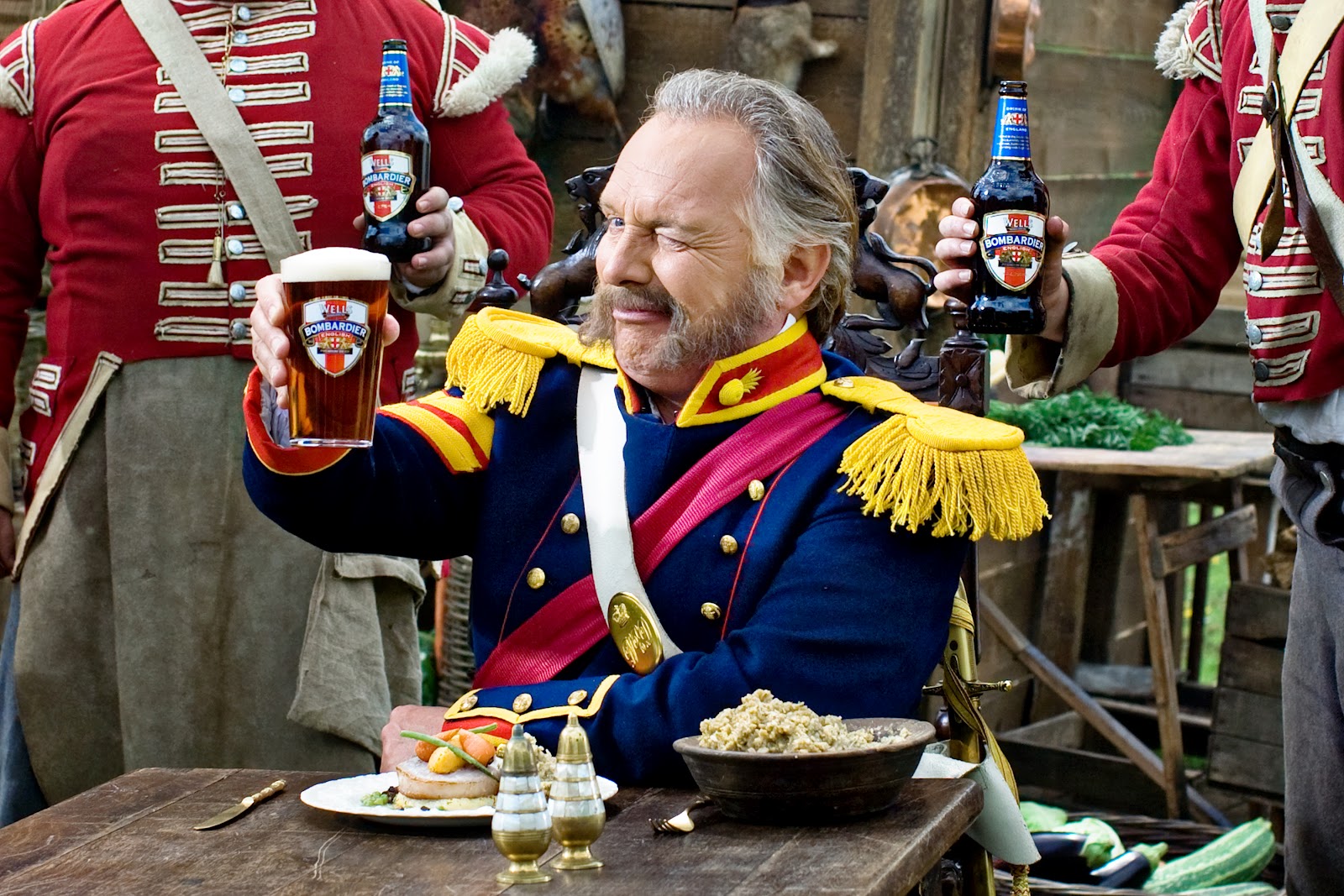
The second event – the one I wasn’t invited to – was launching the next wave in the new campaign for Well’s Bombardier.  Now, I get the feeling that I’m going to come across as disliking this development a lot more than I actually do, so let me say some positive things about it first, and hopefully this will prevent a hit squad being despatched from Bedford – home of William Charles Bedford, ‘your dashing hero on the battlefield, with a caddish twinkle in his eye,’ according to the press release (I am at least still on their email distribution list – at least until they read this.)

Basically, what they’re doing is extending the campaign they launched last year, with Rik Mayall playing the Bombardier, drinking the beer and extolling its virtues with what Well’s & Youngs clearly hope will become a pub catchphrase: ‘Bang on!’  They’re going for a heavyweight promotion on Dave, the channel for blokes who like repeats of the programme Stewart Lee refers to as ‘Mock the Weak’.  Ten and fifteen second idents will frame peak time programmes.  I haven’t seen the idents because like I said, I wasn’t invited to the launch, and didn’t get to meet Rik Mayall, but the press release says ‘viewers can expect to see the Bombardier’s take on the English sense of humour, values, our love of pubs and our social habits.’

They’re spending £5m on this, which is great news for Bombardier and great news for ale too.  It’s the highest ever spend they’ve put behind the brand (but not the highest ever spend in the ale category, as the press release falsely claims).  Whatever your views on the beer and the campaign, this is brilliant because it helps propel ale into the mainstream, makes it more visible and more contemporary.  When I do focus groups, many people assume that if a brand is on telly it must be good, must be doing something right, and this leads to greater social currency.  So here Bombardier are helping ale look more modern (with some caveats, below).  It’s also a great sign of confidence – they wouldn’t spend this money if they didn’t think cask ale was in good shape and people were ready to consider it.

Secondly, they’ve got with the programme and done a Facebook page and taken the Bombardier on to Twitter, extending a true brand property and providing content which people can interact with.  That’s a good thing as far as marketing, brand building, and the saliency of real ale is concerned.

But.

For me, this entire campaign feels like it’s aping lager ads of the seventies and eighties, and even lagers don’t behave like that any more.  Rik Mayall is reprising a character he played in Blackadder thirty years ago, in a slightly less funny way than it was then.  Is this really the way to make ale feel fresh, contemporary and appealing to new generations of drinkers?

To make my own mind up, I followed the link to the youtube channel at the bottom of the press release I was sent.  And I got this:

Woof woof! Bang Off, chaps!

The ads launch 16th April and run from 9pm to midnight weekdays for twelve months.

The other campaign is from Bombardier’s rival, Greene King.  Disliked by many readers of this blog and diehard ale drinkers in general, scorned for bland beers and nicknamed ‘Greed King’ for their sometimes voracious business practices, booed when they were runner-up Champion Beer of Britain a few years ago, they can sometimes come across as difficult to love, and have clearly been doing a bit of soul searching.

I think the results are a pleasant surprise.

Greene King IPA is the UK’s biggest cask ale brand.  It still only has a 7% market share – the diversity and fragmentation of the ale market is (most of the time) one of its main strengths. But GK IPA is, for better or worse, still the biggest brand.  I don’t tend to drink it myself, but clearly lots of people like it.  And like Magner’s does with cider, if it attracts people to real ale for the first time who then start to look around and trade up, that’s no bad thing.

In marketing theory, one classic strategy for the brand leader is to do a job that grows the whole market rather than trying to steal share form your competitors.  The theory is that if you’re already the biggest, advertising what’s good about the whole market means you benefit everyone else, but if the market grows proportionately then you’ll gain more in volume terms than everyone else does.  Most new entrants to any market tend to go for the biggest brands, so you’ll probably grow disproportionately, benefiting everyone but, most of all, yourself.

This is the strategy GK has chosen, and I think it’ll paid off.

They’ve created an ad that quite simply celebrates the joys of good cask beer in a good pub – not the joys of hops and malt and yeast, but the moment that beer – and only beer – can create.

This has always been what’s excited me most as a writer, and it’s lovely to see a brand that has wonga to spend and an ad agency with creative skill taking this aspect of beer and celebrating it.  It’s an ad for the pub as much as it is an advert for beer or Greene King IPA specifically, and I think it’s rather fucking wonderful:

I particularly like the opening, in the cellar – just enough beer craft for the mainstream viewer without getting too technical or boring.  Even if you don’t understand what you’re seeing, you get the impression of craft and care, the sense that this is something a bit more special than what you can buy in the supermarket.

The ad was shot in the Hornsey Tavern, north London, and the music is by a precocious eighteen year-old called Jake Bugg, who is to my ears like Ed Sheeran, only good.  The gaffer is an actor, but many of the people are real punters, sharing real beer moments.  The finished ad has been culled from about five hours of footage, the film crew just passing through the pub as people relaxed and shared a good time having a beer.  It’s the kind of positive image of beer and pubs the whole industry sorely needs more of.

GK is spending £4m behind this, and it’s breaking on 14th and 15th April, during the FA Cup semi-finals on ITV and ESPN.  It’s also going to be on Sky and Dave.

Coinciding with this, they also launched two new beers under the Greene King IPA brand: IPA Gold, a 4.1% golden ale, and IPA reserve, a 5.6% rich, mellow, fruity ale.  For anyone who drinks or works in a Greene King pub, these beers are welcome additions.  The golden ale is a golden ale, no better or worse than many in the market just now, while the reserve is in Fullers ESB territory, and dangerously drinkable.  They won’t set RateBeer alight, but they’re not meant to – that’s not what they’re for.  But they are quite drinkable beers that bring Greene King’s portfolio a bit closer to what drinkers want.

My only, obvious, quarrel is that, already under fire for calling a 3.6% session beer IPA, they’ve now brought out two new beers that are very different from the original, obviously not India Pale Ales in any shape or form, and called them India Pale Ales.  This reveals that as far as Greene King is concerned, IPA is a brand name and not a beer style.  I could just about defend the mainstream GK IPA because while it’s not a traditional IPA, IPA is an evolving style and in the mid-twentieth century this is what it was to most brewers and drinkers in the UK.  But by calling these new beers IPA rather than just ‘Greene King Blonde’ or ‘Greene King Reserve’, GK have created a needless rod for beer enthusiasts to beat them with – a silly own goal at a time when they’re doing some big things right.

GK has also launched an attractive Facebook page to support the campaign.

One tip to both brands: Facebook is an interactive medium.  If people ask you if it’s possible to buy Bombardier in North America or who did the music on the IPA ad, it’s good manners and good business sense to reply.  Don’t fall into the trap of bigger brands who pretend to be there on Facebook but don’t actually read or respond to comments, thereby actively alienating some of your biggest fans.  oh hang on – EDIT – GK actually did respond.

I’m anticipating many tiresome comments about how both these beers are shit, boring and bland, made by big corporations, and that it’s a bad thing they’re on TV.  My answer to that would be that these beers, and these ads, are not aimed at people who write beer blogs and drink in craft beer bars.   We’re fine – we don’t need to be told that real ale is a decent drink or that pubs are nice places to be.  No one who is already drinking great craft beer is going to suddenly start switching to Bombardier or Greene King IPA as a result of these ads.  The useful job that big brands can do is bring more novices into ale for the first time – and remind people how great pubs are.  With nearly £10m being spent advertising real ale over the next few months, this is fantastic news for beer as a whole – whatever you choose to drink yourself.

Cheers to both of them.  Especially the second one.

| Uncategorised

If you really care about the rise in liver disease, read this

Gin Lane

So the main beer-related headline this morning (given that George Osborne deliberately misled the nation over his 5% alcohol duty rise by saying there was ‘no change’ to beer duty, which most people don’t realise means the punitive duty escalator remains in place) is that deaths by liver disease rocketed by 25% between 2001 and 2009.

This is shocking stuff, and any responsible drinks writer or commentator needs to acknowledge the dangers of excessive alcohol consumption.

What’s actually positive about this news is that alcohol isn’t being blamed for every liver disease death – in the past, the Office of National Statistics has, for the sake of simplicity, recorded every liver disease statistic as being alcohol related, even while admitting this is inaccurate.  At least in this new survey, they admit that it’s only one factor, along with obesity and hepatitis.  But this reveals that alcohol actually contributes to a sizeable chunk – 37% of people who die of liver disease in their forties essentially drink themselves to death, for example.

If alcohol is going to continue to be the life enhancing treat that it is for most responsible drinkers, we need to understand why it becomes something much darker for a significant minority.

Which is why it doesn’t exactly help that every story I’ve seen on this so far this morning is illustrated by – yep, you guessed it – a pint of beer.

This is not me being defensive as a beer writer.  This is me being angry at ignorant media creating a grossly inaccurate picture.

So liver disease increased by 25% from 2001 to 2009.

OK, here are some more numbers.

Over the same period as this rise, beer consumption FELL by 18%.

Most of the beer market is lager, and within this figure, premium lager (around 5% ABV) fell by 18%, while standard lager (around 3.5-4.4% ABV) fell by only 4%.  So less beer is being sold, and within that, the steepest decline is for higher ABV drinks.

Kind of makes it hard to blame beer for a 25% rise in alcohol-related liver disease, no?

At the same time, wine consumption in the UK rose by 8%, and the average ABV of wine rose from 12% ABV to 13.5%.

Want to know what happened to spirits consumption between 2001 and 2009?

Up by 18%.*

As I proved in my last post, I’m no mathematician.  And I do know the difference between correlation and causation.  But it seems to me, reading these figures, that there is a very strong correlation indeed between the rise in alcohol-related liver disease and a trend for people to switch from beer to stronger drinks.

Beer, once again, is being used as the scapegoat.  No doubt it makes sense to some, when we see that the biggest rises are among poor people, especially men, especially in deprived parts of the north, and the media stereotype of beer drinkers remains that of the northern working class male.  But this stereotype is inaccurate, as I’ve pointed out many times before.

Liver disease is increasing because people are switching from beer to stronger drinks.  We already know this though, because this has been true of every major alcoholism epidemic in history.  In the gin epidemic of the eighteenth century, beer was part of the solution, not the problem, as the immortal cartoons by Hogarth show.  It should be seen as that today.

And there’s another factor going on which NEVER gets written about (apart from by my excellent co-writer in this area, Phil Mellows).  Most alcohol consumption takes place among affluent southerners.  Statistically, the wealthier you are, the more you drink.  And yet the poorer you are, the more likely you are to die of drink-related liver disease.

A child could see that alcohol-related mortality therefore has nothing to do with overall consumption.  And yet the government and NHS strategy remains firmly founded on the fundamental belief that the best way to reduce alcohol-related harm is to reduce overall consumption (by measures such as minimum pricing etc).

Not only does this approach stigmatise and punish responsible drinkers, it does nothing to help those drinking harmfully.  Put up the price of booze, and an alcoholic will spend less on food, and so on.  There’s overall pattern of evidence to suggest that reducing overall consumption is the best way to reduce harm.

So what is it that makes poor drinkers in the north more likely to drink themselves to death than affluent drinkers in the south, who on average drink more?  Oh, that’s too hard.  That might involve addressing the societal, cultural and economic problems that are the REAL reasons some people drink harmfully.

Much easier simply to blame beer.

Beer Street

* All figures from the BBPA’s Statistical Handbook 2011

| Uncategorised

Why beer duty numbers just don’t add up – and what YOU can do about it

Soon he’ll be the only person the country who can afford a pint
It’s nearly budget time again.  On 23rd March, the Government will yet again add inflation plus two per cent to the tax on beer.  This will bring the total tax rise on beer since the duty escalator was introduced in 2008 to about 45%.  The Conservative government has committed to the duty escalator until 2014. Even if they don’t add any other taxes – and we can’t rule that out – what was already the second highest duty rate in Europe will almost double within a decade.
It makes no sense.  This is a Treasury measure to raise revenue, not a Department of Health measure to reduce drinking.  But word reaches me from one source that an MP very close to David Cameron has admitted that they are now into diminishing returns – each time the duty escalator goes on, the total amount of revenue goes down, because it’s killing volume so much.
I’ve written a lot before now about how the duty escalator is hurting pubs.  But the other day I was with a family brewer who is seeing their business shafted by this relentless punishing of the industry.  I hadn’t thought it through before, but it goes like this:
Say inflation is 4%.  Which it is.  So the duty on beer goes up by 4% + 2% = 6%.
But that’s just the duty – inflation is still 4% on top of that.  Which means the cost to the brewer of making beer is also going up by 4%.
So if a brewer just wants to stay still, with no increase in profit at all, the duty escalator means the price of their beer must go up by 10%.
The public won’t accept this.  The supermarket and the pub trade won’t accept this.  So the brewer has to take a hit and see his profit margins sliced.  Every year this happens, those slices get thinner and thinner.  
To make matters worse, that 4% inflation figure is an average across everything.  Some of a mid-size brewer’s biggest costs are transport, energy, packaging and barley – all of which are increasing much more rapidly than the headline rate of inflation.  With the above maths in place, there’s absolutely no question of them being able to do anything other than take a hit on these costs.
If this carries on, there soon won’t be a reason for many brewers to stay in business – some could make more money demolishing their breweries and turning the space into car parks, which is what’s happening to Tetley’s.  
This equation impacts different sized businesses in different ways.  Microbrewers aren’t hit as hard because they get tax relief if they brew below a certain volume.  So that’s good news for fans of eclectic, interesting beer.  But they still face the same business pressures, and many use this tax relief to sell their beer to pubs cheaper than bigger brewers can, further shrinking the profitability of beer overall.
Multinational brewers are hit hardest, with their profits reduced to an average now of around 1%.  They’ll survive as businesses because they’re big enough to invest in developing markets.  South America, Asia, Africa and Russia are the countries that interest these guys now.  You might say good riddance to them, but they’re not going to abandon Europe and America – they’re just going to relentlessly cut costs to remain competitive – lowering the strength of their beers, using cheaper ingredients and compromised processes, lowering the quality of mainstream beer even further.
And then in the middle you’ve got Greene King, Fullers, Wells & Young’s and Marstons and so on, and the family brewers like Black Sheep, Batemans, Robinsons etc.  These brewers are too big to get duty relief, and too small to go anywhere else.  They’re being squeezed to death, facing a situation where it’s hard for them to actually make beer at a profit.
If you’re a blinkered fan of micros, you might welcome this.  You might say you don’t need boring brown beer and that pubs would be better places if they were only stocked by micros.  But I’m afraid you’re wrong.  Who do you think installs cellar equipment and services it, guaranteeing the quality of all beers on the bar?  Who do you think puts most of the hand pumps on the bar that the micros use?  Who do you think offers staff training and quality management services?  Who do you think microbrewers phone up when they want to start bottling beers but don’t have a bottling line of their own?  Who do you think funds brewing research and laboratory services?  There are many wonderful things about microbrewers, but the whole appeal of them is that they are small and nimble.  They don’t have huge staff to support so they can take risks.  They don’t have huge pub estates so they don’t have to invest in lots of cellar management resource.  However much you love them, and I do, they couldn’t survive on their own – as they’d be the first to admit.
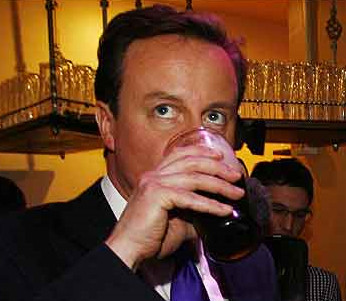
This middle tier is getting shafted the hardest by the relentless duty escalator.  They are small to medium sized manufacturing businesses, a rarity in Britain these days, and yet they’re the very businesses David Cameron believes will save the economy.  As he said last year:
“There’s only one strategy for growth we can have now and that is rolling up our sleeves and doing everything possible to make it easier for businesses to grow, to invest, to take people on.  Back small firms. Boost enterprise. Be on the side of everyone in this country who wants to create jobs, and wealth and opportunity.”
He said that.  We can’t let him get away with doing the direct opposite to one of the best manufacturing industries we have.
I’ve hated the Tories with venom ever since I grew up during the miner’s strike and watched them turn the apparatus of the state – including the army and secret service – on their own citizens and destroy communities including the one in which I grew up.  But this issue is not a party political one.  This cursed duty escalator was introduced by a Labour government, and last week Andrew Griffiths, the Tory MP for Burton-on-Trent and current chair of the Parliamentary Beer Group, introduced an Early Day Motion to debate the duty escalator in Parliament.
But we have it in our power to force another debate.  
Last week Hobgoblin beer launched a campaign to get 100,000 signatures on an e-petition which would force the issue to be debated in Parliament again.  The wording of the petition is as follows:

Stop the beer duty escalator

Responsible department: Her Majesty’s Treasury

Every year, the beer tax escalator increases the tax on beer by 2% above the rate of inflation, thus adding considerably more pressure on the British pub, the cornerstone of many of our communities. Removing the beer duty escalator at the next budget will help keep beer more affordable and go a long way to supporting the institution that is – the great British pub.  Going to the pub is a core British tradition and so is enjoying great beer. If you want to continue enjoying your fresh pint in your local pub then it’s crucial that you support our campaign to grind the beer duty tax escalator to a halt.  If we don’t show our support for the great British pub, we risk losing more pubs and more jobs within our local communities.  Support great beer in the great British pub and sign our e-petition now….. British Pubs Need You.
There are 135,000 members of CAMRA.  And there are millions of people who are not CAMRA members who are passionate about great pubs and great beer.  If we can’t get 100,000 signatures on this petition, we don’t deserve an affordable pint.
Sign it. Now. 
And then make your friends sign it.
It’s not as if it take any effort – it’ll take you about a minute, and the link is here.  And while it probably won’t do anything this year, it just might have an effect next year.  They’re not making any money off this; they’re killing the brewing industry; they’re threatening thousands of jobs in pubs, and they’re making our pints almost unaffordable.  
This is politics – Governments can’t be seen to U-turn without good reason, but this is a chance to provide that reason, to allow them to scrap a misguided measure that benefits no one.  It makes sense whatever you drink, and whatever your politics.

| Uncategorised

Yeeeessssss, it’s in(n)!

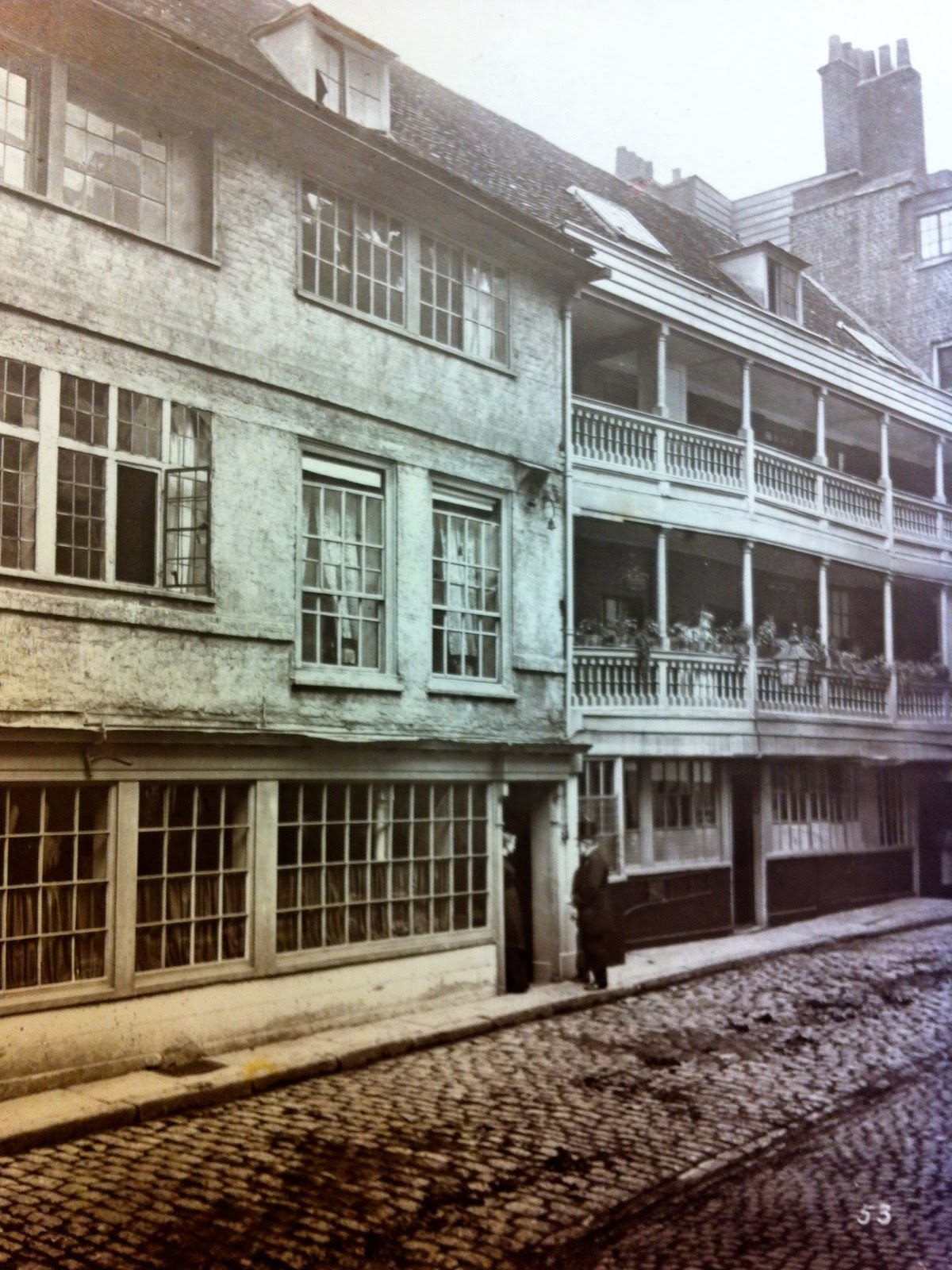
The George Inn, Borough High St, SE1. A while ago.

After a couple of false starts (or false endings I suppose) I’m back in the real world.  On Thursday I pressed ‘send’ on the manuscript of my new book, and this weekend my editor becomes the third person in the world to read it (after me and the Beer Widow).  From here it’s full steam ahead with edits (hopefully not too many) cover designs, bound proofs out to reviewers and so on, leading up to the launch later this year.

I started this book almost a year ago.  Then in October I had my laptop stolen.  It wasn’t backed up (it is now) and I lost every last bit of work I’d done on the book.  I started making my notes again from scratch on 7th October.  I sent the book off on 1st March.  I hope I never have to work to that kind of timetable again, but I think I got away with it.

It’s been confirmed that the book will be called SHAKESPEARE’S LOCAL: Five Centuries of History Seen From One Extraordinary Pub.  It tells the story of the George Inn, Southwark, South London, and everything that has happened in it, to it and around it, and the people who have eaten, drunk, stayed, worked, performed and fought there.

It’s not really a beer book as such – it’s a bit of a departure on that score (though there is one chapter that centres on one of the most famous breweries the world has ever seen).  But it is a book about pubs – not just this one pub, but all pubs, especially inns.  These days we use words like ‘inn’, ‘tavern’, ‘alehouse’ and ‘pub’ interchangeably, but at one time the differences were so stark they were enshrined in law.  One aspect of the book is the story of how inns were essentially the lynchpins for Britain’s entire economy, facilitating the movement of goods, money and people that enabled both the Industrial Revolution and the growth of a mercantile class.  Before we had town halls, municipal buildings, assembly rooms, theatres and concert halls, the inn was the only building in town with large meeting rooms and spaces, and it performed all these functions.

It’s also the story of Southwark – an extraordinary town that was once the centre of the world.  London Bridge was the only bridge across the Thames from Roman times until 1750.  Anything coming to the capital from the south east or Continental Europe came up Borough High Street and past the George – that’s why this pub was just one of twenty or so inns along a half mile stretch of road, along with innumerable alehouses and taverns.  The bottleneck across the bridge meant many people simply stayed in Southwark.  It was just outside London’s jurisdiction and the Citys’ laws didn’t apply, so Southwark became home to nonconformists of every stripe, fugitives and refugees from across the world, villains, rogues, whores and wasters, most of whom popped in for a pint (all except the puritans, who dismissed pubs as the ‘blockhouses of the Devil’.)

The story of the George is the story of the last survivor of these great inns.  It was never the biggest, most famous, most beautiful or important – even though it was big, famous, beautiful and important.  Chaucer chose the inn next door to the south as his start point for the Canterbury Tales.  Both Dickens and Shakespeare chose the inn next door to the north as the setting for key scenes in their respective works.  But they all knew the George, and the George is the one that survived, carrying the legacy of what was once the most important street of pubs in the world.

The story of the George is also the story of some bizarre characters who once drunk there.  There’s Sir John Mennis, Comptroller of Charles II’s Royal Navy and inventory of a literary genre I’ve chosen to call Stuart-Era Fart Poetry.  There’s John Taylor, the Water Poet, who once rowed from London to the Isle of Sheppey in a boat made from paper with oars of salt cod tied to sticks.  There’s Shakespeare, Dickens, Chaucer, Dick Turpin, the Sugababes, Samuel Pepys, Philip ‘the most miserable man in the world’ Stubbes, Samuel Johnson, a monkey riding a horse, and possibly the greatest pub landlady who ever lived.

But the main character is the pub itself – just a pub, and so much more, like all pubs are.  When you see what it’s been through, the survival of the George makes a mockery of anyone who says pubs are dying out.

That’s the gist of what I told my publisher’s sales force when I had to present the book to them a couple of weeks ago.  It wasn’t easy – I had to follow a debut novelist whose book is already tipped for great things and is in discussions about movie rights – and Rastamouse.

Wha’ g’wan? I share a publisher with this mouse.

The creators of Rastamouse had them a-rockin’ and a-rhymin’, grown men and women squealing with delight.  “Follow that,” said my publisher.  I tried.  It seemed to go down well.

So well, in fact, that they moved the publication date.  Shakespeare’s Local will now be published on 8th November, right in the middle of the peak Christmas book buying period, competing with comedians’ memoirs, ‘Katie’ ‘Price’ ‘novels’ and glossy cookbooks.  The cover design hasn’t been finalised yet, but even from early designs it’s going to look like a very nice present to buy someone.

So now, finally, I’m back to blogging.  I’ve got loads to write about as I reacquaint myself with the beer world and start leaving the house again.

I hope you all played nice while I was gone.  It’s good to be back.

| Uncategorised

Odessa in London

Almost a year ago now I went down to Otley Brewing in South Wales and did a brew with them.  Unlike many collaborative brews, they made me come up with the recipe, select the hops and everything.  When I co-created Brew Dog’s Avery Brown Dredge with Zak and Mark, they did most of the work and I just said things like, “Yes. very good.” This time I was on my own.  Nowhere to hide.  (There’s a nice video of the brew day of you follow the link above).

Inspired by Martin Dickie’s ginger nuts (we were very hungover) I decided I wanted to brew an imperial stout with ginger.  And chocolate.  And then mature it in whisky casks for a year.You may say that’s showing off.  I say it was cruising for a fall.  As I kept chucking handfuls of crystallised ginger and Belgian chocolate drops into the copper when Nick Otley wasn’t looking (unaware that Nick was doing the same when I wasn’t looking) I was genuinely worried it wouldn’t work.

For ten months, some of this beer sat in bourbon barrels and some in mead barrels.  Nick finally tasted it last weekend and after he stopped saying ‘wow!’ (which took a while) he said it was pitch black, and very warming.

Tomorrow you get a chance to see if we pulled it off or whether I should stick to writing rather than brewing.  Odessa Imperial Stout is launching in four London pubs, and Nick and I are touring them to give it a try in each one.  Each pub gets either the whisky or the mead finish, randomly chosen.  So if you can, it’s worth trying at least three pubs.  The beer will of course be on sale all day until it runs out.  But if you want to see me or Nick (save the difficult questions for him) our rough timetable is as follows:

1.       The White Horse, Parsons Green, between 1pm & 2pm
2.       The Rake, Borough, between 3pm & 4pm
3.       The Jolly Butchers, Stoke Newington, between 5pm & 6pm
4.       The Southampton Arms, Kentish Town, between 7pm & 8pm

I’ll be tweeting events for as long as I can focus.  Though after the first couple of pints of this stuff, I may well ask someone to take my phone off me.

See you there!

| Uncategorised

Some thoughts on writing about beer history

As I emerge from the British Library, blinking like a mole in the winter sun, I see Martyn Cornell has been doing what he enjoys best, demolishing a passing historical claim that someone else has made.

There was a spat before Christmas about the excellent Oxford Companion to Beer.  Many in the beer blogosphere were queueing up to find errors and cite them as proof that the book is worthless, or at the very least, deeply flawed.  This turned into a rather worrying witch hunt where almost any positive mention of the OCB online was rooted out and lambasted (one beer writer was even attacked on his Facebook page for posting that he was looking forward to reading it).

My response to this was along the lines of ‘of course there are errors – but if you take the thing as a whole, it’s a great piece of work’.  This was (mis)interpreted by some as me saying that errors didn’t matter, and the pursuit of truth, of fact, in beer history was unimportant.

That is not what I meant at all.  If I did mean that, I wouldn’t, for example, have spent all day yesterday in the London Metropolitan Archives reading through letters sent between brewers Flower & Sons and their lawyers regarding their taking over the lease of the George Inn, Southwark – something that will surely take only a line or two in my new book, but which I took a thousand words of notes on, because I want to make sure I get it absolutely right.

What I do think, though, after spending nearly a year doing research that is as forensic and detailed as I can possibly do on the history of coaching inns, pubs in general and one pub in particular, is that some who are interested in the history of beer are in danger of strangling the study of it by imposing standards that are too strict, that are tighter than any proper academic historian would insist upon.

If you’re not that bothered about the study of beer history, please stop reading now, because you’re going to get really bored if you don’t.

First, a few caveats:

One, I greatly admire the work that people like Martyn Cornell and Ron Pattinson do.  I know from great experience myself that it’s not exactly easy, fun or rewarding to trawl through historical documents in search of the truth.  It’s much easier to simply cite what some bloke said in a book eighty years ago without checking where he got it from.  Standards of beer scholarship are improving, and people like Martyn and Ron are playing a significant role in this.

Two, I don’t want to excuse errors – where they are in fact errors, as opposed to differing interpretations.  And I’m not here to defend the OCB’s entry on the yard of ale.  I actually agree with Martyn that the original yard of ale entry in OCB looks like it’s wrong, though I believe that it’s the result of a simple confusion with the ‘stirrup cup’, which is a similar shape to the yard, but smaller – still wrong and in need of correction, but not exactly the biggest controversy ever to rear its beery head.

Three, although this post was prompted by Martyn’s latest, it shouldn’t be read (just) as a criticism of Marytn – he makes points similar to those below towards the end of his post, and I agree with a lot of what he says there.  What follows has been inspired by Martyn’s post – and other comments he’s made previously – rather than being a direct rebuttal.  I’m sure he would agree with much of what follows.

With those out of the way, my main beef is this: there seems to be a growing view that if there isn’t definite, written, primary source proof of something, than we cannot assert that it is true in an historical context, and we shouldn’t be saying it.

I’m sorry, but that’s just not right.  If real historians behaved like this, we wouldn’t have any history at all.

Having come fresh from the coalface, here’s how written historical sources work: since the mid-twentieth century and the age of mass communication, you can find lots of references to pretty much anything if you know where to look.  The biggest problem facing future historians looking at the early 21st century will be too much material relating to any subject, not too little.

Go back to the nineteenth century, and it’s a bit harder.  There are newspapers and magazines – quite a lot of them – and if you’re lucky enough to find databases that have them as word-searchable PDFs, you can fillet all mentions of your chosen subject from tons of last century’s chip paper within minutes.  The trouble is, you know how now, the mainstream press don’t write much about beer?  Well, they didn’t much then, either.  For example, over 99.9% of the 16,000 mentions of ‘India Pale Ale’ in the Burley Collection of 18th and 19th century newspapers are in the classified ads section, and while the first few you look at are very revealing (that’s where I discovered the earliest actual mention of ‘India Pale Ale’ for example) after that, they’re all the same.

Go back before that, and most of the population were illiterate.  Newspapers die out altogether when you reach the seventeenth century.  Now it gets trickier.  There’s the odd diarist whose work has survived, which is why if you read anything historical about the seventeenth century (including my new book) you will unfailingly discover what John Evelyn and Samuel Pepys thought about the subject at hand.

Before that, anything that the Church had direct involvement in, you’re laughing, because they kept copious records of everything.  Anything the monarch did, you’re on safe ground.  But social history?  Stuff that everyday people did?  That gets tricky.  There are legal records if your subject got into trouble.  But unless the Church or the law were interested, written records start to become very thin on the ground.  You’re relying on diarists, the odd pamphleteer (who usually had a particular view on his subject – many of our best descriptions of Elizabethan alehouses come from Puritans who thought they were the ‘nests of Satan’) and the occasional, isolated traveller or chronicler, and you kind of have to go with what those individuals say.

In terms of tangible fact, this is then supplemented by archaeological evidence.  This is incredibly useful.  But foodstuffs, clothing and almost anything else soft and perishable haven’t survived.

Our accurate record of what Elizabethan theatres looked like inside rests on a one page description and a drawing done by a Swiss traveller in 1594 – the rebuilt Globe Theatre relied on this, and the partial foundations of the original.  There are three surviving portraits which we think are William Shakespeare, and scant references to him in legal documents.  There isn’t even a definitely agreed version of his complete works, as whole plays were rarely copied.  Bill Bryson set out to write a book on Shakespeare that just stuck to the known facts.  It’s less than 200 pages long, and he’s padded it out with all sorts of more general stuff about Elizabethan England.  And this is Shakespeare – not some pub, brewery or drinking custom.

So when primary source stuff gets thin, what do you do?

You do not ‘make things up’.

But you do become flexible.

Martyn regularly pours scorn on historical claims that are made long after the fact.  But the first real account of the Battle of Hastings (leaving aside the Bayeux Tapestry) was written by William of Malmesbury over a century after to happened, and historians accept it as definitive.  Historians haven’t always provided academic references and footnotes – that doesn’t mean their work is invalid.  Also, when most people were illiterate, much history was handed down orally before someone put it to paper.  Inevitably, this introduces an element of Chinese Whispers.  But it’s that or nothing – and academic historians, while not always accepting such accounts as gospel (now there’s an interesting example) will usually at least take the gist of it to be true, or use it as a guide.  So while I’m not saying (because I don’t believe) that the yard of ale was invented for stage coach drivers, I am arguing that the fact that this claim wasn’t made until the 1950s is not on its own sufficient grounds to dismiss it.

Martyn’s other maxim is along the lines of ‘the first law of history is don’t assume’.  I’d like to see where these universally agreed laws of history are written down, and have a look at what the others are, because in the history I’ve been reading – mostly books written by academics who work in history departments in reputable universities – educated, reasoned assumptions are being made all the time.  ‘Could’, ‘might’, ‘perhaps,’, ‘possibly’ and ‘maybe’ are some of the most popular words in academic history.  Where I would agree with Martyn 100% is that if it is a ‘could’ or a ‘might’, any writer – especially one working on something as illustrious as the OCB – has an obligation to make this clear rather than writing ‘was’ or ‘did’, and this is a sin of mine that I’ve now resolved to fix. But I’d argue that this is the main area where standards need to be improved.  The simple ‘there’s no written evidence so we must assume it’s wrong’ approach simply is not how history works.

These issues have particular relevance for the study of beer and pubs, because at the time, a lot of this shit just didn’t get written down.  Whenever the yard of ale was invented, and for whatever purpose, no one whose work survives thought it worth recording.  So what are you going to do?  It obviously was invented by someone, at some point, so we are not wrong to speculate on what did happen.

If we don’t, we reduce history to virtually nothing.  And we have to look in a broader context.  That first mention of ‘India Pale Ale’ came at least seventy years after strong, hoppy pale had been exported to the Indian market – so how can we assert when this beer called ‘IPA’ first appeared?

The now pretty-much dismissed claim that George Hodgson began exporting pale ale to India in 1785 is based on this being the date it was first advertised in the Calcutta Gazette.  But the reason it wasn’t advertised before then is not that the beer didn’t exist in India, but that the Calcutta Gazette didn’t.  So when did Hodsgon first export his beer?

Another useful example for me is the story that IPA was first introduced to Britain in 1827 when a ship bound for India was shipwrecked off Liverpool, the casks washed up on the beach, and were auctioned by the ship’s insurance company, and the locals loved the beer and started demanding it at home.  Martyn has dismissed this as ‘myth’ because the claim was made fifty years after the fact, and it’s not mentioned anywhere else.  He says it never happened. Now, if we’re talking about how IPA was introduced to Britain, I totally agree.  A quick look at Peter Matthias’s brilliant brewing history shows that Bass and Allsopp were advertising pale ales domestically in the early 1820s.  In the 1830s, IPA became popular in Britain among families returning from India.  Hodgson, while being squeezed out of the Indian market, saw an opportunity back home and started advertising his beer as the taste of India.  But to say the shipwreck never happened?  That’s an even bolder claim than the original assertion.  Visit any Cornish coastal pub, for example, and you’ll find walls decorated with facsimiles of posters advertising auctions of cargo from shipwrecks from the early nineteenth century.  They happened all the time – surely at least one of these auctions would have included India-bound beer.  I’m certain that the 1827 shipwreck did happen, that India-bound beer was sold to Scousers and that they loved it.  After all, why would anyone simply make up such a story from their imagination?  But this is not how IPA was introduced to Britain.  It’s an important distinction in how we read historical data, how we interpret it.

Writing history is all about interpretation, and we have to make assumptions, especially when studying the history of the beer and pubs.  For example, I will be claiming that inn-yard theatre happened in the George Inn, Southwark, despite a complete lack of evidence that it did.  Why?  Because there are records of it happening in inn-yards across London and all over the country.  It often happened when there was a big fair.  It happened in larger inn-yards.  The George had  a large inn-yard.  Southwark Fair was one of the biggest fairs in the country.  Plays happened in the yard of the Queens Arms just down the road.  Therefore, I can assume, with a high degree of confidence, that plays also happened in the George.

One final point – and forgive me if this sounds defensive.  As a historian, you have an obligation to be as thorough in your research as you can be.  But as a writer aiming at a mainstream audience, you have an obligation to be as readable and interesting as you can be.  For the mainstream writer, in any discipline, it’s a balance between the two, and Bryson’s Shakespeare is a perfect example of how to do it brilliantly.  Just because the detail isn’t on the page in front of you, doesn’t mean it’s not there.

At the end of Martyn’s yard of ale post he gives a brilliant acknowledgement that we cannot research every single last fact back to primary sources, so I don’t think we’re that far apart in the overall scheme of things.

But please – even on the big stuff, sometimes, just because there is no primary source, that doesn’t mean it’s wrong.  Sorry, but that’s not how history works.

=/=

If you’ve read this far, then you’re obviously pretty interested in beer history.  So I’d just like to give a plug to the Brewery History Society.  Membership is only £15 a year, and you get a lot for your money. Martyn is on the editorial board so he would definitely agree with me on this!

| Uncategorised

The Rules of Drinking

There’s light at the end of the tunnel.  Switching metaphors at the points, if it were a loaf of bread, you’d just be able to see it start to rise.
It’s been a very long three months, but on NYE I printed off a rough, shaky first draft of my next book.  The chapters that aren’t quite finished are bloody awful.  The chapters that are finished are pretty good – or at least, my long-suffering editor and wife think so.  And I have two weeks left to kick, bitch-slap, coax, polish, persuade, trick and massage the rest of it into shape.
This week, then, represents a partial return to the blogosphere.  Don’t try to pretend you missed me, now.
I’m ashamed to say my first post-book post is a shameless plug, but it is for something I think you’ll like.  
Last May I spent an afternoon in the Jolly Butchers with a BBC film crew.  I’d just about forgotten about it, and then I got a call this morning to say that the programme is finally going out this week.
It’s a Timeshift documentary called The Rules of Drinking, and it charts our relationship with booze, particularly since the Second World War.  Me and a chap called Iain Gately, whose book on the History of Drink you should have on your shelves, are the two main contributors, only you’re spared having to watch much of me by some fantastic archive footage they’ve found to go over the things we’re talking about.
Here’s the blurb, from BBC4:
Timeshift digs into the archive to discover the unwritten rules that have governed the way we drink in Britain.
In the pubs and working men’s clubs of the forties and fifties there were strict customs governing who stood where. To be invited to sup at the bar was a rite of passage for many young men, and it took years for women to be accepted into these bastions of masculinity. As the country prospered and foreign travel became widely available, so new drinking habits were introduced as we discovered wine and, even more exotically, cocktails.
People began to drink at home as well as at work, where journalists typified a tradition of the liquid lunch. Advertising played its part as lager was first sold as a woman’s drink and then the drink of choice for young men with a bit of disposable income. The rules changed and changed again, but they were always there – unwritten and unspoken, yet underwriting our complicated relationship with drinking.
The waspish and lovely Grace Dent gave the programme a fantastic write-up in the Guardian last Saturday,  acknowledging that there is such a thing as binge drinking, without being judgemental about it or trying to build it to a point of hysteria.  She concludes: