Author: PeteBrown

| Uncategorised

Brew Dog London opens!

Blimey – a look at my Wikio ranking (if anyone still looks at Wikio rankings) shows what happens when you don’t blog for six weeks…

In case you’ve not been following, the reason I seem to have given up blogging is that I have to focus on my new book.  It’s going well: I’ve written about 45,000 words (about 140 pages) so far, but with a mid-January deadline I won’t be having much of a Christmas, and I won’t be blogging too often before it’s finished.

But I just wanted to do a quick post because I went to the journalist’s launch of Brew Dog’s new London bar last night in Camden, North London.

And it’s really just to reiterate what I said when I visited their Edinburgh bar in the summer, and express my delight that they’ve opened one a bit closer to my house.

No brewer divides opinion and stirs up as much controversy as Brew Dog.  And they do that deliberately.  Sometimes I write to slag off their childish pranks, sometimes to praise them.  About two years ago half the blogosphere was devoted to discussion of their antics (oh, and their beers) and I’ve read some people say they gave up reading blogs because they were sick of reading about Brew Dog.

But the company is four years old now and maturing rather nicely.  And the bars – which are starting to spread to many major UK cities – really are excellent.

Purists will be upset that they don’t do any cask beers at all, but this would be a good experiment: if you’re prepared to be open-minded, it’s worth going along and challenging the keg offering to deliver.  I think there’s something there for everyone.  Last night I was talking to someone who writes for London Drinker, CAMRA London’s magazine, and we were disagreeing about keg beer – he was saying he could still taste the gas in the beers he was drinking and that he didn’t like that and wished they were available on cask.  But later, he tried some of the stronger beers and came back to tell me they were excellent.

So there’s a great range on offer.  And the other thing I love about Brew Dog bars is that when I walk in, and I feel a little bit old and that the bar might be too cool for school, this is dispelled as soon as I actually get to the bar.  Brew Dog bars could so easily be too cool for school, and they’re not.  They’re unpretentious and run by people with a genuine passion for beer, a passion they want to spread.

Finally, I went here directly from a new ‘bar and kitchen’ (ugh!) run by a reasonably large pub operator, that’s moving with the times by stocking an interesting range of craft beers that will be familiar to geeks but you really don’t see in many places at all.  That’s to be welcomed.  But £4.25 for a pint of cask Meantime Pale Ale (4.2% ABV), brewed less then ten miles away, was taking the fucking piss.  By contrast, the prices at Brew Dog were perfectly reasonable for what you were getting.

Gotta leave it there – got to go and write about Princess Margaret and the Bishop of Southwark having a lock in.

But if you’re in London, go to Brew Dog Camden.  And of you’re not, don’t worry – a Brew Dog bar will probably be opening a bit closer to you sooner than you think.

| Uncategorised

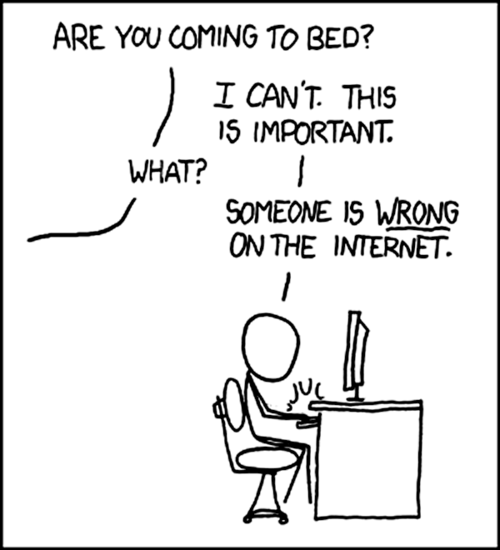
Someone is wrong on the internet.

Add caption

No time to blog at the moment as I struggle to get back on track with my book.  But this is all I have to say anyway.

Thanks to my best mate Chris for first sending me this a while back, last time someone was wrong on the internet.  And kudos to the original cartoonist, whoever that may be – the image has been repeated so often I wasn’t able to find out.

| Uncategorised

Blogging, ethics and payola – what is OK?

As beer blogging matures as a medium there are an increasing number of discussions on what constitutes ethical blogging.  Is it OK to write about a brewery’s beers if they’ve taken you on a tour or sent you free product? Or if you’ve done some kind of consultancy for them?

I’ll come back to these in a minute – different bloggers have different points of view, and there are many shades of grey.

But I’ve recently been approached and asked to participate in one activity that, by any standards, is not OK at all.  It’s ethically wrong.  In fact, it is probably illegal.

Two weeks ago, I received an email from a man called Barry Sonders who works for an agency called Translation, some kind of PR/communications agency based in New York.  Barry’s email read as follows:

Hey Pete, 

I’m working with a beer brand that is looking to “seed” some stories
on blogs like yours about a new beer that is being released. 

I was wondering what the cost would be for me if I wanted to seed
1 story a week for a month. Basically, what I mean by seeding is 
that you’d blog or someone would write something saying… “I heard this
beer is X% alcohol content, etc”… 

Let me know if this is something you’d be interested in doing and again, 
if so, what is the price tag associated with that. 

Thanks! 

Barry

Now there was no way I was ever going to agree to this, and I immediately decided to write this blog post about it.   But before I did so, I wanted to be better informed.  Firstly, I wrote back to Barry to see if I could find out what brand was trying to persuade me to sacrifice my integrity in this fashion:

Hi Barry, 

It kind of depends on the brand, to be honest.  Are you able to reveal which beer or brewer?

Pete

Barry, seemingly, could not be drawn that easily:

To be honest, I can’t right now. It’s a major brand, definitely not in the craft beer arena
or of a mass audience, middle america appeal. 

However, there was a link to Translation’s website at the bottom of his email.  I followed this link, and found a client list that included Coors among a list of reputable companies such as P&G and Johnson & Johnson.

So I contacted Kristy at MolsonCoors UK, who immediately replied that she was ‘appalled’ by this proposal, and contacted MillerCoors in the US (Coors is in a different JV over there) to see if this was something they knew about.  She got this reply from Pete Marino at MillerCoors HQ:

This has nothing to do with MillerCoors or any of our brands.  Translation does not do any work for MillerCoors, nor have they ever. They did at one time work for legacy Coors Brewing Company and they have the Coors logo on their website under the title “brands they have influenced…”. This doesn’t mean those brands are active clients and I can assure you we don’’t work with Translation.  I am not sure who they are representing here, but… we don’t have any association with Barry or Translation and we do not condone this behavior.  

Further down the email trail between Coors people, someone suggests the whole thing might be a hoax, as there are certainly no plans for a new US beer launch by MillerCoors at the moment.
I wanted to make all this very clear before moving on, because this is serious shit, and it’s important to state that whichever brand it is, it’s nothing to do with MolsonCoors or MillerCoors, who object to such practices on both legal and ethical grounds.  (I only mention this in detail because if you Google Translation’s website, you would think it was Coors).
Personally, whatever your views on free beer, hospitality etc (and I will come back to that) what’s happening here is that I am being offered money to blog views and opinions about a beer as if they are my own, when they are not.  By taking money it becomes advertising, and I am being asked to present it as though it is not advertising – clearly misleading my readers, and being dishonest in my writing.
I would never do that, for three reasons.  One – integrity – I have some.  Two – career practicality – if I did this, and someone found out that I’d done it, no one would ever trust anything I wrote ever again. My writing career would be over.  And three – it is probably illegal.  It certainly breaks any general journalistic and blogging standards of behaviour.
To get a clearer picture on this last point, I contacted both the National Union of Journalists (NUJ) and the Advertising Standards Authority.
The NUJ admitted that it’s still early days for standards in blogging but the rules generally – and there’s no reason why they shouldn’t cover blogging – are very clear.  Writing paid for by a brand should be clearly identifiable as advertising or an advertising feature so the reader understands that it’s not under editorial control. The NUJ’s code makes it clear that payments, threats or other inducements should not affect what you write.  Chris Frost, Chair of the NUJ Ethics Council, said:
“I’m shocked to hear that a company is trying to bribe a blogger who’s a member of the NUJ to write material that is not necessarily his honest opinion. Whether a journalist is a blogger or works in more traditional media, trust in what they write is central and the NUJ does all it can to protect that with our code of conduct.”
The ASA took a little longer to respond, but I got their reply yesterday.  There’s a new code, recently extended to cover online advertising.  Here’s what they had to say about it:
In short, yes, this practice would represent a breach of the CAP Code (marketing communications must make it clear that they are so)… we know that the Office of Fair Trading are also interested in looking into this area, as this type of practice represents a serious breach of consumer legislation.
This last point relates back to a test case last year in which the OFT investigated a company called Handpicked Media who were paying bloggers to write for them.  The company was co-operative with the investigation, but it was judged that their activities may be operating in breach of the Consumer Protection From Unfair Trading Regulations 2008, and was engaging in unfair commercial practices.  There will be more test cases to establish whether that ‘may’ actually is an ‘is’ or not.
But either way, whether this turns out to be technically legal or not, it’s morally and ethically wrong.  The whole point about blogging is that it is a subjective medium, that writers write from interest and passion.  I do write paid for commercial stuff, but I write it in a very different style than I blog, and it’s always very clear that I am doing so.  I have never taken a penny from anyone for anything on this blog.  If other people, who don’t get as much paid writing as I do, choose to take money for paid-for ads on their blog that’s fine – so long as it’s very clear that this is advertising.  But what Barry and his agency is suggesting undermines the whole principle and foundation of blogging.
So is this the same as accepting free booze or hospitality from brewers?  There are different views on this, but I don’t think it is the same at all.  Fiona Beckett wrote an article for the Guardian recently about accepting payment for wine reviews, and much of the ensuing discussion was about free samples rather than payment.  
I get sent free beer all the time, and it comes down to one’s own personal ethics.  I’ve got so much beer, I’m constantly trying to give it away before it goes stale.  If someone sends me free beer and I like it, I’ll say so.  If I don’t like it, I probably won’t say anything unless the brewer is really insistent.  But I certainly won’t say I like a beer just because someone has sent me some for free.  

Hilariously, earlier this year someone sent me a bottle of a very well-known beer brand, and seemed to think that, having done so, I would of course be including this brand in my Publican’s Morning Advertiser rundown of my fifty favourite UK beers.  Needless to say, it wasn’t there and never will be. 

It’s trickier with trips/hospitality.  If someone takes you on an all-expenses-paid trip around Belgium, it’s kind of expected that you’ll use the experience to write a piece.  It doesn’t mean you have to write aglowing report of every beer if you didn’t really like it.  But if someone shows you a good time, you’re more likely to feel warm towards them – that’s human nature.  I’d like to think that a combination of full disclosure and personal integrity should mean you avoid saying things you don’t really believe and misleading your readers.
As for consultancy – I do some of that.  But I always tell brewers that while I’m working for them, I won’t be writing about them, and I won’t be promoting the work we’ve done together from a journalistic point of view.  If I ever do write about it – like I did with the launch of Martson’s Fast Cask – I will do so with full disclosure of my relationship, so readers can make up their own minds as to whether they can trust what I’m saying or not.
I know there are some bloggers who would see my standards as too lax, and others who would read this post and say, ‘What’s the fuss about?  If you can get free stuff, take it’.  I’m happy to agree to disagree with both, and am not really interested in attacking either.
But I would hope everyone, on every side, would see that taking payment in return for lying to your readers goes against everything that beer blogging is about.  

I’m sure I’m not the only one who has been approached by Translation.  If you have too, I hope you’re not tempted – you just might end up being the next legal test case.

| Uncategorised

Bastards: a cautionary tale

So, I got my laptop nicked.

If you follow me on Twitter, you’ll already be weary of the trials, tribulations and swearing that followed.

I hadn’t backed up – I have two separate external hard drives, but both had stopped working.  I know I should have backed up online (or in the ‘cloud’ if we really must) but I never seemed to have time to sort out the best way of doing so.

I was in the Jolly Butchers last Wednesday.  I was filming for a TV programme, and after that it was Emma Cole’s leaving do.  Emma has made the beery reputation of the Butchers, and now she’s defecting to the Spotted Dog in Brighton. (Brighton, you are lucky to have her.)

At 6pm I put my laptop bag down beside Emma’s chair. At 10.05pm I went back to it, and found the bag thrown under the table, with no laptop in it.  I know the timings because I spent the following day watching CCTV footage from two angles, and saw myself do these things.

I also saw a photo shoot to celebrate the Butchers being named ‘Beard-friendly pub of the year’, and a giant panda emerge from the toilets and go outside.  But even though the party table was in the middle of the screen from one of the security cameras, I did not see anyone go under the table, pick up a laptop, or put one in their bag.  At no point is the table left empty – there are always at least three people – people who were part of our crowd – sitting down at it.  You’ve got to admit, these bastards are good at what they do.

And I’m stupid.  Really, really stupid.

Look at those timings again: I left a very expensive laptop with every single piece of writing I’ve ever done, all my music, my accounts, all my photos, alone for four hours in a public place.  For half that time I was standing outside the pub.

I’m only writing this now as a cautionary tale, because I’m not the only person who is this stupid.

The Jolly Butchers is a lovely pub, one of my locals, and there’s rarely a time when at least some friends aren’t in it.  I feel comfortable there, as comfortable as I do in my home – that’s what great pubs are all about.

But without taking away from that, this comfort lulls you into a false sense of security.  You extend your trust to cover everyone in the pub.  You start behaving as if you are at home.  I wasn’t the only person to leave my bag unattended that night (I wasn’t the only person whose bag was tossed).  Every time I’m in this or other pubs, I see bags on backs of chairs with purses and valuables in them. I see phones left on tables when people go to the bar or toilet.  I see jackets hanging with wallets in them.

And when I’m out of the pub, I see poster campaigns from the police like the one above, which is currently running all round London.

You never think it will be you – but eventually it is.

As the poster shows, thieves look for the easiest lift they can get.  If you make it easy for them – if you INVITE them to take your stuff, as I did – it’s hardly surprising if they accept the invitation.

So I’m writing this to everyone who goes in pubs, who loves them, and feels relaxed in them enough to chill out and forget you’re in public: don’t be the person who makes it easier for thieving bastards than everyone else does.  Just keep your stuff with you, and out of sight.  It sounds boring. It sounds nannyish. It makes you think of things you’d rather not think of while you’re enjoying yourself.  But it’s absolutely necessary.

Oh yes, and do back up your computer.  Religiously.  Don’t keep putting it off like I did, because shit WILL happen.

Right! Now to start my new book from scratch…

| Uncategorised

Dank

I learned a new word while I was over at the Great American Beer Festival. Or rather, I learned a new usage of a word I hadn’t really heard for ages.

When I was a kid, we used to buy this really cheap washing up liquid called Sunlight.  I can’t find a picture now of how it used to look – there’s no reason why I should be able to.  It was one of those cylindrical white plastic tubes that you willed empty so you could glue Airfix model parts onto and spraypaint silver to make a rocket like they showed you on Blue Peter. Or maybe that was just me.

But anyway.

It had a really cheap artificial lemon smell, and from the pack above I’m guessing that hasn’t changed.  And we used to have a thick, heavy dishcloth that never got washed or replaced (our house was superficially spotless but some of the detail was well dodgy).  This dishcloth was used to wipe down surfaces and clean plates, and after the cleaning was done it was never hung over the tap to dry out; it was just left in a bundle in the bottom of the bowl.  And so it acquired a kind of damp smell, but the artificial lemon aroma was so powerful it override the damp smell, and the smell of grease.

This lemon-wet-damp-cloth-grease smell sounds disgusting. But I liked it.  I don’t know why, I just did.  And it’s a smell, or a sense memory of one, that I get from some ultra-hoppy IPAs.  Just as runny French cheese might be described as ‘sweaty socks’, or certain aged beers as ‘farmyard’, divorced from its context – or perhaps even because of it if we’re driven by bravado – it’s a negative association used to describe an appealing smell.  If you’ve ever heard me describe a beer as smelling of ‘wet dishcloth’, this is a more detailed description of what I mean.

Over at GABF last week, I heard people describing hop character as ‘dank’ – this was a new one on me.  I wasn’t even sure if it was a descriptor or a new hop variety I hadn’t heard of.  According to my OED, dank means ‘unpleasantly damp and cold’, and is of Middle English origin, probably from the Swedish word for ‘marshy spot’.  And the ever-helpful Stan Hieronymous explained to me that it was being used here to describe a full-on West Coast hoppy character, big on citrus – big on everything – and best exemplified by Simcoe hops.

When I sniffed a proffered example, there it was: my old mum’s damp, artificial lemon dishcloth smell.

It’s probably more than coincidence that US hop freaks have chosen a word that means ‘damp’ to describe an extreme hop aroma that I associate with an eternally damp, lemon-impregnated dishcloth.

I’m feeling ambivalent about extreme hops at the moment – which I’ll write more about in due course – but I’m glad I now have a word to describe one of my favourite extreme hop aromas.  I love it – it’s a good word, slightly dangerous and a little alienating, and therefore perfect.

| Uncategorised

The Most Essential Beer Book You Can Buy (apart from any of mine of course)

The Oxford Companion to Beer is out (well, it is in the US, and it will be in the UK on 27th October).

This book has doubled the weight of my carry-on luggage home

Let’s get the quibbles out of the way first: in today’s world of forensic pedantry surrounding beer, some people are bound to find errors. Others will take offence at subjective entries. Others still are bound to find glaring omissions, and some bits will have been out of date by the time the book went to press.
It’s impossible to capture every single fact, statistic and morsel of wisdom about beer into one book, but this is as close as anyone is going to get.
On Thursday night I attended the contributors’ party at the Great American Beer Festival and managed to snaffle a copy.
Obviously, I haven’t read it all – that would be silly – but I wanted to give the book a heads up, and give you an impressionistic view of what it’s like just from flipping through it.  
To give you an idea of how good this book is, I don’t normally like reading encyclopaedias about beer, and when I picked it up, I was in a room full of friends I hadn’t seen for ages, some who I was meeting in person for the first time, and some people whom I didn’t know but wanted to meet.  And it was a struggle to get my nose out of the book and say hello to them.  You open a page at random and you start reading, and you lose yourself in trivia, history, and bits of brewing science you always wanted to know but never got round to asking.  
It’s about two and a half years since I was first asked to contribute to the book.  I filed my last piece about a year ago.  And I was just one of 165 contributors, my 20 just a fraction of the 1100+ entries, which span 920 pages.  This gives you an idea of the incredible scale of this project.  My own pieces stretch from meaty topics such as IPA, Great Britain (how do you ‘do’ a whole country and its brewing tradition in 3500 words?) and Prohibition, to shorter entries on subjects like Farson’s Lacto Milk Stout, Snakebite, BYOB, Oast Houses and the Quarter (an obscure unit for measuring malt, about which I think my 250 words have probably doubled the amount written).  
Opening the book at random, pages 520-521 cover Koningshoeven Brewery, kosher beer, Kostritzer Schwarzbierbrauerei, krausening and kriek.  Flipping to pages 358-359, there are two meaty entries on Flanders and flavo(u)r.  Pages 426-427 cover heather, hectoliter, hedge hops, hefeweizen and Heineken.
Get the picture?  Just about everything any sane person could want to know about beer is in this book, and most of the entries I’ve dipped in to so far are surprisingly readable for such a weighty, authoritative tome.  
The Oxford Companions to wine and food are regarded as peerless and essential by many working in those fields.  I’d say the Oxford Companion to beer is the same: if you write about beer, study it or brew it, you simply cannot do without this book.  And if you’re simply interested enough in beer to be reading this blog, you kinda need it too.
If you don’t yet possess any of my three books you should buy them first, obviously.  But when you’ve got them and you’re back on Amazon, you simply have to buy this.  
Your postman won’t thank you, though.

| Uncategorised

Ten initial observations about the Great American Beer Festival 2011

1. You’ve got to love a beer festival where there are touts on constant patrol outside the venue, because tickets sold out after just one week
2. Something has changed. 
This event is louder, more raucous, more masculine than it was five
years ago, last time I was here.  There
are fewer women here than there used to be.  The vast hall is a constant roar.  I think there might be a link between extreme hops and elevated testosterone.
3. “There’s no margin in having enemies” – John Hickenlooper,
Governor of the state of Colorado and former craft brewer, perfectly sums up
the good business sense that drives the spirit of cooperation in craft brewing
everywhere.
4. A sample pour size of 1oz (ie one twentieth of a UK pint) is not enough to really coat the
tongue, so it’s impossible to taste any beer properly.
5. After fifteen years, in business, Sam Calagione of Dogfish Head is still constantly behind the Dogfish Head stand, still selling his beers personally to a queue of
fans stretching down the hall, tirelessly greeting everyone who wants to shake his hand, have their photo taken with him, have him sign stuff.  You still want to not be impressed by him, to not be taken in by his boyish charisma.  But you still are.
6. It’s too busy. 
Despite the tiny sample pour size, every single beer I’m interested in
trying has a huge queue to get those miniscule measures.  The size of the measures simply feeds back into making the queues bigger.  It’s therefore impossible to get a good taste of a great beer. 
The system is broken.
7. In general, it reminds me a lot more of the Great British
Beer Festival than it did when I was last here five years ago.  I think
this is partly due to the GABF not being quite as good as it once was (see points 2 and 6), but mainly due
to the GBBF being quite a bit better than it once was.
8. Wells & Young’s have relaunched Courage
Imperial Stout here.  Wells & Young’s
is often criticised in the UK for having a dull portfolio of beers relative to
its competitors.  (They rationalised the
range of interesting Young’s beers when they took over that range, and they don’t
place as much emphasis on seasonals and limited editions as their key
competitors do.)  Now, they’re reviving a truly legendary beer –
but it’s only going to be available in the US. 
It won’t be available in the UK for another year.  I have no idea why, in the present British beer climate, any company with such an amazing asset would be so over-cautious with it.
9. There are carpets. 
And the teeny sample glasses are made of plastic.  (All events are a mix of good and bad, swings and roundabouts)
10. There is life after extreme hops. And it’s here too.  And that’s good.

| Uncategorised

A jolly weekend in Cockermouth (stop sniggering at the back)

Great weekend last weekend, but I have to slow down and get this damn book written.

After the Social Media Beer Tasting in Glasgow, I went down to the Lake District for Taste Cumbria.  They’re really doing an awful lot to promote Cumbria as a food and drink destination, and it’s working really well.

Friday night I stayed at the Kirkstile Inn just outside Cockermouth, one of those pubs where the thick stone walls, wood fires and silence outside save for the hiss of river and tree lull you to sleep like a baby.  Another reason to go there is that it’s the brewery tap for the Loweswater Brewery, also known as Cumbrian Legendary Ales.  Their Loweswater Gold was named Champion Golden Beer of Britain at this year’s Great British Beer Festival, and the only thing better than sinking a few pints of it would be doing so after tramping across some of the irresistible mountains just outside.  They were calling to me, I tell you. They just weren’t calling as loudly as the comfy seat by the fire, or my bed, or one other very noteworthy beer.

CLA also brew Croglin Vampire.

Completely out of keeping with a range of beers that’s very nice but nothing you wouldn’t expect from a Cumbrian brewer, Croglin Vampire is an 8% Doppelbock, rich and spiritous, dark and brandy-like, and utterly wonderful.  Currently the Kirkstile Inn is about the only place you can get it.  Don’t worry, it’s a worthwhile trip.  Just as well they have rooms.

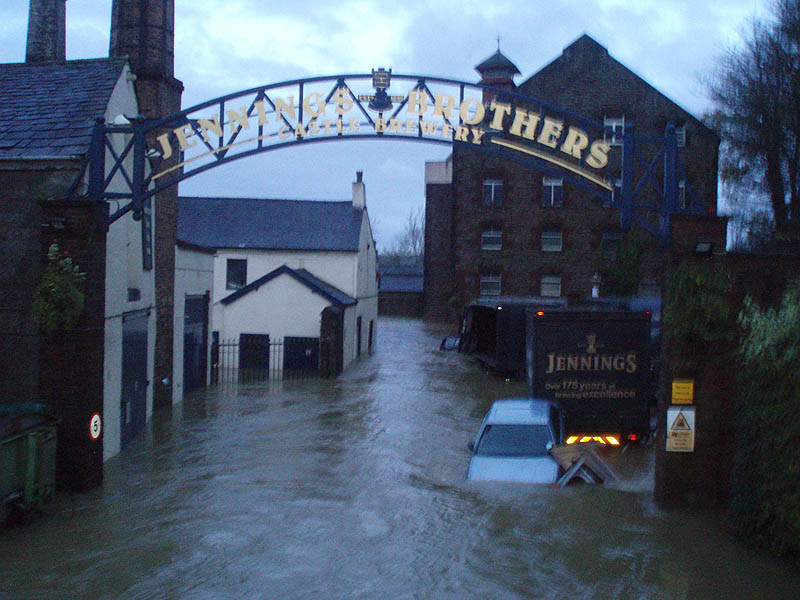
Next day we were off into Cockermouth – yes, Cockermouth – for the festival itself.  This is where Jennings Brewery is.  Again, the beers are good quality but nothing that you wouldn’t expect here.  But I love the story of Jennings brewery.  I’m not an apologist for big regional brewers – I just have an open mind about them.  I find this quite an interesting place to be. When Jennings was bought by Marston’s in 2005, the local CAMRA branch shouted that Marston’s were going to close the brewery, and continued to shout this even when Marston’s invested £250,000 improving the brewery.  If Marston’s had the slightest intention of closing the brewery, they had the perfect excuse to do so when it flooded in 2009.

Photo: Vanessa Graham on www.visitcumbria.com

But they didn’t.  They invested millions getting it open again.  I don’t know if anyone still thinks Marston’s are going to close Jennings, but if anyone does think that, I’ve got some magic beans you might want to buy.

But I digress.  On the first day of the festival, Jeff Pickthall and I were doing a beer and food matching event.  We’re both a bit vague about organisational stuff, and so were Taste Cumbria, so we ended up with about two hours to put some pairing suggestions together from food and beer being exhibited at the festival.  Not everyone was keen to have their stuff featured.  It was like an episode of the Apprentice. But as people filed into the room, we were just about succeeding in putting plates together for the following:

Mitchell Krause Hefe Weizen with goats cheese from Wardhall Dairy

Hardknott Cueboid with smoked cured boar

Jennings Sneck Lifter with lovely raisin fudge from Duerdens Confectioners of Burnley

Coniston Brewery’s Blacksmith ale with an amazing chocolate cake from Ginger Bakers in Ulverston

(We swapped these two around – people were split on what went best)

The aforementioned Croglin Vampire with Parsonby, another cheese from Wardhall which has been rind-washed in The Black Galloway porter from Sulwath brewery.  Beer washed cheese is the future, if you like your cheese smelly and overpowering like I do.

Thanks to everyone who agreed to donate stuff for us.  Amazingly, despite time constraints, exploding hefe weizen bottles and seventy extra people turning up just when we thought we’d done enough plates of food, it all went rather well, and the matches were ace.

Later, we sampled the delights of Cockermouth nightlife.  And encountered the Boogie Bus:

The ‘Big Boogie Bus’ – does that mean there’s a little one somewhere?

As you can see, it’s a pink bus that has pole dancers and lap dancers and glowing dance floors inside it. It roams the streets of Cumbria, stopping to lure stag and hen parties on board.  Then it glows brightly, drives off, and the stag and hen parties are never seen or heard from again.

Jeff and I decided to pass.  Instead we roamed the pubs in search of good beer.  And finally, after trying everywhere else, we found Cockermouth’s perfect pub, a place I’d be happy to see in any town.

1761 is modern and stylish without trying too hard.  It has Guinness, Strongbow and Carlsberg on the pumps because that’s what people want.  But it also has a good selection of local cask ales, and a small but perfectly formed range of craft beers in bottles including Little Creatures, Orval, Duvel, and Pietra.

There isn’t a full kitchen, but they do something I wish more pubs would do – a small, simple tapas menu.  We had stuffed jalapeno peppers, a cured meat platter, cheese platter, and some chorizo cooked in wine, which formed a great alternative to the curry and Cobra we were planning on.

I write about 1761 because it deserves to be written about.  It’s not a fully fledged craft beer pub, but it’s a pub with aspirations that understands the needs of its local community, is independent, and friendly.  It’s not boring like some.  It’s not too raucous like others.  There should be more pubs like it.

| Uncategorised

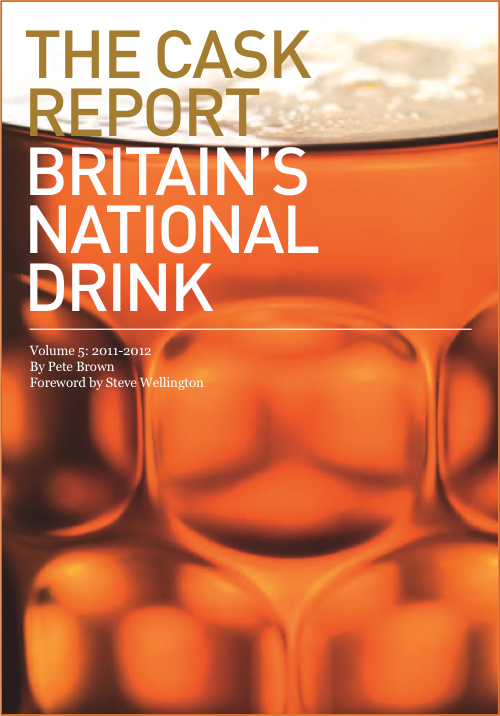
The Cask Report: everything you ever wanted to know about cask ale, launches today

The Cask Report was conceived four years ago to help solve the paradox of the UK cask ale industry: there are few if any national brands, it’s a fragmented industry consisting of over 800 brewers with many voices and little internal structure.

This is what appeals about cask ale: its relative lack of corporate bollocks, its regionality and localness.

It’s also one of cask ale’s biggest weaknesses: no one voice putting a coherent case for the industry as a whole.

So it’s brilliant that, despite their differences, CAMRA, SIBA, the key large regional players, the Family Brewers of Britain, and Cask Marque, can come together and agree to jointly issue a keynote industry report.  I’m paid by these people to write this report every year, and this is the fifth time we’ve done it.  Of course it’s positive, but as an independent writer (who likes cask ale and likes a great deal of other beer as well) I try to keep it objective, accurate and informative, and resist the desire to make it too sales-y.

This year’s report is out today and you can download it at www.caskreport.co.uk.  It’s primarily aimed at publicans who may (or may not) be interested in stocking cask ale, but some of it may be of interest to others who write about beer, or are interested in it.

It’s been a really tough year for pubs generally – and cask ale is only available in pubs.  The story for the last few year is that cask is in decline, but compared to the decline in the overall beer market, cask’s decline is very small.  It’s been getting smaller every year, but has not quite managed to get back into sustained volume growth.  With 25 pubs closing every week, beer duty up by 35% in three years and the total on-trade beer market down by more than 7%, that’s not surprising – what is surprising is that cask is doing as well as it is.  Here are some positive indicators in a difficult year:

  • Cask ale drinkers are more than twice as likely to go to the pub regularly as drinkers who don’t drink cask ale
  • The number of cask ale drinkers has fallen overall – but the number of young people drinking it (18-24) has risen for the second year running
  • This represents a broader recruitment trend – of all people who say they drink cask ale, 10% of them started drinking in the last year.  37% started drinking it in the last ten years.  Cask ale drinkers are leaving the market at one end, but they are entering it at the other – a clear sign of the revival of interest in cask ale
  • 2500 more pubs are stocking cask ale this year
  • Cask ale’s share of on-trade beer has increased to 15% – getting on for one in six pints served in the pub
So if it’s so good, why isn’t volume increasing?  Because for most drinkers, cask is an occasional drink within the repertoire.  Cask ale drinkers are more curious, experimental, have broader interests, go out more and try new things more than non-cask ale drinkers.  This is both a blessing and a curse – it means they’re more likely to try cask ale – it also means they’re more likely to try other things too.
So the task is to get people to drink more of it, more often.  This year, we commissioned some independent qualitative research to find out how publicans might do that – nine focus groups, across the country, probing attitudes to cask ale, and behaviour around it.
The results make for interesting reading.  Some of the solutions sound obvious – but if they were, more pubs would already be doing them.  I won’t go into a full analysis here, but some of the most interesting things for me were:
  • Only the beer industry and beer geeks debate the merits of micros versus big regional brewers.  For most drinkers, the dynamic in the market is about ‘familiar’ versus ‘unfamiliar’ beers – it doesn’t matter who brews them.  Depending on who you are and where you drink, Thornbridge Jaipur could be more familiar than Adnams Bitter.  Pubs need a mixture of familiar and unfamiliar brands.  If you have, say, three hand pumps, three familiar brands is boring, while three unfamiliar brands is too eclectic (unless you’re a specialist craft beer pub, frequented by passionate beer geeks).  Most drinkers want to experiment, and then go back to what they know.
  • The single best way to sell more cask ale is to pre-emptively offer tasters to people who look unsure at the bar.  We’ve been saying this for five years now.  It’s still the first thing that comes up in research.  Yet so few pubs do it.
  • Another failsafe method – which sounds so obvious – is a chalkboard featuring names, ABV and, if you like, something about taste, style and provenance.  At a busy bar people can’t scrutinise hand pumps properly and feel pressured into making a quick decision.  Often, they’ll default to Guinness or lager.  A clearly visible chalkboard gives them plenty of time to choose a cask ale
  • We didn’t ask this, people told us: cask ale is natural, flavoursome and ‘a little bit cool’.  The explosion in the number of new beers available, and the growth in the number of pubs selling them, suggests that cask beer has momentum, and it’s becoming generally regarded as cool in an ‘old school’ way rather than uncool in an ‘old fashioned, way.
Those, for me, are the points anyone interested in promoting cask ale should be banging on about.  There’s plenty more in the main report.  I hope you find it interesting and useful.