Author: PeteBrown

| Uncategorised

May Vlog: East Anglia

I think we’re quite slick in a rather chilled out way on our latest Vlog.

Peter Amor takes his bow-tie to Elgoods, a brewery like you have truly never seen before, that’s over 200 years old.  The young whippersnappers who took it over are now in their fifth generation, and there’s a lovely laid-back feel to Peter’s brewery chat.

I got to go to the Fat Cat in Norwich.  Norwich is a bit out of the way so the Fat Cat doesn’t get talked about in the same breathless terms as North Bar, Rake, Cask & Kitchen, Sheffield Tap etc, but it’s been doing the same thing as those places for much longer – 20 years this year to be exact.  Thirty cask ales on at any one time, and over 50 bottled craft beers from around the world.  How can they get the throughput they need to keep so many casks on?  Well, despite being in a sleepy Norwich suburb, it’s packed – all the time.  We were filming on a Thursday mid-afternoon and it felt like a Friday night.  A truly great pub, worth braving even East Anglia Trains for.

Next month we’re going to Cornwall to visit St Austell brewery.  If you think there’s a pub as good as the last ones we’ve been to in the vicinity, let me know!

| Uncategorised

Stoke Newington Literary Festival gets its own exclusive beers – got a name for them?

“Who cares how time advances? I am drinking ale today.“

Edgar Allan Poe (Former Stoke Newington resident)


Last year my wife Liz, AKA the redoubtable Beer Widow, created the first ever Stoke Newington Literary Festival.  Somehow, it worked, and it was a truly great event, so this year it’s happening again, from 3rd to 5th June.  The line up includes ex-Bond villain Steven Berkoff, Johann Hari, Alexei Sayle, Jon Ronson, Howard Marks, Matt Thorne, Dan Cruikshank, Stella Duffy, Rowland Rivron, BBC 6 Music’s Shaun Keaveny, and of course a nepotistic beer and book matching talk from me.  You can get more details and buy tickets for all events from here.
Like last year, I’ve been putting together ‘Pete’s Bar’ featuring a range of tastefully selected drinks donated by very wonderful sponsors including Budvar, Quilmes, Thornbridge and Hendrick’s gin.  But this year we also have two unique beers thanks to our local brewers.
Redemption Brewery in Tottenham, just up the road from the festival, has created and brewed a summer ale that will be sold in the festival’s own bars as well as at The Jolly Butchers, another collaborator on the project.  Meanwhile, Brodies in East London has created a seven-hopped spectacular to offer festivalgoers a choice of unique local brews.  These beers will only be sold in Stoke Newington during the festival.  Liz even went along and helped brew one of them, with Emma from JBs:
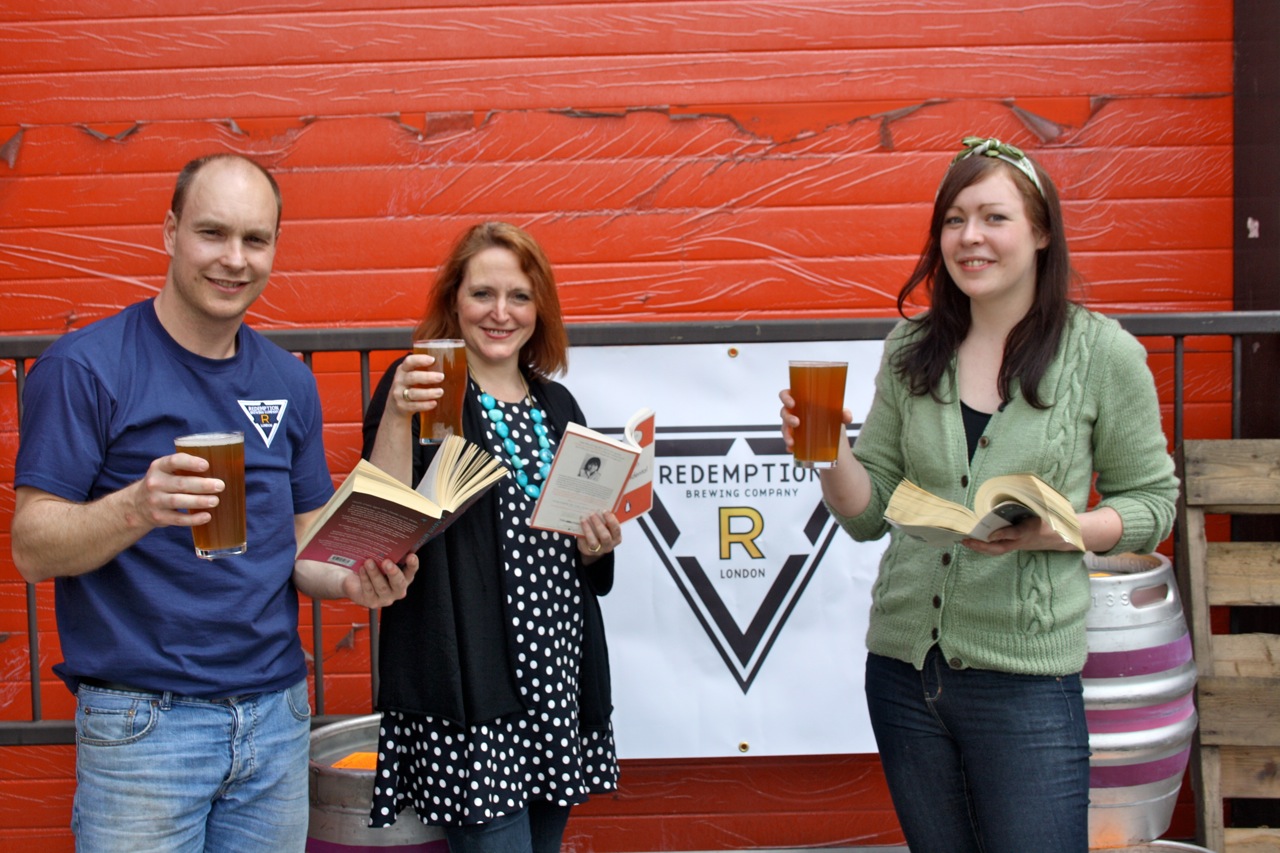
L-R: Nice Andy from Redemption, The Wife, Emma, Beer Queen of the Butchers, pretending to read book. Really drinking beer.
Today, we’re launching a competition to come up with a linked pair of names for these two sibling beers from different breweries – one light and refreshing, the other hoppier and bigger in flavour, both gorgeous, both perfect to accompany a summer’s weekend spent feeding your brain.
Andy at Redemption, James at Brodies, Emma at The Jolly Butchers and I will judge the names and award a host of beer and literature-inspired prizes, including 2 free tickets to my Beer & Book Matching event on Sunday 5th June, the chance to pull (and drink) the first few pints and signed copies of my Beer Trilogy: Man Walks into a Pub, Three Sheets to the Wind and Hops & Glory.
Suggestions should be sent to info@stokenewingtonliteraryfestival.com, @Stokeylitfest on Twitter, or via the festival’s Facebook page, where you can also receive updates about the festival and other beer sponsors. Competition closes 5pm on Friday 27th May.

| Uncategorised

Bombardier Beer Writing Competition winning entry: The Stonemason’s Tale

Not much time to blog at the moment – sorry about that.  Too much paid writing (although there’s never too much paid writing) and helping the Beer Widow organise this year’s Stoke Newington Literary Festival.

Biggest apology goes to the Milton Crawford, winner of the Oxford Brookes/Bombardier Beer Writing Competition.  I announced that he was the winner a month ago, and haven’t yet published his excellent winning piece, so I must do so now.

There are two reasons for the delay: about 75% of the blame is for me because I’m too busy and disorganised.  25% is because I was waiting to see if we could get the essay published first in a national newspaper or magazine.  Charles Campion was looking after this.  He’s infinitely more well-connected than I am, way more charming and much more respected.  Yet even he met with a brick wall when trying to persuade people to publish something about beer.  One food and drink magazine even went so far as to say, “We like it, it’s a very well written piece, but we do not publish features on beer, we just do wine.”  How a food and drink magazine can say this categorically about any food and drink – how it can be not just an attitude or preference, but a publishing policy decision – is beyond me.  But that rant is for another post.

I’m proud that I can publish here a piece of writing you can’t see in the national press – they don’t deserve it.

Congrats again, Milton.

THE STONEMASON’S STORY
By Milton Crawford

‘You’re drinking that like water,’ I said with a laugh as I stood at the bar and watched my friend George glug the top half of his deep auburn pint in one indulgent guzzle. A shaft of low sunlight caught his glass as it reached the horizontal in front of his mouth. There was a flash of red and gold. I watched his throat work hard, swallowing the liquid in rhythmical gulps, before he placed his glass down on the bar with emphasis and gave a long gasp of satisfaction. The liquid in the glass slopped about slightly like a gentle swell in the English Channel on a serene summer’s day.

‘It’s funny you should say that,’ he said, once he had sucked some air into his lungs. ‘A friend of mine was remarking just the other day how in medieval times every man in this country drank beer instead of water because the water could not be trusted. I knew that already, in fact, but what surprised me was the amount that they drank.’

He wiped the back of his hand across his brow and swept his long blonde ringlets from his forehead. His hair was damp and darkened around his temples as he tucked the dry ringlets behind his ears. It was the first really warm day of the year and as the sun dipped and cast long shadows across the stone-flagged floor, and the air outside began to cool slightly, it remained warm and sticky inside our village pub. There was a hum of conversation from around the low-ceilinged room and the cries of playing children and barking dogs shimmered in on the warm air. George placed his large, rough hands on the edge of the bar and leaned his weight slightly against them as though he was trying to move the bar backwards an inch or two. He was a stonemason with powerful arms and shoulders and I believed that if he tried he probably could move the bar if he really wanted to. The landlord – a tall, slim fellow with a long neck and glasses – leaned his right forearm on top of the pumps and listened. George liked to tell a story.

‘A man would be drinking beer from when he woke in the morning to when he went to bed at night. He’d have half-a-pint for breakfast, a couple of pints through the morning, three or four in the afternoon, when he was hot from working, and then, in the evening, another three or four with his friends.’

‘Sounds like old Roger,’ chimed in the landlord with a chuckle, ‘he’d be in ‘ere every day for a breakfast pint if I let him in.’

George looked directly into the sun and took another gulp from his glass.

‘Nine pints,’ he said, turning to us again with his face that looked like it too had been roughly chiselled from stone. ‘That was what the average medieval man drank every day of his life. I suppose that would be quite weak ale, but you must admit, that’s a fair amount of beer. When my friend told me that, I tried to think what the life of a stonemason might have been like in the middle ages. I certainly wouldn’t fancy cutting stone – and especially not lifting it – after a few pints.

‘I often think of those times when I’m on the marshes at the edge of the village and I gaze across to the city. The cathedral spire is staggering to us now. But just think what it must have been like to the people who lived when it was built. Those people would only have seen one or two storey buildings their whole lives, and then this spire – this one-hundred and twenty-metre pinnacle of stone – pierces the sky and aims up to heaven like an enormous javelin. Can you imagine how awestruck those people must have been?

‘The main body of the cathedral took thirty-eight years to build. That’s a man’s entire working life now and back then, by the time he’d finished, he wouldn’t just be ready to retire, he’d be just about ready to die!’

George laughed and lifted his glass once more, draining it entirely.

‘You fancy another?’ he asked me.

I supped up.

‘I’ll get these,’ I said. The landlord soundlessly picked up our glasses and pulled back on the hand pump. I heard the ale hit the bottom of the glass and froth slightly.

‘Imagine if I had been told,’ continued George, ‘when I was an apprentice in my late teens, that I would be working on the same building for my entire life. I’d be about halfway through it right now. Of course, you’d be proud of playing a part in such a towering achievement as a cathedral, but I’m glad I have the variety of work that I do. You see, there’s plenty of differences between how people lived then and how they live now; a lot of similarities, too, but a lot more differences.’

The two fresh pints were served to us and we both took greedy mouthfuls of the cool ale.

‘One of the main differences, I think,’ George said, ‘is that there was more of what you’d call a community then. For one thing, people didn’t have cars or much other form of transport. They couldn’t drive off somewhere when they felt like it. They were stuck in their village and they had to get along with the people who lived around them. There was also no such thing as television or cinema or radio or the internet. What did people have for entertainment? Each other, of course; and beer!

‘When I imagine how the villagers worked back then, I think of how the fields would have been full of people having to dig the earth by hand. All the time they would have talked to each other as they worked. At the site of the cathedral there would have been hundreds of them working together with no mechanical noise other than the sound of hammers and chisels. The stonemasons would have been chiselling and chatting away at the same time. Conversation gets drowned out these days. On building sites there is the constant din of machinery. In the fields, there is no need for lots of people, because the farmer has his tractor and chemicals to do all the work for him. Instead of talking to each other we turn on the TV. We call people our “friends” on the internet but they’re people we haven’t seen or spoken to for twenty years.

‘But there are still places that you can go to feel part of a community. I’m not a religious man but I’ve heard that church-goers live longer because they have the feeling of belonging. “Churches are social glue” someone said to me once. Well, I like to think the same of pubs and I reckon someone should do a study on the positive health effects of going to the pub. All you hear about is bad things about drinking but for me the pub is the only place I can go to tell a story and hear other people tell stories. It gives me an opportunity for companionship. It’s a place where I feel the warmth of my fellow men – and women – rather than watching on the news about another murder or atrocity or war.

‘For this reason I say that beer is as essential to me as water. But it’s not really the beer itself. Of course I love drinking, but I value above that the social element of going to the pub. Human beings need all kinds of nourishment. We need food, sleep and shelter. But we also need to feel part of something that is bigger than us. We scoff at the middle ages. We laugh at how ignorant and filthy the people must have been then. But just think: that cathedral is still standing and how many buildings that are being built now will still be standing in eight hundred years’ time? We can learn a lot from them if we stop and think about it a little.’

‘Like how to drink nine pints every day?’ asked the landlord.

‘Well,’ said George, with a poker-face, ‘at least I can feel happy when I leave here, having drunk four or five, maybe, that I’ve got a comfortable bed to lie in whereas medieval man probably had to drink nine pints just so he could get to sleep on his straw mattress!’

The landlord laughed and George smiled once more. And as the dying sun sent its red-orange glow through the stone mullioned windows of the pub for the final time, his face was illuminated and looked to me at that instant like a westward facing sea cliff when the sun seems to falter slightly, then finally dips below the horizon.

| Uncategorised

April Vlog: Burnley and Moorhouses

Our wayward ramble through the UK continues, and this month we hit the north west.

Why?

Because Lancashire Brewer Moorhouses has spent over £4m on a staggering expansion with a brand new brewery that increases their capacity by a ridiculous amount.  A confident investment for the future?  That’s an understatement.  Moorhouses MD takes a clearly jealous Peter Amor around the brewery, showing him where the money went.  As the most ambitious micros grow to the level of small regional breweries, some shrewd business people clearly believe the revival of interest in good beer is here to stay.

Then we go to Burnley town centre.  I have a strange relationship with Burnley because it’s in the north, has a crap football team and sounds a bit like Barnsley, so people often think I come from there, because I come from Barnsley, which is in the north, has a crap football team and sounds a bit like Burnley.

Anyway, I wish Barnsley had a pub as good as the Bridge Bierhuis (which is in Burnley).  If it did, I might not have left town as soon as I was able.

In various publications as well as this blog, I’ve written quite a bit over the last 12 months about ‘craft beer pubs’ – often moribund or failed pub sites that have reopened or repurposed themselves with a single-minded emphasis on interesting beer – real ale and otherwise.  One criticism that’s been fired back is that these fancy establishments might work well in That London, or maybe Leeds, but you can’t expect people in northern provincial towns to enjoy microbrewed cask ales, imported Belgian beers and German lagers.  The Bierhuis proves them wrong, by doing something quite rare – it combines being a beer shrine with being an excellent and important community Local.

I say all this in the video, actually – but I say more besides, so please give it a view and let us know what you think.

Next month: Scotland.

| Uncategorised

Exclusive: Wanted – New Brewer For One of World’s Best Beers

Perfection

If you love beer, and think you’re a good brewer, this is like Masterchef and Pop Idol rolled into one.

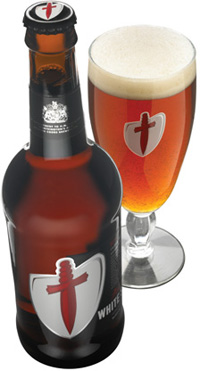
Steve Wellington, Jedi Master Brewer of Worthington White Shield, is looking for a new Padawan.

White Shield has long been a legendary, semi-mythical beer, with a hardcore of devotees sighing wistfully at its very name, a few others going “Dunno, can’t see what all the fuss is about,”and a vast majority in the middle saying, “White Shield? Is that still around?” or “White who? Never seen it.”

For me, it’s one of the best beers in the world.  It traces an unbroken lineage back to the 1830s as one of the genuine IPAs brewed in Burton on Trent and sold in Calcutta.  When I was researching Hops and Glory I found records of it being imported to the Calcutta docks.  It was dwarfed in size by Bass and Allsopps. but did steady business.  Allsopp’s is no more, and Bass is in trouble.  White Shield has certainly had its ups and downs, almost disappeared after brewing was contracted out from Burton, but was rescued and revived by Steve about a decade ago.  Since then, it’s won Champion Bottled Beer of Britain and Steve has been named Brewer of the Year.

But all this was happening on a tiny, ancient three-barrel museum plant, that looked lovely, had a personality of its own, but was showing her age.

That’s why, at a time when most UK macro brewers were disinvesting in ale, Molson Coors took the relatively enlightened step of giving Steve a brand new, state-of-the-art £1m brewery to play with in the newly reopened National Brewery Centre in Burton.  The macro has seen that there is a future in ale and decided to take a bit of an interest.

The new plant has been operational since the start of the year.  So far, the only thing Molson Coors have done wrong with the new William Worthington Brewery is let marketing have the final say on the names of the new beers that come out of the plant alongside White Shield.  Marketing has misunderstood the brand and declared that every beer has to have ‘Shield’ in its name.  So the first seasonal is called ‘Spring Shield’.  Nice beer, silly name – the master brand is William Worthington, guys.

Anyway, within a few months the new brewery was working at capacity, and today Molson Coors will announce that it brewed more beer in the first quarter of 2011 than the old girl did in the whole of 2010.  So successful is it, they will also be announcing the search for a new brewer to work with Steve and his fellow brewer Jo White.  It’s a dream job: one of Britain’s oldest and most revered brands, on one of Britain’s most modern and advanced small breweries.

Interested brewers should visit http://molsoncoors.com/en/People.aspx for more details.

| Uncategorised

So I drank some Stella Cidre…

It’s here…

Analytics suggest that my post ridiculing AB-Inbev’s launch of Stella Cidre is the most popular thing I’ve written on this blog in 2011 so far.  Long time readers will know that among the multinational brewers, I reserve particular ire for AB-Inbev because their relentless focus on cost-cutting is destroying some once decent brands, and because they keep bringing out new ‘innovations’ that are nothing of the sort.

It was therefore with a hint of nervousness that I spied Stuart Macfarlane across the room at the annual Publican Awards a couple of weeks ago.  Stuart and I used to work together, but with the piss-taking I’ve subjected him to on here recently, I wondered if we were in for a bout of fisticuffs.  Especially when, the second he saw me, he got up from his table and made a beeline straight towards me…

We had a good conversation.  Stuart’s actions suggest that he is not passionate about beer itself, but you only have to be in the same room as him to realise he is certainly passionate about the brands he’s responsible for.  (I would argue that you cannot be truly passionate about beer brands if you’re not passionate about the beer itself, but that’s a whole other blog post.)  He reads this and other blogs regularly, and he doesn’t like the criticism.

“Well just make better beer then!” I hear you scream in frustration.  But in the strange world of multinational brands, it’s not as simple as that.

Once we’d established that I wasn’t simply criticising AB-Inbev because they were big, but specifically because of their actions, Stuart challenged me to try some Stella Cidra. I said I didn’t have a problem doing so, because at the end of my blog post on it, I did say that when I saw it I would try it, and that if it was nice, I would say so.  I’m not pushing agendas here – if it’s a good product, I have no reason for saying it’s not.

Fair play to Stuart, at lunch time the next day, there was a knock at the door and a case of Stella Cidre, with a note from Stuart saying how much he’d enjoyed our chat.

Stuart asked me to judge the product against its peers – “the two big yellow ones” as he described them – and one quality ‘premium’ cider.  I chose Aspalls, because I like it, and because it’s probably the first ‘premium’ cider many Magners/Bulmers drinkers would see/try.

Mmmm…

If you’re a craft cider purist, look away now – you’re going to say it’s not cider because it’s not 100% apple juice, and that at least three of these four brands are tasteless abominations.  I’m not about to say anything that will convince you otherwise.
But I’m fairly relaxed about cider.  On a hot day, I like a pint of Aspalls or Addlestones, I LOVE Badger’s Applewood cider made for them by Thatchers.  Not because it’s layered and complex and structured – it’s not.  But because it has a moussy mouthfeel and a clean, dry crispness, with just a hint of satisfying tart tingle, that’s refreshing without the bloating gassiness of lager.  I’ll even happily drink a bottle of Magner’s over ice if I’m in the right mood and the wrong pub.  So I’m not judging Cidre by the standards of farmhouse cider – there’s no point.
Side by side then:
These are poured in the same order as the bottles above.  You can see that in terms of colour, Stella Cidre has gone toe-to-toe with Magner’s and tried to match it exactly.  Bulmer’s is more lager coloured, which is interesting – looking more for that lager-cider pint crossover I guess – while Aspall’s resembles a glass of white wine.  
I should also point out that, according to the labels, Stella Cidre is made from 50% apple juice.  Not much if you’re a purist, but significantly above the 35% minimum you must now have if you want to call your product cider.  Aspall’s is made from 100% apple juice.  Neither Bulmer’s nor Magner’s disclose this information on their labels.
None of them apart from Aspall’s really had much of an aroma – although this may be due to the temperature.
Bulmer’s was simply a monotone, a fizzy, flavourless thing that, if served truly blind, you would simply have no way of guessing was a cider.  No apple taste or character whatsoever.  Not unpleasant at all – you’d have to find fizzy water unpleasant to be able to say that – just…nothing.
So Stella Cidre then: after the vacuum of Bulmers, there’s a bit more of a fruity flavour up front here, followed by an acidity that makes my mouth water.  A bit of a chemical hint, and then, nothing.  It’s amazing how quickly it disappears, leaving you unsure whether you’ve drunk it at all.  Again, not unpleasant – I think – but odd.  
Magner’s has more discernible apple aroma, a bit more of that moussy mouthfeel – Stella was more watery – less fruit, a little more of that tartness, and a slightly longer finish.  It’s very similar, but fits together a little better and leaves you more certain that you’ve just had some cider.
Finally, Aspall’s was quite different.  It clearly tasted of apples, had a nice aroma, was more structured and had a long, dry finish.
Stella Cidre – judged by the standards relevant to it and its competitors – is not a bad product.  It’s certainly nothing like the abomination that is Stella Black.  Both in appearance and flavour profile it seems to be trying to match Magner’s.  The interesting thing is that people perceive Magner’s and Bulmer’s to be the same thing, and they’re quite different, as this tasting shows.  I might have a Stella Cidre instead of a Magner’s if Magner’s wasn’t around.  But Magner’s would remain my first choice – it has the edge in terms of aroma and overall product delivery, and just feels slightly better made.  Stella Cidre strikes me as being a little bit like the monsters from this weekend’s Doctor Who – as soon as you’re not looking at them any more, you forget you ever saw them.  As soon as Stella Cidre is no longer in your mouth, you forget you’ve drunk it.
I believe it will do well where it’s sold, and people in the mainstream cider market will like it.
The product, then, is not a disaster.
But.
The marketing launched last week as well.  The image at the top of this blog is one of the posters currently up everywhere.  I won’t offer my own comment on this, I’ll just share a response to it from a more creatively minded friend of mine:

| Uncategorised

Beer ‘not appropriate’ for Royal Wedding

Yesterday’s papers ran with the story that beer has been banned from the Royal Wedding.

Said one ‘insider’:


“There won’t be any beer. Let’s face it, it isn’t really an appropriate drink to be serving in the Queen’s presence at such an occasion.

“It was always their intention to give their guests a sophisticated experience and they have chosen the food and drink with this in mind.”

What a shameful, depressing, snobbish, bigoted, blinkered, rude, clueless, cruel, idiotic thing to say.

You might just have been able to dismiss this as a faux pas – you can’t and shouldn’t force anyone to drink what they don’t want, and this could just be an unthinking oversight in a wedding where every single choice of decoration, clothing, dinner service and music is being analysed and dissected to discover it’s meaning and symbolism.

Except this is no oversight – that use of the word ‘inappropriate’ shows that this is a deliberate, calculated snub.  It would not be ‘appropriate’ to have beer served in the Queen’s presence.  The very presence of beer – any beer – would be offensive to her royal sensibility.

And so Britain’s national drink – the thing for which Britain is best known after the royals themselves – is barred from the wedding of Britain’s future monarch.

(Also, needless to say, the ‘sophisticated’ wines being served will not include some of the many excellent British wines available today).
In part this just shows up the royal family as the overprivileged and out of touch twits we already know them to be.  But it also shows up the populist impression of the relative worth of different drinks.  Despite all the progress we’ve accomplished in beer look more interesting, classy and worthy of serious gastronomic consideration, the mainstream image is still that it is boorish and not to be taken seriously.
Past generations of royals went to Burton-on-Trent and ‘brewed’ special beers to commemorate events such as royal weddings.  Not this lot.  What can we expect when, last year, a visibly disinterested Princess Anne turned up to open the new National Brewing Centre in Burton and made a speech to the assembled throng about how she didn’t like beer.

Even Prince Charles’ own beer, sold under the Duchy Originals brand, is apparently good enough for him to make a fat profit from, but not good enough to supply to his son’s wedding.

The royal family has stuck two fingers up to one of the last remaining manufacturing industries in their kingdom, especially to the plethora of breweries who have created special commemorative beers for the big day (yes, they’re cashing in, but they’re also wishing the royal couple well).

Particularly given that  £1 of every pint sold in the UK consists of duty and VAT, which goes to the public purse, which is in turn paying for the event, the contempt shown by the royals towards their subjects, their economy, and the icons and traditions of their kingdom, is sickening.

So.  If beer is not good enough for the royal wedding, I suggest the royal wedding is not good enough for beer.  I urge brewers to rebadge their royal beers with republican designs.  I urge pubs not to show the royal wedding, and to advertise themselves as royal wedding-free zones.
I also urge the BBPA to make a formal protest to the royal family using some of the points I have made above, if not the same language, and to issue a press release condemning this shameful contempt for beer.

Go to the pub on Friday.  Celebrate the free day off.  But don’t show one ounce of support for these beer hating snobs.

| Uncategorised

Britain still refusing to drink itself to death – despite media insisting it is

A few weeks ago various shitty newspapers picked up on the shocking rise in binge drinking among women.  Curiously, none of them seem to have picked up on the latter clarification that this isn’t actually true.

Last time I discussed ONS figures on drinking, I pointed out that in 2006 the number of units in a glass of wine was changed to reflect the growing trend to larger glasses.  I had no problem with this change in calculation because it’s true that on average we’re drinking from larger glasses, so the definition of ‘a glass’ of wine needs to keep pace with this.

But it did create an apparent huge one-off jump in alcohol consumption, particularly among women.  However, this was NOT an increase in drinking – it was a change in methodology.  It meant that the figures in the years before the recalculation should probably have been higher, and meant that any figures coming after the change could not be compared directly to those before the recalculation to give any kind of accurate trend. At the time, the ONS said: ““It should be noted, however, that changing the way in which alcohol consumption estimates are derived [in 2006] does not in itself reflect a real change in drinking among the adult population.”

Get that?  That’s the ONS saying it – the people who compile the figures.

Consumption was on a downward trend before this recalculation.  After the jump caused by the change in calculation, it resumed this downward trend.  In other words – let me spell this out as clearly as I can, because it seems to be a difficult thing to understand – THE OFFICIAL ONS FIGURES SHOW THAT ALCOHOL CONSUMPTION/BINGE DRINKING IS IN LONG TERM DECLINE.

So why in March 2011 does the ONS then issue a press release that states: “The percentage of females consuming more than the weekly recommended units of alcohol has increased by a fifth since 1998”?

Is this true? Or did they forget the change in their own methodology that they themselves were previously so keen to point out, in order to ensure people read the figures correctly?

The answer is: yes, they forgot to take account of their own methodology change, which led to them releasing a false story about alcohol consumption to an anti-alcohol national press!

They did at least have the decency to point this out, reissuing the press release with a clarification on the front page that reads:

Corrections have been made to reported trends in alcohol consumption in this article, published on 31 March 2011. The errors are unrelated to estimates of output, inputs and productivity.
In Annex C, figure C.5 illustrated trends in alcohol consumption from 1998 to 2009, using estimates from the General Lifestyle Survey (ONS 2010), but omitted references to a change in the estimation methodology in 2006. The change means that trends over the whole period do not necessarily reflect changes in drinking habits.
Accordingly, explanatory footnotes have been added to figure C.5 and paragraphs C.2.7 to C.2.10 in Annex C. References to alcohol consumption in the main article (Table 4.2) and the News Release have also been amended.
ONS apologises for any inconvenience caused.

According to the Liberal Conspiracy blog, the ONS has apologised to the Portman Group for the error.

According to the Straight Statistics blog, which helpfully found this little clarification for us, the Portman Group wrote to the Daily Mail and pointed out this error, but the Mail has refused to print this correction to a factually inaccurate story they ran, and is no longer accepting comments on the online version.

I wonder why?

The Telegraph story is also still up online and uncorrected.

A special prize goes to anyone who can find a single UK media outlet clarifying the story with the correct data.

Thanks to Jeff Pickthall and to Dave Boyle for alerting me to this gem.

| Uncategorised

O-Lordy – caught on the hop(s) in the Welsh Valleys

Last Thursday in Pontypridd, the early summer seemed to have revealed itself as a false start.  A chill mist hung over the peaks and dulled the valleys.  The sombre mood was enhanced when I got off the train at the wrong stop, forcing Nick Otley to come looking for me on a hillside industrial estate he’d never been to before.

When he finally found me and took me back to the other industrial estate back up near Pontypridd – the one where the Otley brewery is – my first impression was that Otley will soon need a bigger unit, if not to expand their brewing operations, then to get a bigger office for all the framed awards certificates.  If they carry on winning stuff at the rate they have since opening shop in 2005, they’ll run out of wall space this year.

I’m not the first beer writer to brew at Otley – not by any means.  I would have been higher up the list if I’d got my shit together when they first invited me to brew, but since then Melissa Cole, Adrian Tierney-Jones and Roger Protz have all been asked to come down and get their hands dirty – Glyn from the Rake, AKA @RabidBarFly, was here before any of us – his Motley Brew has become a regular addition to the range.

The trend of collaborative brewing is an exciting one, but I think, dear reader, you could be forgiven for getting more excited about, say, a collaborative brew between Thornbridge and Brooklyn, or Brew Dog and Mikkeller, than one between a thrilling new brewery and a beer writer whose only experience at brewing before has been a kit from Boots in 1981.

I’ve been asked to brew before – several times.  But on most of those occasions ‘brewing’ meant I dug out the mash tun and basically got in the way.  The notable exception would, of course, be Avery Brown Dredge – and my write up of that experience is long overdue – but Zak and Mark had much more to do with both the recipe design and the labour than I did.

Like our ABD experience, Otley ask writers to get stuck in.  Not just the symbolic digging out of the mash tun, but designing the recipe, choosing ingredients and really taking responsibility for how it’s going to turn out.  Go brew with Otley, and there’s nowhere to hide.

The pressure was on.  I’d previously talked to Nick about brewing a big old Imperial stout, because when he first asked me to come and brew – at the end of 2009 – I’d only ever brewed IPAs, and was – not bored exactly – but wanted to spread my brewing horizons.

Funnily enough, inspiration came when we were sitting in Brew Dog, about to brew our Imperious Stout, weeping with hangover.  (The Brew Dog bar in Aberdeen is great – but almost every beer is one you want to have at the end of the evening.  The End therefore goes on for hours.)  I was sitting there, feeling guilty at not having contributed more to ABD, thinking, what will I do at Otley?  And Martin Dickie, Brewing Boy Genius, handed me a nice cup of life-saving tea and popped a packet of ginger biscuits on the table. I looked at the packet of ginger biscuits.  The packet of ginger biscuits looked at me.

And I thought, Imperial stout brewed with ginger, maybe a bot of chocolate, aged in whisky or rum casks.

Otley have so far resisted the cask ageing trend.  This was to be their first attempt.  The easiest casks to get were Welsh Penderyn whisky casks – and they weren’t easy to get.  So that’s what we’re ageing the beer in.  It’ll be ready late Autumn.

A man with a camera came, which I hadn’t expected.  I didn’t have my entourage, make-up or anything.  But, I reasoned, I never have an entourage or make-up, so it makes no difference.  So I hastily improvised a quick description of what and how we were brewing.  I insist all errors in describing the brewing process are down to necessary editing, but I think Wales Online did a really nice job here.  They turned up just after we’d finished mashing in, so I’m covered in malt flour.  I’m also pitifully knackered.  But it’s come out OK.  

After we finished brewing, I had several pints of ATJ’s excellent Saison Obscura down at the Bunch of Grapes, and even though I was falling asleep from mid-afternoon onwards, the beer somehow galvanised me into giving a competent account of myself during the evening’s entertainments, when I matched various beers with each of my three books for an audience bussed into the brewery.  The smell of chocolate filled the air by the time they arrived.  I think they enjoyed the multi-sensory beer experience.