Author: PeteBrown

| Uncategorised

Introducing “Shakespeare’s Local” – my next book!

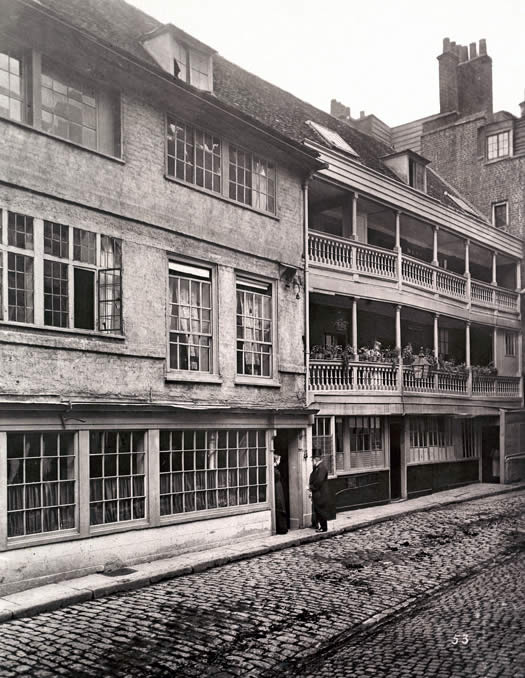
The George Inn, Southwark, Late nineteenth century

So, at the end of last week, my agent shook hands on a very nice offer from the wonderful Pan Macmillan for my follow-up to the Beer Trilogy!

It’s been four years now since I signed the deal on my last book, Hops & Glory. That’s so long ago, I had only written three entries on this blog at the time, and most current UK beer blogs were still twinkles in a beer geek’s eye.

For the past two years I’ve been trying to develop ideas that move on a little from beer. After three books that look at history, travel and complete obsession, I’ve done all I can in book form for the time being – or at least, the kind of books I write.

I have no intention of stopping or even slowing down in beer journalism and blogging, and there may also be other books – more conventional style drinks books – in the offing. But all the ideas I’ve had for narrative, story-driven, personal journey type books in beer feel like they subscribe to the law of diminishing returns. If I ever reach the stage where tens of thousands of people are prepared to buy a book just because it has my name on the cover, I’ll definitely revisit various ideas for more epic beer journeys, but at the moment there’s simply not a big enough market to justify the expense and time commitment they require.

So after the epic travel of the last two books, I wanted to do something that would keep me closer to home – but that’s still grand in scope in its own way. I’d also like to do a book where I don’t spend the entire advance – and more – on plane tickets and boat voyages. And finally, I wanted to do something that could extend my growing interest in social history beyond beer, but still keep one foot firmly in the pub.

To tick all these boxes, my editor has been urging me for months to write a very detailed social history of one pub, through the ages, and everyone who drank in it, everything that’s happened to it. Fine, but what pub?

The answer hit us just before Christmas – and has been taking shape since then.

The George Inn in Southwark, south London, is London’s last remaining galleried coaching inn – one of the few left in the country. The current building has stood there since 1686, when it was rebuilt after fire. The inn dates back before then at least to 1452, and probably earlier. Its vast network was once home to the hop trade from Kent up to London.

For centuries, when London Bridge was the only river crossing into the city, the gates were locked at night, so travellers to and from the south would set off from and arrive at Southwark.  By Hewnry VIII’s time Borough High Street was one long line of inns. The Tabard – Chaucer’s start point for the Canterbury Tales – was right next door. Neighbouring on the other side was the White Hart, mentioned by Shakespeare in Henry VI, and featuring heavily in Charles Dickens’ Pickwick Papers. Dickens was also a regular at the George, and mentions it by name in Little Dorritt. And Shakespeare – who lived just down the road for a few years – almost certainly performed plays in the inn-yard before the Globe was built.

So you have the three great cornerstones of the English literary canon in or near the pub. But more than that, the constancy of the George as everything around it has changed (none of the other twenty-odd Southwark inns now survives) makes it the perfect vehicle to look at six centuries of social history. As you stand on the ancient wooden balconies now, you can see London’s latest phallus, the Shard, rising up in front if you. And that kind of freaks me out. When Dickens wrote about this place 175 years ago this year, he was already being nostalgic about it. Imagine that!

Imagine all the people who have drunk here – not just Winston Churchill, Clement Attlee, Dwight D Eisenhower, Princess Margaret, Gary Cooper and other Hollywood stars who made a special pilgrimage, not just the long gone society of London ale conners who used to bless the new season’s ale here, not just the Thespians who staged Shakespeare plays in the inn-yard all the way up to the 1970s, or the ghost of the old landlady who haunts the upper floors. Imagine all the ordinary market traders, hop merchants, bear baiters, prostitutes from the nearby Southwark ‘stews’, clergymen, highwaymen, theatre goers, waggoners, gentlemen and rogues who’ve passed their time in this building. What did they eat? Drink? Wear? Talk about?

That’s the pitch.

I’m writing it intensively through the rest of 2011, hoping for a release in 2012, in time for the Olympics.

And hopefully, it won’t be the only book I’ll be working on! But more on that later, if my other project, in collaboration with a very talented photographer, also comes off.

Anyway, if the blogging slips, that’s why. If you want me, I’ll probably be in the Southwark Local History library.

| Uncategorised

Bombardier Beer Writing Prize – ladies and gentlemen, the winner!

At the beginning of March I announced a major new beer writing competition, for which I’d been asked to be a judge.

The incredibly generous £2000 prize offered by Wells & Young’s certainly did the trick – we had 42 entries by the time entries closed just over a week ago, giving us a huge judging task over one weekend, ready for the winner to be announced last Friday during the Oxford Literary Festival.

We managed it, but the short timescale and weight of entries meant we were less than professional about announcing the winner publicly, for which I apologise.  It’s the first year of the competition.  Hopefully it will happen again, and the learning will make it more efficient next time.

There were two things I really liked about judging this: one, the prize attracted some very established beer writers, and some people I’ve never heard before.  Two, I only found out who these entrants were after the prize was awarded.  An independent administrator processed the entries, and posted them out to the judges with the names removed – my fellow judges and I had no idea who we were reading.  Everyone was on a level playing field, and we were only able to find out who had written the ones we enjoyed after we’d made our decision (though I admit some stylistic tics gave me a clue here and there).

Having never judged a writing competition until recently, this is the third I’ve done in a year.  In all three, the pattern is the same: one or two rubbish entries, a lot that are competent, interesting but quite similar to each other, and a few that really stand out and make me very happy as a reader, quite jealous as a writer.

The brief this time, as summed up by my fellow judge, food and drink writer and telly pundit Charles Campion, was to sum up “the joys and jolliness of beer”.  The judges were looking for something that was lyrical, positive, optimistic – something that, if published in a national newspaper, was actually capable of forcing non-beer drinkers to re-evaluate the most sociable drink in the world.

(Speaking personally, and definitely NOT for the other three judges, essays that began by slagging off beers the author thought were inferior, before moving on to those they liked, kind of missed the point.)

The majority fell in to two camps: personal journeys of awakening to beer appreciation and the incredible role beer has played in the author’s life, and/or historical treatises on the cultural role of beer.  There’s nothing wrong with either approach, but the sheer volume of entries meant that all the entries that simply did one or both of these well were hard to differentiate from each other.

A few stood out – a grasp of language, an interesting construct, a mastery of storytelling, maybe even an original perspective – seven or eight – and I hope we’re able to publish all of them, somewhere, in due course.  The eventual winner was the best of these.

For his essay, ‘The Stonemason’s Tale’, the winner was Milton Crawford.

Milton may not be a familiar name in the world of beer writing (especially as it’s a pseudonym – no, not for an established beer blogger or writer) but he achieved a measure of critical and commercial success last year for the Hungover Cookbook, praised on both sides of the Atlantic, and paired rather unfortunately on Amazon with some unpleasant corkscrews designed to look like little men with massive curly metal cocks.

Milton’s entry showed that he can write lyrical as well as laxative, and it genuinely moved all the judges.

We’re still hoping to publish it somewhere more noteworthy than this blog… but I’ll save the tales of appalling newspaper idiocy and disgusting snobbery for another post.

This competition was the first salvo from Oxford Brookes (home of Oxford Gastronomica and the national brewing library), Wells & Young’s, and celebrity patron Charles Campion, to attempt to create a more positive image of beer in the UK.  (With occasional involvement from me, and Mike from Utobeer.)

There are much bigger plans in the works, subject to sponsorship that is starting to look more definite than hypothetical.  All competition entrants will be contacted by the judges and, with your permission, kept informed of future developments.  It’s early days yet, so if you feel like you should know about it, but don’t, that’s only because there hasn’t been anything to tell you so far.  But stay tuned – hopefully this could lead to something.

| Uncategorised

Wikio beer and wine blog rankings: March

Another month of all change – at least outside the top five.  This table is virtually unrecognisable from what it was a few months ago!

1 Pete Brown’s Blog
2 Pencil & Spoon
3 Beer Reviews
4 Master Brewer at Adnams
5 Are You Tasting the Pith?
6 Bibendum Wine
7 Drinking Outside The Box
8 Travels With Beer
9 Zythophile
10 The Wine Conversation
11 The Good Stuff
12 Ghost Drinker
13 Raising the Bar
14 Spittoon
15 Called to the bar
16 Woolpack Dave’s beer and stuff blog
17 HopZine.com
18 Tandleman’s Beer Blog
19 Bordeaux-Undiscovered
20 The Pub Curmudgeon

Drinking made by Wikio

My return to the top is due to a combination of Young Dredge being preoccupied with starting a new job, and me finishing a freelance adman contract that freed up some time to blog.  I think it will be the last time I’m top of the pile for a while… as the readership of beer blogs grows, it gets more competitive, and I’m not going to be able to blog as much for the rest of this year thanks to getting quite a bit of new column and feature work, the upcoming Stokey LitFest, the next Cask Report, and what will hopefully be imminent good news on new books which will need to be turned around very quickly – I’ll blog more fully about those when and if they are confirmed.

You can see the list for yourself.  From now on when I preview these rankings (and if you want to preview them yourself, PLEASE drop me a line – it would be good to spread this around a bit more) I think I’ll just pick on one blog that’s showing some action and urge you to check it out if you haven’t already done so.

This month I want to have a look at number eight, Travels with Beer, mainly because it is more focused on pub photography than writing, and we don’t really think about about photography generally when we think about communicating beer.  Good photographs of pubs are wonderfully evocative, and Robert Gale from South Wales is very good at taking them.  I get a very sharp yearning to just be in most of the pubs depicted on the site.

Rob is one half of www.BeerLens.com, a transatlantic partnership of beer loving snappers with the delightful Kim Reid in Rochester, NY.  Kim was one of the people who looked after me on a recent trip to the city, and is probably the only person living in America who wishes she lived in Newport, South Wales, instead.  Most people who live in Newport don’t want to, so it’s an extraordinary enthusiasm to have.

Travels with Beer is also brilliantly laid out and put together, and makes me feel quite ashamed of my basic blogger template.

Generally it feels like beer blogging is starting to get a bit more serious, a bit more respected, a bit more polished.  There will always be good and bad of course, but ‘noisome bloggers’ (copyright: Roger Protz) have in the space of a few years become a fundamental part of beer communication, and have made it much more diverse, richer and more influential.

Social media + world’s most sociable drink – not hard to see why, is it?

| Uncategorised

AB-Inbev *hearts* Goose Island. So now what do we do?

I know I’m probably the last beer blogger on earth to weigh in with a comment on the news that AB-Inbev has bought Goose Island, but comment I must – even if I repeat what everyone else has said.

At the outset it looks tricky: I’ve criticised AB-Inbev more than any other macro, not out of any prejudice, but simply in response to their actions.  And Goose Island is one of my favourite brewers in the world, with their IPA my standard issue secret weapon for converting people who ‘don’t like’ beer.

AB-Inbev do not like beer.  Most people I have met personally who work for the corporation don’t even drink it.  I have argued with AB-Inbev marketers, trying to convince them that, if you want to make money from selling beer, you must recognise that it is not like other grocery products – that it has more romance, charm and mystery around it, that people take a greater degree of ownership in beer brands than they do in other product sectors.  And those marketers have disagreed with me, stating categorically that they feel beer is no different from any other product and can be standardised and treated exactly the same.  Stuart Macfarlane, CEO of AB-Inbev UK, has said that he works not for a brewer, but for an FMCG marketing company that happens to sell beer. It’s a company that has an industry-wide reputation for being a ruthless cost cutter – after all, their relentless expansion has to be paid for somehow.  The tragedy of Stella Artois is that it was once a special beer, and the last ten years have seen every single ounce of value stripped from that beer.  AB-Inbev is also a company where, if you are an employee and you are seen drinking a beer from a different brewer – even on your own time, off the clock, when the company is not paying you – this can be, in the words of more than one former employee, “a career ending move.” (Apart from anything else that completely transgresses employer-employee relationships, making working for AB-Inbev a form of indentured slavery, and I look forward to the day when some ex-employee sues their asses over this disgraceful policy.  And if what I am saying is not true, I invite AB-Inbev to sue me for libel.  I’m not short on potential defence witnesses.)

So no – I don’t think it’s good news that a mean, ruthless, cost focussed, heartless, acquisitive, jealous company run by people who don’t even like beer has bought one of the best craft brewers in the world.

But this is not because “they’re a macro” – it’s because of the specific organisational policies and practices I’ve outlined. Interbrew in the old days were not like this.  Not all AB-Inbev’s competitors are like this.  My point is, it’s not about how big they are, it’s about what they do – it’s about their record.

I can only hope that people on Twitter who talked about their Goose Island beer ‘turning from a micro to a macro’ when they were half way down a pint were joking.  As many people have pointed out, AB have long had a stake in Goose Island – they’ve just upped the size of that stake into a controlling interest.  If your problem with this is the mere association, the smell of a macro brewer, then – actually, you know what? You just stick with that.  I’m not going to try to convince you otherwise.  But I don’t think you’ll end up a happier drinker because of it.  The Goose Island products that are currently sitting in your beer fridge, in your local craft beer pub, your supermarket or beer shop, are no different than they were a week ago.

This takeover occurred, weirdly, just two days after I finished a piece for Brewers Guardian on innovation and new product development.  In that piece, I argued that the brand management culture of big companies is entirely different from the entrepreneurial spirit of smaller companies.  One can manage and grow brands on a global scale, but is incapable of nurturing genuinely new ideas to market.  The other is the opposite.  If a big company really wants something fresh and new, the best way for them to get it is to buy it, once it’s reached a point where it has proven to be a profitable and sustainable niche product that is ready to make the transition to something bigger.  And if a small company wants to grow beyond that point, the best thing they can do is to sell to a company that has processes, channels and people in place who know how to do that.

I think it’s a perfectly valid argument for a craft beer fan to say, “Yeah, but we don’t want them to grow! We want them to stay small and crafty.”  It’s your opinion – beers are built by fans and fans have a say, and God knows, I’m all for supporting small companies because they are not multinationals.  But remember, when a big company buys a small company in this way, the small company also wants to sell.  If the people who built this thing from scratch, who devoted 20 years of their lives to it, decide this is the next step in the evolution of the business, you have to respect that.

So where does all that theory leave this particular acquisition?  I’m in total agreement with Nigel Stevenson of James Clay, the importers of Goose Island into the UK.  He says,

Anheuser-Busch has acquired an American brewer of high acclaim, we thereby feel they recognise the potential within this market and appreciate that genuine craft beer brands cannot be ‘invented’ by a large Multinational organisation.


“At James Clay we are immensely proud to have been involved in Goose Island’s growth and development over the years.  We urge Anheuser-Busch to respect the culture of experimentation and innovation that has made Goose Island the world renowned brewer it is today. James Clay will continue to work with Goose Island in the UK but will monitor the impact of Anheuser-Busch closely.”


To illustrate what this could mean: I’m currently consulting with another global macro brewer who is doing a deal not dissimilar to this (though on nothing like the same scale).  It’s not something I will cover as a writer because that would be a conflict of interest, and I can’t say who it is until it goes public later in the year.  But the macro in question is saying to itself internally, “We can’t manage brands like this the way we normally do – if we apply our standard processes to the craft market, we’ll only fuck it up.” The deal therefore gives the craft beer access to far greater distribution channels and new investment in the brewery, and gives the macro a slice of the profit plus a little kudos, and the chance to see how craft beer works.  But the macro has committed to not trying to interfere with how the micro makes its beer.

Similar deals occurred in Canada a few years ago, when Molson Coors acquired craft brewers Creemore Springs and Granville Island.  These beers now have far greater distribution, but so far their craft brewing values and ways of doing things have not been compromised by pressure from the macro.

Will AB-Inbev follow a similarly enlightened process? Who knows? It would be nice if they told us – the only comment so far, unless I’ve missed something, is from the Goose Island guys.  On the one hand, their record makes me very pessimistic.  On the other, despite recent evidence to the contrary, they can’t actually be total morons.  If they wanted to make Craft Beer Lite, they could do so without forking out $39m for Goose Island.  One can only hope they’ve bought it for the right reasons – that they recognise the value of craft beer, concede that they cannot do it themselves, and have a deal in place that will allow the craft brewer to continue doing that they do best, but on a larger scale.

I wouldn’t bet money on this, but I have my fingers crossed.  Either way, I’ll be waiting until they completely screw it up before I start attacking them for having done so.

| Uncategorised

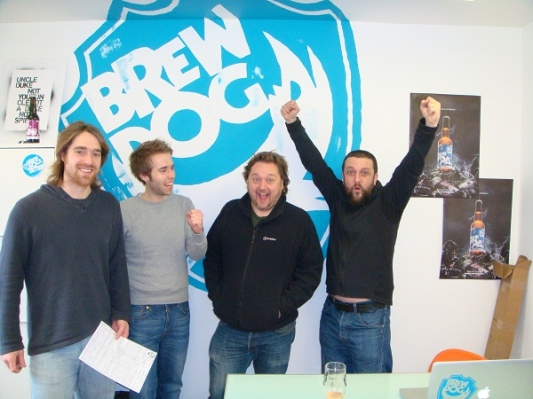
Brew Dog hires rank amateurs to create its latest beer

Entering the revolutionary spirit

Well, it was an offer we couldn’t refuse.  Especially when, with their trade mark hyperbole, Brew Dog publicly referred to us as ‘the rock stars of the beer blogging world’*.

On 27th January, massively and pathetically hungover after hosting a beer dinner at Musa Aberdeen, Mark Dredge, Zak Avery and me were whisked up to Fraserburgh to brew a beer we had designed.  (When I say ‘we’, I mean mainly Zak and Mark thought about it and designed it and I said ‘yes’.)

We went into the hops store and chose the hops.  We tipped the frankly worrying amount of malt into the mash tun, which we filled almost to the top, and we made Young Dredge stand on top of a ladder and do a continuous addition of hops throughout the boil.  I’ve no idea how long this took him, because I bailed out early and was on my way home by then (to be fair, my flight was booked weeks before and brewing somehow took a lot longer – or started a lot later – than we had thought.)

The result is a 7.5% ‘Imperious Pilsner’.  Zak wrote some label copy that goes on about killing your ideals and worshipping your heroes and stuff, which is really good and adorns the bottle label.  But basically it’s doing to lager what new wave brewers such as Brew Dog have done to pale ales, porters and stouts.  (I’m not saying we’re the first – just that that’s what we did.)  It features an insane amount of Saaz hops, and was lagered for a full six weeks before being dry-hopped with yet more Saaz.

If we were music writers being offered the chance to go and make a record with a popular and influential band, the result would be horrible beyond belief.  One of the nice things about the brewing world is that an idea like this can actually work out quite well.

The result of our collaboration is a bitter, hoppy character that’s refreshingly different from the prevailing, ubiquitous Citra-sy trend.  It’s more elegant, more structured, more noble – a classy beer, a very firm, gentlemanly shake of the hand rather than a slap around the face.

We’re giving Avery Brown Dredge a triple-headed launch this Thursday, 31st March, at three separate locations.  Zak will be at the North Bar in Leeds,  I’ll be at the Jolly Butchers, London N16, and Mark will be at the Rake, London SE1, at 7.30pm.  We’ll probably link up with something like a #ABD hash tag on Twitter and try to do some Live Aid style three headed technology shenanigans.

Brew Dog MD James Watt will be joining me at JBs, and various other Brew Dog honchos will be at the other locations.  These will be the only three outlets in the UK with the beer on draught, with just one keg each, so get there fast.  I wouldn’t be surprised if there were other Brew Dog treats turning up as well…

Post launch, the beer will be available only from the Brew Dog online shop.  We hope you enjoy it!

*Being called rock stars, we had to decide which ones we were.  Well, I did.  Mark is obviously one of McFly.  Zak is Flea out of Red Hot Chilli Peppers (I did not see his sock).  And I’ hoping to be Hooky out of New Order, but am probably Gary Barlow.

| Uncategorised

Beer duty: the facts, presented handily

Not going to go on about this again but I just received a very useful press release from the BBPA. The trade body is calling for a ‘return to clarity’ over beer taxation, noting as I did yesterday that with an ‘escalator’ in place, announcing ‘no new taxes’ is wilfully misleading.

There were a few questions and comments after my post yesterday about how all the various figures and calculations around the swingeing duty increase add up, so I thought it would be useful to share the following table for the release.

BEER TAX INCREASE
7.2%
Predicted increase in tax of a typical pub pint
3.57p
Average new price of a pub pint of lager (4.2 per cent abv)
£3.05
New typical duty on a pub pint of lager
44p
New typical VAT on a pub pint of lager
51p
Combined VAT and duty increase this year
10p
Beer Tax increase since March 2008
35.4%
British Beer Tax, times higher than France
7.9
British Beer Tax, times higher than Germany
12.4
British Beer Tax, times higher than Spain
12.0

The release also contains one crucially important piece of information, which I urge you to share with everyone you know, especially your MP: with the 7.2% rise yesterday compounded by the 2.5% rise in VAT in January, 2011 has already seen the highest EVER increase in tax and duty on beer in any single year.

| Uncategorised

Chancellor punches beer and pubs in the face with one hand – but gives us a clever gift with the other

I have no plans to kick this oleaginous, deceitful, dishonest, callous multi-millionaire (inherited) repeatedly in the face*

Today’s budget has been called many things. ‘A budget for growth’. A ‘tax cutting budget’. It comes one week after David Cameron promised to ‘remove all obstacles to growth’ from small businesses.  You know, businesses like, ooh, craft breweries.  Or pubs.

So it’s pretty repulsive that in what is indeed being hailed by the media as a budget for growth, George Gideon Osborne hit beer with a whopping 7.2% tax increase, bringing the total increase in VAT and duty on beer to a whopping 32.4% since October 2008.
“Whoa, hang on there, Pete!”  I hear you saying.  “I’ve been watching the budget, and Osborne specifically said that beer tax wasn’t going up.”
Did he?
Oh yes, he must have done.  Look, the Guardian says “No change to rates of alcohol duty.”   The BBC confirms this in its coverage, categorically stating that the chancellor “froze alcohol duties.”
That must mean alcohol duty didn’t go up, right?  There is no other possible meaning of the words being reported right there.
Wrong.
What Osborne actually said was there would be “no additional rise” in alcohol duty.
No additional rise.  But that means it’s not going up, surely!  Well, that’s what it means to any casual observer.  The man in the street.  In fact, anyone who does not have a thorough working knowledge of treasury tax plans in relation to the brewing industry.
If you DO know those plans (and if you don’t work in beer or pubs, there’s no reason you should), you will know that Labour instigated a ‘beer duty escalator’ of inflation plus 2% every year, and that one of the first things Osborne did on coming to power was to extend this so that it happens every year until 2014.  So when Osborne says there are no additional rises, he means no rises in addition to the 7.2% he was already planning to slap on.  
See what he did there?  
By saying he was only going to increase tax by the amount he planned to increase tax by, that is, by saying he isn’t going to implement any tax rises on top of the tax rises he was already planning to implement, he’s conned everyone – including intelligent, major, reputable news outlets – into thinking he hasn’t increased taxes at all.
If you didn’t know about the duty escalator, you would have no idea what he’d just done.

True, he’s only applying the tax increases Labour would have done.  But at least Labour told us honestly and clearly that they were shafting us, and how much by.
So it’s a tragedy for everyone really.  Pubs will close because of this.  Jobs will be lost because of it.  The price of a pint will go up 10p because of it.  And the most stupid part is, the effect it will have on demand means that the treasury will actually make less money because of it.  Stupid beyond belief.
But while we lick our wounds over this latest battering, we should reflect on the marvellous gift Osborne has given us with this new piece of spin, a greasy deceit that even Malcolm Tucker would applaud.
Because we can all take this same linguistic construct, this same extreme economy with the truth, and use it in our every days lives.
Say, for example, that I haven’t had anything to drink for five days, and tonight I plan to go out and drink ten pints and get rat-arsed.  If you ask me, “Are you going to have another night off the beer tonight?” I can simply reply, “My plans relating to drink tonight remain unchanged.  I won’t be drinking any additional beer.” Unless you know I was already planning to drink ten pints (and you won’t, because I haven’t told you) you’ll think I’m not going to drink.  Hah! But the joke is on you, because I am!
Here’s another one.  I’m very angry with George Osborne, even angrier now than when I first saw his pompous, arrogant little face sneering down at the rest of us while he rubbed his multi-million pound inheritance all over his pasty white doughy skin.  I have always thought that if I ever met him, I would kick him repeatedly in the face.  
But you don’t know that.  
So, say I was invited to a Parliamentary Beer Group function at which he was going to be a guest, and someone took me to one side and said, “Pete, we know you’re very angry with Mr Osborne about his wilful deception and deliberate misleading of the media and the British people over beer duty increases.  You’re not hoping to kick him repeatedly in the face or anything are you?”  
I could in all honesty reply, “The way that upper class, over-privileged, callous, pig-ignorant dickhead misled the nation over alcohol duty has not increased the likelihood of me kicking him repeatedly in the face.  Not one bit.  I have no additional plans to kick him in the face repeatedly.”  And unless you were listening very, very carefully, you’d think I meant I wasn’t planning on kicking him repeatedly in the face.  
It’s brilliant!
I’m going to use it all the time from now on.
*Or rather, what I mean is, the plans I have to do so have not changed.

| Uncategorised

Champagne beers: they’re lovely!

It strikes me that, for a beer blog, I don’t actually write much specifically about beer itself on here. Partly that’s a conscious decision – there are roughly a gazillion blogs providing reviews and analysis of favourite beers and I’m not sure we need another one.

But hey, it’s a beer blog.  The reason we’re here is that we enjoy drinking beer.  And every so often, beers come up that are too remarkable not to comment on.

I’ve always loved ‘champagne beers’.  Up to now there have been too few of them to attempt anything so anal as defining the ‘style’, and I’d resist that even now, because I think the inspiration of champagne, the selective application of some champagne ingredients and/or processes, signals a creative approach that combines classiness and elegance with a wonderfully liberating playfulness, and I would resist at all costs attempts to stifle that with anything so boring as a style guide.

But there are certainly enough of them around now – all different – to suggest, if not a style, than a loose coalition, a movement, a trend.

The first one on most people’s radar was Deus, still magnificent, a Belgian Tripel matured with champagne yeast in champagne caves, using the traditional methods of remuage and degorgement, where during secondary fermentation, the bottles are turned and angled so the yeast collects in the neck, where it can be frozen and extracted.

Simpler – in both process and flavour – is Kasteel Cru.  This is simply a lager fermented with champagne yeast, and while as such it’s easy to dismiss, it has some merit – it’s light, spritzy and has a grapey hint, a great aperitif that prompts re-evaluation among people who ‘don’t like beer’.

There are other Belgians who have followed Deus’ lead, most notably (for me) Malheur Brut, which is possibly even better than Deus.

But I’ve recently been given three new champagne(style) beers in quick succession, and they each make me very happy indeed.  In no particular order…

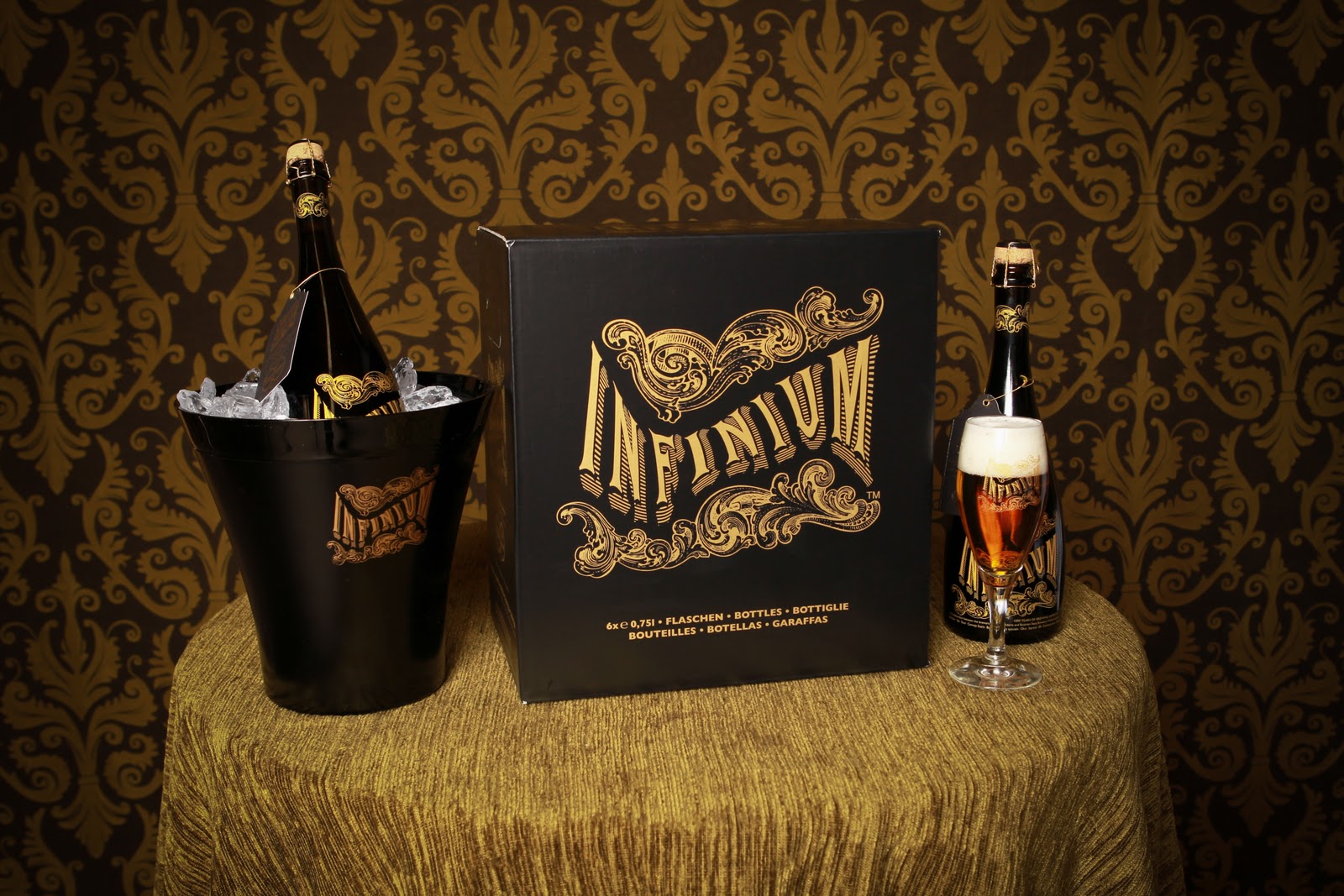
Infinium, by Samuel Adams and Weihenstephan

Roll up! Roll up!

Samuel Adams is a brewery that understands the value of special, premium packaging, but can sometimes err into gaudy rather than premium.  This one stays on the right side of the line, but only just – with the result that it looks magnificent – like it was created by some insane genius who lives within a travelling funfair invented by Terry Gilliam.  Whether your initial reaction to the following image is a laugh or gasp probably reveals something deep about your psyche:

Brewers by appointment to Dr Parnassus

But what about the beer?

The press release is full of superlatives.  German Weihenstephan is ‘the world’s oldest brewery’, and this collaboration has ‘shattered industry preconceptions of the limits of the German purity laws’, by remaining faithfully within those laws to produce a beer that’s 10.5% ABV that will be in ‘selected outlets for discerning consumers prepared to pay vintage champagne-style prices.’

I was lucky enough to be sent a bottle.  It made me want to wait for a special occasion to open it, but I couldn’t – I gave in, celebrating the fact that I was at home for once on a Sunday (the Beer Widow would argue that this is an event rare enough to celebrate with vintage Krug.)

It pours an amazing, alluring bronze colour, beautiful and rich.

It has complex nose of caramel, that biscuity vintage champagne aroma, with a hint of sherry sweetness. It’s one of those rare, special beers where you enjoy nosing it so much, you almost forget to drink it.

You should though.

On the palate there’s banana, lemon, caramel, perfectly judged winter spices and a brief, intense sweetness before a nice champagne-like dryness and a hint of earthiness at the back.

It’s classy, elegant and sophisticated, yet fuller and bolder than other champagne beers I’ve had.  It’s available in a mere two outlets in the UK: Vino Wines in Edinburgh, and Inspire, a cafe bar in Coventry.  Utterly random, but there you go.  More info is available from Branded Drinks.

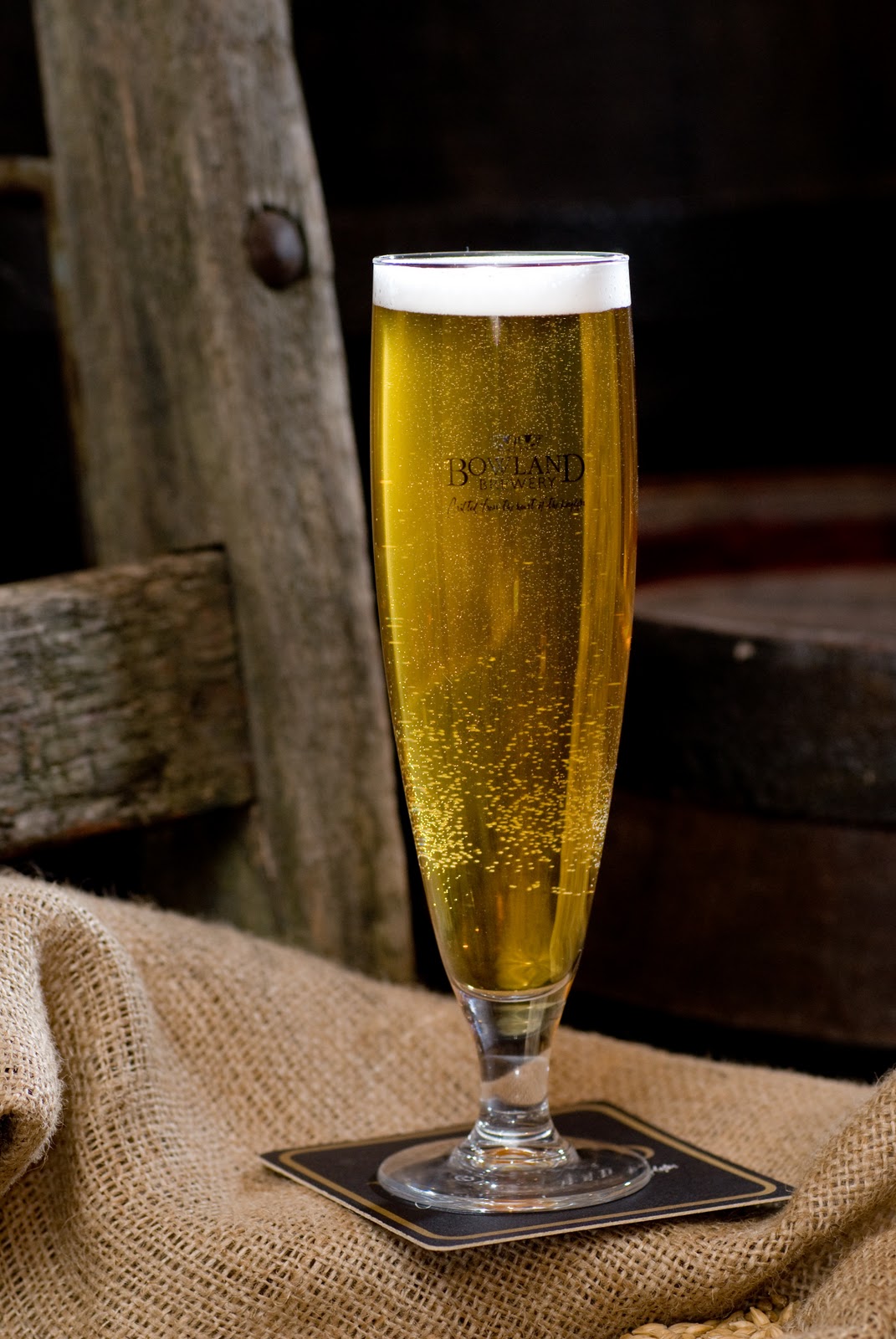
Bowland Artisan Gold
If the location for an artisanal champagne beer surprises you, the quality of that beer will surprise you further still.  Bowland is a microbrewery some miles north of Burnley, Lancashire, which has been doing a good job of crafting quality ales since 2003 (its Admiral Best Bitter was named Champion Best Bitter of Britain in the recent SIBA awards, and I reviewed it on the Vlog from those awards).

Bowland brewer Richard Baker decided the only way he could absolutely guarantee perfect beer time after time would be to produce a top quality bottled beer.  He wanted to use bottle conditioning, but didn’t want to leave a sediment – and that made him think of champagne-style secondary fermentation.  Baker studied champagne methods in depth and reproduced them as closely as he was able, and this is the result:

You want premium?  You got premium

It’s a remarkable beer.  It has all the refinement and complexity of any other champagne beer – though perhaps not the dense layers of flavour – at a low (for champagne beer) ABV of 5.7%.  I’m afraid I didn’t make too many tasting notes on this one, just lots of adjectives like ‘classy’ and ‘elegant’.  The mix of noble and new world hops gives it a lot of fruit, but it’s held in check by a smooth dryness.  I felt I was wasting it, enjoying it in front of the TV with a bowl of pasta, and I was very sad indeed when I finished the bottle, because it’s very quaffable despite (or probably because of) its structure and complexity.


Richard Baker told me, “I am hoping that Artisan Gold will help to open up the minds of people in Britain to the fact that beer is not just for swilling down in back street pubs up North (although there’s nowt wrong with that!) but that there are craft brewers all over the country producing a wide range of beers that we should be massively proud of and that there really is a beer for everyone if they just opened themselves up and gave it a try.”
It should certainly work.  Served in a glass like the one above, it’s one of those beguiling drinks you can’t pin down into a category.  You may not even be certain it’s a beer at all.
Artisan Gold is available only from Northcote Manor – the Michelin-starred restaurant a few miles from the brewery – the brewery itself, and the online shop, where you can buy it mail order for £15.99.  
The price tag made me hesitate, and that made me think – I’d pay that happily for Deus, at 11.5% ABV, but was hesitant here because the beer is only 5.7%.  Fascinating, because I don’t know about you, but I like to think I’m above paying for alcohol units, that for me, it’s all about the quality of the beer.  I always bang on about how quality is not necessarily linked to ABV.  With Artisan Gold, you’re paying for the time, the care and attention, the method, and the experience of a beer that is easily worth the price tag.  It may require you to overcome a prejudice you may not even have been sure you had, but it’s worth the effort.

Chapel Down Curious Brew Brut

This isn’t quite the same deal as the previous two. But I include it here to show the breadth of champagne(style) beers.

By the standards of Infinium and Artisan Gold it’s more of an everyday drink.  But by the standards of draught lager – which is how we should be judging it – it’s just as special as the previous two.

Chapel Down is one of the leading English wineries, based in Kent.  Their wines are seriously good, and if your experience of English wine stretches as far as fruit wines that are half a step away from home brew, you need to shift your frame of reference south, to the Loire valley and the champagne region – Kent has a similar climate and terroir, and Chapel Down wines easily stand alongside their French cousins.

The thing is, the MD of Chapel Wines is a former beer man, having worked for Whitbread and Heineken (full disclaimer: he’s an ex-client and current friend of mine) and he’s been dabbling for a few years with getting winemakers to approach beer with a wine sensibility.  Bottled Curious Brew Brut, Admiral Porter and Cobb IPA are all well worth seeking out, each with a winey twist.  Now, Brut has been revamped and launched around Kent on draught.

It’s a premium strength lager, lagered for a decent length of time, and brewed with sparkling wine yeast.  As such it’s along similar lines to Kasteel Cru, but the end result is quite different.  It’s a fuller, more assertive beer, more fruity and rounded, that grapey sweetness getting a much bigger stage to show off on, but still reined in at the end by a crisp dryness.  Refreshing and satisfying, the true test of it is that it feels vulgar drinking it from a pint, as I first did.  Get it in the correct half pint glass, and it’s a lovely halfway house between beer and sparkling wine in every way, and proved to be the perfect aperitif before dinner at the winery’s excellent restaurant last weekend.

It’s currently brewed by Hepworth’s, who do a lot of contract brewing, but Chapel Down is considering commissioning its own brewery alongside the winery just outside Tenterden.  If the current sales growth continues, that should be happening pretty soon.

So, that’s some seriously fancy drinking right there.  And I’ve just remembered why I don’t write as many beer reviews as I should.  It’s 12.19, and I’m now gasping for a beer…

| Uncategorised

Video Blog: The SIBA Conference

SIBA is the Society of Independent Brewers, kind of the equivalent to the Brewers’ Association in the US, and it’s doing a grand job of fuelling the growth of great quality beer from small producers in the UK.  It is a beer trade body, and as such it has its political struggles, battles with other bodies, internal strife and all the rest of the issues that plague every trade body in beer.  But SIBA events are fun.  And the people who organise and run them are decent, talented people who you enjoy having a pint with.  I wrote here about the time I had at the conference last year, so it was a pleasure to go back with the film crew this year.

So what happens in this episode? It’s twelve minutes long, so let me guide you through it.

First, Peter Amor talks to SIBA head Julian Grocock about the society, what its stands for and what it does to help promote beer.  SIBA organises a year-long brewing competition, where beers judged at regional heats go through to a national final, with the winners announced at the conference.  I then sneak into the bar while the conference is going on in the next room, and help myself to a sneak preview and tasting of all the category winners (or rather, all bar one in the final edit – not everyone likes the fact that SIBA judged a national keg beer competition this year).  This gets interspersed with interviews with some of the young, new cask ale brewers who were at the conference this year, where we seek to uncover the motivations behind a new generation entering the brewing industry.  This concludes with an interview with the brewer who created this year’s grand champion.  Which of the beers was it?  Well, if you’re eagle-eyed during the tasting segment, you’ll spot it well before I did…

These video blogs now have their own home on the web too.  Go to http://www.britishbeervideoblog.blogspot.com/ if you want to see them all together, and there’ll also be the odd extra bonus clip knocking around there too.  You can also find the embed code there now that allows you to feature them on your own site of you wish.

Finally, can I ask for some feedback?  This year of video blogs represents a significant financial investment, which aims to help spread beer appreciation beyond the usual community of beer aficionados and hopes to reach a wider audience.  If you’ve been following them for the last six months you’ll see that we’ve tried different formats and ideas, and also that we’re steadily learning our craft as presenters (the filmmakers already knew what they were doing).  We want to make them as good as we can. Any constructive comments would be very gratefully received!