Author: PeteBrown

| Beer, Craft Beer, Food, IPA

The Craft of Balance

As in music, as in food, as in life, as in beer: extremes can be thrilling, but harmony is ultimately more satisfying.


I’m a huge fan of Felicity Cloake’s series of articles in The Guardian, where she takes a beloved recipe and tries to distil the perfect version of it. She does so by consulting various chefs who are each famed for their own versions, reading about its development, trying different variations with her friends, and synthesising an overall best version with the help of their comments. Recipes are like language: they evolve and adapt, and everyone puts their own signature on them. Felicity’s are of course influenced by her own tastes, which aren’t always the same as mine, but the articles are never less than compelling.

Last week, she did Vindaloo, a dish I’ve been obsessed with ever since I studied and subsequently went to India for my third book, Hops & Glory. You may well know that, strictly speaking, Vindaloo isn’t an Indian dish at all, but is in fact Portuguese in origin. Neither chillies nor tomatoes are native to India – both were introduced by Portuguese sailors, who picked them up in South America. Before they did so, the heat in Indian food relied primarily on pepper, which is quite a different heat altogether. As Felicity points out in her piece, it’s kind of ironic that carne de vinha d’alhos (meat in wine vinegar and garlic) has become a bastion of competitive British male masculinity given that it was perfected in Portuguese Goa – one of the few parts of India never ruled by Britain.

In the hands of the typical Anglo-Asian curry house, Vindaloo has become an exercise in chilli intensity. Ever wondered how a high street restaurant can have such a wide menu and serve dishes from any part of it so quickly? They work from a very small number of basic sauces, and simply add more of less chillies, plus a few other ingredients, to great different permutations on them. So while in India, Madras and Vindaloo are entirely different dishes with different spice bases, in England, one is the same as the other only with more chilli.

Vindaloo is my usual order. I like the English version, and am fascinated by the high variance I get in heat from different restaurants. But I also yearn for the ‘proper’ version. So as soon as I saw it, I tried Felicity’s recipe.

Fuck me, it was good.

My wife Liz has much lower tolerance for chill heat than me. She had a tiny spoonful of it, and just managed to say “That’s gorgeous” before the screaming started. “Never bring that near me again,” she said between gulps of water. But a couple of days later, when I heated up the last of it for my dinner, she couldn’t resist having another taste. She knew it was going to hurt, but she was compelled to try the incredible depth and layering of flavour once more.

There’s a a lot of chilli in Felicity Cloake’s Perfect Vindaloo (and on this occasion, that title is justified). There’s more chilli heat in it than I’ve had in any high street curry house version I’ve had outside the Midlands.

But that chilli goes into a masala marinade along with a shit-ton of cloves and cinnamon as well as the usual Indian spices, and then there’s more garlic than anything else, with the vinegar and tamarind adding yet a another layer. It’s hot. It’s complex. But it’s balanced. And it’s all the more irresistible for it. The chilli may be the lead instrument, but it sounds so much better with a backing band rather than completely solo.

This reminded me of a conversation I had with some marketers at a British regional ale brewery a few months ago. I was saying that what I admired about their beers was their balance, but they’d just done a lot of market research with their old guard of drinkers and younger craft beer drinkers, and they came back and said, “Oh no – for the younger craft beer drinkers, balance is boring.”

I was surprised and saddened by this, but it’s just one feature of the quest for novelty that seems to be giving the beer scene much of its momentum these days.

I wonder if it’s based on a misunderstanding, a perception that balance = bland. And that’s why I offer up The Perfect Vindaloo as an analogy for great beer. The image of the graphic equaliser above shows a balanced music mix. It happens to be in the middle of the scale. But it could be higher (more intense and full-on) or near the bottom (quieter) and it would still be balanced. My Vindaloo was as perfectly balanced as a good korma, but at a very different point of intensity.

Aggressively hoppy beers changed my life. They blew my mind like my first proper curry did, and I’ve used that as an analogy ever since. But even a beer with a hundred IBUs (bitterness units) can be balanced. A full, malty backbone in such a beer gives the hops something to work from, just like the rhythm section behind a scorching axe solo or the cinnamon and cloves behind the chilli. I taste a lot of hoppy beers these days where the hops are one-dimensional. They’re hoppy, but they’re not that interesting. For me, it’s the lack of balance that is becoming deeply boring.

Sour beers are exactly the same. Beers that shove a massive icepick of sharpness through your skull with nothing else to offer may shock initially, and that shock can be quite thrilling. But if there’s nothing else to it, it soon becomes dull and monotone. With the best ‘sour’ beers, that word is hopelessly inadequate, because the sharp sourness is in concert with earthy funk and bright fruit.

I think this is why novel beers come and go, but old favourites that you probably find boring at certain points in your beer journey will inevitably come back and claim you. Sierra Nevada Pale Ale, Rochefort 10, Orval and Harvey’s Best are not dull beers, nor bland crowd pleasers, but they are balanced. And that’s why generations of beer drinkers not yet born will still be drinking them in thirty or forty years time, when some of today’s most hyped beers will have been long forgotten.

| Books, Food

I just finished writing my next book

Provisionally titled Tastes of Britain: How Eight Meals Shaped a Nation, my fourth book launch in two-and-a-bit years should be my last for a while… 

Never mind the quality, feel the width.


High quality problems don’t come much higher than an editor at Penguin saying, ‘We loved your last book [for us]and we’d like another one, but we’d like it from you sort of now-ish’ when you’re already knackered from writing three books in eighteen months for three different publishers. Of course I said yes, immediately.

One of the benefits of Dry January (there are pros and cons) is that I get a bit of an energy spike because I sleep better, and also I’m not going out as much. So last January I rattled out an idea, which Penguin liked, and this January, after researching it for nine months and then sitting down to write it at the start of November, I finished the book. That’s the quickest I’ve ever turned a book around – it usually takes two years from start to finish.

A book about the meals that shaped Britain may seem like a bit of a departure for me. It is, really: there are cameos from beer, cider and pubs but only in passing. But some of the themes in this book have been kicking around in my head since at least 2009, and they come from exactly the same place as my first two beer books: what makes us tick? How did we get to be the people we are? And why do we seem so curiously reticent about shouting about the things we’re really good at?

To explore these issues and more, I trawled through survey after survey that asks us what our favourite meals are. I chose the meals that kept coming up in every one, and compiled my own list of eight. This list definitely misses off some national favourites and classics, but just like when I was visiting beer drinking countries for Three Sheets to the Wind, you have to have a cut-off point in numbers much lower than you would ideally like if you want to do justice to the ones you’ve chosen. So there are eight (it crept up from a magnificent seven) in total.

For each meal, I choose the perfect location to eat the typical, most representative example of it (not the best – at least, not necessarily) and go there and eat it. While doing so, I explore its history; I look at the emerging discipline of food studies to see what it tells us about ourselves; I explore why in most cases the meal seems to be under threat even as we say it’s one of our favourites; and explore personally what the meal means to me, growing up as a distinctly working-class northern lad and now being a fully paid up member of the middle-class north London Metropolitan foodie elite, or so I’m sometimes told on Twitter. Lots of things shape our attitudes and relationships with food – class is a pretty big one.

I won’t say any more just now because we still have the editing process to go through. It’s due out in September, and I’ll release more details before then. And I’m sure many passages will be cut, some of which I might be able to use for previews here or elsewhere.

Apart from that, I’m taking a break from writing and working on ideas for books for a short while, for the first time since 2014. This means I should finally have time for more blogging again, as well as having a social life… see you around.

| Beer Books, Beer Writing, British Guild of Beer Writers, Events, Miracle Brew, Pubs, Radio, Writing

So Farewell Then, 2017

I don’t really do Golden Pints. But here are some reflections on the year that just sped past without anyone noticing while we were all gazing at our smartphones. First there’s a personal look back at what 2017 meant to me, followed by a transcript of a speech I gave at the annual Beer Writers’ Dinner on 29th November, which touches on some broader themes. It’s a bit long overall, so you might just want to read one part or the other, but if you’ve got this far, you’re probably feeling bored and it should fill a few minutes before you hit the pub again. 

My weight-limit-busting haul from the Hill Farmstead brewery, Vermont, October.

The personal bit

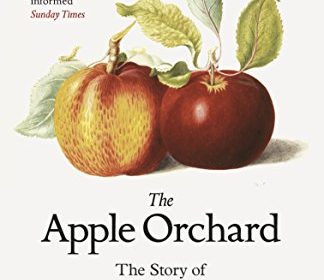
I feel increasingly guilty that, as the rest of the world goes to shit, with all the best people dying, and hatred, intolerance and wilful ignorance given free rein, I’m doing OK, thanks! 2016 was the worst year I could remember in world terms but was great for me professionally, and 2017 has been a similar follow-up. My year has been dominated by books: the paperback release of 2016’s The Apple Orchard,  the hardback release of Miracle Brew (my first straightforward beer book since 2009), extensive touring in the UK and North America to support that book, and the research and writing of my follow-up to The Apple Orchard, my ninth, as-yet-untitled book, now overdue, and the project that will be claiming every waking minute of January 2018. The Apple Orchard was shortlisted for many awards but didn’t quite win any, whereas The Pub: A Cultural Institution, also released in 2016, was named Fortnum & Mason Drinks Book of the Year. Reader, we partied.

(Along with some of the other winners from last year I’m judging these awards this year. Find out more and enter your work here.)

I also joined the editorial line-up of of Original Gravity magazine and had great fun helping shape the direction of the UK’s only independent beer magazine. Exciting times ahead on that. We ran the Beer and Cider Marketing Awards for the third time (first time with cider included), for which I chaired the judging, as I did for this year’s Guild of Beer Writers Awards after being named Beer Writer of the Year in 2016. I was delighted that Adrian Tierney-Jones won. (I was also delighted that, with Adrian being a friend, I didn’t express my preference until every other member of the judging panel had had their say, and they all said ‘Adrian’.)

Between all that I managed to fit in quite a few trips to breweries. A few days in Belgium in March included tours and chats with Rodenbach and new Flemish brewery Verzet.

The massive barrel-ageing hall at Rodenbach, producing the sharp, tangy beer Michael Jackson once called ‘the most refreshing beer in the world’.

… and the more modest barrel ageing room at Verdett, where each barrel is named after one of the brewers’ favourite rock stars.

In June a group of us did a whirlwind tour around Bristol, organised by people who were keen to convince us that the city was one of the most exciting beer destinations in. the UK. They succeeded in their task.

The illustrations on Bristol brewer Lost & Grounded’s beers all fit together into one big picture and magical set of characters. It’s clever, warm, funny, and strangely moving. Oh, and the beer inside is pretty amazing too.

In July I was invited back to speak at Beer Boot Camp in Johannesburg and Cape Town. The brewing scene there is developing at a ferocious rate. It’s madly exciting. And within seconds of arriving at their beautiful brewery, the Aegir Project became one of my favourite breweries in the world.

Wonderful, imaginative beers brewed and drunk in a location you’ll never want to leave.

October saw my North American tour, during which I got to visit Hill Farmstead, one of the most interesting and talked about breweries in the world. I found a balance in my views on New England IPA, possibly the most divisive topic I’ve seen in my time as a beer writer. (Apart from cask breathers. And the definition of craft beer. And brewery buy-outs. And a whole bunch of other stuff.)

Hill Farmstead – the most talked about brewery in the world? When we were there, people were queuing up for growler refills two hours before the doors were due too open. And it’s a two-hour drive from pretty much anywhere else.

The breweries that have impressed me most this year are Wiper & True, especially for their English saison; Lost & Grounded for their creativity, rigour and flawless Belgian Tripel; Verzet, for their overall vision and their Flemish brown; and Siren, for consistently combining experimentation with class to create beers I’m excited to drink. There have been many more doing great stuff too, but that’s my top four.

I’ve done scores of events and met loads of brilliant people. The highlight has to be presenting my Beer and Music Matching show to over a thousand people at the Green Man Festival in August. I still regularly do events where only three people turn up. That keeps you humble. But this one was at the other end of a very wide scale.

Thank You, Green Man.

Pub-wise, I was lucky enough to have Gracelands – a small pub company that runs some of the best beer pubs in London, including there King’s Arms in Bethnal Green – open a new site, The Axe, just five minutes walk from my house. The effect on my bank balance and liver has been alarming, but not only do they get hold of really good beers, they also curate them really well – the right balance is always on at the right time – and while they’re expensive, they don’t overcharge. If you’re ever in Stoke Newington, it’s unmissable.

The year ended with Miracle Brew receiving the best review I’ve ever been given, by no lesser august publication than the New York Times. That’s one to keep me going whenever the self-doubt kicks in – which is often. The same day the review appeared, I was on the Christmas edition of BBC Radio 4’s Food Programme, providing festive drinks for a dinner hosted by Sheila Dillon and cooked by and eaten with guests including Giorgio Locatelli, Yotam Ottolenghi and Angela Hartnett.

Merry foodie Christmas!

I have no idea how I got to be in a position where things like this happen to me. But I do know none of it would happen if people didn’t read what I write, or didn’t like it when they did. I know I don’t please everyone with what I do, and I’m absolutely fine with that. But if you do take some enjoyment from or interest in my writing, thank you so much for your continued patronage. If a particular idea or passage of writing, a recommendation of a beer or cider or pub, or a pairing of a beer with a particular dish or tune gives you pleasure, then I’m doing something worthwhile, no matter how small.


The review/reflection bit

It’s been a tumultuous, dramatic, fascinating year in beer. I did a short intro speech before I presented the awards at the annual Beer Writer’s Dinner on 29th November, in which I commented on some aspects of it, with a particular focus on where beer writing is going. A few people asked if they could get a copy of the speech, so here’s an edited version. 

What a year it’s been! Another year of dramatic developments in beer with so much to write about.

People say it can’t carry on, but we’ve had yet another year of declining numbers of pubs, declining beer volume overall, coupled with a dramatic increase in the number of breweries brewing and beers available to drink.

As the pressure and competition grows, we’re seeing the sustained trend of takeovers of craft breweries by bigger corporates – sorry – I meant to say ‘partnering with like-minded business colleagues among the brewing fraternity’ apparently.

And like those proverbial Japanese soldiers lost on a desert island who don’t realise the war is over, some of us are still lost in the woods trying to find a technical definition of craft beer.

If do you want a precise technical definition, be careful what you wish for.

CAMRA of course, have a very tight and precise definition of real ale, which is precisely why they’ve spent the last two years trying to revitalise now we’re in a globalised world of excellent beer, wondering if they’re about cask ale, good quality beer more generally, saving pubs, or acting as a sales promotion agency for Wetherspoons.

In 2017, beer writing has been characterised by discussions – robust discussions – OK, arguments – fierce arguments – OK fights – about all these issues, and more.

Given that we proudly call ourselves one of the friendliest, most sociable industries in the world – and I genuinely believe we are – it’s amazing how much we can find to argue about!

Cask ale for example. Is it good enough? Is it expensive enough? Is it cheap enough?

After dipping my toe in this issue back in January, I’d like to say now on the record, categorically, that cask ale is great and there is absolutely nothing wrong with it. It has always been great, it is always great now, and it always will be great, and Paul Nunny, could you please just give me some proof that my wife and dog are safe and well, and will be released soon like you promised. Thank you.

More recently we’ve had very public spats about New England IPA, a beer style that’s created civil war among craft beer fans. On one side there are those who think this is an absolute joke of a style, an affront to brewing tradition, a product of Instagram culture and the first solid evidence that craft beer might be getting too faddy for its own good.

And on the other side, I suppose there are some people who must disagree with that for some reason.

Just this week, we’ve seen an online spat between people on one side, who think beers using sexist imagery to sell themselves should be banned for beer competitions, and people on the other side, who are dicks.

And then there’s a seemingly intensifying spat about the ethics of beer writing.

If a beer writer gets sent beer for free, can their opinion on that beer be trusted?

If a beer writer gets invited on a trip – a junket, sorry – to a brewery and is entertained, can any of their opinions be regarded as valid?

If a beer writer falls down in a bar and there’s no one there to hear it, do they make a sound? Or do they just Instagram it instead?

But these arguments, these spats, are important, at least up to the point where social media amplifies them and twists them into something nastier.

The role of the Guild is ‘to extend the public knowledge and appreciation of beer and pubs and to raise the standard of beer communication’.

Much of the time, that means celebrating beer, educating our readers about it, finding the good stuff and getting it to a wider audience.

But that doesn’t mean the guild is some provisional wing of the beer industry’s PR machine, providing gushing coverage of whatever that industry decides to do, in the terms the industry wants. We shouldn’t just be cheerleaders, breathlessly parroting the industry’s agenda.

Like any other industry or interest, beer needs to be scrutinised, analysed and occasionally held to account.

And so do we, as writers.

Beer writing has expanded so much in the last twenty years, and we as writers must now think carefully about what role we want to perform.

Not a single one of us can be an expert in every single aspect of it. You can’t be a newshound, and a flavour expert, and have an academic knowledge of the history of brewing, and be an industry analyst, and have a perspective on alcohol policy, and an in-depth knowledge of global beer styles, and be an effective campaigning voice for cask ale, all at the same time. It’s not possible.

And that’s great! There’s room for specialisation in all those things, and the totality of beer writing is so much bigger and richer as a result.

The social media revolution has made us all communicators about beer, and while I personally believe writing will always be the most important and effective part of that, the broader landscape is hugely exciting. Even if we want to write, we have to start thinking about photography. We may find out voices are more effective, or get a different side to them, on podcasts or radio, or even in person, at live events.

But there are risks in this brave new world.

Social media has the potential to make narcissists of us all. Badly-lit bottle shots and a hundred hash tags on an Instagram post do not extend the public knowledge and appreciation of beer. Self-indulgent blog posts describing in detail about how you swapped a bottle of Cantillon Geuze with someone in Vermont for a bottle of Hill Farmstead’s Society and Solitude #10 making you the only person in Britain to have a bottle don’t represent a raising of the standard of beer communication.

(And anyway, I’ve got a bottle in my fridge at home that I bought when I visited the brewery last month so screw you, you ticker.)

Whatever channel you’re communicating in, the basic rules of old-fashioned journalism still apply. As your reader or viewer, make me care. Take me somewhere. Tell me a story.

All tonight’s winners have succeeded in this mission, have told compelling stories about their subjects in fresh ways that engage readers, listeners and viewers.

Each judge on the panel is an expert of some kind, but probably not in what the entrant is writing about. They probably don’t know the entrant, and may never have read their work before, and next year their places will be taken by someone new.

So if you think it’s always the same old names being shortlisted in the same categories year after year, this is not because judging is some kind of cosy old boy’s network. It’s because those people’s work appeals fresh, every year, to a different set of judges who may not have read them before.

Conversely, if you’re someone who has entered several different categories with work you’re really proud of, and you haven’t been as successful in getting shortlisted as you hoped – this is not a referendum on your worth as a beer writer. At no point have the judges sat down together and decided to shun you this year. Your work in each category has been judged independently of every other category. Believe me, we all have years where we feel like some of our best work has been overlooked, and next year might be completely different.

You can see the full list of winners here. Go check out some of their work. 2017 was a great year for beer, and a great year for beer writing. Let’s have it again in 2018.

Cheers!

| Beer, Brewing, Harveys, Hops, Yeast

A Trip To Lewes Cathedral

Harvey’s Brewery in Lewes, Sussex, is as old school as they come. Sometimes, no matter how much you think you know about brewing, or how forward-looking you are in terms of what’s new in beer, you need to revisit a place like this to ground you and remind you what it’s all about.

We were in Lewes for a strategy day. Along with publisher Daniel Neilson and editor Adrian Tierney Jones, I’m now one third of Original Gravity magazine, the latest edition of which is just out. We got together a couple of weeks ago for a day or so to work out the future direction of the mag (clue: it’s really exciting). After a few beers the night before, the conversation loosened, and we got onto a bit of a riff I could clumsily title ‘Beers some people take for granted and others ignore completely because they’ve been here forever but if they were launched tomorrow by a hip new brewery you would totally lose your shit over how good they are.’

We came up with a pretty impressive list. Near the top was Harvey’s Best Bitter. I think we were excited because we knew that after our morning’s session, we had a tour of the brewery planned.

Harvey’s is an unusual brewery in that it’s smack in the middle of the town of Lewes, dominating the skyline. And it’s uncommonly beautiful to look at. It’s a Victorian ‘tower brewery’, where all the ingredients are hoisted up to the top floor, and then steadily make their way down through the various brewing vessels with the assistance of gravity. There are other Victorian tower breweries in town centres, but Wadworth in Devizes is the only other one that springs immediately to mind as such a compelling tourist attraction. Harvey’s has the edge on it: there’s a waiting list of two months here for brewery tours.

Miles Jenner – the third generation in a family of brewers – has been head brewer at Harvey’s since 1986, and joint Managing Director since 2000. His office, with its carefully painted door, is just opposite the main brewing copper. From the outside, with its coloured glass and gabled window, it looks like a small chapel in a Tudor Manor House.

The religious comparison doesn’t stop there.

“People often refer to the brewery as Lewes cathedral,” says Miles when we meet him in the brewery yard. “I changed the sign really to see if anyone would notice.”

Harvey’s was founded in 1790, and has been on this site since 1838. It’s been rebuilt and added to ever since, and there’s currently a lot of scaffolding and ladders around the place. It’s all done with an incredible attention to detail in preserving the feel of the original. It’s a lovely story, but the building is now Grade II listed. From an architectural point of view, so it should be. But for a live brewery, that occasionally needs to install new brewing or fermentation vessels – which are usually so big as to require a roof to be taken off or a wall dismantled to get them in – it’s a curse as well as a blessing.

That helps explain why even a lot of the new stuff at Harvey’s is quite old. Mash Tun number one looks like it belongs on the Nautilus. No matter what the agenda of the host, when you get to this room any group of visitors ignores everything else and stops to take photographs, trying to capture it’s deep sheen and industrial romance.

Eventually Miles drags us away and takes us through to the hop store. Harveys only ever uses whole leaf hops rather than pellets. It’s just proper. The hops are kept refrigerated by the hop merchants to preserve their freshness, and called into the brewery about a week before they’re needed. The brewery’s labelling system displays the name of the grower as well as the hop variety – Harvey’s isn’t far from the hop gardens of Kent and Sussex, and Miles likes to have close relationships with his growers.

Harvey’s mainly uses English hop varieties such as Fuggles and Goldings. In the age of the citrusy, tropical fruit delights of new world hops, these more conservative varieties often receive short shrift, being described as dull and twiggy. The Fuggles here are fresh and spicy, peppery with a hint of lemon meringue. If you can only make dull, twiggy beers with these hops, you’re either not buying from the right place, keeping them badly, or you’re not a very good brewer.


Those hops often end up in the old Harvey’s copper, which isn’t as old as it seems, and hasn’t been here for as long as you might think. When Miles opens the hatch towards the end of the boil, we brave scalding steam to see the drama inside and try to win an inhalation of that deep, spicy aroma.

Harvey’s still has open fermentation vessels, which means you can actually see the beer being made in the truest sense of the word. Different fermenters hold beer at different stages in its fermentation period. The yeasty head goes from brilliant white foam in the first to beige sludge in the older second, the scummy sides suggestive of the orgy of consumption and reproduction the yeast has enjoyed over the last couple of days.

All of this plays its part in making Harvey’s beers somehow better than others in their style. There’s just something more here, a slight wildness in the yeast – undetectable in the Best Bitter, but more pronounced in the Imperial Stout once its been aged for a few months. The quality of the hops. The experience of a head brewer who’s been in the job for over thirty years. the reverence this building inspires.

“There’s always speculation that we’re going to sell up and move, especially when there’s all this scaffolding around,” says Miles. “I mean we could. We could sell this place for an absolute fortune for redevelopment, and move to an industrial park outside town. But that would destroy everything that Harvey’s is about. So what would be the point?”

| Media bollocks, Neo-prohibitionism

It’s nearly budget time: cue more neo-prohibitionist nonsense

The press invariably swallows anti-alcohol stories without question. Even when a cursory glance reveals them to be increasingly silly. 

Rule Number One when writing negative stories about alcohol: you MUST always illustrate the story with beer. Here’s the pic the Guardian used for their story on how parent’ drinking is supposedly damaging to kids

Whenever the Institute of Alcohol Studies releases new research on the perils of drink, their findings are usually reported without question by the mainstream press. It’s never ‘the IAS claims this is the case’, just ‘this is the case’.

If the drinks industry said it had overwhelming evidence that drinking is good for you, newspapers would quite rightly report this as ‘the drinks industry claims’ this to be the case, and seek an opposing point of view for balance. They don’t do that with the Institute box Alcohol Studies, because it sounds important and learned. I wonder if things would be different if the IAS still went by its old name, The UK Temperance Alliance?

The Institute of Alcohol Studies, yesterday.

Anyway, we’re getting close to the budget, which means the drinks industry is campaigning for a reduction on alcohol duty, and the Temperance Movement (but please don’t call it that – these days it merely studies alcohol rather than. trying to ban it – honest) is campaigning for more punitive financial penalties on drinkers.

To support its case, the drinks industry points to data showing that the UK had the second highest beer duty in Europe, that Brits drink 12% of all the beer drunk in Europe but pay 40% of all the beer duty. It points out how many jobs the drinks industry creates, how much it contributes to the economy, and how duty increases hurt the industry and put these jobs at risk. It may be a coincidence that the volume of beer sold in the UK plummeted in the years of the Beer Duty Escalator (which saw duty increase automatically by inflation plus 2%), stabilised when the escalator was abolished, and then began falling again when Philip Hammond started to increase duty once more. But I doubt coincidence quite covers it. And I’m sure that’s why the Temperance Movement want drink to be more expensive.

Meanwhile, the Temperance Movement makes its case by producing scary data about the damage that alcohol is causing. But as almost every measure of alcohol related harm in society is in long term decline, they’re struggling harder and harder each year to find something negative to say. Cue last month’s research, reported without question by the Guardian, into the harm caused by parents drinking in front of their children.

According to this exposé:

  • – Three in ten parents have been drunk in front of their children.
  • – Half have been ‘tipsy’.
  • – 15% of children have asked their parents to drink less.
  • – 16% of parents have felt guilty or ashamed of their parenting as a result of their drinking.
  • – 12% of children said their parents paid them less attention because of their drinking.
  • – 29% of parents believe it is acceptable to get drunk in front of their children as long as that does not happen very often.

This behaviour ‘can’ cause children to feel anxious, and have less respect for their parents. But there are no statistics offered to illustrate how serious this might be.

Concerning, right?

Well, let’s take another look.

‘Tipsy’ is different from drunk. There’s a big value judgement being made here that being tipsy is a bad thing. But moderate drinking makes people relaxed and happy, without losing control or becoming embarrassing. Are children who see their parents tipsy as upset by this as those who see their parents drunk? We’re not told. Is ‘tipsy’ being included here simply because the figures for ‘drunk’ are so small, and conflating the two allows the problem to be presented as more serious than it really is? Without seeing the raw data, I couldn’t say. But I’ll just leave the possibility there.

Now let’s get into the detail. I grew up with an alcoholic parent and it’s really not pretty. I’ve also designed research surveys. And if I truly wanted to understand the problems associated with drinking in front of children, if I genuinely wanted to do anything to help the children who are really being hurt by their parent’s behaviour, I’d want to look at the most serious cases. Instead of asking ‘Have you ever been drunk in front of your kids?” I’d be trying to quantify how often this happens by instead asking ‘How often have you been drunk in front of your children?’ And giving an answer grid along the lines of:

  • – Never
  • – Hardly ever – just on one or two occasions
  • – Rarely – maybe once or twice a year
  • – Sometimes
  • – Often

This would allow me to separate families where it’s happened every now and then from those where it’s obviously a habit. I’d zoom in on those who answered ‘sometimes’ and ‘often’, and it’s those parents – and their kids – that I’d want to know more about. I’d want to cut the data so I could compare and contrast the emotions of kids who often saw their parents drunk with the feelings of those where it’s only ever happened once or twice, so I could start to speculate on whether the real harm to kids was the spectacle of ever having seen their parents pissed,  or the regularity of it.

My personal bias: in my experience, it was the fact that it happened every week – the regularity and inevitability of it – that was so upsetting about my alcoholic parent’s behaviour. I only ever saw the other parent drunk once a year at Christmas and I thought it was funny and charming in their case. By contrast, the alcoholic parent’s behaviour made my home feel like a prison. The real hurt – which I certainly felt and which I’ve seen confirmed by many other accounts – is the sense that this parent, given a choice, will always choose alcohol over any concern for their kids. Imagine how that feels, what it does to a child’s self-esteem and sense of worth, compared with ‘Oh mummy/daddy you acted silly last Christmas’. But I guess the distinction between these two effects is not important to the people who claim they are more concerned about alcohol-related harm in society than anyone else. I guess they know better.

(Oh, and for the record: the alcoholic parent never touched beer and wine. I’ve never understood why pictures of spirits feature so seldom in stories about alcohol harm.)

Of course, to go into this kind of detail and distinction would by definition give me a much lower percentage of the total population than if I simply asked ‘Have you ever been drunk in front of the kids?’ Back when I was designing research questionnaires, that’s the question I’d ask if my only intention was to produce the biggest number possible so I could share it to create a media story, rather than digging into the true scale and nature of the problem.

I haven’t seen the study questionnaire. Maybe they did ask a ‘rarely/sometimes/often question. But whether they did or not, the IAS is only reporting the overall number and declining to give any useful textural detail – if there is any. I wonder why?

Whatever was asked, we can only work with the data that’s been reported. And the way this is being positioned is ‘Have you ever been drunk in front of your kids’? Think about that. Think about every year, both mum and dad having a birthday, probably a wedding anniversary, the family experiencing Christmas and New Year, the kickback of a summer holiday. Then think about the likelihood of bereavements, funerals, or the quick fix to cope with stress at work. Think about this over the course of five, ten, fifteen years of parenthood. Take all this into account, look at the question again, and realise that it’s asking  ‘Have you EVER done this, even once, on any of these occasions?’, and then flip the answers around.

Through the entire period of parenthood:

  • – 70% of parents have never been drunk in front of their kids – not once, not at a party, not on their birthday, not at new year – never.
  • – Half of parents have never even been tipsy in front of their kids.
  • – 85% of children have never asked their parents to drink less
  • – 88% of children say their parents have never paid less attention to then because of their drinking.
  • – 84% of parents have never felt guilty or ashamed of their parenting as a result for their drinking.
  • – 71% of parents think it is unacceptable to get drunk in front of their kids, even if its doesn’t happen very often.
  • Doesn’t seem like so much of a crisis now, does it?

If I’d presented these numbers this way around in order to demonstrate that there’s not much of as problem here, doubtless sceptics would point to the numbers and say “Ah, but maybe parents are’t being truthful? Maybe they’re under-claiming?” Well, maybe they are. But when presented the other way around, the IAS and the media clearly felt the numbers were so large as to be a cause for alarm. I’m only working with the IAS’s own data here – data they are presenting as robust and sound – and looking at it in a different way.

Children are an emotive topic in any regard, and are therefore an effective way to get your point across. Not long after this research came out, the latest figures (for 2015) on under-age drinking were released. They show that under-age drinking has fallen to its lowest level since the survey began in 1990. Strangely, the Temperance Movement made no mention of this in their commentary on the figures. Instead, they pointed out that the rate of decline was slowing, and suggested this was a cause for concern, rather than an inevitable slowing given the consistent fall in the numbers meaning there’s a substantially smaller base left for any further reduction to come from.

I have said this before. But if you were genuinely concerned about the harm alcohol cases in society – and make no bones about it, alcohol does cause harm in some places – wouldn’t you celebrate a reduction in that harm instead of deliberately trying to exaggerate the scale of it? And wouldn’t you want to help those most at risk rather than doing your absolute damnedest to make it seem like everyone was at it?

| Brooklyn Brewery, Miracle Brew, US Craft Beer

My Spin-Ale Tap Tour: A Look Back at America

Last month I did my first ever book tour of North America. I had intended to blog the tour as it progressed, but the sheer amount of time and effort it took, combined with limited access to wifi, meant I couldn’t do much at all while I was over there. So here, on the faint off-chance that it might be interesting, is the first part of my highlights of a beery ten days over the pond.

Part One: New York, 14th-17th October

When you fly into the US from Europe, beating jet leg is easy: you just have to stay up really late the first night. (It’s so much more difficult the other way round.) For this trip I’m staying in Queens. I’ve only ever stayed in Manhattan before, but in terms of affordability, that may as well now be Mars. Most of my events are in Brooklyn, so it makes sense to stay close. An AirB&B just over the border in Queens is the limit of affordability on this trip.

Queens reminds me of parts of North East London where I live: a highly ethnically diverse population (in this case Latin American) with the first signs of creeping gentrification. The first of these signs are, inevitably, the artisanal coffee shop and the craft beer bar. There are plenty of the former around my apartment (some doubling delightfully as second-hand bookshops) and there’s one of the latter just at the bottom of the road I’m staying on, amid the 24-hour delis selling six-packs and microwavable heart attacks. The coffee shops are all closed by the time I’m settled in, so it looks like it’s going to have to be the craft beer bar.

Craft Culture has only been open a few months. It follows the craft beer bar template: brightly lit, minimally modernist, with big fridges, a wide array of taps and a generosity with the wifi password I never find in more traditional bars or pubs. (Bars like this recognise that the punters’ Instagram accounts are their primary marketing channel.)

I ask what’s local, and among the suggestions is a ‘gose cider’. I can’t imagine why anyone would want to create this particular combination, so I have to give it a try.

Murky. Minimally carbonated. Massively fucked about with. And unutterably refreshing and enlivening. The perfect dislocated jet lag cure.

‘Peaks and Valleys’, from the Graft Cidery in Newburgh, New York, is one of a range of ‘Gose ciders’ that is itself part of a broader range of sour ciders. It’s another lovely example of what can happen when you start messing with stuff where you don’t have established traditions to hold you back. There’s a trend for sour beers. A lot of farmhouse and a great deal of Spanish cider has sour characteristics. What happens if you play in the space between the two?  This seasonal, ‘Not Pumpkin Cider’ has been created with the addition of birch bark, cinnamon, anise & sea salt. They say it ‘tastes like a spiced birch beer!’ I say it’s one of the most absurdly refreshing drinks I’ve ever tasted and should be given out as a mandatory tonic to any non-teetotallers immediately at the end of a seven hour flight. I have no idea what a traditional West Country cider maker would say about it, but I imagine you’d have to stand well back while they were saying it.

I move on down the road to the Ridgewood Alehouse, for my traditional New York ritual – namely, sitting at the bar late at night, trying to understand the sports on the banks of TV screens behind the bar, insisting on figuring it out for myself and resisting the friendly attempts at explanation from my fellow bar flies, and just soaking up the atmosphere.

The commercial breaks come every five minutes, and every time it’s the same ads. There’s one for Taco Bell, showing a quesadilla being made with a ton of cheese, covered with deep-fried chicken nuggets and then folded over. My arteries fur just watching it. The strapline at the end is ‘Live Mas!’ or ‘Live More’. I don’t think I’ve ever seen an advertising line that’s more at odds with the product it’s showing.

One of these has 650 calories and contains 65% of your daily recommended intake of saturated fat, 25% of your daily cholesterol and 62% of your daily salt. They are always shown in servings of four. Live More!

Most of the other people here are drinking shots now rather than beers, bourbon poured into chunky glasses that shape the liquid within into a brown bullet. The proprietor of a blog called naughtygossip.com is being interviewed about Harvey Weinstein. California is going up in flames and Donald Trump still hasn’t mentioned it. The new Lexus ad is an action movie with a constant stream of subtitles such as ‘Professional drivers, do not attempt,’ and ‘collision damage not covered by warranty.’ Another ad for college football cuts between images depicting an ancient battlefield, corpses lying with feathered arrows in their backs, and the football team striding purposefully towards the camera.  This is the land of the free, whose origin story is defined by scarcity, and now allows us to let loose our appetites like nowhere else in the world. The whole country hankers after excess. Trump waddles to a podium, and I realise the only thing he cares about is being top of the news cycle, all the time. He doesn’t care why he’s there, he just has to be. Melania stands behind him, a waxwork in big dark glasses.

I’m not drunk. I’m not tired. I’m in a grey limbo beyond both, my sober mind locked in a panic room, believing it’s still calling the shots. But I’ve made it. It’s late. I have no idea how long I’ve been awake, how long ago that first drink in the departure lounge was. I can go now, back to my studenty apartment. If I want to. I’m not sure I do. The capacity to make decisions has long gone.

The next day I kill my laptop. I spend two hours walking across Brooklyn and realise that on its own, it’s bigger than most other cities I’ve ever visited. I take the subway into Manhattan, ready to spend a day being a tourist. I have one column to write before I can relax into my schedule here, and decide to do it sitting at a bar watching the ballgame. As I finish the column, I reach for my pint of IPA, go in a little too high and tip it over, pouring it into my keyboard. Over the past decade I’ve done this twice before. I turn the computer off, flip it upside down, stuff it with paper towels, but I know it’s pointless. It’s dead. I need to work while I’m here and I need to present the slides for my talk tomorrow night. So I spend my one touristy afternoon in New York spending money I don’t have on a new laptop, going back to my apartment and downloading my life back from the cloud. And then rewriting the bastard column.

Monday, it’s time to get to work. Back over in Brooklyn I’m due at the Heritage Radio Network. Just around the corner is a ramen place, where I stop for lunch. Back in the nineties I ate in the first branch of Wagamama just after it opened, when there were queues around the block. I thought I knew what ramen was. Now, I can never eat in Wagamama again. Ichiran is a traditional ramen place opened by a family that immigrated from Japan and does Tonkotsu ramen and nothing else. You’re directed to a private booth, separated from the kitchen by a bamboo screen. You order a customisable ramen, where you can choose the softness of your noodles, the heat, the richness of the stock and additional toppings and sides, by ticking boxes on a slip of paper. You hand this over, and the bowl arrives within five minutes. The servers – whose faces you never see – then bow deeply and lower the bamboo screen, and you eat your ramen in splendid isolation.

Reasonably spicy, rich stock, extras mushrooms, special red sauce.

I will never eat ramen again until I can be assured it will be this good. It’s a terrible curse: taste it once, experience bliss, knowing it’s changed you and made things that were once OK taste like ash by comparison. If I have to sell my house in London and buy a shoebox in Brooklyn to eat this again, it would be worth it.

On to the radio station – deliciously situated in the back of a wonderfully homely pizza restaurant and bar broadcasting Halloween movies, with a courtyard featuring an extra pizza grill and a tiki bar. Heritage Radio is an entire network devoted to praising the joys of local food and drink. With its origins in the Slow Food movement, it’s as if the BBC Radio 4 Food Programme gets to take over the entire schedule.

Typical weekly schedule for Heritage Radio. Let’s start one here in London.

I record an episode of Fuhmentaboudit, a show that covers all things fermented, from cheese to tempeh, but with a focus on home brewing. You can listen to my episode here.

Fuhmentaboudit!

Then, it’s off to the Brooklyn Brewery to record an episode of the Steal This Beer podcast, with Augie Carton and John Holl. You can listen to my episode here.

And then, straight into a presentation of Miracle Brew to the Legion of Osiris. This is basically a group of beer fans masquerading as some kind of freemason cult. They’re hilarious, passionate about beer and insanely welcoming. I’d put up a link to them singing their song, cribbed from this Simpsons scene, but I fear I might be breaking some rules of the ancient order of Osiris if I did so. It’s a brilliant event – a great start to the tour. And it ends with Brooklyn brewmaster Garrett Oliver pouring secret, unlabelled bottles from his experimental stash until I can no longer see.

Next day it’s over to Jersey City for a tour with my friend John Holl and a look around the Departed Soles Brewery. Saying you tasted wonderful IPAs in this country is like saying the sun rises here, but these guys make a really wonderful IPA. So there.

Back over to Brooklyn and Heritage Radio, to do Beer Sessions, with Jimmy Carbone. This is my third programme talking about Miracle Brew in two days, but everyone has wanted to explore different things within the book, and I’m on the programme with Jason Sahler, the founder of the Strong Rope Brewery, which makes a point of using ingredients entirely from New York state, so we have a great chat about terroir and the role of place in beer ingredients. Jason’s stuff really is worth checking out. You can listen to our show here. 

Afterwards, it’s great to go out and explore a few bars with Jason, Qurban Walia from Crafted Exports, who ships beers both ways between the UK and US, Ed Valenta of Harpoon Brewing who flew down from Boston to have a beer with us, and Qurban’s friend who looks eerily like Eric Cantona, and has no idea who that is until I spend all night telling him how much he looks like Eric Cantona.

Yes, a German Style IPA. You got a problem with that?


My new ‘trying to keep my eyes open’ pose.


His Cantona is way better than my Russell Crowe, which seems to have faded…

And that’s New York. A whirlwind of breweries, bars and banter, and hardly any of it in Manhattan itself. It’s so nice to get a picture of the broader city, the different rhythms and textures within it. Does it make any difference to book promotion? I have no idea. But Miracle Brew was already being stocked in Barnes & Noble, and being able to see that alone made the trip.

Next Time: Boston and Vermont.

Miracle Brew is my third book to receive a bespoke US publication, but the first where the publisher has devoted so much time and expense to promoting the title. I’m enormously grateful to Chelsea Green Publishing for flying me across and organising my itinerary. Thanks so much guys.

| Barley, Craft Beer, Hops, Miracle Brew, Water, Yeast

Miracle Brew – and me – to hit North America!

My new beer book is published in the United States and Canada this week. And I’m going to be doing a short tour to promote it. 

My latest book, Miracle Brew, is a globetrotting adventure into the nature of beer. It’s a tale that grew in the telling, with some parts going back as far as ten years, coalescing into the idea for a book about the ingredients of beer back in late 2014.

Why a book about the ingredients of beer? Well, it’s a timely thing: recent research in the UK by the There’s A Beer For That campaign shows that only 22% of people know what beer is made of, which is odd given that it’s the third most popular drink on the planet.

So in response: Miracle Brew presents a complete natural history of beer and emphasizes the importance of place—or terroir—that each ingredient brings to the finished glass. I travelled from the vast hop gardens of the Yakima Valley in Washington State to Bamberg in the heart of Bavaria, where malt smoked over an open flame creates beer that tastes like liquid bacon. The book explores explores traditional malting techniques, the evolution of modern hop breeding, water chemistry, and the miraculous catalyst that is fermentation to show how craft beer brewing has become a part of the local food movement and is redefining how the world perceives beer.

There’s more information about the book, and reviews, here.

So I have a short but very busy promotional schedule as follows. If you’re in town, have any beer or cider tips for me, or want to interview me or chat about the book, just let me know!

Saturday 14th October to Tuesday 17th October – New York

I’ll be doing some interviews and podcasts, and on Monday 16th taking part in an event for the Legion of Osiris.

Wednesday 18th October – Somerville, Massachusetts

An evening event with Aeronaut Brewing.

Thursday 19th October – TBC

Friday 20th October -Brattleboro, Vermont

An evening event with Hermit Thrush Brewing.

Saturday 21st to Sunday 22nd October – Toronto

On the Saturday afternoon I’m delighted to be doing a book signing alongside friend and fellow author Stephen Beaumont at the magnificent Cask Days festival. Then on Sunday evening I’m doing an event with Henderson Brewing.

Monday 23rd to Tuesday 24th October – Boston

On the evening of Monday 23rd I’m doing an event with Harpoon Brewing, then kicking around Boston for the day before flying home on Tuesday night!

Madly excited about my first ever North American book tour. I’ll be adding more dates back home in the UK on my return.

| Beer, Books, Cider, Writing

Welcome to petebrown.net!

I’ve upgraded my blog to a new website that covers all my writing and events, and aims to reflect the ongoing developments in communicating about beer, cider – and writing beyond that.

The tools of my trade.

I used to have a beer blog once. At one point I was blogging two or three times a week. I used to enjoy it. Then, various things happened. Firstly, I got screamingly busy with books and journalism, and didn’t have much time to blog any more. Also, my writing started to diversify from beer into other subjects. And then, one day, my blog suddenly looked so old-fashioned, with broken links all over the place, a cheesy photo and outdated backgrounds, that I got embarrassed about it. Even when I had something I wanted to write, I was put off the idea by one look at my sorry homepage.

I took a look at some other blogs and online beer writing. Sites like Good Beer Hunting and superb blogs from writers like Matt Curtis and Jeff Alworth showed me how important good visuals have become to the experience of communicating about beer (something I need to work on) as well as great words and ideas. They and others also demonstrated how the possibilities for – and expectations of – layout and design have vastly improved since I last gave my old blog a polish in 2012.

When I started blogging in 2006, the impetus was purely to promote my books. There were only one, maybe two other beer blogs in the UK at the time, and blogging as an end in itself hadn’t really been established.

Back then I had two books to promote. Now I have eight, with a ninth on the way in 2018. Every time I meet someone who proudly tells me they’ve read all three of my books, I realise I could be doing more on the book promotion side of things.

The realities of modern book publishing also mean that, just like the music business, if you want to promote books you really need to do so via live events. I’ve been doing a great many of these but not really sharing enough information about them beforehand, so my events page will be markedly improved from now on.

So part of this is hard-edged commerce: the landing page of this site, and various other pages, work like many an author’s website does across fiction and non-fiction, famous names and first-timers, to give the latest news of what I’m up to and promote my wares.

But on top of all that, blogging as a discipline isn’t going away. Over the years I’ve seen many people dabble and even make their names as bloggers before moving away from the medium when they get professional writing gigs. It’s great that blogging allows us to do that. But it can also do things professional writing can’t always do. For example, I love having my column in the Morning Advertiser every month, but the lead-times mean I have to write it two to three weeks before it appears in print. I’ve seen so many stories recently that I’ve wanted to comment on, just in a few words, to provoke discussion, make a point, ask a question or just get something off my chest. They’re things that need to be said in the moment, and said in more than 140 (or 280) characters.

So take a look around. All the content from my old blog has been transferred across. Explore links to writing I’ve done for other publications, learn more about books you may not have read yet, arrange to come and see me doing an event near you – whatever, I hope you just enjoy the writing. I’ll be adding more stuff, tidying up categories and links etc, over the coming weeks.

One final word – blogging has become murky water these days when it comes to brands, marketing and public relations. These days, PRs ‘reach out’ to us, not to give us ideas for stories but to ‘work with us’. Companies offer to write guest posts for us, occasionally for money if we agree not to mention that this is a commercial transaction, which breaks all kinds of laws and regulations around ethical advertising. The only way this website will make money is by helping me sell my books and events, and possibly other beery products in a forthcoming online shop. I never have and never will take a penny in advertising (though I don’t have a problem with people who do – at least it’s open and above board) or in underhand sponsored/paid for content. There is a lot of talk these days about ‘junkets’. I know some bloggers who began blogging simply to blag free beer. I don’t need to do that. But I do sometimes get sent free beer. I also frequently take hospitality from brewers and other bodies in the industry. I wouldn’t be able to do my job if I didn’t accept trips to breweries etc – I don’t earn enough from doing this to always get there at my own expense. It’s common practice in this and other industries, but for some readers (and writers) this is also an ethical issue around trust. So I will always make a note wherever trips, visits, free samples etc are relevant to something I’m writing about. I know they don’t unduly influence what I write, but you’ll be well informed enough to decide for yourself.

This site is all about celebrating good beer, good pubs, good cider – but also, good writing. Above all, that’s what I’m most passionate about. That’s what I always strive for personally, and celebrate elsewhere. This site will increaingly cover a broader subject area than beer and cider. But I hope whatever is featured here, it will always be worth reading.

| Beer, Craft Beer, Hops & Glory, IPA

A Quick Blog Post For IPA Day

If you really want to know why IPA was supposedly so strong and hoppy, look not to the breweries, but to India…

Today is apparently International Let’s Argue About The Mythology Of IPA Day.

One of the main points of contention about this much-mythologised style is whether or not it really was strong and hoppy, and if it was, why it was.

Wherever I’ve seen this point argued, it’s been exclusively to do with the nature of the beer itself: did it have to be strong and/or hoppy to survive the journey? What do the brewing records say?

Some eminent brewing historians have found evidence of low strength, relatively low-hopped IPAs making the journey, which is fascinating. But some commentators have then taken this as evidence that disproves the ‘myth’ that IPA was strong and hoppy.

But the logic of that is flawed: evidence of weaker, less hoppy proves that IPA did not have to be strong and hoppy. It does not disprove that strong, hoppy beers went to India.

In my research for my book Hops & Glory, I found requisition orders from the India Office from the 1870s which specified the gravity, hopping rate, size of barrel, even the width of the bung on the barrel, for both India Pale Ale and Porter. When we translated the specs into modern brewing, we had a beer that was around 8% ABV and had an insane amount of hops. When we recreated it with Everards Brewery, the volume of hops clogged up the kettle and the beer was green when it came out. It was so hoppy we had to new the same beer again without any hops, and blend to two to get a beer that was still damn hoppy. But what’s important to remember is that the alpha acid content – the potency of hops – is far higher now, far more concentrated, than it was then. You’d have had to had far greater physical quantities of hops in 1870 to get the bitterness from hops you get today.

Anyway, these requisitions prove that at least some IPA that went to India was very hoppy and very strong. But its presence against other less hoppy, weaker beers, proves that it did not have to be like this in order to survive the journey.

What does this tell us? Well, there’s only so much that looking at the production end of things can tell us. For further clues, we have to look at the consumption side. What did people in India want their beer to be like? Throughout the whole of brewing history, this is a question that is asked all too seldom.

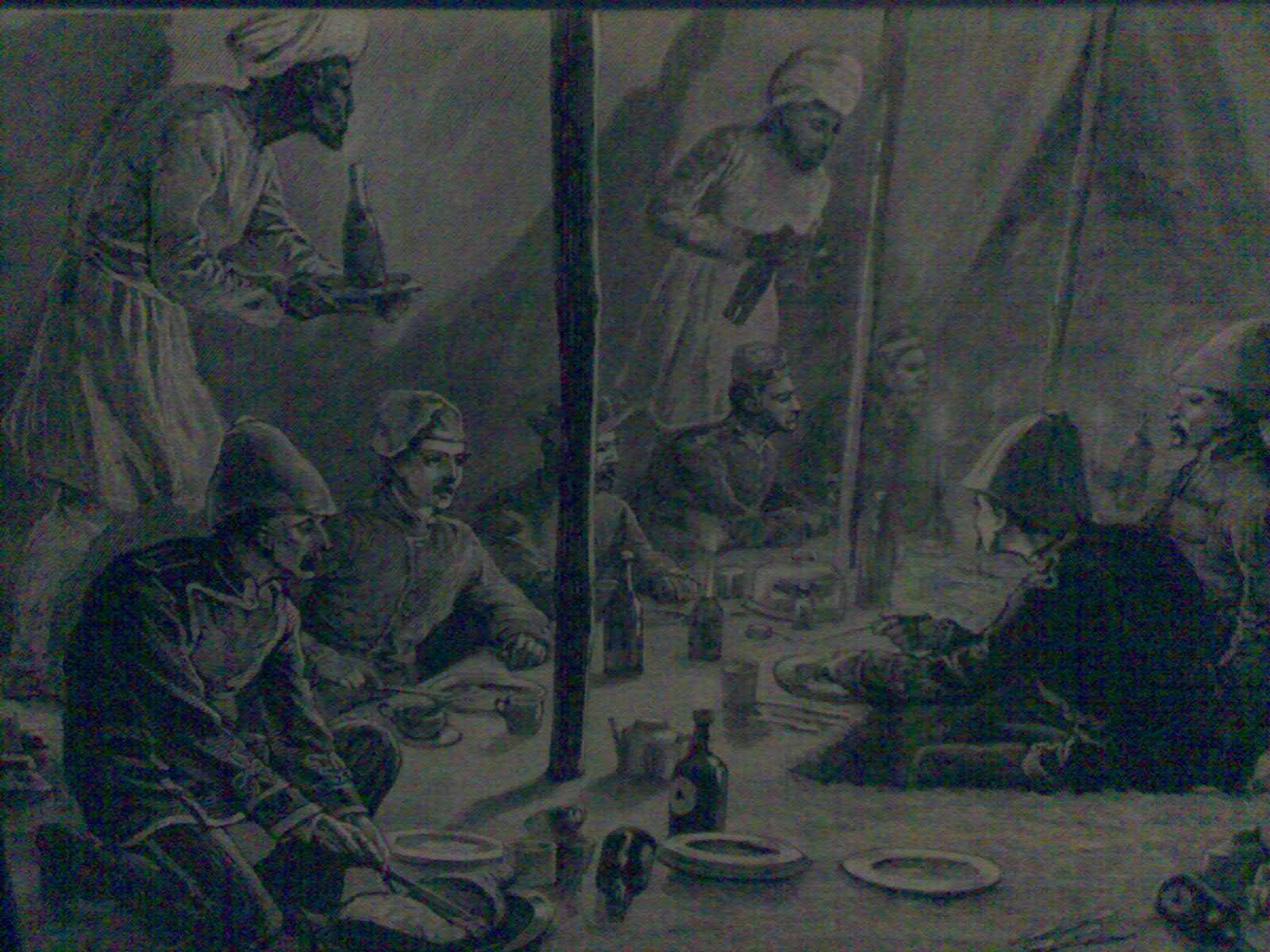
Another contentious ‘myth’ is that IPA was brewed for the troops. For some reason, there’s a school of thought that it wasn’t. Certainly, it wasn’t the only think they drank. And yes, the civilians in India drank it too. But the big orders I saw for requisition were specifically for the he numbers of troops that were sent to India after the 1857 first war of Indian Independence (referred to by colonialists as the Indian Mutiny.)

Being a soldier in India was a life of short periods of extreme violence separated by long stretches of total boredom. The soldiers filled that boredom by drinking.

When Fanny Parkes went India on a ship full of soldiers in 1827, she came to know many of her fellow passengers and was shocked at how quickly many of them died. The average life expectancy of a soldier serving in Calcutta was just three months. Disease was a far bigger killer than combat, and much of it was caused by alcohol.

Beer couldn’t be brewed well in India, but a drink known as arak could be made simply by drawing off palm sap and letting it ferment in the hot sun. Arak drinking contests claimed the first European casualties in India when the Dutch and English spice traders got there. One binge could be fatal.

So, in order to keep soldiers alive, they had to be given alcohol that was strong and flavourful, like arak, but not fatal. IPA was strong because if it wasn’t, the boozy soldiers would have drunk arak instead.

As for hoppiness? The vivid hop characters we love today would have vanished from the beer after months on a hot ship. But the flavours changed. The locals used to say IPA ‘ripened’, and when it was ripe, they described it character as being like champagne. My sea-matured IPA certainly had that character to it – somewhere between what we think of as IPA and barley wine.

So – at least some IPA was strong and hoppy. It didn’t have to be. It was like that because that’s how people wanted it to be, so they drank it instead of the local gut rot.