Author: PeteBrown

| Uncategorised

Molson Coors buys Sharps!

Transfer window madness: Burton-on-Trent buys Cornwall

Yes, it’s the same story that will be appearing on about eight or nine UK beer blogs at this very moment:

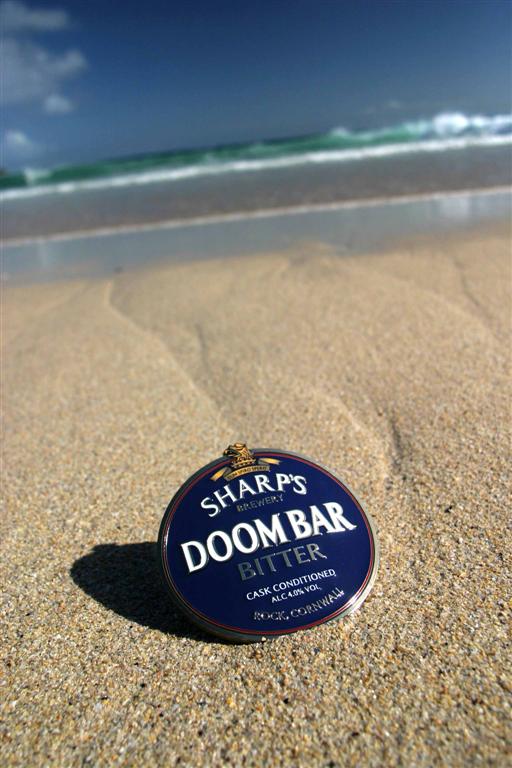
Burton-based Molson Coors, brewers of Carling and Grolsch, have just announced the purchase of Cornwall’s Sharp’s Brewery, home of the fast-rising Doom Bar and a range of wonderfully eclectic, sometimes even visionary, but difficult to get hold of beers from top brewer Stuart Howe.

There’s not too much info on the value of the deal, what it means for breweries and brands etc.  The press release quote from Molson Coors CEO Mark Hunter is:

The Doom Bar brand is modern and progressive.  It has a loyal following and excellent reputation amongst consumers and customers alike and has the potential to become a truly extraordinary brand. We have a wealth of experience with this type of venture and an excellent track record of building brands across all markets. We respect and want to preserve the unique culture of Sharp’s Brewery and the special appeal of their brands to beer drinkers.”

Stuart Howe adds:

“We are delighted to be joining the Molson Coors team, all of whom are passionate about Sharp’s Brewery and committed to the Doom Bar brand. We are incredibly proud to be voted the best regional cask beer by our customers, with the support of Molson Coors we’re looking forward to being recognised as the best cask beer in the country.”

So what does it all mean? Why has it happened? Here are some initial, ill-informed thoughts and speculations.

Firstly, before we get into the detailed ramifications, this represents a major change in direction for the UK cask ale market.  In four years of writing the Cask Report, we’ve been saying that the big national brewers have abandoned cask ale and left it to the regionals and micros.  Molson Coors have been talking a good cask ale game for a while now without doing much to deliver against it until recently.  This marks the creation, or reinvention, of a national brewer with a big commitment to cask ale.

Of course there are good and bad sides to that.  Many will ask why MC can’t just leave cask ale to people who care about it.

But this is actually a great fit.  To beer aficionados, Doom Bar is an acceptable but very ordinary beer.  And yet it is massively popular with mainstream drinkers.  It looks contemporary on the bar and recruits new people to the ale market.  It’s taken on by many pubs who are looking to trial cask for the first time.  Anyone who met the previous owners will have got the impression that they were aggressively building the brand, attempting to turn it into a national cask ale brand as quickly as possible.  It’s only been going since 1994 and the original recipe was from a kit, so it’s not as if there is any heritage here that’s about to be trashed by a big corporate.  There’s no better brand for MC to acquire – mainstream, modern, little specialness to lose.  With glorious hindsight, this is just the logical next step for Doom Bar’s evolution.

So how does it fit with the Worthington brand, also given a reboot by Molson Coors with the building of the new William Worthington Brewery (which I wrote about in this week’s Publican magazine)?  Doom Bar is at the moment stronger in the south, while Worthington’s is bigger in the Midlands.  Mark Hunter told me that draught White Shield and the long-awaited Red Shield will be focusing on a radius around Burton.  My prediction is that MC will aggressively build Doom Bar as a national cask ale brand.  My hope is that they’ll then nurture White Shield/Red Shield as something a bit more special.  If that’s what happens to Doom Bar it’ll be good for cask ale overall, making the gateway to the category that bit bigger for the kind of drinker who doesn’t have the confidence to seek out flavourful beers without the reassurance of big brands. (Yes, I know I just described Doom Bar as a flavourful beer, spare me the wisecracks – I’m talking relatively).

And what of Stuart Howe and the rest of what he does at Sharp’s?

Those of us who have met Stuart know he finds brewing Doom Bar a bit of a chore – it’s growing massively, it’s a routine to brew – and he has a huge imagination. The line from MC is that Stuart “Stays doing what he’s doing but supported by more investment in the brewery and greater distribution capability.” I’d like to think this means he’ll be staying on in the new company, and will be given freedom to experiment, getting some of his Belgian-influenced ales out into the market properly. My mouth also waters at the prospect of collaborations between him and Worthington brewery legend Steve Wellington.

But whether or not this will actually this will happen within the well-meaning but slower, more corporate, conservative set-up of Molson Coors, I’m more doubtful about.  Stuart won’t hang around if he’s just brewing Doom Bar on a bigger kit, and if he does eventually jump ship, you can bet your life it will be to start something new with a greater focus on innovative beers.  So the craft beer drinker still wins out.

I’d say the only people who could/should be pissed off or alarmed by this are the regional brewers like Greene King, Marston’s and Wells & Young’s, who now face a serious new contender.  It’s going to be interesting to see how they react.

Meanwhile, Howe’s blog is going to make even more compelling reading than normal!

| Uncategorised

Don Younger – a beer world legend

Don Younger RIP

Last night the brewing world lost one of its best, someone who summed up everything – every last little wave and particle – that is good about the world of beer and pubs.  And that’s no hyperbole – anyone who ever shared a drink with Don Younger could tell you what those qualities are, and how Don encapsulated them.
I was introduced to Don when I was in his hometown, Portland Oregon, while researching my second book, Three Sheets to the Wind.  If I tell you that I have read out the bit about our encounter at every single event at which I was promoting the book, that might give you the first inkling as to what a great man he was.  It was one of the highlights of the book – one of the funniest passages, but also one of the most revelatory about the nature of beer.
I was in Portland because it’s the heart of North American craft beer.  You might now say that’s San Diego, or wherever has produced this month’s latest extreme whisky aged Imperial stout, but Portland still has more craft breweries per capita than anywhere else (I think), and its brewers and drinkers perfectly capture the cooperation, camaraderie and conviviality that make beer great – uniquely great.
And Don was its Godfather, its benign inspiration, in his passion, his kindness, and more than anything else, his legendary drinking prowess.
The story I was told is that he bought the Horse Brass Pub after a night on the piss.  He woke up the next morning clutching a piece of paper bearing his signature, confirming that he was the new owner of the pub. He’d never wanted to run a pub, and had no memory of signing the paper.  He could of course have blamed the booze and negotiated his way out of it.  But he always lived by a strict code: if you make a decision or promise while drunk, you either follow through with it when sober, or you give up drinking.  And Don never gave up drinking.
Under his leadership, the Horse Brass became the hub of the emerging craft beer scene, attracting beer loving locals, many of whom went on to start celebrated breweries.  No one in that brewing scene speaks of him with anything other than love.
Don was 68 or 69, and had a fall last week in which he injured his shoulder.  According to reports, this led to multiple complications, and he died around midnight last night, West Coast time.
I’ll leave it there.  I only met Don the one time and I’ll leave the proper obituaries to the people who were lucky enough to know him well.
But on the basis of one meeting, he was one of my favourite people in the beer world.  Even if you didn’t know who he was till now, take a while to read about him, and raise a glass of your favourite US craft beer to him tonight.  After all, there’s a good chance it may not have existed without his influence.

| Uncategorised

January Video Blog – It’s Festival Time!

Went to the National Winter Ales Festival in Manchester last week, and had a rather marvellous time.

The result is a video with me and Peter Amor – he gets to talk to people and I get to drink a lot of beer.  I almost manage to hold it together to the end…

| Uncategorised

Britain’s beer tax problem

Don’t have time to really write much about this today but I received an interesting press release from the British Beer and Pub Association (BBPA) this morning.

As the budget approaches, the beer industry is bracing itself for yet another duty increase.  Duty on beer increased by 26% between 2009 and 2010, and is due to carry on increasing.  The Tories have committed themselves to sticking with Alastair Darling’s policy of increasing duty on beer by 2% more than the rate of inflation.  Which means that this year, just a couple of months after a 2.5% VAT increase, we look set for an increase of 5.7%.

Beer volumes are already in steep decline.  The plight of pubs is exacerbated because supermarkets continue to absorb the increases and keep prices low – because they can afford to lose money on beer to get people into the store – while pubs can’t afford to.

Analysts PriceWaterhouse Coopers have predicted that this relentless duty increases will actually result in the government receiving lower tax revenue overall, as the benefit for a higher tax per pint is more than outweighed by the resultant fall in demand the price rise creates.

And yet, incredibly, there are some ill-advised, hostile or just plain ignorant people out there who believe that, in the face of a watered down announcement about minimum pricing, tax on beer is too low.

If you hear anyone spouting such garbage, feel free to share with them a few stats the BBPA pulled together:

UK taxes (duty plus VAT) on beer already massively outstrip rates in any of our neighbouring countries. UK tax rates are EIGHT times higher than in France, TEN times higher than in Spain and ELEVEN times higher than in Germany.
The BBPA analysis also reveals the astonishing figure that Britain’s beer drinkers are paying FORTY per cent of the entire beer duty bill in the European Union – despite Britain’s small, 12 per cent share of the total population.  UK beer drinkers are paying £3.1 billion out of an EU total of £7.7 billion in beer duty revenues.
In addition, some countries, such as Italy, Portugal, and Spain, have lower tax rates of tax for pubs, bars and restaurants – to help their hospitality industries and the hundreds of thousands of jobs that depend on them.
BBPA Chief Executive Brigid Simmonds, comments:
“When it comes to alcohol taxation, we need a debate based on facts, not myths. Our alcohol taxes are among the highest in the developed world, and for beer we have had huge, 26 per cent duty increases in the past two years. What we really need is a freeze in beer duty in the Budget.
“Our already high taxes show that duty-plus-VAT cannot be used as a proxy for a minimum price for alcohol. This would have a particularly devastating effect on pubs. When it comes to tacking alcohol misuse, what we need most is improved alcohol education and awareness, and tougher, targeted enforcement of the huge range of existing laws. Pubs need lower taxes – and less red tape.”

| Uncategorised

Hops and Glory and Jeff and Smuggling

***SPOILER ALERT***
If you STILL haven’t read Hops and Glory (what is wrong with you?) and you don’t want to know what happens, look away now.

If you have read it, you’ll remember that Barry the Barrel exploded in Tenerife, and I found myself in Brazil with a serious problem – how to get a replacement, pressurised keg into Brazil so I could board my container ship with it.  In the end I had to ask friends for a volunteer to smuggle it in in their personal luggage.

The man who stepped forward was Jeff Pickthall.  Risking time in a Brazilian jail (perhaps) he brought me the keg and enjoyed a few days in Brazil, after a nailbiting race against time to get to me before I had to board my ship.

Some people have asked if I was perhaps laying on the drama a bit thick, exaggerating just how tight it was to make the story better.  Ask Jeff, and he’ll tell you that, if anything, I downplayed it.

Except now you don’t have to ask Jeff because finally, a mere three and a half years after that fateful day, he’s written his own account of his cameo in Hops and Glory.

It’s an epic.  And it’s right here:
http://jeffpickthall.blogspot.com/2011/01/my-hops-and-glory-adventure-part-one.html

| Uncategorised

It’s official: hell hath truly frozen over

“Ha! Ha! Ha! Being a stock photography model is such FUN!”

Birds fall dead from the sky.  Australia sinks into the sea. Brazil disappears under an avalanche of mud.

This is truly the end of days.

Any second now, birds will fly backwards.  Dogs will howl into the sky.  Flags will hang heavy at the tops of their poles and your wallet will fill with blood.  Time will reverse, volcanos will erupt, the four horsemen will ride and everything you knew will turn into the opposite of itself.

And lo.  It’s already started.

Because today, the Daily Mail publishes a positive story about beer.  Yeah, you heard me.  Good news.  About beer. In. The. Daily. Mail.

There is not one attempt to spin it negatively, distort the news, misrepresent anyone, lie, or otherwise seek to create fear and suspicion in their readers.

It seems that two Spanish scientists have done a study that confirms what people like the Beer Academy have been saying for years: moderate consumption of beer is not only not bad for you – it’s positively good for you.  One pint a day (yeah, I know, but bear with), accompanying a healthy diet, reduces the risk of diabetes, high blood pressure and heart disease.  Rather than putting weight on, in some cases it actually correlated with weight loss.

Suddenly, the Mail is saying things that the beer community have been trying to make people listen to for years, as if they were news: moderate beer consumption has the same health benefits attributed to red wine; beer is not to blame for the famous British beer belly, etc.  There’s some interesting stuff about the difference between Spanish and British drinking culture, and how it’s the way we drink that makes a difference.  I covered all this in Three Sheets to the Wind five years ago, but it’s still nice to see someone finally sitting up and taking notice.  It’s more than nice.  It’s bloody wonderful.

One thing that made me laugh out loud though, because the alternative was to open a vein: in my 2010 round-up I commented upon the relentless negativity that afflicts many on the internet, noting that even when I post a blog about something really good, the first comments are without fail from people who have somehow managed to see a down side.  I speculated that even if I were to post news that great-tasting craft beer cured cancer, some of you would still be able to find a negative angle on such news.

Well get a load of the Mail page.  Here is news that is quite wonderful to behold, almost in the same territory, though not the same magnitude, as my hypothetical cancer cure story: moderate beer consumption is positively good for you.  Could anyone POSSIBLY have a problem with that?

Oh hell, yeah.

The kind of people who write on Daily Mail comment boards make you haterz out there look positively cuddly and benign.

By half ten this morning, Royston Amhplett from Bournemouth had got in there with “And yet another ploy to increase the tax revenue.” Yeah, that’s right, Roy! That beer lovin’ government and reactionary right-wing tabloid are conspiring to trick you into drinking more beer and enjoy yourself! That’s what they want you to do!

Fraz from Gosport chipped in with “Researchers never fail to ASTONISH me with thier [sic] Groundbreaking “Discoveries” Just how much are these IDIOTS costing the Nation ???!!!” Er – nothing Fraz.  If you’d actually read the piece before getting your specially green-inked keyboard out, you’d see that they’re at the University of Barcelona.

Andy in Scotland moans, “If you wanna keep lapping up these fantasy stories that it’s good for you, please feel free to drink as much as you like.  It’s just a shame that the reality is that your lax-attitude to alcohol is costing the national health service, tax-payers and police more money than any other substance on Earth. Shame on you, drunken Britain.” Well, no Andy, they were at pains to point out it’s not about drinking as much as you like; it’s about moderate consumption.  Hey Andy, go for a walk! In a few weeks the daffodils will be out and the little lambs will be frolicking in the fields. Go look at them for a bit.  Breathe the fresh air.  Let it go.  Smile!

Pete in the UK (no relation), actually knows more about the topic than scientists who have conducted in-depth rigorous studies into the effects of alcohol: “What absolute nonsense, DM – and you wonder why the UK has a drink problem? This apologist lie of a story is not only scientifically inaccurate, but also is just another excuse for drunks to decimate our national health service.”  Yep, the scientific community and the right wing reactionary media are looking for excuses to cost the health service money all the time.  That’s what they do.  Scientists wake up every morning and go, “Hmm, how can I use my big scientific brain to fuck up the NHS today?”

But top prize goes to a fella from New York who is in such denial about his relationship with alcohol and so unable to take responsibility for his own behaviour that he posted this classic: “There is a chemical additive in beer that they claim is a preservative. But in actuality it is a addictive agent [sic]. Many years earlier when I drank, a few beers did the job. Many years later 24 beers was not enough this is due to the so called preservation which is actually an addicting [sic] agent. I gave up drinking 14 years ago and never looked back.”

When I have my first pint following my dry January, I’ll smile and reflect upon the fact that every single day of my life, even the stressful days and the days where self-doubt moves in and squats over me like a heavy weather front, I am happier and more at peace with myself than any of these people ever are.

If I have one moan myself, it’s not with the Daily Mail, the study itself, or anything like that.  It’s that at the time of writing, a quick internet search revealed that the only national British newspapers to cover this story were the Mail, Daily Express and Daily Telegraph.  The Guardian, Independent, Times, Sun and Daily Star have all ignored it.  How different it was back in November, when David Nutt produced a study that had not a shred of the scientific rigour and process this one has, that claimed alcohol was worse than heroin, and received blanket coverage.

| Uncategorised

The ‘death of the pint’? How?

A schooner. Be afraid.  Be very afraid.  Actually, don’t.

Recently I’ve done a bit of moaning about the relentless negativity from some quarters that immediately greets almost any topic you can think of in the world of beer.

Last night, I was approached by a TV station to comment on the new proposals to relax drinks sizes, notably to include two-thirds of a pint as a legal measure.  However, they were specifically looking for someone who was violently opposed to it.  When I told them I thought it was a fantastic idea, they thanked me and said they didn’t need me any more.

To be fair, I’m sure the station already had plenty of people in support of it, and they did say that they felt most sane drinkers would be supportive.

So why did they want someone who was against it then?  For editorial balance, of coursee.  But who on earth could be against it?  That’s what startled me.  And on what grounds? I couldn’t think of any reason to oppose it.

Of course, I soon found some.

The telly people thought I might be against it because of my stance on neo-prohibitionist measures, and because I’ve spoken to them before about the campaign to ban glassware from pubs.

But I don’t see this as a neo-prohibitionist move at all.  A move that might encourage responsible drinking, sure.  But those are by no means the same thing.

Some government people have said it will curb binge drinking, and when governments start saying that, it does set alarm bells ringing.  But no one is saying anything about banning the pint.  (And please, conspiracy theorists, don’t start with any of that ‘thin end of the wedge’ crap.  The pint is not going to be banned.  It’s not going to happen.  OK?)

That brings us on to the traditionalist argument.  The pint is a great British icon.  The two-thirds measure or schooner undermines it, threatens its existence.  Why?  Does the presence of 175ml wine glasses, or 125ml, threaten 250ml glasses?  Hardly.  The point is, there’s a choice.  Many people will still choose a pint.

This is why I don’t think it will do that much to curb binge drinking.  The worst binge drinkers don’t do it on beer anyway.  Those who do, who still want to get pissed, will still order pints.

What’s good is that it will give drinkers greater control.  Someone driving, say, may be worried about having two pints, but can drink two schooners without worrying.

Closer to home, I think it’s a brilliant idea for stronger craft beers.  I would never order a half of something like Thornbridge Jaipur (5.9%) because it feels like a cop out.  But when I drink beers like this by the pint, it feels like too much.  And if I do this on a session, that’s the only time I get drunker on beer than I would like.  There are people who would never drink halves, but who would consider a pint of something above 5% ABV to be ‘loopy juice’.  The two-thirds measure will actually make stronger craft beers more accessible to a wider audience.

Apparently some people have argued that unscrupulous publicans will use it as an excuse to rip people off, charging considerably more than two-thirds the price of a pint for two-thirds of the volume.

Well first off, that’s a classic example of that negativity I was talking about: could you at least wait and see if that happens before you start complaining about it?

Secondly, on the rare occasions where this happens with a half pint versus a pint, the difference is rarely more than a few pence.  If you think that’s a rip-off, don’t buy it.

My final word on the whole subject: if both Brew Dog and the British Beer and Pub Association, so often at opposite ends of various arguments, are both delighted by this move, it’s kind of hard to imagine who could be vehemently against it.

This is the first bit of good sense we’ve seen in drinks-related legislation for some time.

| Uncategorised

2010: What the blazes was all THAT about? (Part three)

A day late thanks to laptop crashes. Here are my final reflections…

Source of cautious optimism of the year: The rebirth of the (good) pub

Is the worst over?  The number of pubs per week that are closing their doors for good fell from 49 in mid-2009 to 29 in 2010.  That’s still too many – but it’s an improvement.
That’s actually a net figure – more pubs are closing than that, but some of them reopen as pubs.  In fact Christie & Co, a big pub estate agent, claim 60% of the closed pubs that pass through their books reopen as pubs.
And everywhere I’ve gone in 2010, I’ve seen great new pubs opening, and flourishing.  In every one, the story is the same: here was a pub that, before the end, had chased the lowest common denominator in search of shoring up its income, with brighter lights, louder TV screens and music, karaoke and promotions on lurid drinks.  In every one, the new landlord said to me something along the lines of “Before this placed closed, there was more money changing hands in the toilet cubicles than was being passed over the bar.”  Pubs signal the kind of place they are as soon as you walk in, and attract custom – or not – accordingly.
And whether we’re talking craft beer pubs like the Jolly Butcher’s on my doorstep, the Cask and Kitchen in Pimlico or the newly opened Thornbridge pub the Greystones in Sheffield, or revived community pubs like the Chesterfield Arms in Chesterfield or the Morgan in Malvern, these boarded up shells have been taken over by people who get that a good pub should be about good beer and good conversation.  They’re reclaiming their roles as community hubs.  People who haven’t sat together and spoken for years come together once more. 
It’s not foolproof, but decent beer pubs offering good beer in the right location are thriving.

Buried hatchet of the year: The Great British Beer Festival

Regular readers may have noticed that I slag off CAMRA with some regularity.  I don’t enjoy it, but it has to be done. 
The first slagging I gave our consumer campaigning body was in my first book, Man Walks into a Pub, and the main focus of my ire was the Great British Beer Festival.  I used to be drawn to it every year, and I used to hate it every year.  I hated its unfriendly staff, its singular lack of atmosphere, and the fact that every single aspect of it seemed to actively alienate anyone who was not already a fully paid-up CAMRA member.
In 2009, I grudgingly admitted that much had changed, and despite reservations, it was getting pretty good.  In 2010, I enjoyed it unreservedly. 
We could still point to the appalling acoustics, the ludicrous situation whereby Meantime, a brewer of incredibly authentic traditional London beer styles, is not allowed to exhibit those beers in a London beer festival thanks to an irrelevant technicality, or the apparently growing hostility to the large regional brewers who kept real ale alive until the micro boom came along.  It’ll never be perfect. 
But there’s been a lot of thought given to layout and navigation, the foreign beers now get the space and respect they deserve, and the staff of volunteers have undergone a massive charm offensive, and are, on balance, as unfailingly polite and helpful as they were rude and hostile a few years ago.  More than that, festivals are made by the people who attend them.  The craft beer revolution and CAMRA’s more open body language have attracted a much broader spectrum of people, and GBBF now actually feels like a festival.  It feels like a celebration of great beer on a grand scale – which is what it ought to be.
Congratulations, CAMRA.

Big night out of the year: Kelly Ryan’s Euston Tap Farewell

Most sadly missed, Britain’s loss is New Zealand’s gain etc. 
At the end of the year Kelly Ryan, Thornbridge brewer, brilliant public face for the brewery and perfect foil for the gifted but shy genius that is head brewer Stefano Cossi, decided to return home down under. He announced that he’d be having a few drinks in the newly opened Euston Tap on 1st December, if anyone wanted to come along and say goodbye.
Earlier that evening I’d already been to a Beer Genie Christmas beer tasting with my oldest friend, Chris.  This was also a leaving drink of sorts, with Chris leaving London after 16 years to return oop north.  Kelly’s party was in full swing when we arrived, with many familiar faces.  Thornbridge Alliance, one of only two casks in existence of a beer brewed three years ago in collaboration with Garret Oliver, was on the bar, alongside several other Thornbridge solo and collaborative brews.  I was asked for my autograph when I walked in, which was weird – I’ve signed lots of books and stuff, but never actually been asked for my autograph before, and certainly not on the basis of my appearances on a long-lost food TV programme four years ago.  
There was already a certain giddiness in the air.  With heady beers of 10% or 11% on the cards, I planned my night’s drinking carefully – three or four different halves, building in flavour and intensity, until finishing on the Alliance at about 10pm then heading home. 
This would have worked if I was buying my own drinks, but on nights like this in the Tap that’s not always easy.  Various indeterminate pints and halves began appearing in front of us.  And then in burst Jamie, proprietor of both Sheffield and Euston Taps, bearing a heavy plaque that had been awarded him by a bunch of railway enthusiasts for the restoration of the Sheffield Tap, presented by none other than celebrity trainspotter Pete Waterman.  More drinks all round.
And then it started snowing, heavily, and then pizzas arrived, and then it was snowing inside, because a bunch of polystyrene appeared from somewhere and Chris was tearing it into smaller pieces and throwing it in the air.  Jamie was challenging people to arm wrestling contests at the bar, goading them with slaps around the face if they proved hesitant.  I don’t think the stoic bar manager, Yan, ever actually called time or declared a lock-in.  It just reached a point deep in the night where anyone who came to the door took one look inside and hurried away again.  Kelly and his girlfriend Kat looked delighted, accepting endless drinks and occasionally even trying to buy one.   The snow continued to fall and barley wine followed Imperial Stout followed Double IPA, and we stayed there, drinking irresponsibly, until about 2am.
One of those nights you’ll remember for years to come – the sheer joy of drinking great beer with great people.  In the snow.

Local triumph of the year: London finally catches up with Microbrew revolution

In 2006, Ben McFarland and I spent a day touring Boulder, Colorado, while visiting the Great American beer festival.  At that time Boulder (population, 85,000) had 15 breweries.  London (population 7 million) had two that people knew about, and maybe two more that were known to real aficionados.  It seemed bizarre that, in the midst of the UK microbrewing revolution, the nation’s capital, home to legendary historical breweries like Whitbread, Courage, Watney’s, Truman’s and Barclay Perkins, had fewer breweries than places like Sheffield and Derby.
In 2009-2010, that all changed.  When the explosion came, it was all the more forceful for having been kept waiting so long.  Sambrooks opened at the end of 2008, Brodies in 2009, and in 2010 we gained Redemption, The Kernel, Saints and Sinners/Brew Wharf, Camden Town and, a little further out, Windsor and Eton.  With Fuller’s breaking new ground, Meantime moving to a new level, Battersea Brewing somewhere below the radar, Zero Degrees in Blackheath and the Twickenham brewery, London finally has a vibrant brewing scene once more.  Not only that, across the board there’s a level of variety, experimentation and cooperation that gladdens the heart as it excites the palate.
So, lots of moans about 2010, but lots to be very happy about too.  I think the trend towards interesting beer has proved not to be a fad.  Now, when I tell people what I do for a living, about half of them say, “Oh yeah, beer’s pretty cool at the moment isn’t it?  I was trying something new and interesting the other day.”  I don’t know if we’ll ever get the sudden explosion of interest that cider got with Magner’s.  But compared to when I started writing about beer, the variety and enthusiasm surrounding it now is phenomenal.
Here’s to more of the same in 2011.

| Uncategorised

2010: What the blazes was all THAT about? (Part two)

Here’s part two of my review of the year – three more arbitrary categories…

Villains of the year: The rise and rise of the neo-pros

I spent most of January trying to offer a robust and factually based defence against the wilful distortions and occasional outright lies told by those who seek to curb our right to drink.  The actual data – from most sources – suggests that Britain’s drink problem is declining, yet the NHS, Government and newspapers from the Daily Mail right through to the Guardian are trying to tell us the ‘epidemic’ is getting worse.  Any rational, scientific analysis of the data shows this is not true.  But no one is giving us that analysis. 
As the biggest consumer body, CAMRA does absolutely nothing to confront or challenge the lies being told about drinkers and pubs.  All it does is ‘welcome’ the bits where people like Alcohol Concern acknowledge the role of well run community pubs as part of the solution, not the problem, and campaign for a lower rate of duty for low strength beers.  Where distortions are put forward about drink in a wider sense, CAMRA remains silent.  Always.  
People like Mike Benner deserve to be congratulated for at least getting Alcohol Concern to concede the point on community pubs.  But for a body that, according to its website, acts ‘as the consumer’s champion in relation to the UK and European beer and drinks industry’ (ie it’s NOT ‘just about real ale’, as many of its defenders are quick to argue) it plays no role at all in supporting the industry or the consumer in this wider attack on our right to drink and our reputation as drinkers.
The BBPA is little better – though it at least has an excuse.  If the BBPA were to actively argue that the scale of alcohol abuse in this country were being deliberately exaggerated and distorted (it doesn’t), the media would say “well you would say that wouldn’t you?  You’re the drinks industry.” Even though this argument is never put to self-declared temperance advocates,  whose “findings” are accepted without dispute.  Every time.
Look at the case of David Nutt, for example.  In the autumn, he published a study that was not peer-reviewed, had a deeply questionable methodology, and had questionable, self-interested motivations, claiming that alcohol was more harmful then hard drugs such as heroin.  His findings were published without question, as ‘authoritative’ scientific fact.  The Guardian broke this story on a Monday.  I wrote to the Guardian pointing out the problems with methodology and the self-interest point, arguing that the Guardian, as professional journalists, should at least show some scepticism about what they were being told.  I was ignored.  An archive search shows that in the week that followed, no dissenting voice was published in the paper arguing against Nutt’s claims.  And yet on the Friday, he was given a full page to ‘answer his critics’ – critics who no one had actually been allowed to hear from.
And look at the case of the Dentist’s Chair.  The legislation banning promotions that encourage excessive alcohol consumption actually names the Dentist’s Chair specifically. Even though, at the time the legislation was passed, it seems that there was only one pub in Newcastle that actually did it.
A few people think I overreact about this.  But I’ve studied Prohibition in some detail for my books, and the point about everything from total Prohibition in the US through to the UK smoking ban in 2007 is that before you pass the legislation, you create a climate in which most people will support it.  That’s what’s happening now, and it’s happening quickly, and it’s happening because we are being deceived about the true scale of the problem.
Ben Goldacre, we need you.
Time to cheer up I think…

Personal regalvanisation event of the year: America

I’ve done so much this year that I haven’t had chance to write about a lot of it.  Partly I’m too busy doing stuff to actually write about it, partly the process of getting features commissioned, delivered and published is akin to the gestation period of an elephant.
In October I went to the US for ten days.  A trip that was based upon a book and a feature I’m writing expanded to include a bit of self-indulgent travelling.
It’s the first time I’ve been to the US for four years, first time in New York for six years, first time I’ve done a big beery adventure since I got back from India at the end of 2007.
And it’s a trip that completely reset me. 
I spend so much of my time now writing about the kind of shit above, arguing with people about beer style definitions, trying to meet trade press deadlines, negotiating the fine balance of political interest around the Cask Report, or worrying about keeping abreast with everything that’s happening in an ever-accelerating craft beer scene, I sometimes wonder why I want to be a professional beer writer, making my living from researching and commenting upon the beer and pub industry.
I went to New York and visited a couple of the obvious craft beer bars, and also found wonderful dive bars where the spirit of the boozer is alive and well.  I went to Brooklyn, had a tour of the Brooklyn Brewery, almost finished in its ambitious expansion, had a tasting of the stunning, poetic boutique beers Garrett Oliver is creating, then went out and got riotously drunk with Garrett in a selection of stylish Brooklyn craft beer bars, before wondering off into the New York night.  The next morning, scrolling back, I had cause to regret the invention of Twitter, reading what I’d posted the night before.
Then I got on a plane to Rochester, New York, the main purpose of my visit.  In an unassuming town, robbed of much of its purpose after the decline of Eastman Kodak, I visited the Old Toad, the pub I’d come to write about, one of the first real ale pubs in North America. 
My plan on Day One had been to sit at the end of the bar, order a pint and take in the ambience, observing anonymously before introducing myself to the people I was there to meet.  I was on the premises for ten seconds before someone tapped me on the shoulder and said, “Pete?”  They were waiting for me, Rochester’s craft beer drinkers, and they proceeded to show me a life-affirmingly excellent time. 
In three days I never got my chance to sit quietly at the end of the bar on my own.  I tried it one afternoon and the staff were sitting there trying to put together a ‘trifecta’ beer, food and whisky matching menu, which they pulled me into.  I mentioned that I loved Buffalo Wings and was taken to the place that served the best wings outside Buffalo itself – which also had a great selection of American micros.  I mentioned I loved the whole dive bar thing and was taken to Rochester’s best dive bars – which, again, had a great selection of American micros.  The Old Toad and its sort-of-sibling, the Tap and Mallet, and the group of great beer fans who drink in them, are worth the price of a transatlantic plane fare on their own.
But I wasn’t done yet.  On the Amtrak, around the Lakes and up to Toronto, to stay for a few days with Rudgie out of Hops and Glory, who now lives there.  A few days in town with him and the excellent Steve Beaumont, and again Toronto’s constituency of craft beer fans, beer writers and Hops and Glory fans were waiting for me in the craft beer pubs and at Volo, a one-time Italian restaurant that now boasted a cask ale festival featuring over thirty Canadian real ales, including some of the best Imperial porters and dark IPAs – sorry, “Cascadian dark ales” – I’ve ever tasted.  We won’t mention Rudgie taking us to the hockey game only to find out we had tickets for the wrong day, because we still had one of those evenings you remember for years, and the following morning he drove me for two hours up through Ontario to Creemore Springs, a craft brewery in a town strongly reminiscent of Groundhog Day’s Punxsutawney, especially when the Halloween snow started flying at the windscreen.  Creemore Springs itself was an object lesson in great Kellerbier and how sometimes, a macro can go into a partnership with a micro successfully, to the benefit of both partners.
Beer people, beer places, and great beer.  I came back from that trip re-energised, repurposed, the flame of passion for this crazy, infuriating, eccentric scene burning brighter than ever, with so many plans and ideas for 2011 and, more importantly, a pubfull of great new friends.
This is what beer is all about.  This is why I started this, was pulled into it, allowed it to change my life.
All of which makes me even more frustrated about…

Green ink moments of the year: Craft beer, CAMRA, real ale and beer styles

Beer is only any good if it’s from cask.  Fuller’s ESB is not ‘to style’ for an ESB.  The new wave of keg beers will consign cask to history.  Brewery X has grown so big I no longer like their beers (even though the beer hasn’t changed).  Micro is good, macro is bad – but how do we define micro?  Craft beer is a meaningless term and we shouldn’t use it.  Greene King IPA is not a true IPA.  Micros are parasites feeding off regional brewers.  Craft beer is only craft beer if the brewery producing it is below a certain size.  This beer is not really real ale if it served with gas pressure.  How can you have a black IPA?
Shut up.  All of you, just shut up.
I include myself in that.  I get pulled into some of these debates – I even fuel them sometimes – but I always regret doing so, and I apologise for every moment in 2010 where I’ve made people focus on these aspects of beer more than they otherwise would have.
On some level they’re important.  But try this test.  Find a friend or work colleague who you think is open to discovering the flavours of your favourite beer, but currently just drinks something boring and characterless.  Now try to interest them in that beer by telling them about your definition of craft beer, or real ale, or talking to them about the politics of craft brewing, or explaining the importance of the absence of cask breathers.
Now you’ve lost their interest and reaffirmed their status as a wine drinker for the foreseeable future, find a similar friend or colleague, and say, “Here, drink this,” and if they’re interested, tell them a bit about the history or provenance of it, or why it tastes as good as it does with reference to how it’s made and what’s in it.
Or if you can’t be bothered, just shut up.  Find the beer that made you fall in love with great beer.  Drink it.  Savour it. Enjoy it. And marvel at how good beer can be, how much happiness it can bring, the flavour sensations, the inspiration, the soft mellow buzz, the conviviality, the laughter, the friends.
Part three tomorrow.