Author: PeteBrown

| Uncategorised

My final post on beer styles

I’ve been swayed by some of the really interesting points in response to yesterday’s post – but also reaffirmed in my conviction not to stay in these murky waters any longer than I have to. There is no right answer. It’s fascinating that on one side, you have people arguing that an obsession with beer style liberates craft brewers and inspires them to be more creative. And on the other you have equally qualified, equally talented people arguing that it stifles creativity. I have absolutely no interest in weighing in on that one any further.

But the very debate there brings me on to my second observation on beer styles – the argument changes entirely depending on whether you focus on the brewer, or the drinker. So…

2. The drinker doesn’t need 133 beer styles. Or 70. Or even 30.
Most people who cook have only seven recipes in their repertoire.  Even if they have shelves full of Jamie Oliver and Nigella Lawson, when it comes to planning what the family meal is going to be that night, research shows they revert to a list of no more than seven or eight choices. If they learn a new favourite dish, they forget one of the regulars they used to rely on.

Hold onto that thought – I promise it’s relevant.

On Monday night, in a very engaging defence of rigorous beer style definitions, Meantime’s Alastair Hook repeatedly made the comparison between wine and beer.  Wine, he argued, has triumphed over the last twenty years by focusing on style and educating the consumer in that style spectrum. Beer is lagging behind, and needs to do the same.  I think he is absolutely, 100 per cent right in this.  I couldn’t agree more.

Allow me a little thought experiment. I drink a lot of wine as well as beer.  I love it.  I’ve done a ten week wine tasting course.  I’m now going to name as many wine styles as I can think of off the top of my head.  Ready?  Here goes:

Chardonnay.  Sauvignon Blanc.  Cabernet Sauvignon.  Merlot.  Shiraz.  Pinot Grigio. Um…

I do know some more, but those ones came easily.

Let me think a bit harder:

Bordeaux.  Burgundy.  Claret.  (Are those styles?  Isn’t Claret the same as Burgundy?).  Cabernet Franc (I only know that one because of the course). Sauternes. Viogner. Rose (!?) Chablis? (No, that’s a Chardonnay).  There’s an Italian red I like, begins with P… no, it’s nearly there but… and what’s the really famous Italian Red?  Hannibal Lecter – Chianti!

No.  I’ve been sitting here for thirty seconds and that’s as many as I can get.  I’m having to work harder and harder to get each new one.  Of course I know more styles – I probably have at least twenty in my cellar.  Under hypnosis I might get to thirty or forty.  But as a knowledgeable consumer of wine, that’s the limit of my short term, top level, easily accessible memory.

How many did I get spontaneously? Six.

How many recipes can we store in our heads at an accessible level? Seven or eight.

You can see where I’m going.  Wine is indeed a useful comparison if we want consumers to engage with craft beer.  But it shows you how simple you have to make style.

Let’s take Chardonnay as an example.  As I mentioned, Chablis is a Chardonnay.  So is Blossom Hill Chardonnay.  There couldn’t be two more different wines, but from a consumer point of view, they’re both Chardonnay.

Maybe behind the scenes, the wine guys behave in a similar fashion to craft beer geeks.  Maybe Chardonnay breaks down into New World Oaked, New World Unoaked, Old World Unoaked, Old World Oaked Premier Cru, New World Single Estate, and so on.  But if it does, then as a heavy wine drinker and passionate adorer of good Chardonnay, I have no awareness of it.

From a brewer’s perspective, if you’re going to have 133 beer styles, why not knock yourselves out and have 500? If the system inspires one guy to produce one amazing beer that he otherwise would never have come up with, then it’s worthwhile.

But please, don’t foist it on me, or anyone else who doesn’t want it.  And don’t foist it on beers that are obviously more one style than they are anything else but ‘not to style’ according to a definition that’s meaningless beyond the circle of enthusiasts who created it.  (The comment about Fuller’s ESB not being ‘to style’ makes me want to reach for a shotgun – of course it’s a fucking ESB.)

Learn from wine.  Of course there are more than ten wine styles.  But I would hazard that most wine drinkers wouldn’t be familiar with more than that number.  Keep it simple.  Keep it relevant. Think about it from the point of view of the time-pressed, information overloaded consumer.  This is one of those occasions when I realise the marketing guys have something to contribute.  Sometimes, the reason they simplify stuff and reduce it down is because they understand that most people give a fraction of a second to each purchasing decision they make, and things have to be simple in order to register.

Beer styles help inspire some people to better brews.  I’m very happy about that.  But that’s ultimately meaningless if it doesn’t help – or in some cases even prevents – turning more people onto great craft beer.

| Uncategorised

Beer and women – and me – on the telly

Filmed this the day after Stoke Newington Literary Festival, back in June (which is why there are huge bags under my eyes).  It went out on BBC Midlands last night.

Marverine Cole, who produced the segment, has since gone on to become a fully fledged beer evangelist, better known as the Beer Beauty.

Great job Marverine!

| Uncategorised

Beer styles: the first of only two posts I will ever write on the subject

Really interesting night last night at the magnificent Old Brewery in Greenwich, where the Guild of Beer Writers held a seminar on beer styles.

There was some entertaining and thought-provoking stuff which I’m not going to summarise here, partly because I can’t really be arsed and partly because the cream of British beer blogging talent was there, and I’m sure lots of other people will be providing a full and frank account – they were certainly making more notes than me.

Why can’t I be arsed? Because talking about beer styles makes my brain itch.  This is why I’ve stopped trying to get on judging panels for international beer competitions – I’d much rather judge a beer on whether I like it or not than whether it is brewed ‘to style’.  When I wrote Hops & Glory I poked a bit of fun at the US Brewers Association because they believed there were 70 different beer styles. That was three years ago.  They now think there are 133 different beer styles.  If someone invited me to judge at the Great American Beer festival – which they never will – I would honestly have to decline.

I have two things to say about beer styles, and two only.  It used to be one, but the second one emerged last night after talking to Meantime’s Peter Haydon about the aforementioned 133 beer styles.

In this post, I’m talking about the first point:

1. Style is not fixed – it evolves
Take India Pale Ale (as a random example plucked from the air).  No one knows what the true style is because it evolved from something else, and no one actually called it India Pale Ale until at least 50 years after it was first recognised as a pale ale brewed for consumption in India.

Historians of IPA claim that Hodgsons was the first IPA, and then go on to explain how Burton brewers like Allsopp improved upon it.  OK, so right there you have two quite different beers – London IPA, which was described as ‘muddy’ and bitter, and Burton IPA, which thanks to the water achieved a condition that made it bright and sparkling.

May IPA brewers today tell the story of how the beer changed on its journey to India, and in the same breath claim their beer is an ‘authentic’ IPA, despite the fact it has not been on that journey, and therefore not undergone that change.  If I were a pedant I would argue there has only been one genuine, authentic IPA produced in the last sixty years, and the dregs of it are in a keg behind the bar at the Deputy British High Commission in Calcutta.

Today many English brewers believe authentic IPA should only contain English hops, and that US IPA is some kind of inauthentic, brash cousin.  But brewing records from places like Bass and Hook Norton show American hops, which sometimes gave the beer ‘an aroma of blackcurrant leaf’, were in widespread use in the 1870s because there weren’t enough British hops to meet demand.

And at the same time, we had a change in taxation that incentivised brewers to cut the alcoholic strength in their beer.  By the mid-twentieth century there were hundreds of IPAs in the UK, and pretty much all of them would have been 3.4-3.5% session beers.  That twisted genius Ron Pattinson has shown that even in IPA’s heyday, there were some lower strength beers going out to India under this name.  The most popular IPA rant these days is that Greene King IPA is not a ‘real’ IPA.  OK it’s not authentic if you take the 1830s as your point of reference.  But if you could talk to any British brewer in the 1940s, he would have said Greene King was typical of the IPA style.  It’s no less valid – it’s the same beer at a different point in brewing history.

The problem (it’s not really a problem unless you’re trying to define beer style) is that we’re now so interested in all the facets and possibilities of beer that something which had been quite happy to evolve over time now finds itself being pulled out of its timeline at various points, and offered up in the present. It’s like those old episodes of Doctor Who where you’d get three or four different doctors all meeting up. Every beer I’ve described above is a genuine, authentic, traditional British IPA – they should ideally all fit in the British style IPA category in the Brewers Association style guide.  But we’ve got:

  • London style 18th century IPA
  • Burton style 19th century IPA
  • American hopped traditional British IPA
  • Fully matured, warm conditioned and agitated IPA
  • Nineteenth century low strength IPA
  • Twentieth century session beer strength IPA

Six beer styles where there used to be one.  And if you were being responsible, you’d cross-reference things like the warm conditioning with the other ones to create even more.

But who would that help, apart for giving a stiffy to some guy in the Brewers Association?

They’re all genuine IPAs.  They all taste quite different.  Most of them are more similar to each other than they are to other beer styles.

I hope this demonstrates why beer style may be useful to a point, but if you pursue with the relentless classification and sub-groupings, it only leads to insanity or absolute indifference.

I’ll tell you my other thing a bit later unless you tell me to shut up about beer styles.

| Uncategorised

Crap pub tells customers how much it despises their custom

I’ve never really enjoyed drinking in Camden, North London.  It’s all just a bit too cool for school, edgy pubs with an ultra hip vibe and clientele and aloof bar staff disguising the fact that the pubs are actually a bit seedy and the beer is crap.

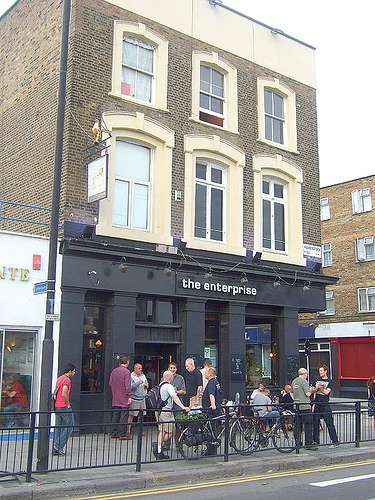
There are, of course, exceptions.  Read reviews of The Enterprise at Chalk Farm on sites like fancyapint, and punters love it’s old school indie atmosphere, eclectic mix of regulars, music and poetry nights and decent beer selection.

However, it appears the feeling is not mutual: the Enterprise really dislikes its customers.  BLTP alerted me to the front page of their website, which is, incredibly, an extended attack on the behaviour of punters at the bar.

This pub hates you and your custom.  Go away.

I worked behind a bar for four years.  I know people can be annoying after a few drinks.  But you know what?  It comes with the territory.  If punters behave in a way that really is abusive, unpleasant or unreasonable, you absolutely have the right to eject or even bar them.  But if it’s merely irritating, I’m afraid you just have to deal with it, or if interacting with people upsets you so much, get a job somewhere else.

No one likes an arse or someone who gets to the front of the queue and then spends five minutes deciding what they want.  But it seems the objectionable behaviour that so upsets the Enterprise staff includes asking for a full pint and making sure you’re given the correct change.  And as for trying to start up a conversation with the bar staff – how dare you!

Here it is in full:

A MESSAGE TO OUR CUSTOMERS:-

To all of our lovely patrons, to make life easier and more fun, when at the bar please do the following:

Be rude, whistle, click your fingers and shout when you want to be served. Don’t forget how blind we are…so wave that money!

Order one drink at a time-then pay separately

Get to the bar and forget what you ordered, then proceed to ask your 10 mates what they want again. We love to stand around and wait whilst you decide…Fosters or Kronenburg?

Complain about the music being too loud…then complain about the music being to low

If we say we don’t sell something, the chances are we are lying to you! So please keep asking for what we don’t sell (Stella please!)

If we can, we will always serve you a cold beer in a warm glass

There is nothing on Earth more attractive than a drunk man…so whip out those o-so-witty chat up lines…us girls love it

The bar staff get paid far too much money, so please do not tip us it is just insulting!

You are right! The head on that pint was far too big! Let me give you an extra pint for free because of our greed

We always like taking your money, but there is nothing better for us than you leaving your money on the bar in a puddle of beer…don’t forget to point at it, just in case we can not see it floating there

If paying on a debit or credit card, when it comes to putting your pin number in, ignore us and finish that conversation with the stranger next to you…or better go for a little walk. Its fun for us to find you

I’m sorry you were correct! That was a £20 note not a £10 note!

Please tell us when we close…I’m sure you deserve that last drink after time…why do we want to go home when we can serve you until you collapse!

Thank you for coming and we cannot wait to see all of your happy faces again soon

Love

The Enterprise

Maybe it’s a not serious, but an in-joke between the pub and its regulars.  Maybe I’m just not hip enough to see the warmth and deep but ironic levels of customer service and love that exude from the pub’s every pore.  Maybe when you go to the bar there’s lots of joshing and banter.  But I doubt it.  And if it is a joke, clearly no one’s told the hipsters of the Enterprise that jokes are meant to be funny.

I’m sure staff in most pubs in the UK need to occasionally vent their frustration and I fully support their right to do so.  But to do it in public like this – this is the home page of the pub’s website – is extraordinary.   BLTP summed it up perfectly when he sent the link to me: graceless.

So if you drink in Camden, please, please don’t drink in the Enterprise.  They clearly don’t want you there.  In these difficult times, there are many other pubs that would welcome your money.  Everyone will be happier.

| Uncategorised

Hops and Glory in Notting Hill

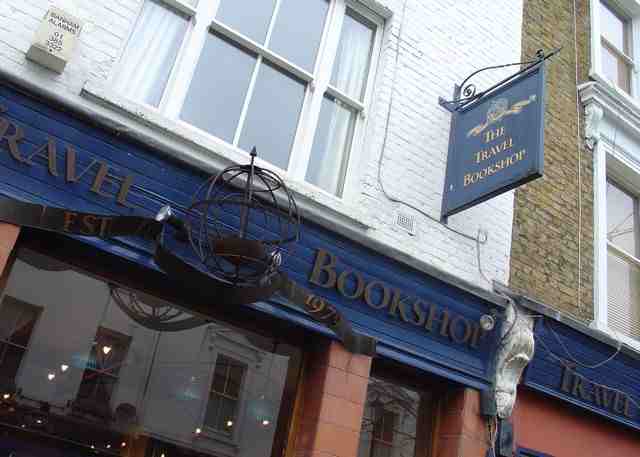
I’m doing a reading at the esteemed Travel Bookshop in Notting Hill, West London, tomorrow – Thursday 14th October.  Doors open, 6.30, we kick off at 7pm.

The talks I’ve been doing at festivals up and down the country have been getting bigger and bigger and selling out, which is deeply gratifying.  This is more intimate, and is the first one I’ve done in London for nearly a year.

As an added attraction, we have a couple of quite cool beers.  As the bookshop is on Fuller’s manor, I asked them if you would supply a couple of beers.  So we’re going to have Bengal Lancer to taste, and then, as we talk about how IPA aged, we’re going to illustrate this with the 2005 expression of Fuller’s Vintage Ale, which is drinking particularly well just now according to head brewer John Keeling.

All this for the measly price of £5!  Buy now from here (as I said, it’s an intimate venue) to avoid disappointment.

Hope to see you there.

| Uncategorised

What I did on my holidays

Post Cask Report launch, the Beer Widow and I took a much-needed week’s holiday and went to Majorca.

I’d heard that there were nice parts of it, that it wasn’t all Costa del Puke.  What I wasn’t expecting was for the vast majority of the island to be beautiful, with loads of fantastic historic towns and villages, with the seedier side of British and German holidaymaking confined to a few small strips of coastline.  It’s a wonderful place.

Beer
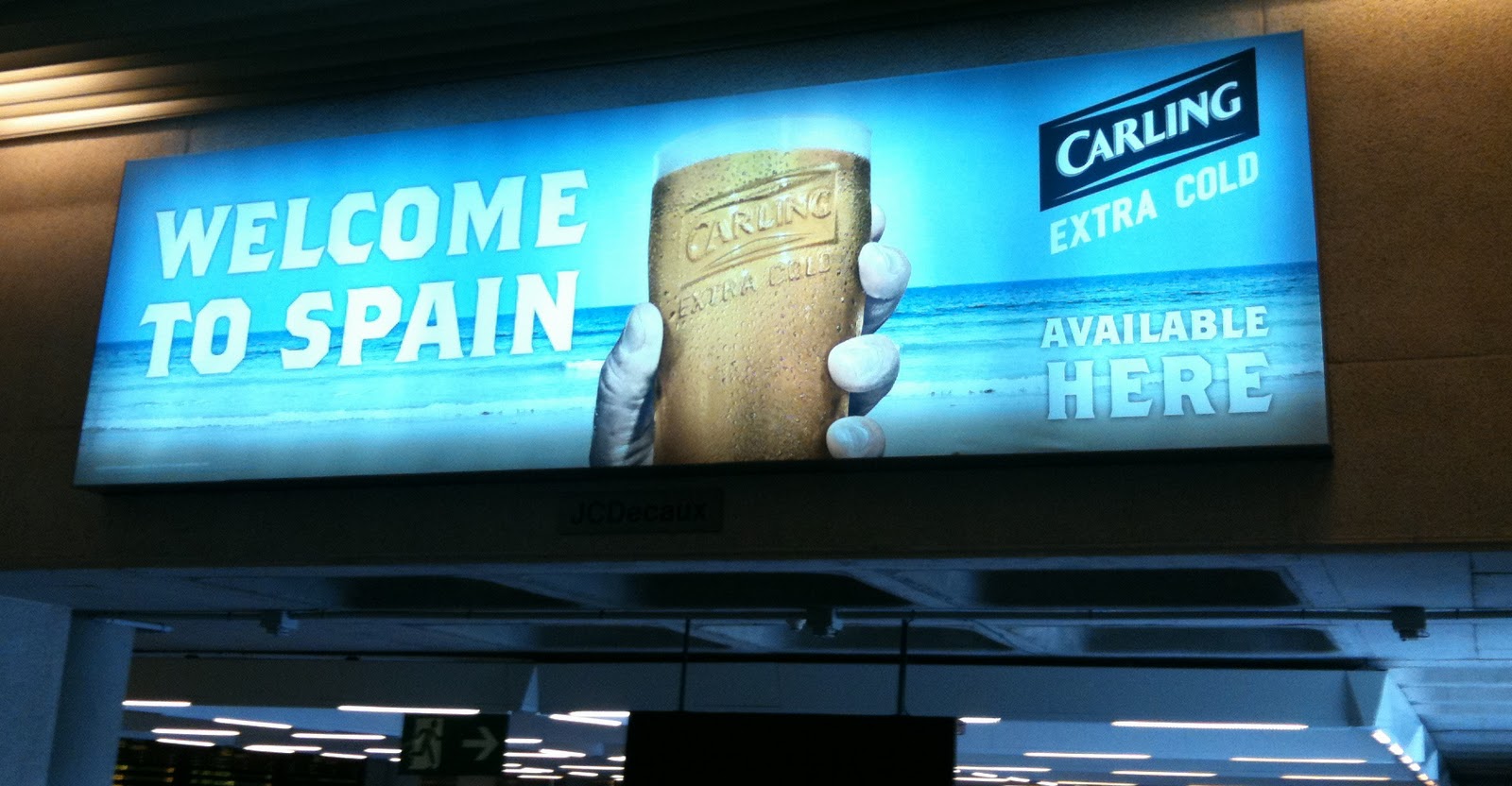
Admittedly it doesn’t start well, when this is what greets you even before passport control:

Oh.  Great. 
Spain has some great lagers.  They’re not finely structured Pilsners.  They don’t have a delicate nose of grassy, spicy Saaz hops.  But they come with a tight, creamy head, and they have flavour – a nice full-bodied sharp sweetness followed by a drying bitter finish.  There’s substance in the likes of Estrella and Cruzcampo.  They’re satisfying drinks.
We didn’t do much in Port de Pollensa.  We read books and sat on terraces along the unspoiled, pine tree-lined pathway along the bay shore, relaxing and gazing at sunsets like this one:
“Of course they were much better than this on board Europe you know.”
“Yes dear.”
Wary of the airport Carling ad, for the first few days I asked what the beer was whenever I ordered one, and it was always Estrella or Cruzcampo.  The latter soon emerged as my favourite, and we gravitated to the bars that served it.
And so I relaxed.  And I grew complacent.
On our fourth night we tried a new restaurant, and I just asked for a beer.  When it arrived in a Strongbow pint glass, an alarm bell started ringing in my head, but not quickly enough.  I took a mouthful of something that was thin and watery, and yet still managed to taste offensive – overly sweet and cloying, like watered down Cresta soda.  
“That’s Fosters,” I spluttered, to an eye-rolling Beer Widow.
The thing is, I can actually drink Carling.  If you haven’t yet had a beer that day, so your palate hasn’t yet been woken to the flavour profile it expects, Carling is merely bland.  It’s unremarkable but inoffensive, like a sense memory of a decent beer that you almost evoke, but not quite. Whereas Foster’s is one of those special beers that manages to be bland and actively taste foul at the same time.  I’ve never been able to understand how they do that.
But that wasn’t the worst part.
The worst part was that later, when I went inside to the loo.  I walked past the bar and saw that there were two draught beer fonts: Fosters (so I had identified it correctly – get me) and next to it, Cruzcampo.
My heart sank.  Because this meant that when I’d ordered my Cerveza with a heavy English accent, the waiter hadn’t even bothered to explain that there was a choice of beers, and ask me which I would like.  He’d simply heard my accent, and assumed that I would be a Foster’s drinker.  I was English.  Therefore I would want the shit, English beer rather than the halfway decent Spanish one.  He knew this.  He didn’t even have to ask.
When I wrote about Chodovar I wondered why we Brits actively choose to drink shit quality lager.  I pointed out that well made lagers were no more challenging or difficult to get into, no less fizzy or refreshing.  They were just nicer.  Now, more depressing than that, we actually insist on taking our inferior beer abroad with us, and drinking it when there is a much nicer beer waiting there for us.  I’m sure it costs more to buy Foster’s in Spain than Cruzcampo, and there’s simply no comparison between them.  Depressing.
Booze
To cheer myself up, we went to the offie.  I was hoping to find a decent Fino or Madeira.  I failed, but we found something much better – the two best spirits brands I’ve ever seen.
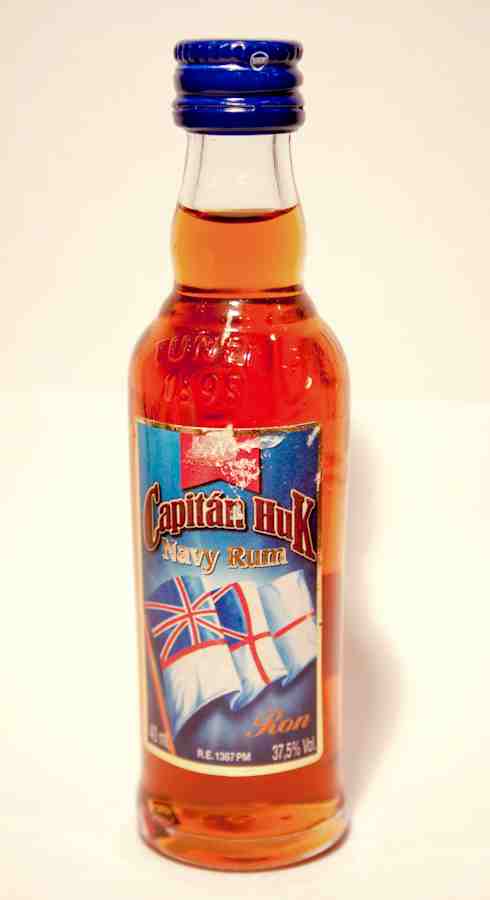
First up, here’s Capitan Huk rum:

I’ve no idea who makes this.  I’m guessing it’s not Diageo.
This is one of the best brands I have ever seen in my life.  I can imagine the meeting that gave birth to it. Translated from the Spanish, it went roughly as follows:
“OK, so we’re going to launch a rum. How should we brand it?”  
“Well, the history of rum is tied inextricably with the British navy.  If we’re going to sell this to holiday-making Brits, that would be a good association to evoke.  They’re always wearing England shirts and that, so if we create a sort of naval ensign flag that combines the Union Jack and the St George’s Cross we’re onto a winner!”
“Brilliant!  Let’s do it! So who shall we get to draw the label then?”
“How about my eight year old son?”
“Brilliant!  Does he know what the Union Jack looks like?”
“No.”
“OK, but given that we’re investing a sizeable amount of money in launching a new brand, should we at least perhaps give him some visual reference so he gets it at least partly accurate?”
“No, fuck it, I’ll just describe vaguely what a Union Jack looks like, and then invest several thousand Euros in printing up the first thing he comes up with.”
“OK, cool.  So what about a name?  Something English and naval…”
“How about Captain Hook?”
“Wasn’t he a pirate in a children’s story, and therefore both fictitious and absolutely nothing to do with the British navy?”
“Yes.”
“Ok, works for me.”
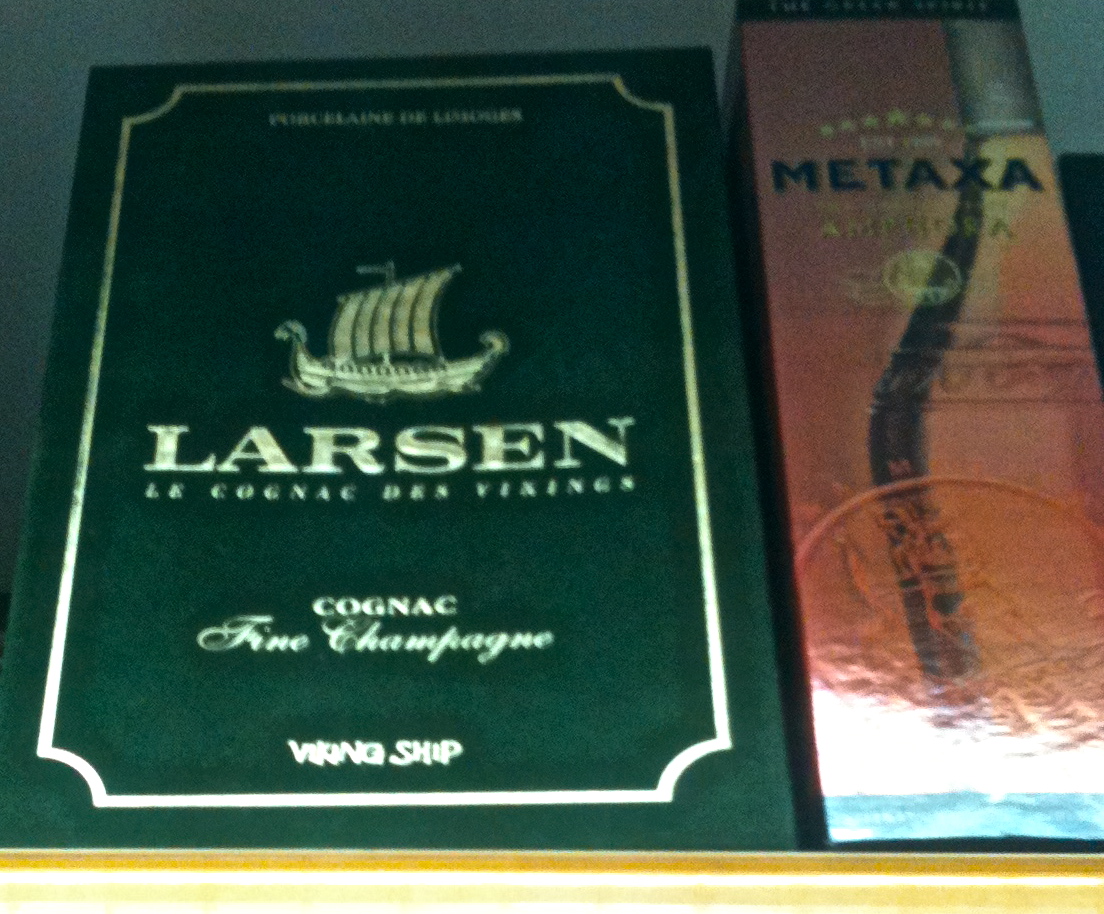
But Capitan Huk was not the best brand in that offie.  Oh no.  The best brand, high on the top shelf, out of reach without the use of a stepladder, was this muscular bad boy:
It says ‘Viking Ship’ on the bottom.  In case you don’t know what the drawing is.

LARSEN, the cognac of vikings.

The very concept of a ‘cognac of Vikings’ is wrong in so many different multi-layered ways, the person who dreamed it up can only be genius.

Every single part of the execution of that concept reinforces the original wrong-headedness of it.

The random inclusion of ‘fine champagne’ just to reinforce the quality cues.

Labelling it with ‘Viking Ship’ like a child would label his drawing.

‘Le Cognac des Vikings.’

I’m in mourning that I didn’t go out and get a stepladder and buy this, just so I could look at it every day when I needed to smile.

Sparkly hat
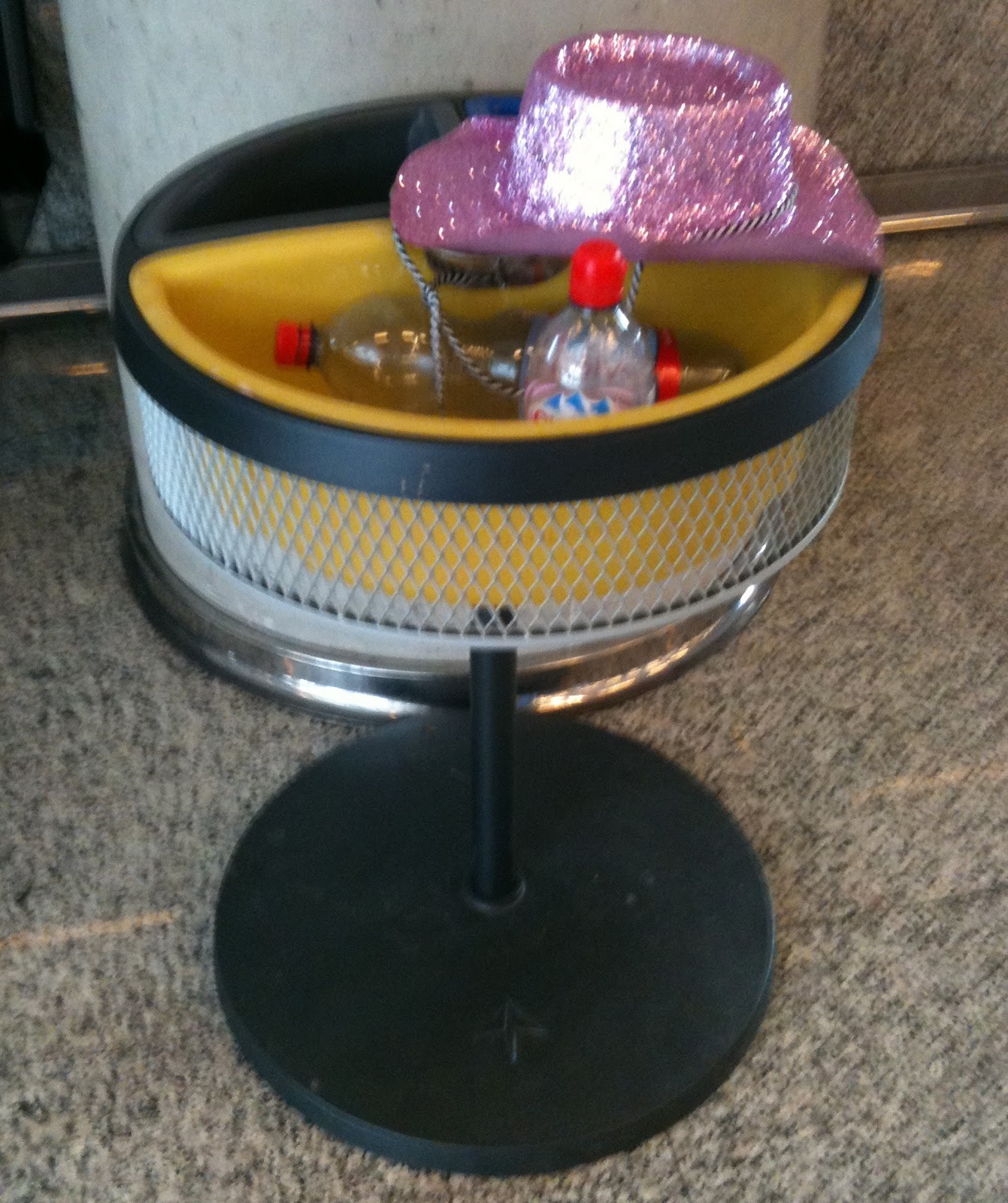
Anyway we had a great holiday, even if we did have to fly Ryanair.  At the airport on the way home we, along with a long, snaking queue of other budget holiday makers, used unstaffed check-in desks to weigh our bags and repack them to stay within the airline’s draconian baggage weight restrictions.  Here and there, items were discarded.  And in one waste bin, about half an hour’s queuing away from the one check-in desk Ryanair deigned to open, we saw this:

Majorca.

At some point, the glittery cowboy hat has replaced the Kiss-Me-Quick policewoman’s hat in British holidaymaking law, quickly and completely.  If a picture paints a thousand words, this one tells you the story of a thousand Mediterranean holidays, encapsulated perfectly.  The object itself.  The fact that it’s been discarded.  The fact that it was only discarded minutes before check-in.

Did its owner intend to take it home then change her mind? Or did it symbolise her holiday, and was she clinging to that holiday till the last possible second?

Did she think “Oh I can’t be arsed to take this on board now I think about it,” or did she think, “I can’t bear to part with you, and all that you represent.  But I must.  For tomorrow I have to go back up Tesco’s.”

The tanlines fade.  But the pint of Carling will always be there for us.

| Uncategorised

The Best Bit of the Job

(Catch-up post: this has been on my to do list for almost two months!)

It was the Brooklyn Chocolate Stout that did it.
I’d been waxing lyrical to Dominique, proprietor of Hardy’s Brasserie, and she was nodding and clearly starting to enjoy the beers I’d brought for her to taste.  Then, as I opened the Brooklyn Stout, I said something that was potentially very rash.
“This is a perfect dessert beer.  No, seriously, beers can match perfectly with dessert.  In fact – taste that, it’s gorgeous – in fact, you could just pour this beer over a scoop of vanilla ice cream and it would be wonderful.”
“No,” said Dominique, incredulously.  
“Yeah, seriously.”
“No.”
“Absolutely, I promise.”
“Ok then.”  And Dominique stood up suddenly.
At this point I remembered that she was a restaurateur.  And that we were having our conversation at a table just outside her restaurant.
Two minutes later, Dominique returned with a dish of home made vanilla ice cream.  I tried not to let my nervousness show as I poured the beer over it.
A minute after that, after the oohs and aahs, and mmmms, she simply said, “Right I’m convinced.  So how do we go about organising this beer and food matching dinner then?
Three weeks later, with a slight change of ingredient in a nod to an up-and-coming local brewer, ‘Stout poured over ice cream’ had become ‘Vanilla Ice Cream Affogato with Kernel Export Stout’ (you get to call it that when it’s a chef that pours the beer on the ice cream).  And it was one of six choices for dessert on a three course beer and food matching menu at Hardys Bar and Brasserie, Fitrovia, Central London.
There’s a good reason why portlier blokes should be wary of having their photos taken with slim, attractive women.  I actually look about twice as big here as I do in real life.
It’s always a pleasure talking to fellow fans of craft beer.  But it’s an even greater pleasure to convert new people to the delights of beer.  Once convinced, Dominique leapt into the world of beer appreciation with a dedication and professionalism that was inspiring to watch.  Within three weeks, the brasserie’s beer list had gone from Becks, Budvar, Kronenbourg and Hoegaarden to include Kernel porters, stouts and IPAs, Schiehallion, Westmalle, Brooklyn, Ola Dubh and many more.

And rather than stop there, having made the investment Dominique went to great lengths to make sure the evening was a success.  The restaurant was full to bursting on the night, mainly with curious foodies rather than beer fans.  I did a talk and beer tasting, signed a few books, then we sat down to the menu with beer recommendations worked out between us, ably assisted by Mike at Utobeer.

It was one of the best events I’ve been involved with.  Afterwards, Dominique said, “Hardy’s beer dinner was a great success! Pete’s talk and tutored tasting was the perfect combination of information and entertaining anecdotes. Our wine drinking regulars surprised themselves at how well the beer complemented the food. Particular highlights for us were The Kernel Pale Ale Centennial with the delicious Barbecued Ribs (recipe taken from Pete’s recommended BBQ bible) and the Duchesse de Bourgogne, a slightly sour red Belgian beer with Stilton. We are now trying to finalise a new interesting beer list and it’s a tough choice as my mind and palate have been opened to this vast, exciting new world. We are also thinking of offering a Christmas menu with beer matching.”

Since the dinner, the beer list has evolved and expanded.  I often say you can’t tell people about beer and food, you have to show them.  Hardy’s is certainly showing them now.  If you’re ever in London, check them out.

And thanks once again to Niki ‘The Flavour Thesaurus’ Segnit for making that auspicious first meeting happen.

| Uncategorised

What now?

I must be losing my touch.

This ad is obviously a few years old, but I only just became aware of its existence.

If you’re familiar with it and your reaction is “Oh keep up grandad”, I invite you to move along quickly.

If it’s new to you, however, this is a banned ad from the successful ‘no nonsense’ campaign that ran in the early noughties, when Peter Kay was fresh and interesting and when large ale brewers still made some kind of serious attempt to sell their beers.

Ah, those were the days…

| Uncategorised

October Wikio Rankings

Gosh, it’s that time of the month again, when beer bloggers get grouchy and irritable for a few days and I’ll just draw that analogy to a close before it gets going.

Here are the rankings for the month of September:

Wikio.co.uk Beer & Wine Ranking – October 2010

1 Pete Brown’s Blog (=)
2 Pencil & Spoon (=)
3 Brew Dog Blog (=)
4 The Pub Curmudgeon (=)
5 Woolpack Dave’s beer and stuff blog (+3)
6 Are You Tasting the Pith? (+1)
7 Tandleman’s Beer Blog (-1)
8 Beer Reviews (+1)
9 Called to the bar (-4)
10 Zythophile (+1)
11 Boak and Bailey’s Beer Blog (+1)
12 Brew Wales (+3)
13 The Beer Nut (-3)
14 Thornbridge Brewers’ Blog (+5)
15 Spittoon (-2)
16 I might have a glass of beer (Ent.)
17 Reluctant Scooper (-1)
18 Beer. Birra. Bier. (-4)
19 “It’s just the beer talking” – Jeff Pickthall’s Blog (+2)
20 Travels With Beer (-3)

Ranking made by Wikio.co.uk

No change up at the top then.  But look what’s happening overall: with the honourable exception of Spittoon (which to be fair looks like a very well put together blog about wine and food) the rest of the top 20 are now all beer blogs.

So momentous is this, Wikio has even started calling it the ‘beer and wine’ listing rather than ‘wine and beer’.

I wrote a section in the Cask Report about how the online beer community is actually helping drive the growth of craft brewing in the UK, spreading enthusiasm and knowledge, giving brewers a platform to showcase their beers.  With my marketing hat on, when you look at the twiss ups, meet the brewer events, V-blogs, promotions, beer swaps etc that are happening now, I think we’re seeing a new marketing model emerge, where consumers and manufacturers work together to promote the category.  Sure we can be inwards looking and cliquey at times, as any community can, but please, keep it up – this is brilliant.

And do let me know if you’d like to feature the exclusive rankings on your blog at any time.