Author: PeteBrown

| Uncategorised

Real Ale – Preference or Dogma?

“Are the beers dispensed by gravity or gas?”

When I previewed the opening of the Euston Tap, this was the first question I received on both my blog and Twitfeed.  It’s because the real ale taps come straight out of the wall rather than being from hand pumps on the bar.

And when I replied that they were served with gas, there was a supplemental question: “Does that mean air pressure or do they also use CO2?”

These questions are of no interest to the vast majority of craft beer drinkers.  But they are of fundamental importance to the Campaign for Real Ale.  And because CAMRA is the biggest and most influential consumer body in beer in the UK, that makes them important.

While I’m a champion of cask ale, I obviously love other beers as well – as I think do most drinkers.  But this is an issue that won’t go away, and the Tap has thrown it, for me, into sharp relief.

CAMRA as a body fight for real ale.  When it suits them they fight for other stuff as well, but let’s leave that to one side for now.  When it comes to British brewed craft beer, by their constitution they have to champion ‘real’ or cask conditioned ale.  Given that, it’s quite understandable that they need to have a pretty specific technical definition of what real ale is.  That means there are bound to be some beers that are pretty close to that definition, but fall outside it.

I can accept that.  What’s more bizarre is what happens to beers that do not qualify as real ale, and to the pubs that serve them.  If they are not real ale – even by a whisker – CAMRA cannot support them.  Pubs that start using cask breathers are promptly dropped from the Good Beer Guide.

I understand how they get here.  But I still think it’s bizarre.

I don’t know whether the beers in the Euston Tap are served with CO2 (i.e. cask breathers) or not.  But what if they were?

Let’s take Thornbridge Bracia.  Normally a bottled beer, it’s won numerous awards around the globe.  It’s breathtaking in its complexity, subtlety, structure and power.  Now it’s on cask at the Euston tap, and nowhere else.

Now, I know most CAMRA members join because they love great beer and by and large that’s what CAMRA’s about.  But let’s focus on the hardliners, the people who propose motions at AGMs, who campaign most actively, who write stuff like this on Cambridge CAMRA’s official website:

“The beer must remain untainted and utterly genuine. CAMRA have fought off all sorts of threats, some blatant, others more subtle and the image remains intact. The dishonest cask breather must not be allowed to corrupt CAMRA’s standards.”

If you agree with this, I would genuinely like to hear from you…

Let’s say I get you into the Euston Tap and place a pint of Bracia in front of you.  Would you demand to know about gas and cask breathers before you deigned to drink it?  If I told you it was served without cask breathers, and you drank it and enjoyed it, would you then change your mind about it if I said, “Actually I lied, it is served with cask breathers”?

What would you do if I said “Why not taste it and decide if it has a cask breather or not?” Given that the main argument against cask breathers is that they supposedly affect the taste (something every brewer I’ve spoken to denies), surely you’ll be able to tell whether it has a cask breather or not?  If you can’t, then what exactly is the problem?

Because this is the nub of the debate: the Campaign for Real Ale was founded from a genuine belief that cask ale tastes better than other beers.  Whether you agree with that or not, it’s an argument about the quality and delivery of the beer.  But it’s about your senses.  It’s about the beer.  If I give you a beer that doesn’t fit with your definition of cask, but is generally regarded as a flavourful, quality beer, you could:

  • Drink it and say, “Amazing – it’s not about cask or keg or cask breathers – it’s just about the taste of the beer.”
  • Drink it, and perhaps say something like, “Wow, I still prefer cask beers generally, but I’ll admit there are some pretty damn good beers that are not cask conditioned.”
  • Say, “If it’s not cask beer I refuse to drink it.  It must be rubbish.”

Most people I know would go with the first option.  I think the vast majority of CAMRA members would go for the second one.  But I have met people who do the third.

I once told the chairman of Edinburgh CAMRA I’d really enjoyed a pint of Harviestoun Bitter & Twisted in my hotel while visiting the city.  Because it was delivered to me at a table by a waiter, I had no idea whether it was cask or keg.  This man, who surely considers himself an expert on beer, was adamant that if it had been cask I must have enjoyed it, but if it was keg I couldn’t have.  He was telling me to ignore the evidence of my senses and instead focus on a technical aspect of beer dispense to decide whether my beer tasted nice or not.

Surely it’s meant to be about the taste of the beer.  Why else are we all here?  If you need to ask technical questions about methods of dispense before deciding if you like a beer or not, you are making your decisions based on dogma.  You are making a political decision rather than taste driven decision.  And I believe that means you’ve lost sight of what the whole Campaign for Real Ale was supposed to be about.

Some CAMRA people argue that things like cask breathers, and FastCask from Marston’s, are “the thin end of the wedge” – that if we accept this, we’ll see a gradual erosion of real ale until it doesn’t exist any more and, by stealth, CAMRA will have been defeated.

I think that’s a pretty paranoid argument.  And if I were being contentious, I’d also say “But if the quality of the beer doesn’t change, what’s the problem?”

CAMRA was established because beer most beer was shit.  A lot of beer still is.  But dogma, definition and politics mean that the most hardline CAMRA members often save their hostility for really good beers that simply don’t meet an over-specific technical definition.

If you’re one of these people, I know ranting and telling you you’re stupid isn’t going to change anything. But I believe craft beer bars like the Euston Tap demonstrate that the definition of quality craft beer has changed an awful lot since 1971.  I don’t think your hardline attitude does anything to help beer drinkers, CAMRA’s image and credibility, or even cask ale itself.

I’ve tried to outline the argument in reasonable terms, understand your position and specify why I think it’s wrong.  I’d be hugely grateful if you wanted to respond in kind.

| Uncategorised

The Book Tour That Wouldn’t Die

It’s deeply, deeply gratifying, but it seems that what began as a tour of readings and tastings to promote the release of Hops and Glory has become a semi-permanent, perpetual round of speaking and reading gigs.  That is so not a complaint – I love doing these events – I’m just surprised.

Anyway, this is just a short post to announce some events I’m doing between now and Christmas.  If I’m near you, please come along!

Tuesday 9th November (today!) – Fuller’s Brewery, 6.30pm
bengal Lancer on draught is this month’s seasonal from Fuller’s.  John Keeling will be giving a tutored tasting of the draught versus the bottled beer, and I’ll be telling the story of IPA, which is a lot more romantic but slightly less funny than the story behind the naming of the beer.

Friday 12th November – Westmorland CAMRA Beer Lovers’ Dinner, Kendal
Sold out

Saturday 13th November – Ulverston Brewery, Cumbria, 7.30pm
Exciting new Cumbrian brewery, already winning awards, Ulverston Brewing Company, The Old Auction Mart, Lightburn Road, Ulverston, Cumbria. Tickets from the brewery shop, 11am – 3pm, Mon – Sat.

Sunday 28th November – Amber Ales Brewery Tap – The Talbot Tap, Ripley, Derbyshire
This exciting new brewery loves hops and they’re having an IPA weekend, 25th-28th November, with a bunch of excellent different IPAs from around the UK and beyond.  I’m talking on Sunday at 3pm.  £6 ticket price includes a tasting flight of IPAs.

Sunday 5th December – Abergavenny Christmas Food and Drink Fayre
Not really book-related, I’ll be tasting Christmas beers and doing a bit of food pairing.  Ticket details will be on the website soon.

Thursday 16th December – The Greystones Pub, Sheffield, 7.30pm
The latest acquisition by Thornbridge, a pub in an affluent part of Sheffield that may well be Richard Hawley’s new local.  I’ll be tasting Thorndbridge beers and talking about the book.

See you there!

| Uncategorised

Exclusive: the Euston Tap: A Sneak Preview

When the Sheffield Tap opened almost a year ago, I wrote that it was almost worth getting the train to Sheffield just to sit and have a drink in the station.  Since then, I have done just that.  But now there’s no need: the team behind this wonderful craft beer bar – one of the best in the country – have now repeated their stunning success at Euston Station.
In an audacious and visionary move, Jamie Hawksworth and co – also responsible for the Pivo bar in York – have taken a lease on one of the iconic square Portland stone buildings flanking the front of the station, and made it the Euston Tap.  Yesterday, manager Yan Pilkington invited me for a look around.
London landmark becomes beery destination.
The builders – imported like the management from Sheffield – were still busy when I arrived.  A lobby into the bar area was being erected over the door, and Yan and Jamie were in the cellar struggling with the three pythons that will take the beer into the bar.  Said beer was standing on pallettes outside on the grass, and there was an awful lot of it.  I imagine the guys won’t be getting too much sleep between now and 6pm tomorrow,  Friday 5th November, when the place opens.
Signage will be subtle, to say the least
I love the ambition here.  And while it’s not finished, it already looks stunning.
It’s a small place, but not as small as you’d think if you walk past.  There’s standing room for around 65 downstairs, and then a spiral staircase leads to a second floor where a lounge area will seat up to around another 50.
When you walk in, the main bar itself – like the one in the Sheffield tap – takes your breath away.
Would you like a beer sir?

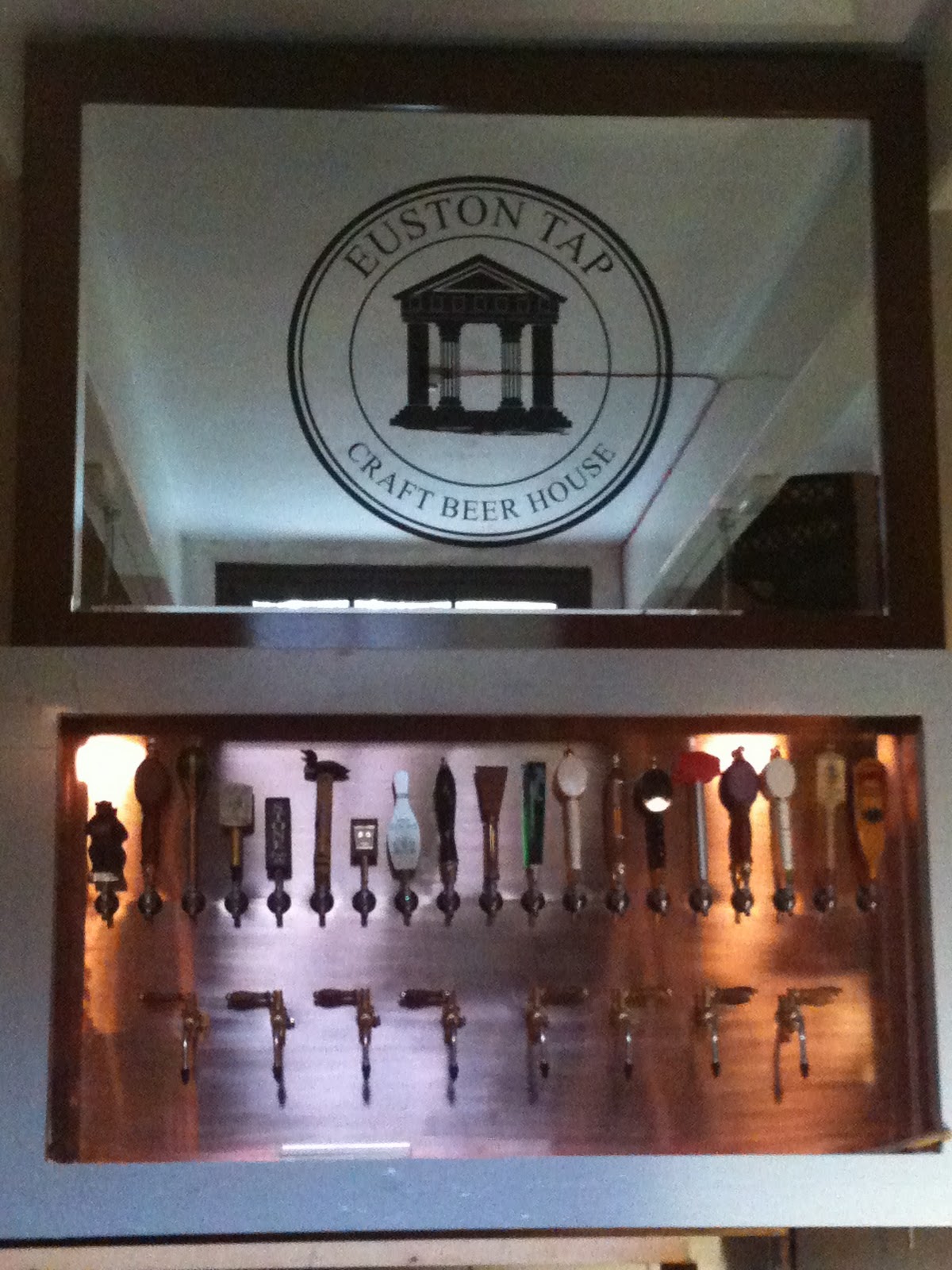
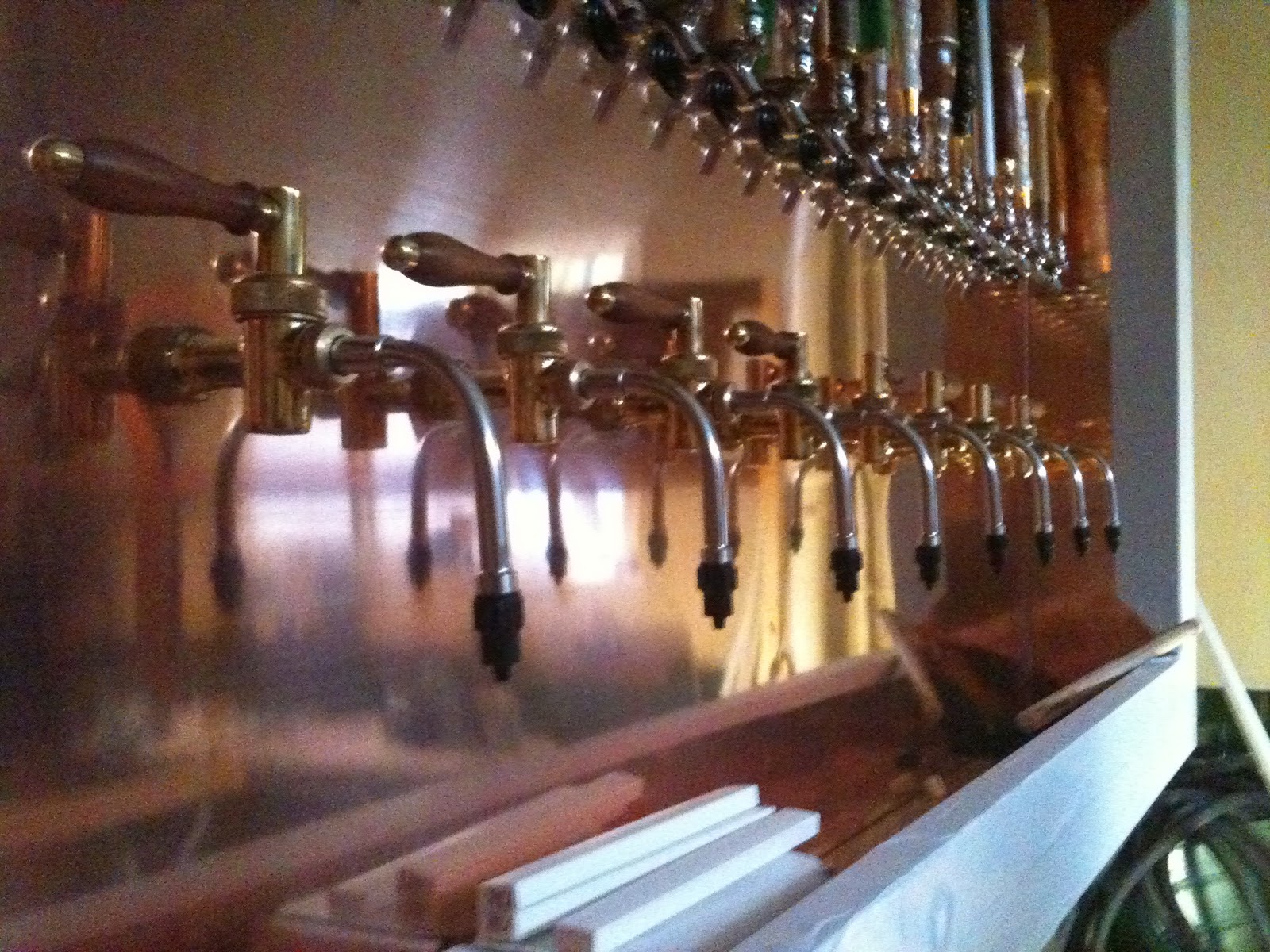
They’ve gone for the American craft beer bar style, with all the taps coming out of the back wall and nothing on the bar itself.  By opening time, this back bar will be flanked by two fridges, which you’ll be able to walk up to and inspect.

But the main stars are the draught beers.  Expect to encounter beers here that you will never see anywhere else.  The taps will be constantly rotating, and treats lined up for the first couple of months include cask Thornbridge Alliance and Bracia – outstanding, rare beers never seen on tap before – and Coalition, a collaborative brew with Dark Star that has been maturing for two years at Thornbridge.  One cask is coming here, the other is going to the Sheffield Tap, and the rest is going to be bottled – that’s how rare this beer is.  The cask beer selection will at all times include three beers from Thornbridge and three from Marble.
Eight cask ale taps, looking forward to the objections from dinosaurs
There are 19 quality keg beers.  I spotted Bernard’s wonderful unpastuerised lager, Matuska, a rising star from the Czech Republic that blew us beer writers away when we visited recently, Dogfish Head 90 Minute IPA, and Stone Pale Ale, to name but a few. In those fridges there’ll be 100 rotating bottles.  Currently these include 60 American craft beers, 30 German and ten from Danish cuckoo brewer Mikkeller.
You have never seen a craft beer selection like this anywhere else.  And Yan insists you won’t be paying through the nose for it either – cask ales start at £2.70.
There’s just one serious flaw.  This is a listed building, and the work that can be done to it is limited.  Which means there is one – ONE – toilet in the entire place, and it’s at the top of the spiral stairs. So remember to go before you get here.
   
If you’re a craft beer geek already, you will now be reading this already queuing outside the Tap for tomorrow’s opening.  If you’re not, I urge you to get to Euston as quickly as possible to sample some remarkable beers in what will be a wonderful atmosphere.  You’ll never make your train from Euston again.
See you there.

| Uncategorised

Wikio Wine and Beer Blog Rankings for October 2010

There hasn’t been much movement of late in the blog rankings.  I blogged a few months ago that it seemed to have gone a little stale.

Well, be careful what you wish for:

Wikio.co.uk  – November Wine and Beer Ranking

1 Boggle About Beer (+39)
2 Pencil & Spoon (=)
3 Brew Dog Blog (=)
4 Pete Brown’s Blog (-3)
5 Zythophile (+5)
6 Tandleman’s Beer Blog (+1)
7 Beer Reviews (+1)
8 The Pub Curmudgeon (-4)
9 Called to the bar (=)
10 Master Brewer at Adnams (+34)
11 Are You Tasting the Pith? (-5)
12 Woolpack Dave’s beer and stuff blog (-7)
13 The Beer Nut (=)
14 Rabid About Beer (+15)
15 Thornbridge Brewers’ Blog (-1)
16 Boak and Bailey’s Beer Blog (-5)
17 Bibendum Wine (+37)
18 The Wine Conversation (+15)
19 Spittoon (-4)
20 Brew Wales (-8)

Wine and Beer

Ranking made by Wikio.co.uk

Congratulations, Boggle!  Up from number 40 to the top of the pile!  A very busy month from me does nothing to stop me sliding to my lowest ever position after nearly a year on top, and there’s all sorts of moving and shaking going on throughout the chart.  Sadly, Cooking Lager’s campaign to install Zak at the top of the chart also seems to have backfired, with Mr Avery slipping five places.

Call me arrogant if you like, but I did check with Wikio, they’ve been through the data very carefully and have confirmed that the rankings are correct.

Time to maybe check out some blogs you don’t normally read!

| Uncategorised

The MAIN reason Professor Nutt is bad for our health

There are many, many reasons to be angry, frustrated, or simply full of despair at former Drug Czar Professor David Nutt’s latest outburst claiming alcohol is more damaging than any other drug, including crack and heroin.

There’s the fact that many reputable news outlets chose yet again to illustrate the story with a picture of cask ale, the least damaging, lowest alcohol drink on the market.

Or the fact that in many places Nutt was reported as ‘confirming’ or ‘revealing’ how damaging alcohol is, rather than ‘claiming’ alcohol to be more damaging – accepted as fact, rather than challenged in any way.

There’s the fact that Nutt has a serious conflict of interest which has gone uncommented on – that he is working with a team at Imperial College to develop a synthetic drug that gives a temporary alcohol buzz without the effects of drunkenness – something that will surely have a commercial application if trials are successful – meaning he has a personal, potentially profitable interest in undermining alcohol’s place in society – a fact that, at best, means his findings should be scrutinised rather than simply accepted.

There’s the fact that in the methodology of his study, the scores given to each drug are a combination of harm to the self and harm to others.  And when you break it down, even according to Nutt’s own research, ALCOHOL IS NOT THE MOST DAMAGING DRUG TO THE INDIVIDUAL.  The reason alcohol gets the highest overall score is because it is calculated to give by far the highest score for damage to others – which I’ll come on to in a sec.  But Nutt’s own research shows heroin, crack and methylamphetamine are more damaging to the user than alcohol.  This is determined by a combination of different factors, such as dependence, mortality etc.  Serious concerns have been raised regarding the relative weighting of these factors.   But never mind the fact that the methodology is flawed – even though the report DOES NOT CLAIM that alcohol is more harmful to the individual than any other drug, that’s exactly what has been reported.

The ‘harm to others’ bit is made up of scores given to various factors such as crime, injury, damage to the environment, cost to communities etc.  For many of these, there is no way of calculating them accurately.  Earlier this year I detailed serious doubts about the methodology of calculating economic cost, crime, cost to the health service, etc.  And where there is no data available, Nutt and his team simply MADE THE SCORE UP.  As the excellent Phil Mellows reveals this morning – these expert, scientific scores were determined not by months of research but by a one day workshop where they sat around and chatted, assigning scores as they saw fit.  Scientific? About as scientific as a bunch of blokes in a pub working out a top ten list of shaggable birds.

And Nutt’s previous writing on alcohol reveals a worrying lack of knowledge even about current alcohol policy.  In a recent ’21 point action plan’ to combat what he inaccurately refers to as an alcochol epidemic, this ‘expert’ on policy seemed unaware of the introduction of the mandatory code that limits promotions encouraging excessive drinking, and he repeated various ‘facts’ and figures that have been shown to be dubious. (My point-by-point response to his ill-informed action plan is comment number 44 beneath his post).  I don’t believe that, on the basis of the knowledge he displays here, Nutt is qualified to determine the cost of alcohol to society.   And then there’s the dodginess around weighting of different factors again.

Most obviously, Nutt doesn’t take into account the simple fact that alcohol is drunk by millions – of course it’s going to have a bigger impact.  But when over 80% of us drink within the government’s recommended guidelines, the simple fact – that is completely ignored here – is that the vast majority of people drinking alcohol do so without causing harm to themselves or others, and the same cannot be said of many other drugs calculated here.

So – of course – the entire thing is a load of bollocks that has been widely accepted as fact.  So far so predictable.

But here’s the main reason why I think this report is damaging:

I agree with what Nutt is trying to do.

When Nutt was sacked for saying alcohol was more harmful than LSD or cannabis, what he was actually trying to do was draw attention to the fact that government classification of drugs is completely out of whack with those drugs’ actual harmful effects.  He’s right.  The vast majority of ‘harm’ caused by illegal drugs is, in many cases, because of their illegality.  Heroin users contracting diseases through using shared needles.  Drug users turning to crime to fuel their habit.  Drug pushers forming organised international crime cartels.

Cannabis, used in moderation, isn’t harmful – just like alcohol.  And yet it’s illegal.  The number of deaths from ecstasy use is tiny compared to the proportion of people using it – and it could be argued they were at least partially due to lack of information, because the drug is illegal.  As Bill Hicks said memorably, no one ever took LSD and said “Let’s go and beat some people up”.  And despite popular myth, there has been no recorded case of someone jumping to their death because they were tripping and thought they could fly.  British aristocracy has a long history of heroin users living to a ripe old age because, although the drug is highly addictive, if you have access to a regular, clean supply, take it in the right doses, and you’re free to lie around doing nothing all day being really boring, and you have people to look after you, it doesn’t actually do you that much damage.

The only reason cannabis is illegal in America is because the hemp industry posed a serious threat to the dominance of the petrochemical industry in the 1920s, who were a very powerful lobbying force, which is why not just cannabis but any hemp product – even cloth – was made illegal. I’m paraphrasing, but read this excellent book for more details on the hypocrisies and inconsistencies of drugs policy.

Many people working with addicts suggest the best way to deal with drugs is to legalise them.  Schemes where drugs have been made readily available to users, in a controlled environment, have consistently shown huge success in getting people off those drugs.

Policy on drugs is driven by political ambition, expediency, and commercial lobbying interests far more than it has anything to do with damage to the individual or society.  On that I’m sure David Nutt and I would agree 100%.  But because he’s an unashamed publicity seeker, every time he tries to make this point he does so by attacking alcohol in a way that is at best distorted, and at worst deliberately inaccurate.

That’s what makes me most mad.  Because if Nutt truly wants a sensible debate about the relative harm that drugs do, all he succeeds in achieving is giving ammunition to the neo-prohibitionists who would rather any intoxicating drug be banned outright.  Nutt’s approach is never going to make anyone say ‘Why isn’t cannabis or ecstasy legal?’  All he’s doing is encouraging people to be as stupid and wrong about alcohol as they are about other drugs.

And that’s why it is David Nutt who is causing huge damage to individuals and to society as a whole.

| Uncategorised

October Video Blog: Wales

It was a tough choice figuring out where to film this month – from being a virtual beer desert a few months ago, Wales is now bursting with great craft beers. I say Wales, but we only really did south Wales – and only really scratched the surface there.  Hopefully we can go back and do central and north Wales, and look at people like Waen and Purple Moose.

Each of these pubs was the kind of place you want to spend an entire day in.  We did also want to film in a Brain’s pub.  They’re a pretty glaring omission from a South Walean beer blog.  Unfortunately we were told we had to ask permission from head office to film in a Brain’s pub.  I attempted to get this permission by both phone and e-mail.  Two weeks later, I’m still waiting to hear back from them.  Shame.

Anyway – here goes…


Pete Brown’s British Beer Blog – October from Ian Hudson Films on Vimeo.

And after doing the ingredients of beer last month, this month Mr Amor shows us around his brewhouse.


Peter Amor’s Brewing Blog Ep2: The Brew House from Ian Hudson Films on Vimeo.

Hope you enjoy watching them.  If yiou do, please link to them if you can – we’re trying to maximise traffic so we can gain interest from other places to help get the message about British craft beer out to a broader audience.

Next month we’re in London, filming a London beer week at my local, the Jolly Butchers.

| Uncategorised

How risk aversion is choking big brewers

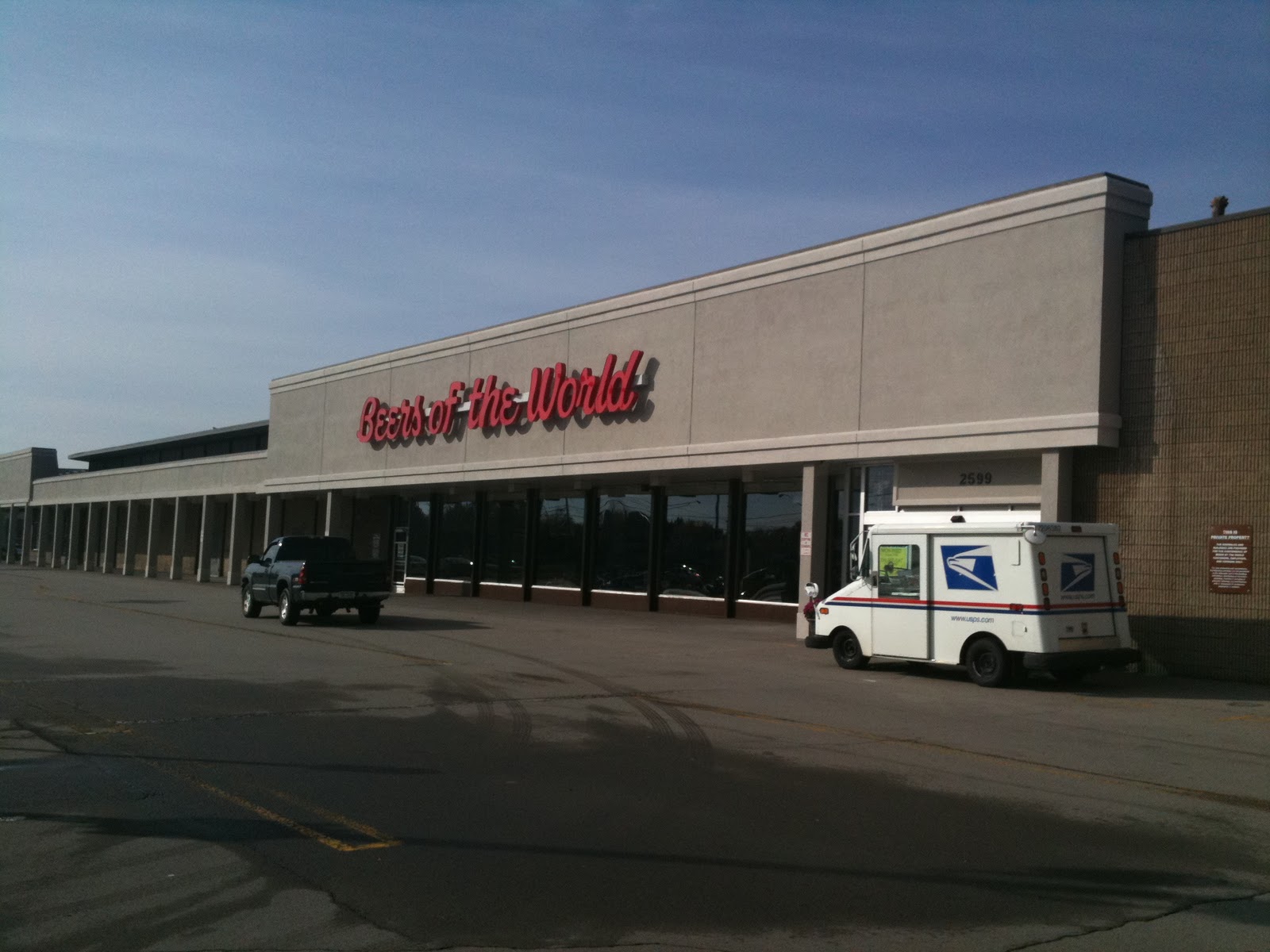
I’m in Rochester, New York.  Yesterday, we went to this shop:

This is a very big beer shop.

I’ll save the beer porn pictures for later, because there’s something else that cut through my gibbering excitement and imminent worry about weight limits on the flight home.

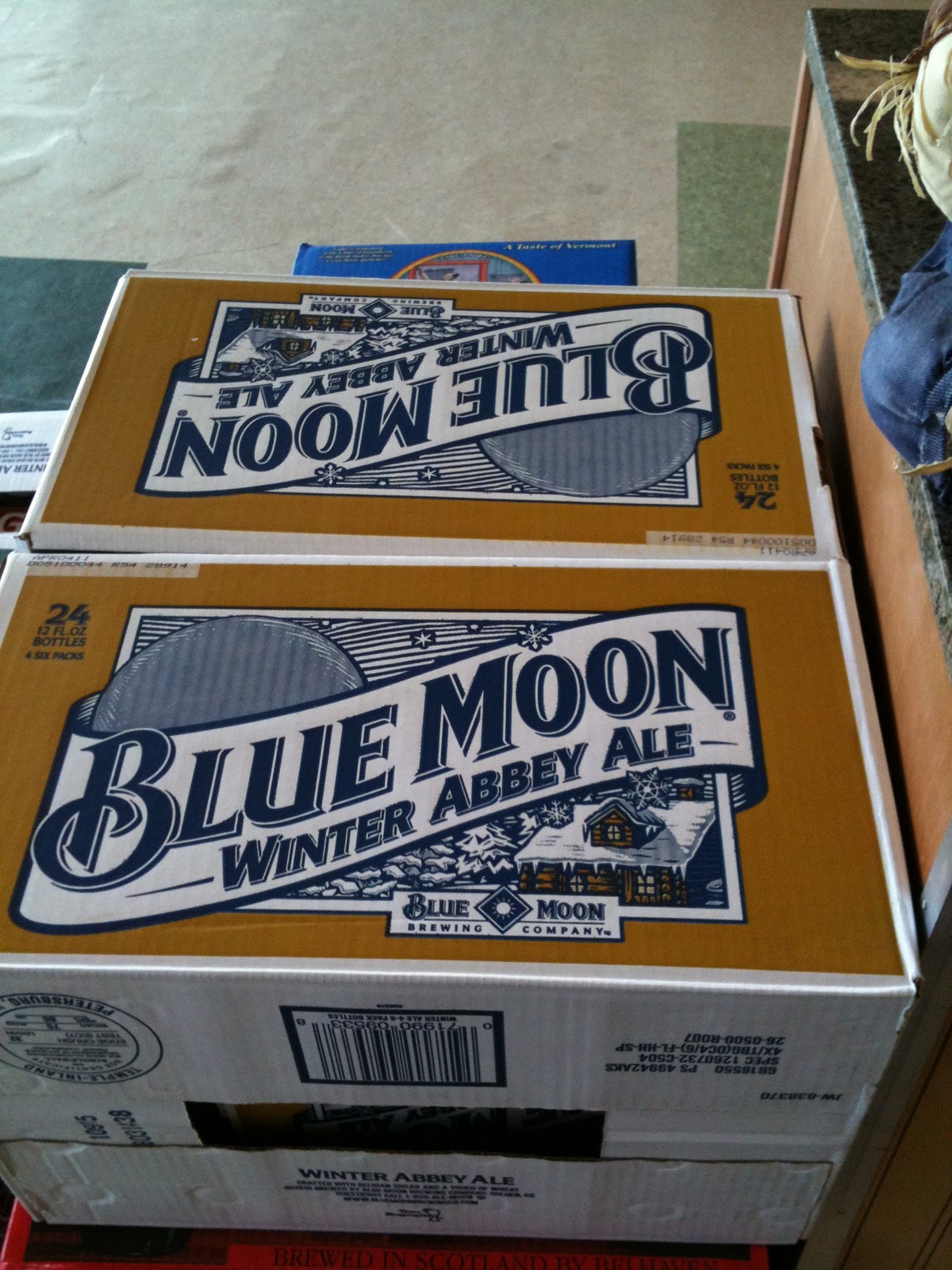
Blue Moon.  It’s not my favourite beer.  I find it too sweet, and the serve with a slice of orange a bit forced.  But I’m glad it has been launched in the UK.  I’m glad Molson Coors are at least showing recognition of the need to develop a craft beer portfolio if they want to prosper long term.  And I know various people who really do like the beer.

With my marketing hat on – and because there are people working on Blue Moon whom I count as good friends – I also know that the launch of Blue Moon has taken an awfully long time and cost a serious amount of money.  Not because they fucked up (they didn’t) but because that’s how big companies work.

In Beers of the World, they also stocked these:

Instantly, to my mind, Blue Moon becomes a much more interesting beer.  I’m curious about trying the range.  I don’t expect these beers to blow my socks off, but now we have a global brewer launching a series of seasonal beers and I think ‘Yay, they’re finally getting it!’

So given that these beers have already been manufactured, tested and distributed, why don’t we see them in the UK?

I may be completely wrong (and if I am, I’m certain to be told so in no uncertain terms very soon) but I think this is a perfect example of how the systems and processes of big brewers are stifling their creativity.  I’ve worked on ‘New Product Development’ (NPD) projects a hundred times.  These companies are risk averse – they actively reward caution.  A typical ‘critical path’ to even get to a regional test launch for a new brand is at least a year long and costs hundreds of thousands of pounds.  There will be at least two sets of focus groups.  Both the ‘liquid’ and the brand positioning will be tested against various target groups, both at concept stage and much closer to pre-launch.  Consumers will be asked their opinion on everything, down to the shade of orange on the box.  At each significant juncture there will be a ‘gate’ where the team responsible has to present to the board or whoever, to convince them not to even launch the thing, but just that it’s worthwhile proceeding to the next stage of research and development.

I’ve maybe worked on eight or nine different new beer launches for big brewers in the last few years.  I think one of them saw the light of day – and despite all that investment and caution, it failed.

Look – here are the beers, sitting unsold in a big beer shop in North America.  What’s stopping some bright, beer loving person at Molson Coors (there are plenty of them) simply saying, why don’t we ship a palette of each one over to the UK, stick ’em in places like the Rake, the White Horse, North Bar, go down there and chat to punters and see how they go down?

That’s what a micro brewer would do.  That’s what the likes of James Clay are doing with brands like Saranac, Flying Dog, Stone and Goose Island.  You might take a bath on one shipment.  But you’ll probably make it up on the others.

Multinational brewers in theory have an infrastructure that would make this very easy.  But it’s too much of a risk.  It has to go through the system.  I’ve no idea if Molson Coors are looking at bringing these seasonals to the UK, but if they are, it’s going to take a lot of research, a lot of time.

I’ve only singled Molson Coors out because it’s their beers I saw in the shop yesterday.  But all the big boys operate like this – it’s a general criticism.  And it’s not a criticism of the people who are genuinely passionate about beer in these organisations, it’s a criticism of the systems and processes that stifle them.  I’ve worked with many of their competitors and found them all the same.  Great for me, because it can mean up to several months of lucrative and much-needed freelance work.  Bad for them, because at the very least, the market will have moved on and developed between saying ‘let’s look at launching brand x’ and actually getting the product into pubs and bars.

Come on, Big Guys.  Take a chance.  Live a little.  Every single marketing text book I’ve read by gurus like Tom Peters urges businesses to embrace risk.  Brew Dog are at the other extreme – some of what they do is unspeakably bad, but I always support their stance because if they didn’t have the attitude to risk that produces the stinkers, we’d never see the likes of Paradox or 5am Saint either.  It nets out pretty positive in the end.  You don’t have to go as far as they do.  But really, what’s the worst that could happen?

| Uncategorised

Mainstream lager makes decent ad

Kronenbourg’s advertising strategy has, over the years, always seemed a little lost to me – like the brand doesn’t really know what it wants to be.   It’s arty – or maybe not.  It’s French – OK, but does anyone care?  It’s got small bubbles in it – oh, puh-leease.

The new campaign launches this weekend, and it’s based on the idea of slowing things down.  I’m not yet convinced by this as a strategy for a mainstream premium lager – it feels more like ale or stout territory.  But as this is what I used to do for a living, I can take a decent stab at post-rationalising how they got here.

They’re not talking to bitter or stout drinkers but to people who almost always drink lager.  Lager has become commoditised, boring, indifferent an interchangeable.  It has a loutish image.  Kronenbourg is positioning itself as a more thoughtful, grown up brand.  Its French heritage allows it to do this, because French cafe culture is slower and more laid back than British pub culture.  How am I doing, BBH guys?  I’ve almost convinced myself here.

So, on to the ad itself:

French face culture is slower – just look at the effect it’s had on Lemmy (who, famously, was recently told that he had to slow down by doctors, now he’s in his sixties and suffering from illness.  His manager famously said, ‘He is slowing down – he now takes ice in his Jack Daniels’.)

The fact that Ace of Spades is a classic song and actually works well as a blues number stops the ad from becoming a cheap, one-shot joke, and the docu-realism of the way it’s shot means it cleverly navigates the thorny issue of doing slow, mellow and mature in a way that’s stylish and contemporary.

And there’s a longer, showreel version of it here:

I’m almost there on the strategy of Kronenbourg doing slow, but not quite.  But never mind that – the ad itself shows there are still great things that beer advertising can do, and I think it will be successful.

The track will soon be available to download.  You can follow the campaign on Twitter http://twitter.com/K1664slow , where they’re asking people to help pull together the ultimate slowed down playlist.

| Uncategorised

New York Dive Bar Drinking

This city is like an abscess that I can’t stop poking.  It makes London look like Somerset.

After Jay-Z and Alicia Keys’ Empire State of Mind and Paloma Faith’s New York, and of course the big daddy (why is that phrase sticking in my head?) New York New York,  I’ve been wondering why people write so many songs about NYC when no one does anything similar for London.  Sure, there are songs about London, songs set in London, songs that are of London, but no direct hymns of praise to the city like those NYC regularly gathers.  It’s simply more impressive.  (Waterloo Sunset may be one of the best songs ever, but even it addresses London obliquely).

Stop to look around you at New York’s awesomness though, and you’re likely to be knocked into the road by someone who cannot stop or slow down and WILL NOT change their straight course down the pavement for anyone or anything.  I blame all the coffee: at 10pm, the Starbucks queues are almost out of the door, and there’s one on almost every corner.

There are no people on bikes here.  Clearly that would be instant suicide, even for London’s most hardy don’t-give-a-shit weavers and pavement riders.  And there are no grocery stores – there’s no Tesco Metro grab something to cook on the way home culture here.  Even shops that call themselves delicatessens don’t sell fresh bread, fruit or vegetables.  What I thought was a clever move renting a self-catering apartment now starts to look flawed.

It’s Friday night in Manhattan.  I’ve been in town for six hours.  I only had four hours sleep last night and my body clock is now suggesting it’s 2am, but I need to stay awake for a couple more hours to try and beat the jet lag, so I look for a bar.  I know where the craft beer bars are, but when I start trying to walk there from my aparthotel in the garment district I realise my legs won’t carry me more than a few blocks, so I look for somewhere closer to home. There were scores of Irish bars around here when I looked earlier, but now I can’t find any.

And then, on West 44th Street just off Times Square, I come up trumps.

I’m not sure whether I should tell you about this place, but if you’re around NYC it’s probably already old news to you, and if you’re not, well hopefully you’ll fuhgedaboudit before you’re next here.

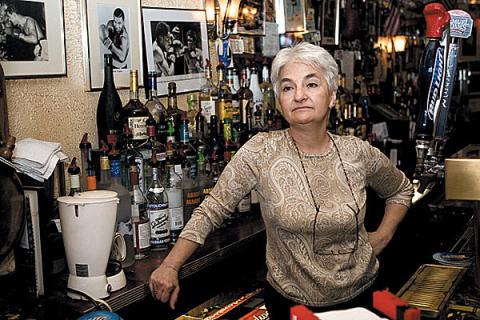
Jimmy’s Corner is about fifteen feet wide and every surface is crammed with framed photos of boxers.  It stretches back into a neon fairy-lit, jumbled haze for about sixty yards or so, but there’s one spare stool at the bar so I grab it.  This is no Irish theme bar, no tourist destination.  It’s what locals call a dive bar, but we use that word differently in the UK.  A British dive is run by someone who doesn’t give a shit, makes no effort, just sells bad drink to people who need it.  This ‘dive’ may be shabby, but love and tradition are worn into every part of it, layers deep.  The mirrors behind the bar are almost covered in autographed dollar bills.  The bar top consists or laminated photographs of Jimmy (if it’s him) and other bar staff meeting boxers, celebrities such as Paul McCartney, and a generous smattering of topless women.  Simple A4 signs, posted at regular intervals along the bar, read LET’S NOT DISCUSS POLITICS HERE.  There’s a signed photo of someone out of The Sopranos.

The first pint of Sam Adams lager goes down without touching the sides.

I nicked this fantastic photo of Jimmy’s Corner from the Time Out New York website.  I hope no one minds, because I daren’t take a photo myself.  As this was the woman who served me, I think you can see why.

Everyone here is watching the baseball game.  Greying, careworn men with New York Italian or New York Irish accents order beers and tequilas, roar at the screen and argue over the rules.  The New York Yankees are playing the Texas Rangers and have to win this game to stay in the series, or cup, or whatever it is.  I order a second pint and watch, uncomprehending, as A-Rod hits what I would call a six and yet the score doesn’t change – still 1-0 to Texas.  I watch for an hour, and the score gets to 1-1, and stays there.

I love this place.  It’s not about the beer (although Sam Adams seems to be a regular fixture next to Bud, Bud Light and Rolling Rock in pretty much any New York bar now.  And if you’re about to comment that ‘yeah well, Sam Adams isn’t really a craft beer now it’s just as bad as Bud and anyway there are way better beers to try in the US such as x, y and z,’ then congratulations on missing the point so impressively).  It’s about finding pubs or bars that just have that feeling.  This is the kind of place you’d return to night after night, eager to establish a quiet routine, because it just feels like the kind of place you want to be.

Later, I’ll Google it: apparently Jimmy Glenn was a boxing trainer who met Ali.  The walls are lined with his personal effects, and he still works here.  Despite its location, they reckon tourists accoutn for only 5% of custom.

But for now, I’m too tired to read or write any more.  It’s 3am London time, which means I’ve been awake for 21 hours after only four hours sleep the night before.  I think if I go to bed now, I’ll sleep through.

I get to my room ten minutes later.  I check the game: 5-1 to Texas.  I have no idea how this is possible.

G’night.