Author: PeteBrown

| Uncategorised

Exclusive… the Christmas number one

It may still be three weeks away, but Christmas is already here in our hearts. People are recommending Hops and Glory as the ideal gift, and I didn’t even pay them to. Twitter is alive with the sound of people debating the best Christmas beer.
And our thoughts turn to who is going to be Christmas number one.
It’s always a contentious issue. It carries more weight than the number one at any other time of the year – not commercially perhaps, but symbolically.
And this year, I have the preview on who it is.
At this stage I should point out that I’m not talking about the pop charts. No one gives a shit about that any more. The drama has gone out of it. It’s all been downhill since Jonah Lewie.
No, I’m talking about the new obsession, the all-important wikio rankings.
I may have given the impression over recent weeks that I’m quite obsessed by wikio rankings. If you believe that, you fell for my irony-laden trap. I don’t care. Honestly I don’t. Not about my position personally.
The only reason I’m writing about them now is that wikio ask a different blogger each month to reveal the latest monthly rankings in advance of official publication. This month, they asked me again. So I’m in a position to tell you who is the number one beer and/or wine blogger over Christmas, with no jealousy or bitterness whatsoever.
And so… *drumroll* step forward Brew Dog. You are the blogging world’s Cliff Richard.

1 Brew Dog Blog (=)
2 Pete Brown’s Blog (=)
3 Pencil & Spoon (=)
4 Tandleman’s Beer Blog (+2)
5 The Pub Curmudgeon (-1)
6 Woolpack Dave’s beer and stuff blog (-1)
7 Spittoon (+1)
8 The Beer Nut (-1)
9 Jamie goode’s wine blog (+6)
10 Stonch’s Beer Blog (=)
11 The Wine Conversation (+3)
12 The Bitten Bullet (+1)
13 Bibendum Wine (-2)
14 Reluctant Scooper (+3)
15 Real Ale Reviews (+3)
16 Brew Wales (-7)
17 Called to the bar (-5)
18 Taking the beard out of beer! (+7)
19 Tyson’s Beer Blog (+3)
20 Impy Malting (-4)

Ranking by Wikio

| Uncategorised

ARE LESBIANS HAVING SEX WITH THE MEMORY OF DIANA?

Carol Vorderman getting pissed up and going completely fucking apeshit, making our town centres no go areas for normal people, earlier today. At least, that’s what she would be doing if the story she is promoting was actually true.
The above headline, created by an online Daily Mail random headline generator, has finally been trumped by the real thing. Today’s Mail carries a story headlined ‘Average Briton drinks 84 times their bodyweight in alcohol‘.

But that’s not the best bit. The best bit is:
Soaring levels of binge drinking mean that many Britons drink an average of 3.7 pints of beer, or 8.5 large glasses of wine, each week.

That’s right. Half a pint of beer a day is now binge drinking on Planet Hate.
In the real world, this equates to 12.5% of the government’s approved definition of binge drinking.
The article goes on to say that if we’re not careful, we might consume a shocking 1000 calories a week through drink. If we do no exercise at all, this somehow means that this amount (which in the real world equates to 5.7% of an average adult male’s weekly calorific intake) will make us put on an extra pound every 3.5 weeks. No idea how that gets worked out with no reference whatsoever to the other 94.3% of the recommended calorific intake. Or what point they’re trying to make.
The article also repeats the lies about soaring alcohol consumption and ‘soaring levels of binge drinking’ in the UK, which the government’s own figures – along with those of every body that studies this area using proper research techniques – explicitly contradict.
The headline is factually incorrect too – it refers to 11,800 pints over 60 years – which are on average between 3.5 and 5% alcohol. Yet states – or implies – it’s referring to pure alcohol. Apart from being wrong, it’s meaningless. Any liquid the consistency of water weighs pretty much the same. By point of comparison, it’s worth noting that a glass of orange juice every day would weigh exactly the same, but would contain an additional 438,000 calories over the 60 year period.
This horse poo is part of the launch of something called the ALculator by Lloyds Pharmacy, launched by Carol Bloody Vorderman. It’s just wrong, wrong, wrong. But people read it and believe it – just see the comments at the end of the piece. Please join in giving it the ridicule it deserves.
Next week: how real ale drinking homosexual asylum seekers are turning house prices gay.
The official definition of a binge is double the recommended daily unit limit – which is 3-4 for men. Half a pint of beer is one unit. The recommended calorific intake for an adult male is 2500 a day, or 17,500 a week. Half a pint of average beer contains 105 calories, whereas the same volume of orange juice contains 124.
UPDATE:
I posted some comments (which were not published) to the Mail’s website this afternoon, and posted this blog around 8ish. At 9.56pm the Mail story was amended. References to ‘soaring binge drinking’ have been removed. The link between 3.7 pints a week and binge drinking has been removed. The reference to increasing alcohol consumption has been removed. The statement that 1000 calories a week can lead to a weight gain has been removed. Basically, there’s no substance at all left to the story. It may not be my efforts or all those who retweeted links to this post that are responsible. It may be some of the comments that were printed below the story. But somebody, somewhere, has had an effect and these lies and distortions have been taken down. We CAN stop this nonsense being perpetrated.
Depressing thing: in the comments, more than one person has read this piece of Daily Mail scaremongering, disagreed with it, then blamed the distortion not on the Mail, but on New Labour – who had nothing whatsoever to do with the story! Brainwashing still works long term 🙁

| Uncategorised

Beer Tickers – A Loquacious Film Review

As a writer, there are many other writers I admire and appreciate.

Sometimes I just enjoy them, other times I’m deeply envious of them. I can savour the wonderful lyricism of, say, Arundhati Roy without even thinking about my writing because it’s so different from anything I would ever do. But one writer I wish I could simply be is George Orwell. I will never, in all my days, be one hundredth of the writer he was, but he shared many of my ideas and beliefs about the world at large and about how to write in particular.I quote him several times in Man Walks into a Pub because it’s a book I wish he had written before me. But then, he didn’t need to – being Orwell, he said everything worth saying about the pub in a short essay, The Moon Under Water. (Arguably the only truly unforgivable thing Wetherspoons have ever done is appropriate that name.) As a piece of writing it is simple perfection. If I’m feeling sentimental and it’s one of those evenings where I’ve made the fatal transition from beer to whisky, I can literally read it and weep.But I’m wandering off the point – something Orwell would never do. And going on too much. Ditto.The reason I brought up Orwell was that he also once wrote:We are a nation of flower-lovers, but also a nation of stamp-collectors, pigeon-fanciers, amateur carpenters, coupon-snippers, darts-players, crossword-puzzle fans. All the culture that is most truly native centres around things which even when they are communal are not official – the pub, the football match, the back garden, the fireside and the “nice cup of tea”… It is the liberty to have a home of your own, to do what you like in your spare time, to choose your own amusements instead of having them chosen for you from above.But one hobbyist Orwell never had the dubious pleasure of encountering was the beer ticker.Hobbyists today are nerdy, and the only areas it’s socially acceptable for blokes to be nerdy about are cars and football. If you can name every player in England’s unsuccessful 1970 World Cup side, or talk knowledgably about the engineering perfection of a Maserati, you’ll get admiring nods from other blokes, and even women will roll their eyes with an affectionate “ah, you guys” shrug.But thanks to the hoary CAMRA socks-and-sandals stereotype, claim an interest in beer and blokes and women alike will start to edge away and make excuses.It’s fascinating how contextual this stereotype is. For about two years now I’ve worn a beard and long hair. If I’m working in an ad agency, people think this makes me look cool – they simply assume I’m one of the creatives.But in the beer world, the exact same look is increasingly uncool – people tell me I’m “starting to look like a CAMRA member”. With CAMRA’s membership having doubled in the last ten years, the average CAMRA member increasingly looks no different from anyone else. But they don’t mean that. They mean I look like the stereotypical CAMRA member.The beer ticker. And whatever your views on that, it’s not meant as a compliment.Within the beer world, tickers are the people even the saddest geeks can look down on. Adult life is merely the school playground writ large, and tickers are the snivelling, emphysemic, half-blind larvae that the most bullied kids in the school – the fat kids and the ones with sellotaped national health glasses and Oxfam clothes – turn on with joy when they realise there is in fact someone one rung below them. We all recognize that part of our interest in beer is driven by a nerdish tendency, and that’s not something we like in ourselves. And when we find that someone is inarguably more nerdish than we, they become an outlet for all the pisstaking and antipathy we’ve ever received. It was the tickers those people were suspicious of, or bored of, or regarded with pity and condescension – not us. We merely channel their disdain to its rightful target.Except now someone has gone and made a film about them.Surely that’s just not fair. It should be a film about the broader appreciation of beer. It should be a film about how great beer is and why more people should take an interest in it. Surely if you focus on the tickers no one will go and see it? And those who do will simply have their prejudices about beer nerds reinforced?The thing is, if you’re a filmmaker who’s keen to shine a light on little-known, entertaining and intriguing corners of the British psyche, tickers are – say it – pretty interesting.Phil Parkin is an independent filmmaker who lives in Sheffield. One day he was drinking in the wonderful Hillsborough Hotel. There’s a brewery in the cellar, where the phenomenally talented and hugely underrated brewer Stuart Ross pretty much does as he pleases and makes it up as he goes along, continually creating new beers. And every week, the tickers descend. Sheffield competes with Derby for the title of ticker centre of the universe – some of the biggest names in ticking are regulars at the Hillsborough and the nearby Fat Cat and Kelham Island Tavern. As soon as Phil had asked what they were doing and had it explained to him, he had his next project.Phil’s method of filmmaking is what social anthropologists call ‘participant observation’. He lived among them, like that woman out of Gorillas in the Mist, becoming accepted by the tribe.What emerges is a warm, funny, and amazingly non-judgmental portrait of a hobby Orwell would have been quite proud of – perhaps even indulged in. The principles are explained with disarming simplicity ‘you find a beer, you drink it, you tick it’. What could be easier?And rather than coming across as unbearable nerds, the characters do make fascinating viewing. Mick the Tick – the man who allegedly invented the hobby and gave it its name thanks to its easy alliteration – is a deeply likeable character, like a cuddly, benign bear. The Beer Widow has a special designation for people she has fallen in love with and wants to protect from the world and care for. She talks about keeping them in a special luxurious room in the cellar wrapped in cotton wool and feeding them biscuits and soup. So far we’ve got Bill Bailey, the band Lamb, and psychologist and thinker Eckhart Tolle down there. Mick the Tick is the latest recruit.Dave Unpronouncable is deeply fascinating – a natural in front of the camera, articulate, intelligent and surprisingly normal looking – at least for the first half of the film – but there are clearly kinks and complications to his character.There’s a story going on with him through the making of the film that we never quite get to the bottom of.Brian the Champ – the king of the tickers – is probably the closest to what we would imagine a ticker to be, but he has a wife who indulges him and a pleasant suburban house, and you share his excitement as he sets off for the Great British Beer Festival to mark a momentous tick in his book.I have to declare an interest in that I met Phil several times while the film was being made, and he’s become a mate. I provided him with a lot of the historical context, and pop up in the film showing him round the Museum in Burton.One time we met in the Rake, and he seemed to be taking a long time sending a text message. I became suspicious.“You’re ticking aren’t you? You’ve gone native. You’ve become one of them.” This was ticking 2.0, ticking invisibly, with minimal risk of losing your social status.This brings me to my only criticism of the film – the definition of its narrative. Phil spends as much time in front of the camera as behind it, and very charming he is too. The film is his personal journey into the world of ticking (which I was fortunate to witness). That’s a great construct, but the arc of Phil’s journey doesn’t quite make it on film. It’s as if he can’t really decide whether this is a story about him or about the tickers he meets. There’s no real exploration of his motivation for doing it, or what he was trying to discover or prove, other than that it’s a great topic to make a film about.But as I said to Phil after watching an early cut – it made me thirsty, and it made me want to spend more time in Sheffield, and it made me proud of my involvement in the beer world. And it made me think differently about tickers. I won’t be starting any time soon – despite the fact that, apparently, I’m starting to look like one – but the tickers featured in this film at least are not the Aspergers stereotypes other beer enthusiasts enjoy looking down on.You can find out more about the film and watch a trailer here. I’m not sure whether or not it will recruit more people to the cause of great beer, and some will see it as a missed opportunity for that. But that’s not what it’s about. It’s not about beer – not really – it’s about people. And in that respect, it is a very successful film indeed. And anyway – it’s got a bright, young, ambitious filmmaker all passionate about the beer world. Who knows what he’ll do next?There’s a public screening of the film at the Showroom in Sheffield at 8pm on 15th December. Tickets are available through the Showroom box office.

| Uncategorised

The Great Christmas Beer Hunt

I could rant about this but I’m not in a ranty mood, so instead I’ll make a simple plea:

Around this time if year newspapers and magazines are full of festive food and drink coverage. Publications like Sainsburys Magazine tell you where to get your ‘wine and fizz’ for Christmas as if no other drinks exist. Observer Food Monthly lists “Forty Festive Wines’ without telling you why any of them are more suitable for Christmas than any other time of year, without giving any food matching tips or anything.
And as every year, there are countless Christmas and winter ales being produced by brewers across the country and the world, and they’re getting no coverage at all.
It just doesn’t make sense. Our foodie culture is rightly getting more interested in seasonal produce. Beer is emphatically seasonal. You’d think it would be a no-brainer for any food and drink coverage. But as far as I can see – nothing.
So my plea is this. If you see any newspaper or magazine coverage of winter/Christmas beers, can you let me know where and when you saw it?
Cheers.

| Uncategorised

Brew Dog creates world’s strongest beer – can we talk about the beer?

Slag ’em or praise ’em, you just can’t stop talking about ’em.

But it’s nice to be able to talk about Brew Dog for the right reasons again. Today, the brewery announces the launch of Tactical Nuclear Penguin – at 32%, the strongest beer on the planet, beating previous record holder Sam Adams Utopias by 7%.
The boys – slightly chastened by the whole Portman farrago a few weeks ago – assure me that this launch is all about the beer. Doubtless there will be headlines about how irresponsible it is to brew a beer at this strength, and the whole presentation of the launch will be edgy and controversial (without explicitly baiting the Portman Group, thankfully)because that’s who they are – that is the Brew Dog brand.
But the press release proves Brew Dog have learned that you can do edgy and at the same time still promote a responsible drinking message. I love this:
Beer has a terrible reputation in Britain, it’s ignorant to assume that a beer can’t be enjoyed responsibly like a nice dram or a glass of fine wine. A beer like Tactical Nuclear Penguin should be enjoyed in spirit sized measures. It pairs fantastically with vanilla bean white chocolate it really brings out the complexity of the beer and complements the powerful, smoky and cocoa flavours.
A warning on the label states: This is an extremely strong beer, it should be enjoyed in small servings and with an air of aristocratic nonchalance. In exactly the same manner that you would enjoy a fine whisky, a Frank Zappa album or a visit from a friendly yet anxious ghost.
So let’s talk about the beer. TNP is an Imperial Stout that has been matured in wooden casks for eighteen months. It has then been frozen to minus twenty degrees at the local ice cream factory in Fraserburgh (not much demand for ice cream up there I’d have thought, but I guess the ambient temperature makes it much easier to produce). By freezing the beer to concentrate it this way, they get the alcoholic strength.
This could make for an incredibly harsh and fiery taste. I’ve yet to taste the beer myself, but Brew Dog claim that because of the 18 months in cask, there’s a very rich, smooth, mellow and complex flavour.
In beer circles the debate will be as to whether you can still really call this a beer at all, given that (apologies if my science isn’t quite right here) the freezing technique is effectively doing the same thing as distillation. Is this cheating?
I once attended a breakfast hosted by Jim Koch, founder of Samuel Adams, father of the awesome Utopias. I asked him a similar question – is this still beer? – and was inspired by his answer. He said something along the lines of beer has been around for thousands of years. Over that time it has evolved continually, and the pace of evolution has picked up considerably in the last couple of centuries. “How arrogant would we have to be to say that in this time, our time, we’ve done everything with beer that can be done? That we’ve perfected beer?” he asked me.
This is why when I love Brew Dog, I really do love them. It’s easy – and not always inaccurate – to accuse them of arrogance. But not when they do something like this. It’s far more arrogant to say ‘we can’t possibly improve on our beer’ than it is to never stop trying to do precisely that. In my marketing role, I often hear brewers talk about something like a slightly different bottle size and refer to it as ‘innovation’. Brew Dog are genuine innovators on a global stage, redefining what beer can actually be.
I hope to taste some soon. If it tastes like fiery alcoholic gut rot, then that’s what I’ll say. But I hope – and suspect – that it’s going to taste sublime.

| Uncategorised

More goings on down at the Red Hand

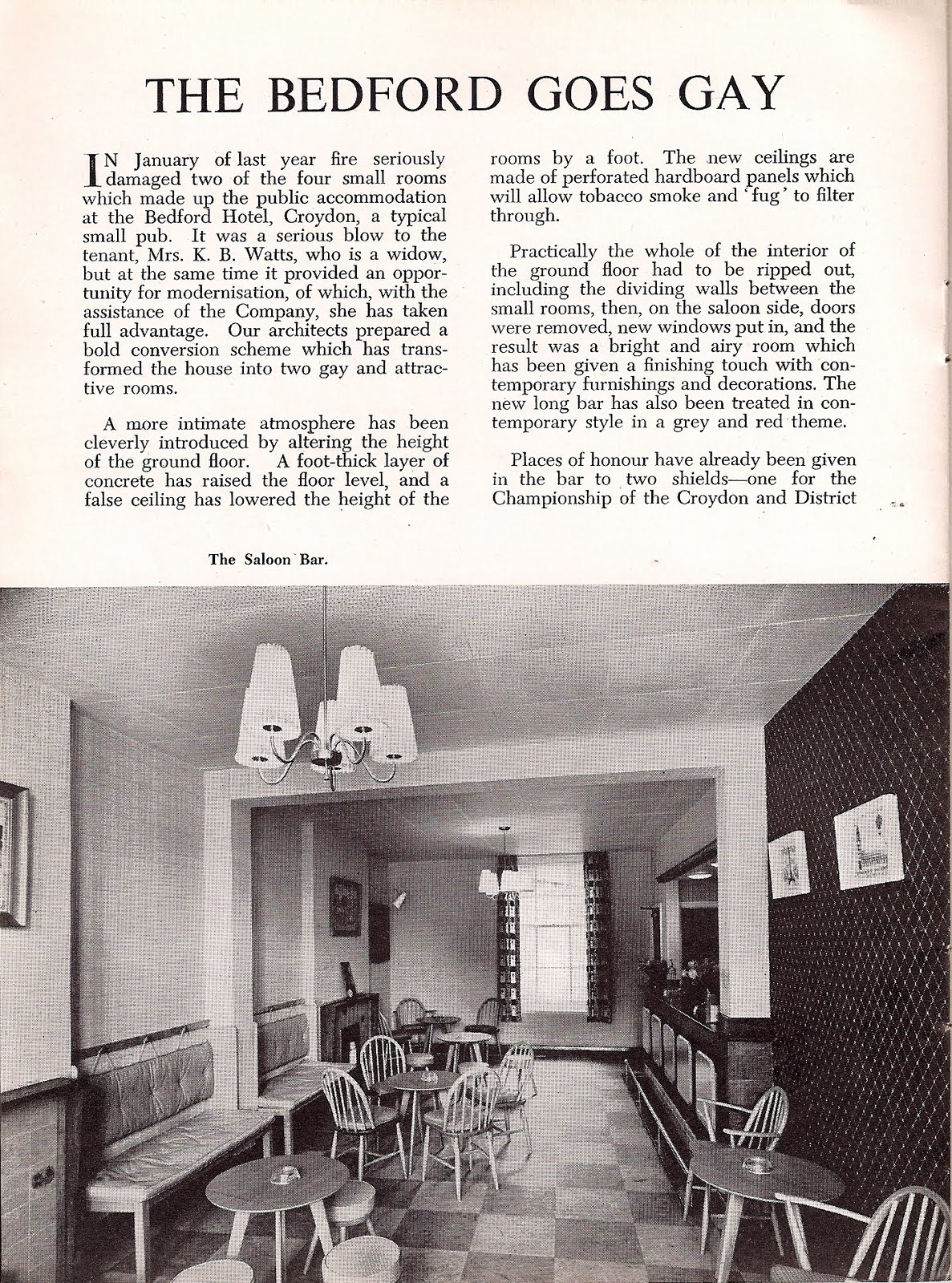
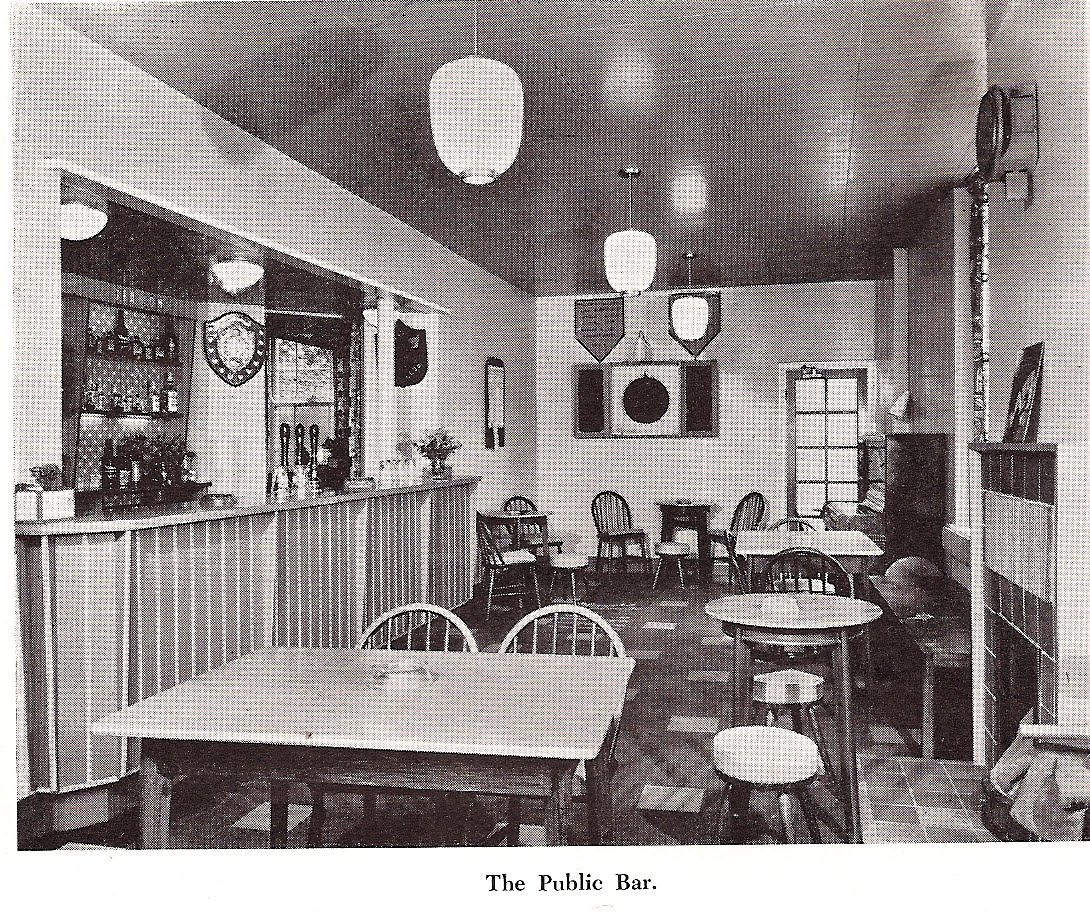
Back to 1955, and there’s an element of schoolboy humour behind this post.

The fact that the word ‘gay’ has changed its meaning over the years is an endless source of amusement to anyone with a juvenile streak. And I sniggered at the headline to this feature before I could stop myself:
But what strikes me about the Bedford – and what makes this worth publishing here – is just how un-gay this newly refurbished pub looks in any sense of the word. Here are the six – count ’em – meanings of the word ‘gay’ according to Dictionary.com:
1. having or showing a merry, lively mood: gay spirits; gay music.
2. bright or showy: gay colors; gay ornaments.
3. given to or abounding in social or other pleasures: a gay social season.
4. licentious; dissipated; wanton: The baron is a gay old rogue
5. homosexual.
6. of, indicating, or supporting homosexual interests or issues
The only recognised meaning of the word that applies to these two pictures is the highly contentious one that’s not covered by dictionary.com, but is mentioned at www.urbandictionary.com. It’s the one I hear mostly in London streets and on the bus in the morning, and while it may have developed as a separate strand, it does nevertheless have its roots in homophobia.
So if you exclude that one, and just go by any of the six definitions above – does this pub look gay to you?
Which ever way you look at it, our ideas about gayness have changed an awful lot over the last 54 years.

| Uncategorised

Burton gets its brewing museum back – along with a brand new brewery

Burton MP Janet Dean with Coors and Planning Solutions bods who are giving the Home of Brewing a lot to smile about.

It used to be the Bass Museum, then it was the Coors Visitors Centre, and for the last 18 months its been an abandoned, heartbreaking relic of the world’s greatest brewing town’s former glories. But tomorrow sees the official announcement of the opening of The National Brewery Centre. Coors have done a deal with a company called Planning Solutions to reopen the museum by Easter 2010. Planning Solutions run a host of leisure and tourism attractions across the country. According to Coors and Planning Solutions, “it will retain key elements of the existing facilities, updating and reorganising the site to create a unique visitor attraction that will ensure its success well into the 21st Century.” This comes after widespread protest from the town and the wider beer community. But I always felt that Coors were looking for ways to make it work – the PR mess that would have resulted from permanent closure would have been very damaging, and the people I’ve spoken to up there show a genuine enthusiasm for the chunk of brewing industry they now own. Planning Soluitons aims to introduce animatronics and ‘live’ actors to help entertain and inform visitors in full historical character. “The public’s expectation is ever-greater and we will make sure that all of the exhibits fully-engage with people of all ages,” says CEO John Lowther, “Having live actors fulfil roles previously held by plastic dummies, the visitor experience will be completely transformed. It will be a lot more interactive and immerse visitors into an historical setting.” Bars and restaurants will be incorporated in the plans for the new centre and these will be open to the general public and available for private bookings and live performances. The move has been welcomed by the town, its MP and the volunteers who have kept the exhibits in good condition while the museum has been closed. This enthusiasm stretches from the past to the future – the museum will feature a new 30-barrel brewery, overseen by Steve Wellington, legendary brewer of Worthington White Shield. This will be the hub for the full national launch of Red Shield, a new cask ale from the Worthington brand, and will also allow more brewing of legendary beers such as P2 Stout and No.1 barley wine. I spent two days in Burton a couple of weeks ago brewing with Steve and hearing about the future plans, and my fuller account of it will be in February’s edition of CAMRA’s Beer magazine.

| Uncategorised

When in Leicester…

More from The Red Hand, this time from 1955. And this picture deserves a post all of its own.

Nowadays, especially in magazines, it’s de rigeur to make a potentially humdrum snap a little more exciting by giving it a cheeky caption that in some way takes the piss out of the photo’s subjects.
The Red Hand occasionally manages this – apparently without actually trying to be funny.
Take this one: the photo is worthy of any caption competition. But you’d be hard pressed to beat the one that accompanied the original snap.
Yep, what you’re looking at here ‘has been described’ as ‘Leicester’s most original cocktail bar’.
If there’s a higher accolade than that, I have no idea what it is.

| Uncategorised

Purity and Simpsons – a match made in a very posh kitchen

Back in September I was invited to a beer and food matching dinner at Simpsons restaurant in Birmingham by Purity Brewing. It was an intimate gathering for twenty in a private dining room with chandeliers and silver floral wallpaper.

To the best of their knowledge it was the first serious beer and food matching dinner in the Midlands, after restaurants in London, Leeds and Manchester have started getting quite into it. The fact that it happened the week the brewery announced a like for like annual sales increase of 84% gave the whole evening a triumphal air.

“We’re passionate about beer. Andreas, the restaurant owner is passionate about food. We let the French get away with murder with their wines. Let’s get a scene going!” said Purity’s MD Paul Halsey as we sat down to a daunting-looking menu.
As well as their own beers – Pure Gold, UBU and Mad Goose – Purity have an exclusive import deal in the Midlands for Veltins and Maisel Weisse. These formed the beers. Paul Corbett from hop merchants Charles Farham was on hand to talk about the hops in the beers, and the fresh hops he’d brought with him filled the room with their woozy, resiny perfume.
But I wasn’t sure about the menu. I do get frustrated when people talk about beer and food matching or cooking with beer and all they deliver is a steak and ale pie or beer battered cod. But this was at the other end of the scale.
Five courses – and the first one was – according to the menu – ‘Terrine of ham hock, chicken and foie gras, sweetcorn puree, truffle vinaigrette’. By any standards this was a bit fancy, but as the first of five courses it filled me with foreboding. And it was to be matched with Veltins Pilsner.
But it worked. Veltins is a big, soft Pilsner, like a comforting bready pillow. There were some diverse flavours in the terrine, but the beer dried off the sensuous, slimy jelly and gave a very decadent dish a sheen of respectability, bringing the whole together and reassuring me that this was indeed a starter.
Next up was ‘Escalope of salmon on a bed of sauerkraut, light mustard sauce”. Again, what were they thinking? Salmon is reasonably light. I love fish, and here it was being weighed down with mustard and sauerkraut. It was matched with Purity Pure Gold, the lightest beer in the range, brewed with Northern Brewer, Fuggles, Hereford Golding and Styrian Gold hops. That’s a big mix of hops. Wasn’t the whole thing becoming too tricksy?
Most of my fellow diners were regular customers at the restaurant and this was their first experience of beer with food. A girl opposite me asked if there was honey in the beer. No, just an extraordinarily complex hop character, that also brought a big hit of lemon with it.
And it worked perfectly with the dish. The hoppiness in the beer married with the earthiness of the sauerkraut, and the flavours of the salmon flowed around it. There were hints of smoke and wood, and my brain leapt to images of freshly ploughed fields, damp clear mornings and the first chill of autumn on the air. Not bad for a bit of beer, cabbage and fish.
OK. The next course was there the wheels must surely come off. The menu read like something from the last days of Nero’s Rome: ‘Slow-cooked belly of sucking pig, ravioli of braised trotter, fennel compote, spiced baby pears, honey & cracked pepper sauce’. I expected I was going to have to eat it from the naked belly of a Reubenesque model. What next – lark’s tongues? I started to suspect someone in the kitchen needed a holiday.
And I wasn’t sure about matching all this with Mad Goose. Brewed with Northern Brewer, Cascade and Willamette for a fruitier, more rounded flavour, it may be SIBA’s best bitter of the year but there was an absence of hoppy notes on the nose for me – all I was getting was caramel.
Of course, it worked. I mean, this was just mental. How could something so ridiculous actually make any sense? But it did.
What looked on the menu like a banquet fit for Mr Creosote’s last supper was of course exquisitely presented. There was just a tiny bit of everything mentioned, arranged artfully on the plate with dun swirls and gravy flourishes – though my use of the word gravy in this context is probably as welcome as nails clawing a chalkboard.
The buttery, opulent sweetness of the pork crackling took down the bolshy caramel of the beer as if with a taser, allowing the spicy hops to come out to play and wrap themselves around the pork. Finally, the dish made sense.
There was more to come, of course. Pudding was ‘Caramelised banana, caramel parfait, peanut butter ice cream’. The match with Maisel’s Weisse was an easy win, schoolboy simple. The banoffee yeast character of the beer was going to make love to this dish. Put off only briefly by the fact that the caramelised banana looked exactly like a burnt Wall’s sausage, I dived in. Everything I expected was there, the beer merging with a nicely tart orange and banana finish. But there was more too. The caramel biscuit at the bottom of the parfait, together with the caramel sauce, made me realise what a big caramel character there is to the beer. My stomach expanded, and began to creak.
Mercifully, it was almost over – just one more course to go. And what was that course? A little petit fours, perhaps? A nice, palate cleansing sorbet?
The only surprising thing is that there was still something they could do that did surprise me: ‘Welsh rarebit’. No flowery descriptions or flourishes, just ‘Welsh rarebit’. Cheese on toast, after four courses. Why not? Apparently it used to be traditional.
It was matched with UBU. The whole thing was dark and rich and lovely. No more. My hand had become too fat to write.
This was one of those meals after which you don’t eat for twenty four hours. It was extraordinarily ambitious. I think it’s probably a little too much for most people, and it was telling that, after the plates were finally cleared, most diners opted for a glass of burgundy or port rather than continuing to drink the excellent UBU.
But the restaurant and the brewer had set out to prove a point, and they had proved it. These were very fine beers, but they can’t really be described as ‘speciality’ or ‘extreme’ in any way. And yet they were paired with Masterchef Grand Final levels of Fancy Dan food, and gave as good as they got. They worked perfectly, and in some cases stopped the dish from becoming too much.
I offer this account as proof to anyone who thinks beer and food matching can only work on a basic, clunky pub grub level.
Just don’t hold your breath that pig’s trotter ravioli will be appearing on the menu down your local any time soon.